Singapore Advertising Market Size, Share & Growth Rate
The Singapore Advertising Market was estimated at USD 345 Million in 2025 and is projected to reach USD 462 Million by 2032, growing at a CAGR of 4.3% from 2026 to 2032. This growth trajectory is driven primarily by increasing investments from businesses eager to connect with their target demographics. As consumer behavior shifts towards digital platforms, advertisers are innovating to capture attention in an ever-evolving landscape, where effective strategies become paramount.
Singapore Advertising Market Year-wise Growth Rate and Key Drivers
This graph highlights how the Singapore Advertising Market has steadily grown over the years, supported by major growth factors.
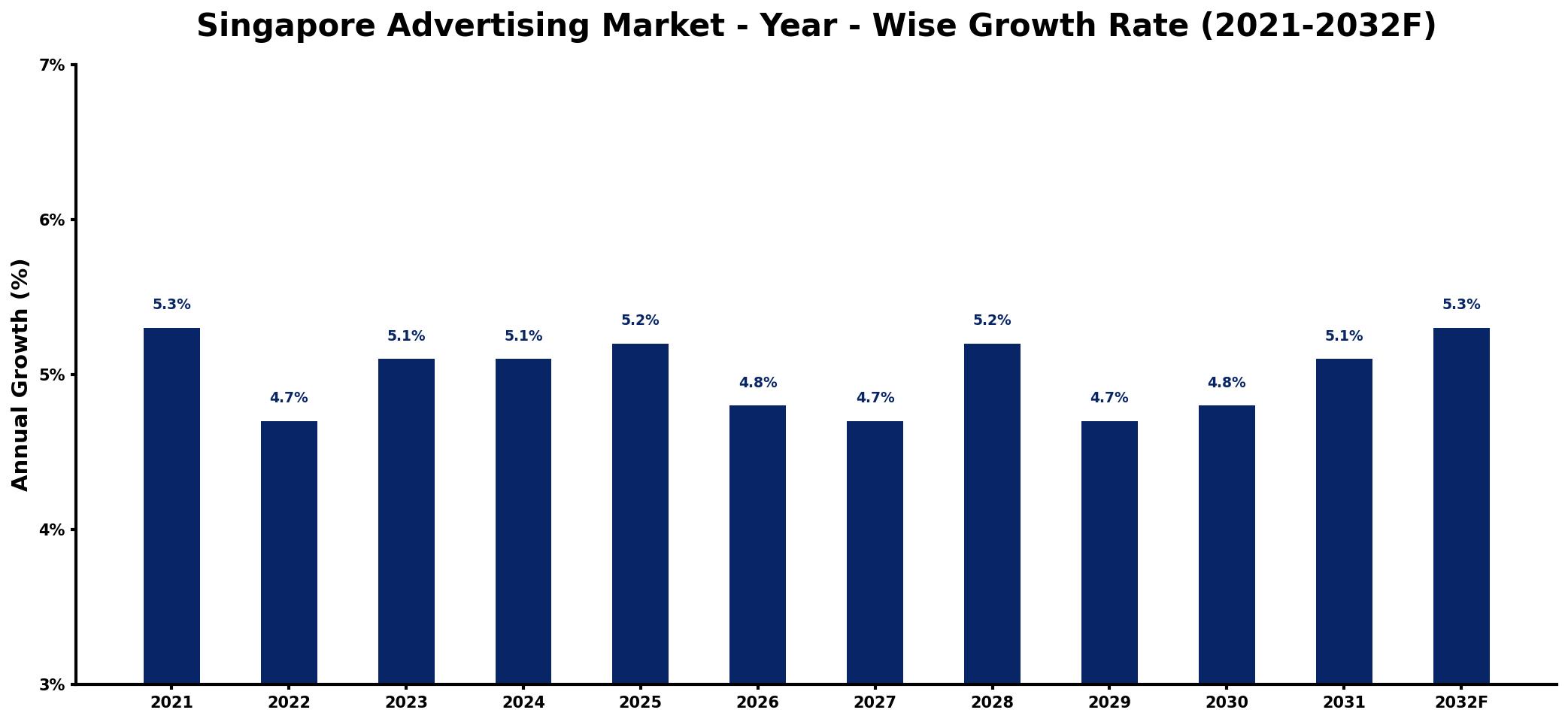
The table below presents the year‑wise growth rates along with the key drivers influencing the market
| Year | Growth Rate | Major Drivers |
| 2021 | 5.3% | Increased digital media consumption |
| 2022 | 4.7% | Growth in e-commerce platforms |
| 2023 | 5.1% | Rise of influencer marketing strategies |
| 2024 | 5.1% | rising procurement volume requirements |
| 2025 | 5.2% | Investment in programmatic technology |
| 2026 | 4.8% | Diversification of content creation |
| 2027 | 4.7% | Emergence of new social platforms |
| 2028 | 5.2% | Strengthening brand loyalty initiatives |
| 2029 | 4.7% | Adoption of augmented reality experiences |
| 2030 | 4.8% | Focus on sustainability messaging |
| 2031 | 5.1% | Development of targeted audience segmentation |
| 2032 | 5.3% | Enhancement of data analytics capabilities |
Note: Market size estimations and growth projections presented in this report are based on 6Wresearch's proprietary forecasting methodology, utilizing the latest available industry data, government publications, and primary research inputs.
Singapore Advertising Market Synopsis
In recent years, the Singapore advertising market has witnessed significant transformation, marked by the rapid expansion of digital channels. As brands leverage social media and targeted online campaigns, they are increasingly focused on data-driven strategies to optimize their outreach and engagement.
With competition intensifying and consumer attention becoming more fragmented, the need for innovative advertising solutions has never been more pressing. This market serves as a critical platform for businesses across various industries to enhance their visibility and effectively communicate their value propositions.
Singapore Advertising Market Key Takeaways
- The shift towards digital advertising is reshaping how brands engage with consumers.
- Ad-blocking technologies pose significant challenges, necessitating innovative approaches.
- COVID-19 has accelerated the move towards digital strategies and data-driven campaigns.
- Local agencies are leveraging unique insights into consumer behavior to craft effective strategies.
- Increased competition drives demand for more targeted and impactful advertising solutions.
Evaluation of Restraints in Singapore Advertising Market
Despite its promising growth, the Singapore advertising market faces real constraints. The overwhelming dominance of digital advertising comes with its own set of challenges, notably the rise of ad-blocking technologies that hinder visibility. As consumers become increasingly discerning about their media consumption, advertisers must navigate a complex landscape where traditional methods may no longer suffice. Moreover, the evolving nature of consumer preferences requires ongoing innovation and adaptation, straining resources for many advertisers seeking to remain competitive.
Singapore Advertising Market Trends
Several key trends are currently shaping the Singapore advertising landscape. The integration of artificial intelligence and machine learning into advertising strategies is enabling more precise targeting and personalization. Furthermore, the rise of short-form video content is capturing consumer attention, prompting brands to adapt their strategies accordingly. Theres also a growing emphasis on sustainability and corporate social responsibility, with consumers increasingly favoring brands that reflect their values.
Singapore Advertising Market Opportunities
Opportunities for growth in the Singapore advertising market are abundant. As businesses look to enhance their digital presence, the demand for video and content marketing will likely continue to rise. Furthermore, emerging technologies such as augmented reality and virtual reality offer fresh avenues for immersive consumer engagement. Local firms that capitalize on these trends, while also embracing innovative advertising formats, stand to gain a significant competitive advantage.
Government Initiatives in the Singapore Advertising Market
The Singapore government actively supports the advertising industry through various initiatives aimed at fostering innovation and digital transformation. Public funding programs and incentives for tech-driven advertising solutions are part of a broader push to enhance the digital economy. These initiatives aim to strengthen the ecosystem, encouraging collaborations between businesses, agencies, and tech startups to promote growth within the advertising sector.
Future Insights of the Singapore Advertising Market
Looking ahead to 2026-2032, the Singapore advertising market is poised for substantial evolution. As brands adapt to new consumer behaviors influenced by technological advancements, the landscape will likely see an increased emphasis on personalization and targeted advertising. Moreover, data analytics will play an even more critical role in shaping strategies, allowing advertisers to optimize their campaigns in real-time. The interplay between traditional and digital channels will continue to redefine engagement methods, setting the stage for a dynamic future.
Singapore Advertising Market Latest Developments (2025 - 2026)
Recently, there have been notable shifts within the Singapore advertising landscape. Many firms are investing heavily in innovative digital strategies, particularly in response to changing consumer preferences post-pandemic. The growth of social media advertising has prompted brands to explore influencer partnerships as a viable engagement tactic. Additionally, the market is witnessing a surge in demand for analytics-driven solutions, as advertisers seek to better understand their audiences and optimize their campaigns accordingly.
Singapore Advertising Market - Key Attractiveness of the Report
- 10 Years of Market Numbers
- Historical Data Starting from 2022 to 2025
- Base Year: 2025
- Forecast Data until 2032
- Key Performance Indicators Impacting the Market
- Major Upcoming Developments and Projects
Key Highlights of the Report:
- Singapore Advertising Market Outlook
- Market Size of Singapore Advertising Market, 2025
- Forecast of Singapore Advertising Market, 2032
- Historical Data and Forecast of Singapore Advertising Revenues & Volume for the Period 2022-2032F
- Singapore Advertising Market Trend Evolution
- Singapore Advertising Market Drivers and Challenges
- Singapore Advertising Price Trends
- Singapore Advertising Porter's Five Forces
- Singapore Advertising Industry Life Cycle
- Historical Data and Forecast of Singapore Advertising Market Revenues & Volume By Type for the Period 2022-2032F
- Historical Data and Forecast of Singapore Advertising Market Revenues & Volume By Television for the Period 2022-2032F
- Historical Data and Forecast of Singapore Advertising Market Revenues & Volume By Print (Newspaper and Magazine) for the Period 2022-2032F
- Historical Data and Forecast of Singapore Advertising Market Revenues & Volume By Radio for the Period 2022-2032F
- Historical Data and Forecast of Singapore Advertising Market Revenues & Volume By Outdoor for the Period 2022-2032F
- Historical Data and Forecast of Singapore Advertising Market Revenues & Volume By Internet (Search, Display, Classified, Video) for the Period 2022-2032F
- Historical Data and Forecast of Singapore Advertising Market Revenues & Volume By Mobile for the Period 2022-2032F
- Historical Data and Forecast of Singapore Advertising Market Revenues & Volume By Cinema for the Period 2022-2032F
- Singapore Advertising Import Export Trade Statistics
- Market Opportunity Assessment By Type
- Singapore Advertising Top Companies Market Share
- Singapore Advertising Competitive Benchmarking By Technical and Operational Parameters
- Singapore Advertising Company Profiles
- Singapore Advertising Key Strategic Recommendations






































