Singapore Agricultural Product Market Size Growth Rate
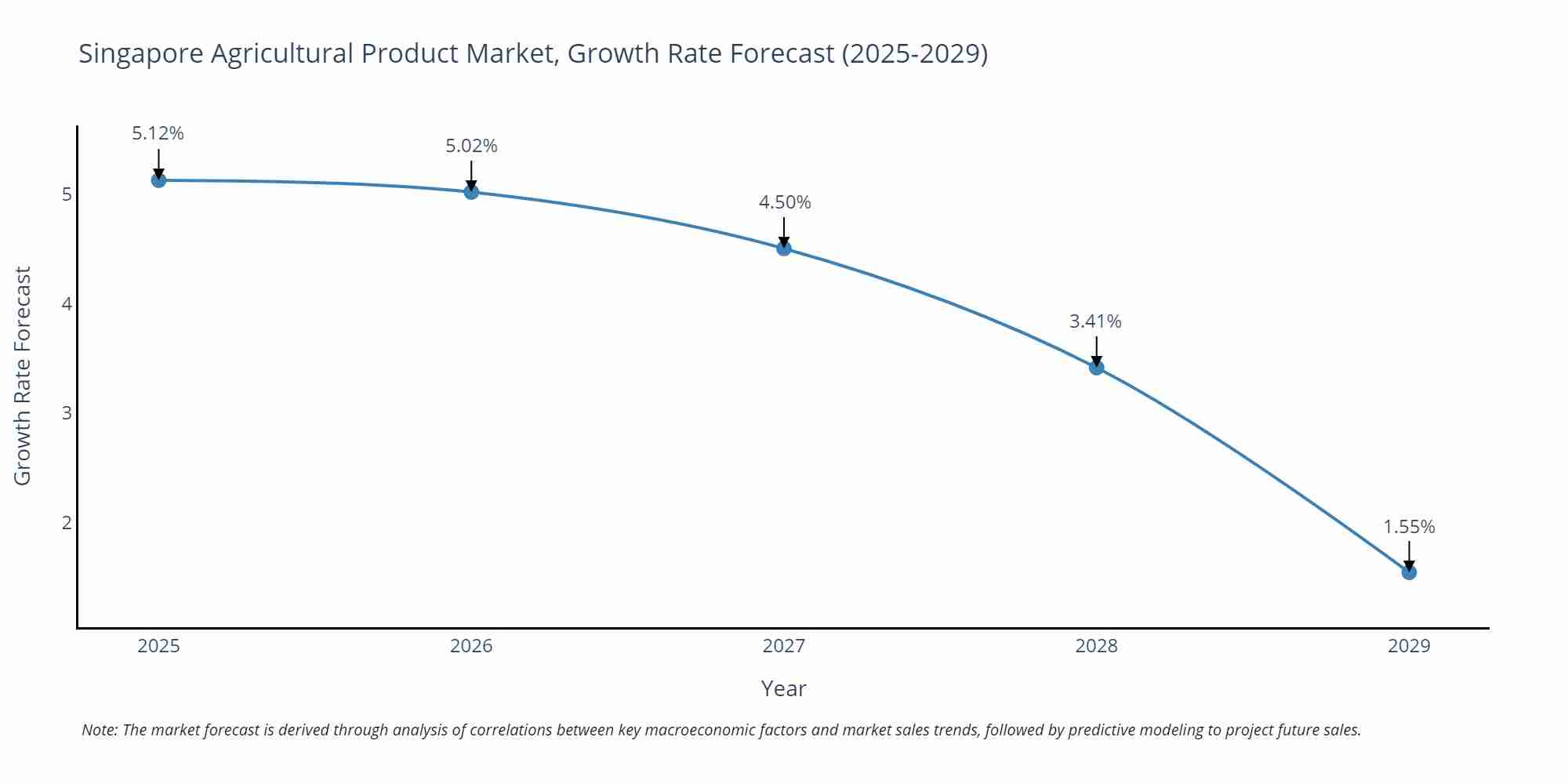
The Singapore Agricultural Product Market could see a tapering of growth rates over 2025 to 2029. Although the growth rate starts strong at 5.12% in 2025, it steadily loses momentum, ending at 1.55% by 2029.
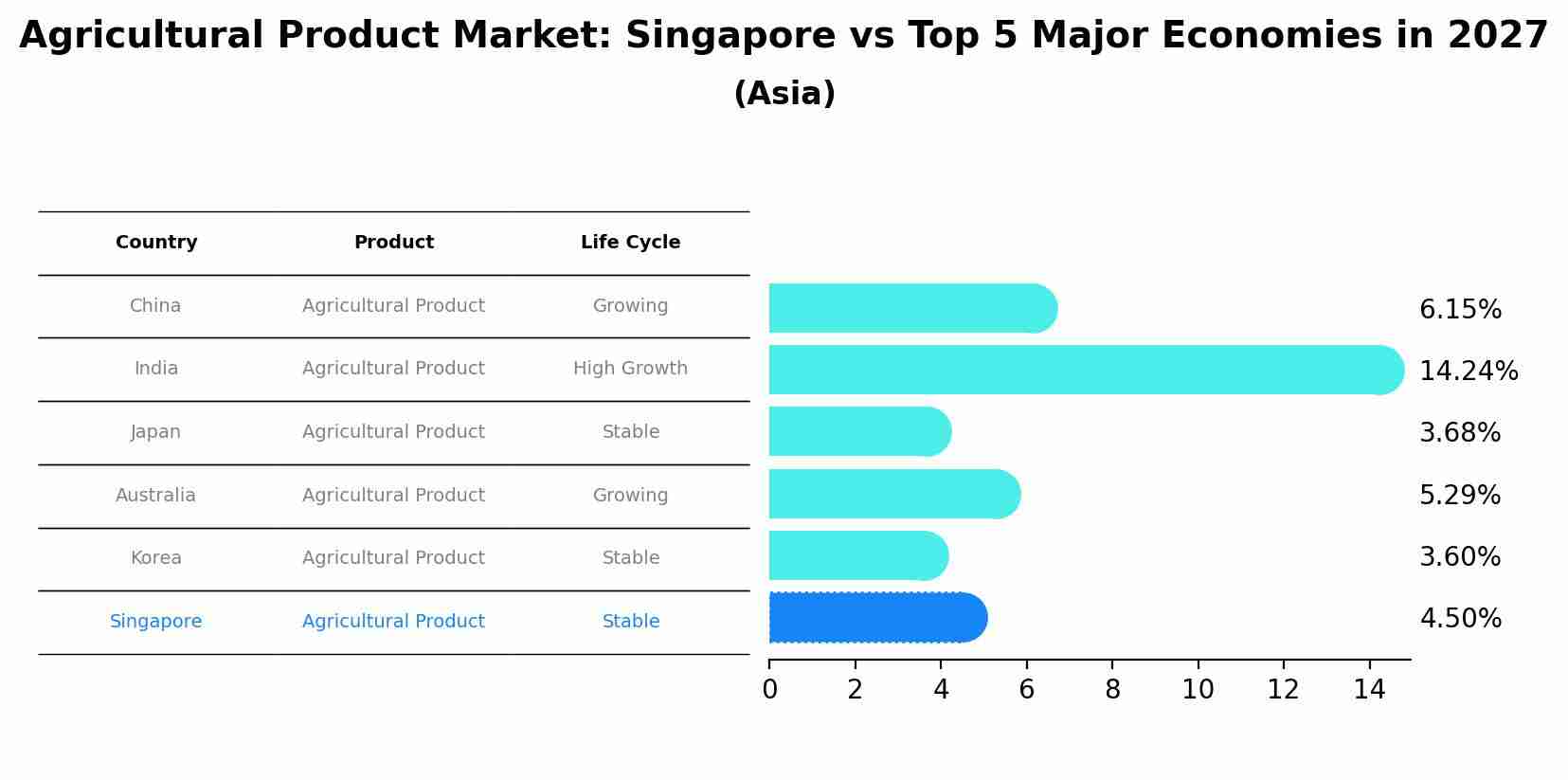
Agricultural Product Market: Singapore vs Top 5 Major Economies in 2027 (Asia)
The Agricultural Product market in Singapore is projected to grow at a stable growth rate of 4.50% by 2027, within the Asia region led by China, along with other countries like India, Japan, Australia and South Korea, collectively shaping a dynamic and evolving market environment driven by innovation and increasing adoption of emerging technologies.
Singapore Agricultural Product Market Synopsis
The agricultural product market in Singapore is anticipated to witness growth as consumers seek a wide range of agricultural products, including fruits, vegetables, and grains, for consumption and cooking. Agricultural products play a vital role in food supply chains and nutrition. The market`s expansion is driven by the demand for fresh and locally sourced agricultural produce.
Drivers of the Market
The growth of the Singapore agricultural product market is influenced by factors such as food supply, agriculture technology, and consumer demand. Agricultural products encompass a wide range of goods, including crops, livestock, and dairy products. Growth drivers include the demand for fresh and sustainable agricultural products, innovations in farming practices for increased yields, and applications in food production, retail, and exports. As Singapore places importance on food security and quality, the agricultural product market is poised for growth, providing essential goods for the population.
Challenges of the Market
The agricultural product market in Singapore encounters challenges related to food security and sustainability. Singapore relies heavily on imports for its food supply, making it vulnerable to global food supply chain disruptions. Ensuring a stable and sustainable agricultural product supply chain is essential for Singapore food security.
COVID-19 Impact on the Market
The agricultural product market in Singapore experienced changes during the COVID-19 pandemic. With a growing emphasis on food security and locally sourced products, there was increased demand for agricultural goods. Farmers and suppliers adapted by diversifying product offerings and enhancing distribution channels. The pandemic accelerated the trend of sustainable and locally produced agricultural products, influencing market strategies.
Key Players in the Market
Prominent companies in the Singapore agricultural product market, including Olam International Limited, Wilmar International Limited, and Cargill, Incorporated, engage in the trading and distribution of agricultural commodities such as grains, edible oils, and tropical products. Their expertise in agribusiness and global supply chain management positions them as major contributors to this sector.
Key Highlights of the Report:
- Singapore Agricultural Product Market Outlook
- Market Size of Singapore Agricultural Product Market, 2024
- Forecast of Singapore Agricultural Product Market, 2031
- Historical Data and Forecast of Singapore Agricultural Product Revenues & Volume for the Period 2021-2031
- Singapore Agricultural Product Market Trend Evolution
- Singapore Agricultural Product Market Drivers and Challenges
- Singapore Agricultural Product Price Trends
- Singapore Agricultural Product Porter's Five Forces
- Singapore Agricultural Product Industry Life Cycle
- Historical Data and Forecast of Singapore Agricultural Product Market Revenues & Volume By Type for the Period 2021-2031
- Historical Data and Forecast of Singapore Agricultural Product Market Revenues & Volume By Food for the Period 2021-2031
- Historical Data and Forecast of Singapore Agricultural Product Market Revenues & Volume By Fiber for the Period 2021-2031
- Historical Data and Forecast of Singapore Agricultural Product Market Revenues & Volume By Fuel for the Period 2021-2031
- Historical Data and Forecast of Singapore Agricultural Product Market Revenues & Volume By Raw Material for the Period 2021-2031
- Historical Data and Forecast of Singapore Agricultural Product Market Revenues & Volume By Application for the Period 2021-2031
- Historical Data and Forecast of Singapore Agricultural Product Market Revenues & Volume By Direct Consumption for the Period 2021-2031
- Historical Data and Forecast of Singapore Agricultural Product Market Revenues & Volume By Food & Fabrics for the Period 2021-2031
- Historical Data and Forecast of Singapore Agricultural Product Market Revenues & Volume By Construction & Paper Products for the Period 2021-2031
- Historical Data and Forecast of Singapore Agricultural Product Market Revenues & Volume By Others for the Period 2021-2031
- Historical Data and Forecast of Singapore Agricultural Product Market Revenues & Volume By Industry Vertical for the Period 2021-2031
- Historical Data and Forecast of Singapore Agricultural Product Market Revenues & Volume By Food & Nutrition for the Period 2021-2031
- Historical Data and Forecast of Singapore Agricultural Product Market Revenues & Volume By Sustainable Agribusiness for the Period 2021-2031
- Historical Data and Forecast of Singapore Agricultural Product Market Revenues & Volume By Production & Harvesting for the Period 2021-2031
- Historical Data and Forecast of Singapore Agricultural Product Market Revenues & Volume By Agribusiness Technological Inputs for the Period 2021-2031
- Historical Data and Forecast of Singapore Agricultural Product Market Revenues & Volume By Others for the Period 2021-2031
- Singapore Agricultural Product Import Export Trade Statistics
- Market Opportunity Assessment By Type
- Market Opportunity Assessment By Application
- Market Opportunity Assessment By Industry Vertical
- Singapore Agricultural Product Top Companies Market Share
- Singapore Agricultural Product Competitive Benchmarking By Technical and Operational Parameters
- Singapore Agricultural Product Company Profiles
- Singapore Agricultural Product Key Strategic Recommendations






































