Singapore Animal Feed Market: Import Trend Analysis
In the Singapore animal feed market, the import trend saw a decline from 2023 to 2024, with a growth rate of -14.82%. The compound annual growth rate (CAGR) for imports over the period 2020-2024 was -0.05%. This negative import momentum could be attributed to shifts in demand patterns or changes in trade policies affecting market stability.
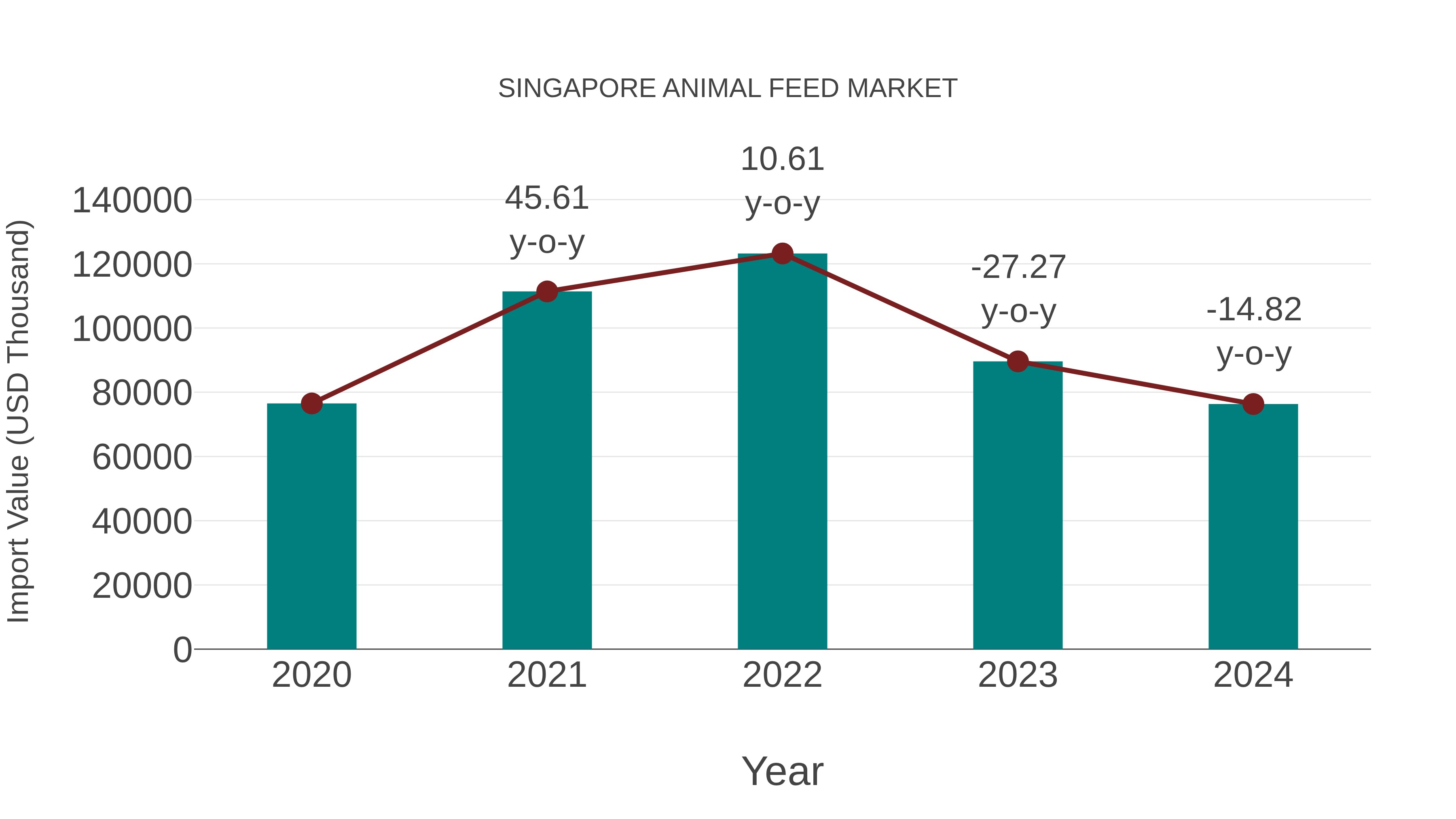
Singapore Animal Feed Market Growth Rate
According to 6Wresearch internal database and industry insights, the Singapore Animal Feed Market is projected to grow at a compound annual growth rate (CAGR) of 5.9% during the forecast period (2025–2031).
Singapore Animal Feed Market Highlights
| Report Name | Singapore Animal Feed Market |
| Forecast period | 2025–2031 |
| CAGR | 5.9% |
| Growing Sector | Poultry & Aquaculture |
Five-Year Growth Trajectory of the Singapore Animal Feed Market with Core Drivers
Below mentioned are the evaluation of year-wise growth rate along with key drivers:
| Years | Est. Annual Growth | Growth Drivers |
| 2020 | 0.044 | Increase in domestic feed blending and quality monitoring |
| 2021 | 0.047 | Rising aquaculture feed needs and government-backed nutrition programs |
| 2022 | 0.052 | Increasing private investment in automated feed mills |
| 2023 | 0.055 | Sustainability-led innovations and import diversification |
| 2024 | 0.055 | Solidified poultry and aquafeed formulations |
Topics Covered in the Singapore Animal Feed Market Report
The Singapore Animal Feed Market report thoroughly covers the market by Form, Species, and Type. The report provides an unbiased and detailed analysis of ongoing market trends, opportunities/high growth areas, and market drivers that will help stakeholders devise and align their market strategies according to the current and future market dynamics.
Singapore Animal Feed Market Synopsis
The Singapore Animal Feed Market is anticipated to get major growth due to the increasing need for high-quality protein sources, the modernization of livestock production, and government support for sustainable feed practices. The country’s large dependency on imports for raw materials has supported diversification and regional trade integration, while technological advancements in feed formulation and nutrient optimization are augmenting productivity and animal health.
Evaluation of Growth Drivers in the Singapore Animal Feed Market
Below mentioned are some prominent drivers and their influence on the market dynamics:
| Drivers | Primary Segments Affected | Why it matters (evidence) |
| Rising Meat Consumption | Poultry, Swine | Increased protein intake bolsters increased need for animal feed formulations that augment productivity. |
| Technological Feed Innovation | Aqua, Poultry | Adoption of smart feed formulation tools ensures nutrient precision and decreases waste. |
| Regional Trade Integration | All Species | ASEAN free trade augments raw material sourcing and decreases logistics price. |
| Sustainable Feed Policies | Poultry, Ruminants | Government push for eco-friendly ingredients decreases the carbon footprint of animal feed. |
| Aquaculture Modernization | Aqua | Increase in allocation of funds in high-protein and floating feed systems enhance fish farming yields. |
The Singapore Animal Feed Market size is projected to grow at a CAGR of 5.9% during 2025–2031. Market growth is mainly bolstered by potent need from poultry and aquaculture, along with strong concentration on precision nutrition, sustainability, and feed traceability. The rising adoption of precision nutrition technologies and smart feed management systems is propelling greater feed efficiency and traceability. Furthermore, a bold emphasis on sustainability and circular economy practices—consisting of the use of insect-based proteins, algae meal, and alternative raw materials—is revolutionising feed manufacturing strategies.
Evaluation of Restraints in the Singapore Animal Feed Market
Below mentioned are some major restraints and their influence on the market dynamics:
| Restraints | Primary Segments Affected | What this means (evidence) |
| Import Dependency | All Species | The market is prone to price volatility due to the large dependability of imported corn, soy, and additives. |
| High Operational Costs | Poultry, Swine | Elevated logistics and storage costs affects overall feed profitability. |
| Feed Adulteration Risks | Aqua, Poultry | Inconsistent feed quality can lead to decreased growth performance in livestock. |
| Limited Local Production | Ruminants | Scarcity of domestic raw materials restricts local feed mill capacity. |
| Supply Chain Constraints | All Segments | Port congestion and shipping delays impact timely delivery of feed ingredients. |
Singapore Animal Feed Market Challenges
The Singapore Animal Feed Market faces challenges such as large reliability on imported feed ingredients, changing global commodity prices, and restricted domestic agricultural land for large-scale feed production. Additionally, small-scale feed mills struggle with high operational price and regulatory compliance, while maintaining consistent feed quality across species remains a continuous concern. Moreover, the competition from regional feed exporters and increasing environmental standards further add problems to the market’s operating environment.
Singapore Animal Feed Market Trends
Several prominent trends reshaping the market growth include:
- Precision Feeding Technologies: To streamline feed efficiency and decrease waste there is increasing adoption of automated feeding systems and AI-driven monitoring tools.
- Sustainability Integration: Rising concentration on sustainable protein sources such as insect meal and algae-based feed to decrease dependency on soy imports.
- Customised Formulations: Advancement of species-specific feed blends with improved digestibility and nutrient absorption to augment animal health outcomes.
- Digital Trade Platforms: To optimise obtainability for small and medium-scale farmers there is increase in e-commerce-based B2B feed transactions.
Investment Opportunities in the Singapore Animal Feed Industry
Some prominent investment opportunities in the market include:
- Insect-Based Protein Processing – Allocation of money in black soldier fly and mealworm-based protein manufacturing for sustainable feed applications.
- Automation and IoT Systems – Increase in smart feed management systems integrating AI-based control for aquaculture farms.
- Specialty Additives Production – Building of local production units for probiotics, vitamins, and enzymes to decrease import reliability.
Top 5 Leading Players in the Singapore Animal Feed Market
Some leading players operating in the Singapore Animal Feed Market include:
1. Charoen Pokphand (CP) Group
| Company Name | Charoen Pokphand (CP) Group |
| Established Year | 1921 |
| Headquarters | Bangkok, Thailand |
| Official Website | Click Here |
CP Group Functions a potent animal feed network in Singapore, concentrating on integrated production for poultry and aquaculture.
2. Cargill Inc.
| Company Name | Cargill Inc. |
| Established Year | 1865 |
| Headquarters | Minneapolis, USA |
| Official Website | Click Here |
Cargill gives a broad range of feed solutions in Singapore, consisting of functional additives and nutritional consulting for livestock, aqua, and pet food sectors.
3. ADM Animal Nutrition
| Company Name | ADM Animal Nutrition |
| Established Year | 1902 |
| Headquarters | Chicago, USA |
| Official Website | Click Here |
ADM specializes in producing high-quality feed ingredients and tailored blends encouraging animal performance, health, and productivity.
4. Japfa Ltd.
| Company Name | Japfa Ltd. |
| Established Year | 1971 |
| Headquarters | Singapore |
| Official Website | Click Here |
Japfa is one of Southeast Asia’s leading agri-food companies, providing a distinctive portfolio of feed for poultry, swine, and aquaculture, with potent regional distribution capabilities.
5. Nutreco N.V. (Trouw Nutrition)
| Company Name | Nutreco N.V. (Trouw Nutrition) |
| Established Year | 1994 |
| Headquarters | Amersfoort, Netherlands |
| Official Website | Click Here |
Nutreco’s Trouw Nutrition division provides innovative feed additives and digital farm management solutions that bolsters feed conversion and sustainability performance.
Government Regulations Introduced in the Singapore Animal Feed Market
According to Singapore’s government data, the government makes stringent feed safety and quality regulations under the Feed Act and Code of Practice for Animal Feed. These consist of traceability standards, import permits, and inspection mechanisms to ensure feed safety and prevent contamination. Additionally, Enterprise Singapore encourages innovation through the AgriTech and Feed Innovation Program, boosting partnerships in feed biotechnology and circular protein development.
Future Insights of the Singapore Animal Feed Market
The Singapore Animal Feed Market Growth is anticipated to undergo steady expansion encouraged by advancement of feed mills, growing aquaculture investment, and government-backed sustainability programs. As technology adoption increases, feed traceability and nutritional precision will play a major role in augmenting productivity. Furthermore, innovation in local feed ingredient processing and regional trade collaboration within ASEAN are estimated to make Singapore a competitive hub for high-quality animal nutrition products.
Market Segmentation Analysis
Pellets to Dominate the Market – By Form
According to Kapil, Senior Research Analyst at 6Wresearch, Pellets hold the largest Singapore Animal Feed Market Share due to their uniform nutrient distribution and ease of handling. They augment digestibility and decrease feed waste, particularly in poultry and aquaculture sectors.
Poultry to Dominate the Market – By Species
The poultry segment leads the Singapore Animal Feed Industry due to Singapore’s increased consumption of poultry meat and eggs, along with augmented feed formulations designed for increased growth and feed efficiency.
Vitamins & Minerals to Dominate the Market – By Type
The vitamins and minerals segment leads as these additives ensure optimal livestock health and higher productivity, addressing nutrient gaps across species and augmenting immune function.
Key Attractiveness of the Report
- 10 Years of Market Numbers
- Historical Data Starting from 2021 to 2024
- Base Year: 2024
- Forecast Data until 2031
- Key Performance Indicators Impacting the Market
- Major Upcoming Developments and Projects
Key Highlights of the Report:
- Singapore Animal Feed Market Outlook
- Market Size of Singapore Animal Feed Market, 2025
- Forecast of Singapore Animal Feed Market, 2032
- Historical Data and Forecast of Singapore Animal Feed Revenues & Volume for the Period 2022 - 2032F
- Singapore Animal Feed Market Trend Evolution
- Singapore Animal Feed Market Drivers and Challenges
- Singapore Animal Feed Price Trends
- Singapore Animal Feed Porter's Five Forces
- Singapore Animal Feed Industry Life Cycle
- Historical Data and Forecast of Singapore Animal Feed Market Revenues & Volume By Form for the Period 2022 - 2032F
- Historical Data and Forecast of Singapore Animal Feed Market Revenues & Volume By Pellets for the Period 2022 - 2032F
- Historical Data and Forecast of Singapore Animal Feed Market Revenues & Volume By Crumbles for the Period 2022 - 2032F
- Historical Data and Forecast of Singapore Animal Feed Market Revenues & Volume By Mash for the Period 2022 - 2032F
- Historical Data and Forecast of Singapore Animal Feed Market Revenues & Volume By Others for the Period 2022 - 2032F
- Historical Data and Forecast of Singapore Animal Feed Market Revenues & Volume By Species for the Period 2022 - 2032F
- Historical Data and Forecast of Singapore Animal Feed Market Revenues & Volume By Poultry for the Period 2022 - 2032F
- Historical Data and Forecast of Singapore Animal Feed Market Revenues & Volume By Ruminants for the Period 2022 - 2032F
- Historical Data and Forecast of Singapore Animal Feed Market Revenues & Volume By Aqua for the Period 2022 - 2032F
- Historical Data and Forecast of Singapore Animal Feed Market Revenues & Volume By Swine for the Period 2022 - 2032F
- Historical Data and Forecast of Singapore Animal Feed Market Revenues & Volume By Others for the Period 2022 - 2032F
- Historical Data and Forecast of Singapore Animal Feed Market Revenues & Volume By Type for the Period 2022 - 2032F
- Historical Data and Forecast of Singapore Animal Feed Market Revenues & Volume By Acidifiers for the Period 2022 - 2032F
- Historical Data and Forecast of Singapore Animal Feed Market Revenues & Volume By Probiotics for the Period 2022 - 2032F
- Historical Data and Forecast of Singapore Animal Feed Market Revenues & Volume By Enzyme for the Period 2022 - 2032F
- Historical Data and Forecast of Singapore Animal Feed Market Revenues & Volume By Antioxidants for the Period 2022 - 2032F
- Historical Data and Forecast of Singapore Animal Feed Market Revenues & Volume By Antibiotics for the Period 2022 - 2032F
- Historical Data and Forecast of Singapore Animal Feed Market Revenues & Volume By Vitamins for the Period 2022 - 2032F
- Historical Data and Forecast of Singapore Animal Feed Market Revenues & Volume By Minerals for the Period 2022 - 2032F
- Historical Data and Forecast of Singapore Animal Feed Market Revenues & Volume By Others for the Period 2022 - 2032F
- Singapore Animal Feed Import Export Trade Statistics
- Market Opportunity Assessment By Form
- Market Opportunity Assessment By Species
- Market Opportunity Assessment By Type
- Singapore Animal Feed Top Companies Market Share
- Singapore Animal Feed Competitive Benchmarking By Technical and Operational Parameters
- Singapore Animal Feed Company Profiles
- Singapore Animal Feed Key Strategic Recommendations
Market Covered
The report offers a comprehensive study of the subsequent market segments:
By Form
- Pellets
- Crumbles
- Mash
- Others
By Species
- Poultry
- Ruminants
- Aqua
- Swine
- Others
By Type
- Acidifiers
- Probiotics
- Enzyme
- Antioxidants
- Antibiotics
- Vitamins
- Minerals
- Others






































