Singapore Armored Vehicle Market Size, Share & Growth Rate
The Singapore Armored Vehicle Market was estimated at USD 402 Million in 2025 and is projected to reach USD 575 Million by 2032, growing at a CAGR of 5.2% from 2026 to 2032. This growth trajectory is primarily driven by Singapore's strategic emphasis on national defense and security preparedness, reinforced by increasing defense budget allocations. Furthermore, the continual advancement in armored vehicle technology ensures that the market remains responsive to evolving operational needs and geopolitical dynamics.
Singapore Armored Vehicle Market Year-wise Growth Rate and Key Drivers
This graph highlights how the Singapore Armored Vehicle Market has steadily grown over the years, supported by major growth factors.
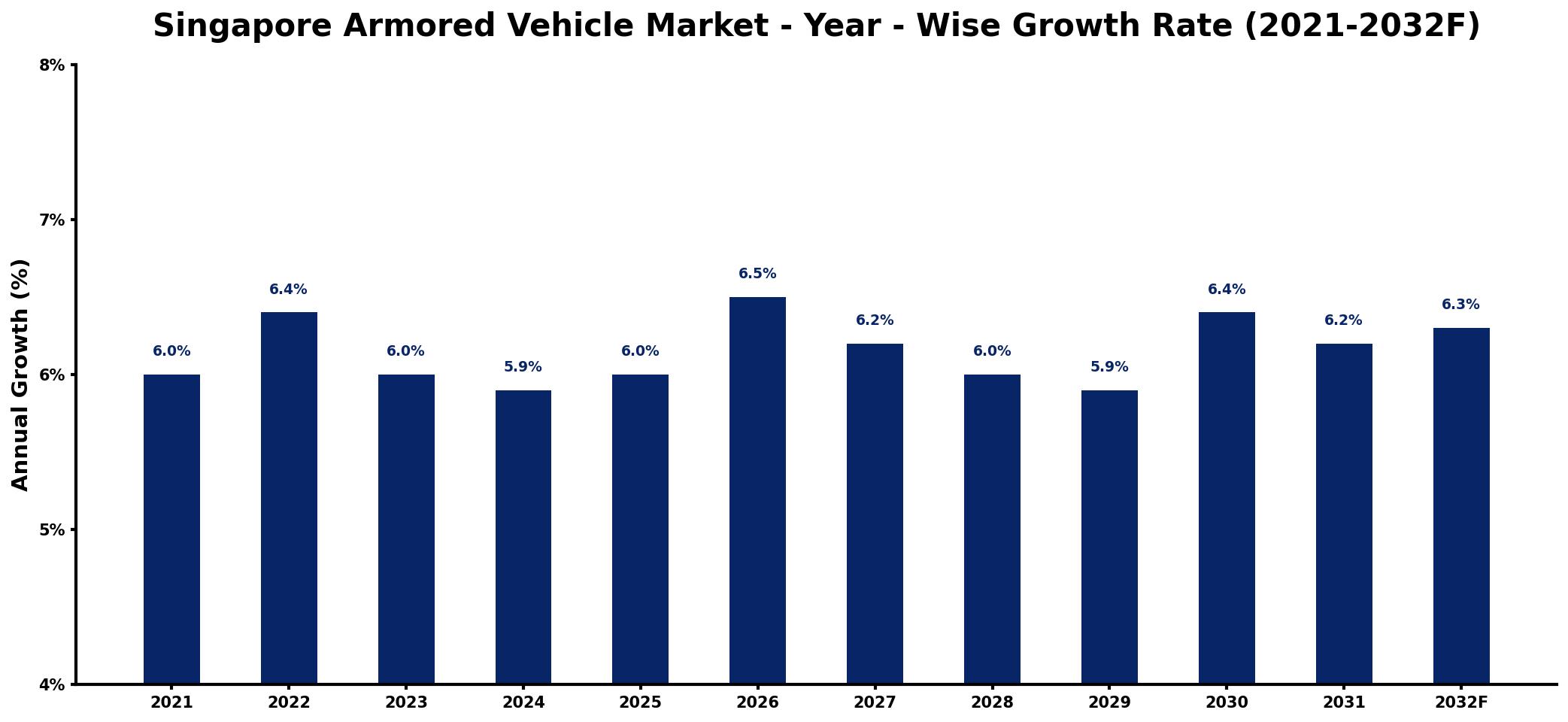
The table below presents the year‑wise growth rates along with the key drivers influencing the market
| Year | Growth Rate | Major Drivers |
| 2021 | 6.0% | Increased defense spending initiatives |
| 2022 | 6.4% | Heightened regional security concerns |
| 2023 | 6.0% | Rising demand for modernization |
| 2024 | 5.9% | Expansion of military procurement programs |
| 2025 | 6.0% | Growing private sector investments |
| 2026 | 6.5% | Emergence of new technologies |
| 2027 | 6.2% | increased capital investment inflows |
| 2028 | 6.0% | Increased focus on urban operations |
| 2029 | 5.9% | Surge in government contracts |
| 2030 | 6.4% | Growing interest in joint exercises |
| 2031 | 6.2% | Enhanced logistics and support systems |
| 2032 | 6.3% | Development of strategic partnerships |
Note: Market size estimations and growth projections presented in this report are based on 6Wresearch's proprietary forecasting methodology, utilizing the latest available industry data, government publications, and primary research inputs.
Singapore Armored Vehicle Market Synopsis
In recent years, the Singapore armored vehicle market has experienced notable momentum, reflecting the nation's unwavering commitment to enhancing its defense capabilities. As regional geopolitical tensions rise, Singapore's focus on investing in advanced armored vehicles positions it for sustained growth and adaptability in defense operations.
Looking forward, the market is poised to benefit from innovations in vehicle design and technology, along with a growing demand for multi-functional military platforms. These advancements are essential for addressing diverse operational challenges while reinforcing Singapore's strategic defense posture.
Singapore Armored Vehicle Market Key Takeaways
- The Singapore Armored Vehicle Market is projected to grow at a CAGR of 5.2% from 2026 to 2032.
- Investment in advanced technologies is driving demand for versatile armored vehicles tailored to various operational scenarios.
- Geopolitical dynamics in the region are influencing defense budget allocations, which directly impact market growth.
- Supply chain disruptions during the pandemic highlighted the importance of local manufacturing capabilities.
- Collaborations with defense agencies are critical for companies aiming to navigate market challenges effectively.
Evaluation of Restraints in Singapore Armored Vehicle Market
The Singapore armored vehicle market faces several inherent restraints, primarily due to its relatively small domestic market size. This compactness can limit the economies of scale essential for cost-effective production and procurement. Additionally, the high costs associated with both the acquisition and ongoing maintenance of armored vehicles pose significant challenges for potential buyers. Stringent export regulations further constrain international market opportunities, making it essential for companies to develop strong local partnerships and broaden their product offerings to mitigate these factors.
Singapore Armored Vehicle Market Trends
Current trends in the Singapore armored vehicle market are being shaped by several key factors. There is a noticeable shift towards the integration of advanced technologies, such as artificial intelligence and autonomous systems, aimed at enhancing the operational capabilities of armored vehicles. Furthermore, an increasing emphasis on modular designs allows for vehicles that can be customized for various missions. Additionally, environmental sustainability is becoming a focal point, as manufacturers explore greener technologies and practices in their production processes.
Singapore Armored Vehicle Market Opportunities
The landscape for investment in the Singapore armored vehicle market is rich with opportunities. As regional security challenges continue to evolve, there is a pressing demand for innovative defense solutions tailored to specific operational needs. Additionally, the governments focus on defense modernization presents an advantageous environment for collaboration between public and private sectors. Companies that invest in research and development, particularly in next-generation technologies, will likely find substantial growth prospects as they align their offerings with emerging defense requirements.
Government Initiatives in the Singapore Armored Vehicle Market
The Singaporean government plays a pivotal role in shaping the armored vehicle market through various initiatives aimed at bolstering national security and defense. Public spending in defense has seen consistent increases, reflecting the governments commitment to maintaining a robust military capability. Programs designed to foster innovation in defense technology and enhance collaboration with private sector partners are also underway, creating a conducive environment for advancements in armored vehicle development and procurement.
Future Insights of the Singapore Armored Vehicle Market
Looking towards 2026-2032, the Singapore armored vehicle market is expected to further evolve in response to both regional and global security dynamics. As threats become increasingly complex, the demand for adaptable, high-performance armored vehicles will rise. Innovations in technology, combined with a strategic government focus on defense spending, will likely drive the market forward. Furthermore, as Singapore seeks to enhance its self-reliance in defense capabilities, localized production and partnerships are poised to become more prominent, ensuring that the market remains resilient and responsive.
Singapore Armored Vehicle Market Latest Developments (2025 - 2026)
Recent developments within the Singapore armored vehicle market indicate a trend towards modernization and technological advancements. Various defense agencies are increasingly prioritizing collaborations with local manufacturers to boost indigenous capabilities. In addition, there has been a renewed focus on integrating cyber resilience measures within armored systems to counter evolving threats. Furthermore, as global supply chains stabilize post-pandemic, there are signs of increased activity in procurement processes, signaling a recovery and growth phase for the market.
Singapore Armored Vehicle Market - Key Attractiveness of the Report
- 10 Years of Market Numbers
- Historical Data Starting from 2022 to 2025
- Base Year: 2025
- Forecast Data until 2032
- Key Performance Indicators Impacting the Market
- Major Upcoming Developments and Projects
Key Highlights of the Report:
- Singapore Armored Vehicle Market Outlook
- Market Size of Singapore Armored Vehicle Market, 2025
- Forecast of Singapore Armored Vehicle Market, 2032
- Historical Data and Forecast of Singapore Armored Vehicle Revenues & Volume for the Period 2022-2032F
- Singapore Armored Vehicle Market Trend Evolution
- Singapore Armored Vehicle Market Drivers and Challenges
- Singapore Armored Vehicle Price Trends
- Singapore Armored Vehicle Porter's Five Forces
- Singapore Armored Vehicle Industry Life Cycle
- Historical Data and Forecast of Singapore Armored Vehicle Market Revenues & Volume By Platform for the Period 2022-2032F
- Historical Data and Forecast of Singapore Armored Vehicle Market Revenues & Volume By Combat Vehicles for the Period 2022-2032F
- Historical Data and Forecast of Singapore Armored Vehicle Market Revenues & Volume By Combat Support Vehicles for the Period 2022-2032F
- Historical Data and Forecast of Singapore Armored Vehicle Market Revenues & Volume By Unmanned Armored Ground Vehicles for the Period 2022-2032F
- Historical Data and Forecast of Singapore Armored Vehicle Market Revenues & Volume By Mobility for the Period 2022-2032F
- Historical Data and Forecast of Singapore Armored Vehicle Market Revenues & Volume By Wheeled for the Period 2022-2032F
- Historical Data and Forecast of Singapore Armored Vehicle Market Revenues & Volume By Tracked for the Period 2022-2032F
- Historical Data and Forecast of Singapore Armored Vehicle Market Revenues & Volume By System for the Period 2022-2032F
- Historical Data and Forecast of Singapore Armored Vehicle Market Revenues & Volume By Engine for the Period 2022-2032F
- Historical Data and Forecast of Singapore Armored Vehicle Market Revenues & Volume By Drive System for the Period 2022-2032F
- Historical Data and Forecast of Singapore Armored Vehicle Market Revenues & Volume By Ballistic Armor for the Period 2022-2032F
- Historical Data and Forecast of Singapore Armored Vehicle Market Revenues & Volume By Turret Drives for the Period 2022-2032F
- Historical Data and Forecast of Singapore Armored Vehicle Market Revenues & Volume By Ammunition Handling System for the Period 2022-2032F
- Historical Data and Forecast of Singapore Armored Vehicle Market Revenues & Volume By Fire Control Systems (FCS) for the Period 2022-2032F
- Historical Data and Forecast of Singapore Armored Vehicle Market Revenues & Volume By Armaments for the Period 2022-2032F
- Historical Data and Forecast of Singapore Armored Vehicle Market Revenues & Volume By Countermeasure System for the Period 2022-2032F
- Singapore Armored Vehicle Import Export Trade Statistics
- Market Opportunity Assessment By Platform
- Market Opportunity Assessment By Mobility
- Market Opportunity Assessment By System
- Singapore Armored Vehicle Top Companies Market Share
- Singapore Armored Vehicle Competitive Benchmarking By Technical and Operational Parameters
- Singapore Armored Vehicle Company Profiles
- Singapore Armored Vehicle Key Strategic Recommendations






































