Singapore Auto Parts And Accessories Market Size, Share & Growth Rate
The Singapore Auto Parts And Accessories Market was estimated at USD 391 Million in 2025 and is projected to reach USD 512 Million by 2032, growing at a CAGR of 3.9% from 2026 to 2032. This steady growth trajectory is propelled by a burgeoning automotive sector and an increasing base of vehicle owners who prioritize both maintenance and customization. As car culture thrives among Singaporeans, the demand for high-quality parts and innovative accessories continues to strengthen.
Singapore Auto Parts And Accessories Market Year-wise Growth Rate and Key Drivers
This graph highlights how the Singapore Auto Parts And Accessories Market has steadily grown over the years, supported by major growth factors.
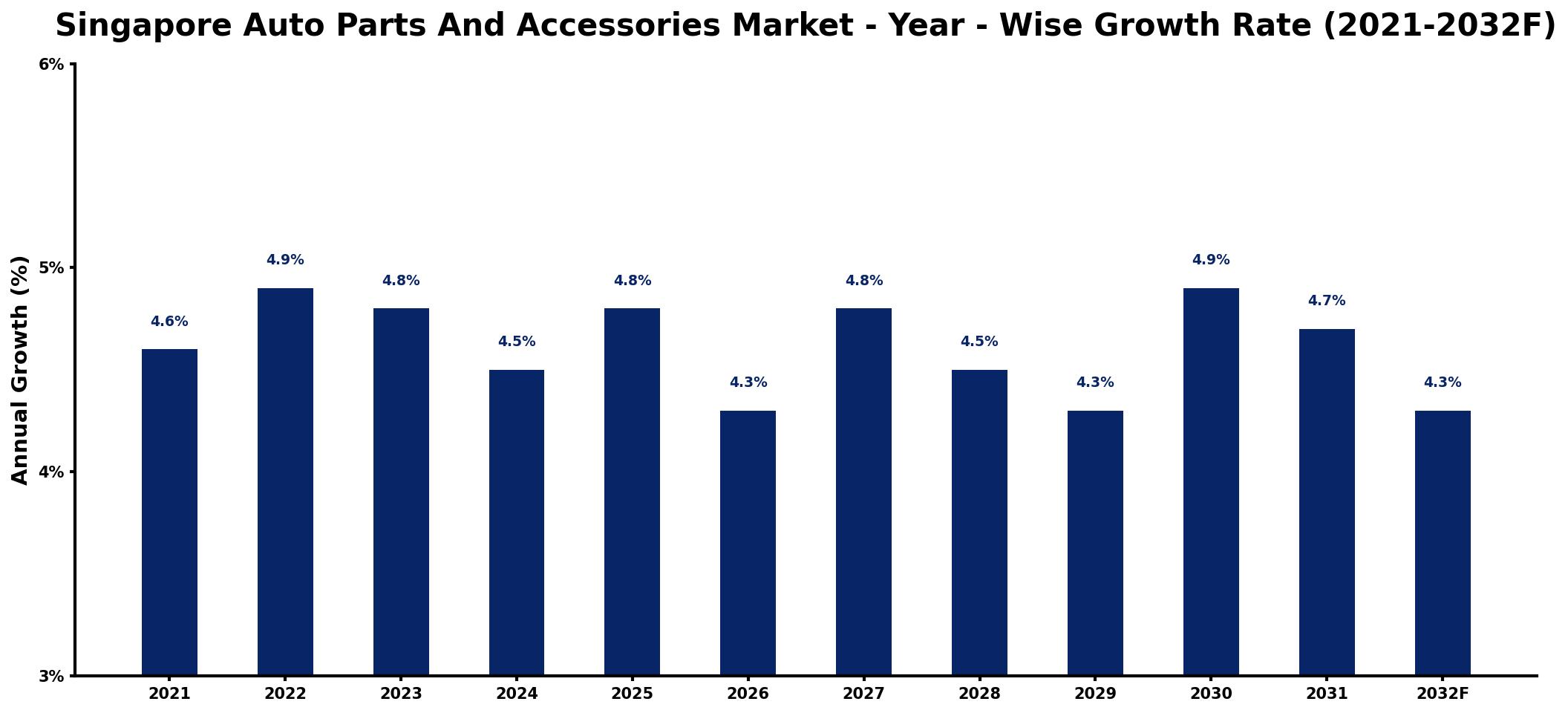
The table below presents the year‑wise growth rates along with the key drivers influencing the market
| Year | Growth Rate | Major Drivers |
| 2021 | 4.6% | Rising consumer spending trends |
| 2022 | 4.9% | Technological advancements in manufacturing |
| 2023 | 4.8% | Increased electric vehicle adoption |
| 2024 | 4.5% | Expansion of online retail platforms |
| 2025 | 4.8% | Growing demand for sustainability initiatives |
| 2026 | 4.3% | Strengthening distribution network capabilities |
| 2027 | 4.8% | Surge in vehicle ownership rates |
| 2028 | 4.5% | Investment in research and development |
| 2029 | 4.3% | Emergence of new market players |
| 2030 | 4.9% | rising export shipment volumes |
| 2031 | 4.7% | Enhanced supply chain efficiency |
| 2032 | 4.3% | Rise in urban mobility solutions |
Note: Market size estimations and growth projections presented in this report are based on 6Wresearch's proprietary forecasting methodology, utilizing the latest available industry data, government publications, and primary research inputs.
Singapore Auto Parts And Accessories Market Synopsis
The most significant force shaping the Singapore Auto Parts and Accessories Market is the vibrant automotive scene, driven by a blend of necessity and passion among car enthusiasts. This demand supports a diverse range of components, from essential maintenance parts like tires and brakes to advanced entertainment systems and customization accessories.
As the automotive market evolves, particularly with the rising popularity of electric and hybrid vehicles, the auto parts sector is similarly adapting. Stakeholders are compelled to innovate and provide eco-friendly solutions that meet the needs of a changing consumer base, ensuring sustainability and performance are at the forefront of development.
Singapore Auto Parts And Accessories Market Key Takeaways
- Robust growth anticipated with a projected market size reaching USD 512 Million by 2032.
- Rising vehicle ownership in Singapore fuels demand for aftermarket parts and accessories.
- The trend towards eco-friendly and sustainable automotive solutions is gaining momentum.
- Technological advancements are reshaping product offerings in the automotive sector.
- Car enthusiasts play a vital role in driving the demand for high-quality and customized parts.
Evaluation of Restraints in Singapore Auto Parts And Accessories Market
Despite its growth potential, the Singapore Auto Parts and Accessories Market faces notable restraints. The shift towards electric and hybrid vehicles necessitates that suppliers not only diversify their offerings but also innovate quickly to accommodate changing technologies. Additionally, fluctuations in consumer preferences and the impacts of global supply chain disruptions could hinder the market's overall growth trajectory. Companies must remain agile to address these constraints while continuing to meet customer expectations.
Singapore Auto Parts And Accessories Market Trends
Several trends are currently shaping the Singapore Auto Parts and Accessories Market. The increasing integration of technology into vehicles, such as advanced infotainment systems and connectivity features, has created a demand for corresponding aftermarket solutions. Furthermore, the rise of sustainability consciousness among consumers is prompting manufacturers to prioritize eco-friendly materials and products in their offerings. Lastly, the growth of e-commerce platforms for auto parts is changing the way consumers shop, emphasizing convenience and accessibility.
Singapore Auto Parts And Accessories Market Opportunities
The evolving landscape of the automotive industry in Singapore presents multiple opportunities for growth and investment. Companies can explore avenues in the burgeoning electric vehicle sector by developing specific components that cater to these new technologies. Additionally, the rise of customization options for vehicles offers a lucrative market for suppliers of unique accessories. There is also potential for strategic partnerships with automotive manufacturers to ensure a robust supply chain that addresses the growing need for quality parts.
Government Initiatives in the Singapore Auto Parts And Accessories Market
The Singaporean government plays an active role in shaping the auto parts and accessories market through various initiatives aimed at promoting sustainability and technological advancement. Programs encouraging the adoption of electric vehicles are supported by grants and subsidies, incentivizing consumers and businesses alike to transition towards greener alternatives. Moreover, public spending on infrastructure improvements enhances the overall automotive ecosystem, creating a conducive environment for the auto parts market to flourish.
Future Insights of the Singapore Auto Parts And Accessories Market
Looking ahead to the period from 2026 to 2032, the Singapore Auto Parts and Accessories Market is poised for considerable growth. The anticipated shift towards electric vehicles will be a major catalyst, driving demand for specialized components and sustainable aftermarket solutions. Additionally, the ongoing enthusiasm for vehicle customization will further bolster market opportunities. As consumer preferences evolve and technology continues to advance, stakeholders must stay ahead of trends to capitalize on emerging demands.
Singapore Auto Parts And Accessories Market Latest Developments (2025 - 2026)
Recent developments in the Singapore Auto Parts and Accessories Market highlight a shift towards technological innovation and sustainability. Companies are increasingly focusing on integrating smart technology into their product offerings, providing consumers with enhanced convenience and performance. Concurrently, there is a noticeable movement towards using environmentally friendly materials in manufacturing processes, in response to rising consumer expectations for sustainable practices in the automotive sector. These trends suggest a significant transformation is underway, paving the way for a dynamic and competitive market.
Singapore Auto Parts And Accessories Market - Key Attractiveness of the Report
- 10 Years of Market Numbers
- Historical Data Starting from 2022 to 2025
- Base Year: 2025
- Forecast Data until 2032
- Key Performance Indicators Impacting the Market
- Major Upcoming Developments and Projects
Key Highlights of the Report:
- Singapore Auto Parts And Accessories Market Outlook
- Market Size of Singapore Auto Parts And Accessories Market, 2025
- Forecast of Singapore Auto Parts And Accessories Market, 2032
- Historical Data and Forecast of Singapore Auto Parts And Accessories Revenues & Volume for the Period 2022-2032F
- Singapore Auto Parts And Accessories Market Trend Evolution
- Singapore Auto Parts And Accessories Market Drivers and Challenges
- Singapore Auto Parts And Accessories Price Trends
- Singapore Auto Parts And Accessories Porter's Five Forces
- Singapore Auto Parts And Accessories Industry Life Cycle
- Historical Data and Forecast of Singapore Auto Parts And Accessories Market Revenues & Volume By Product for the Period 2022-2032F
- Historical Data and Forecast of Singapore Auto Parts And Accessories Market Revenues & Volume By Driveline & Powertrain for the Period 2022-2032F
- Historical Data and Forecast of Singapore Auto Parts And Accessories Market Revenues & Volume By Interiors & Exteriors for the Period 2022-2032F
- Historical Data and Forecast of Singapore Auto Parts And Accessories Market Revenues & Volume By Electronics for the Period 2022-2032F
- Historical Data and Forecast of Singapore Auto Parts And Accessories Market Revenues & Volume By Bodies & Chassis for the Period 2022-2032F
- Historical Data and Forecast of Singapore Auto Parts And Accessories Market Revenues & Volume By Wheel & Tires for the Period 2022-2032F
- Historical Data and Forecast of Singapore Auto Parts And Accessories Market Revenues & Volume By Others for the Period 2022-2032F
- Historical Data and Forecast of Singapore Auto Parts And Accessories Market Revenues & Volume By Application for the Period 2022-2032F
- Historical Data and Forecast of Singapore Auto Parts And Accessories Market Revenues & Volume By OEMs for the Period 2022-2032F
- Historical Data and Forecast of Singapore Auto Parts And Accessories Market Revenues & Volume By Aftermarket for the Period 2022-2032F
- Singapore Auto Parts And Accessories Import Export Trade Statistics
- Market Opportunity Assessment By Product
- Market Opportunity Assessment By Application
- Singapore Auto Parts And Accessories Top Companies Market Share
- Singapore Auto Parts And Accessories Competitive Benchmarking By Technical and Operational Parameters
- Singapore Auto Parts And Accessories Company Profiles
- Singapore Auto Parts And Accessories Key Strategic Recommendations






































