Singapore Bicycle Parts and Accessories Market Summary
The singapore bicycle parts and accessories market was estimated at USD 316 Million in 2025 and is projected to reach USD 463 Million by 2032, growing at a CAGR of 6.9% from 2026 to 2032.
Singapore Bicycle Parts and Accessories Market Year-wise Growth Rate and Key Drivers
This graph highlights how the Singapore Bicycle Parts and Accessories Market has steadily grown over the past five years, supported by major growth factors.
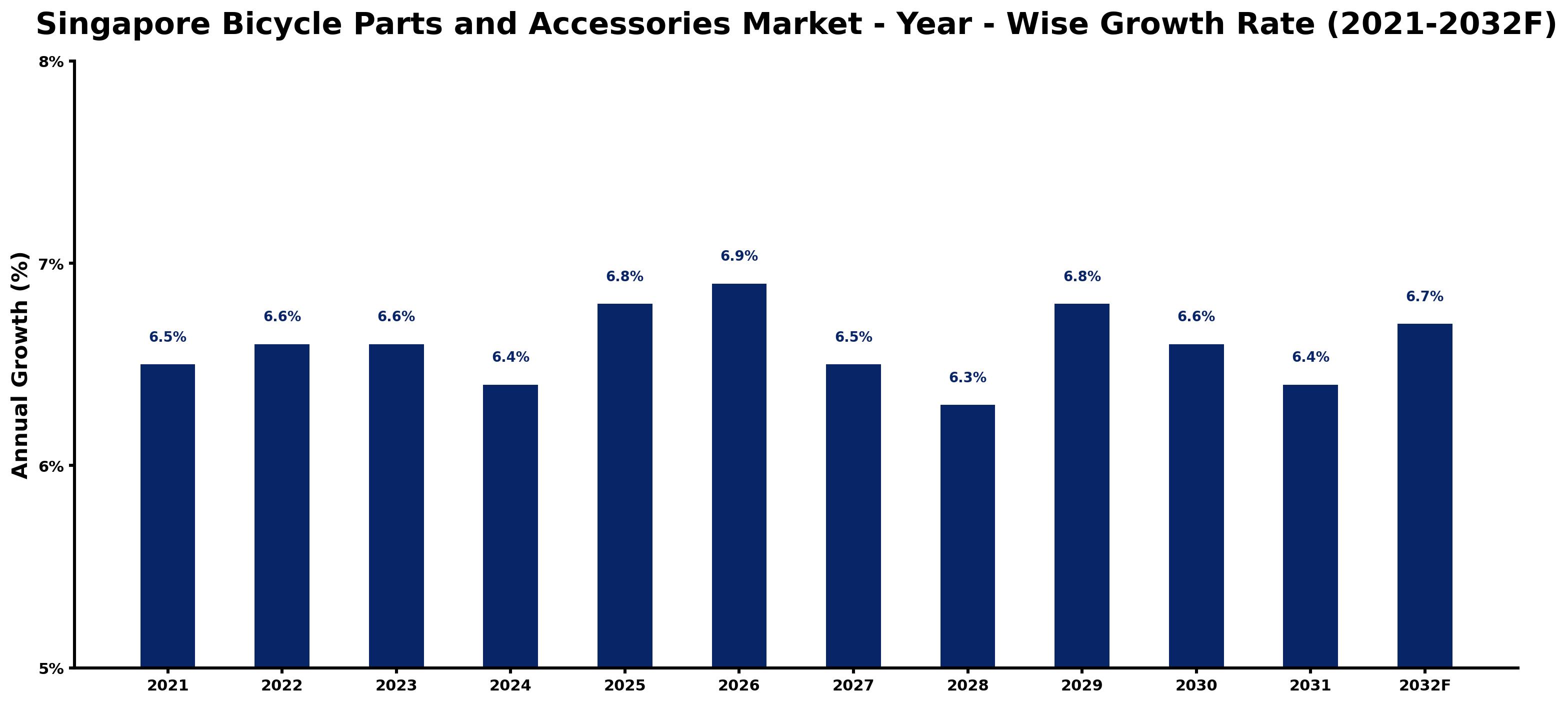
The table below presents the year wise growth rates along with the key drivers influencing the market
| Year | Growth Rate | Major Drivers |
| 2021 | 6.5% | Post-lockdown retail projects saw a surge in bicycle purchases and upgrades. |
| 2022 | 6.6% | E-commerce platforms expanded, offering diverse bicycle parts and accessories online. |
| 2023 | 6.6% | Sustainability trends encouraged consumers to invest in durable, eco-friendly components. |
| 2024 | 6.4% | Urbanization intensified demand for practical bicycles and related accessories in Singapore. |
| 2025 | 6.8% | Health-conscious lifestyles fostered increased interest in cycling as a primary activity. |
| 2026 | 6.9% | Collaborations among local manufacturers enhanced product offerings and reduced costs effectively. |
| 2027 | 6.5% | Technological advancements facilitated smart bicycle accessories, attracting tech-savvy consumers. |
| 2028 | 6.3% | Community cycling events promoted engagement, driving sales of related gear and parts. |
| 2029 | 6.8% | Tourism recovery introduced bike rentals, boosting demand for maintenance and accessories. |
| 2030 | 6.6% | Local councils supported cycling infrastructure, enhancing the appeal of bicycle ownership. |
| 2031 | 6.4% | Consumer education on bicycle maintenance increased DIY repairs, impacting parts sales positively. |
| 2032 | 6.7% | Global supply chain stabilization improved availability and affordability of bicycle components. |
Note - Market size estimations and growth projections presented in this report are based on 6Wresearch's advanced forecasting approach, validated with industry datasets as of June 2026.
Singapore Bicycle Parts and Accessories Market Synopsis
The Singapore Bicycle Parts and Accessories Market is projected to reach 6.9% and witness significant growth during the forecast period (2026-2032). As one of the prominent bicycle parts and accessories markets in the Asia Pacific, Singapore has been at the forefront of this industry, fueled by several interconnected factors. Increasing demand for bicycles as an alternative mode of transportation, a growing interest in cycling both as a leisure activity and a fitness pursuit, and heightened health awareness among the population are driving this growth. Furthermore, supportive government initiatives, such as tax breaks on bike purchases, play a crucial role in enhancing market dynamics.
Singapore Bicycle Parts and Accessories Market Growth Drivers
The growth of the Singapore Bicycle Parts and Accessories Market can be attributed to a multitude of factors:
- There is an increasing demand for bicycles as an environmentally friendly alternative to traditional transportation methods, contributing significantly to the market's expansion.
- The popularity of cycling as a leisure and fitness activity is on the rise, spurred by various community events and cycling clubs that promote active lifestyles.
- Health consciousness among Singaporean consumers has led to a surge in interest in cycling as a means to improve physical health and well-being, thereby increasing demand for related products.
- The proliferation of bike-sharing services, including initiatives by startups, has enhanced accessibility and encouraged new cyclists, further stimulating market growth.
- Government initiatives, including various incentives for bike purchases and investments in cycling infrastructure, help to create a more supportive environment for both consumers and businesses in the market.
Singapore Bicycle Parts and Accessories Market Challenges and Restraints
Despite the promising growth trajectory, the Singapore Bicycle Parts and Accessories Market faces several challenges:
- The high cost associated with purchasing quality bicycles and the necessary components or accessories can deter potential customers, especially in a price-sensitive market.
- Limited availability of spare parts and repair shops poses a significant barrier for consumers looking to maintain or customize their bicycles, impacting overall sales.
- A competitive landscape characterized by numerous low-cost vendors offering similar products can create pricing pressures, complicating profitability for established players.
- The lack of adequate public infrastructure to support cycling, such as bike lanes and secure parking, can hinder the growth of cycling as a preferred mode of transport.
- Market players must navigate the complexities of changing consumer preferences, requiring continuous innovation and adaptation to evolving trends in cycling and health awareness.
Singapore Bicycle Parts and Accessories Market Government Investment and Initiatives
The Singapore government has been actively promoting cycling as part of its broader sustainability and public health initiatives. Significant investments have been made in developing cycling infrastructure, including dedicated bike lanes and parking facilities throughout urban areas. Furthermore, programs that provide tax incentives for individuals purchasing bicycles have bolstered consumer interest. These initiatives are structured not only to enhance mobility but also to address concerns about traffic congestion and environmental sustainability. Additionally, public campaigns aimed at fostering a cycling culture demonstrate the government's commitment to integrating cycling into daily life.
Singapore Bicycle Parts and Accessories Market Latest Developments (May 2025 - June 2026)
In the period from May 2025 to June 2026, the Singapore Bicycle Parts and Accessories Market has continued to evolve rapidly. Notable trends include a surge in e-commerce platforms dedicated to bicycle sales, as consumer preferences shift toward online shopping for convenience. Moreover, innovations in bicycle technology, such as electric bikes and enhanced safety features, have gained traction among new buyers. The market has also seen increased collaboration among local authorities, cycling organizations, and private companies aimed at fostering a robust cycling community. These developments reflect a broader recognition of cycling's role within urban transport strategies and health promotion.
Singapore Bicycle Parts and Accessories Market - Key Attractiveness of the Report
- 10 Years of Market Numbers
- Historical Data Starting from 2022 to 2025
- Base Year: 2025
- Forecast Data until 2032
- Key Performance Indicators Impacting the Market
- Major Upcoming Developments and Projects
Key Highlights of the Report:
- Singapore Bicycle Parts and Accessories Market Outlook
- Market Size of Singapore Bicycle Parts and Accessories Market, 2025
- Forecast of Singapore Bicycle Parts and Accessories Market, 2032F
- Historical Data and Forecast of Singapore Bicycle Parts and Accessories Revenues & Volume for the Period 2022-2032F
- Singapore Bicycle Parts and Accessories Market Trend Evolution
- Singapore Bicycle Parts and Accessories Market Drivers and Challenges
- Singapore Bicycle Parts and Accessories Price Trends
- Singapore Bicycle Parts and Accessories Porter's Five Forces
- Singapore Bicycle Parts and Accessories Industry Life Cycle
- Historical Data and Forecast of Singapore Bicycle Parts and Accessories Market Revenues & Volume By Types for the Period 2022-2032F
- Historical Data and Forecast of Singapore Bicycle Parts and Accessories Market Revenues & Volume By Transmission Parts for the Period 2022-2032F
- Historical Data and Forecast of Singapore Bicycle Parts and Accessories Market Revenues & Volume By Frame & Forks Parts for the Period 2022-2032F
- Historical Data and Forecast of Singapore Bicycle Parts and Accessories Market Revenues & Volume By Wheel Parts for the Period 2022-2032F
- Historical Data and Forecast of Singapore Bicycle Parts and Accessories Market Revenues & Volume By Steering Components for the Period 2022-2032F
- Historical Data and Forecast of Singapore Bicycle Parts and Accessories Market Revenues & Volume By Applications for the Period 2022-2032F
- Historical Data and Forecast of Singapore Bicycle Parts and Accessories Market Revenues & Volume By Mountain Bicycles for the Period 2022-2032F
- Historical Data and Forecast of Singapore Bicycle Parts and Accessories Market Revenues & Volume By Road Bicycles for the Period 2022-2032F
- Historical Data and Forecast of Singapore Bicycle Parts and Accessories Market Revenues & Volume By Others for the Period 2022-2032F
- Singapore Bicycle Parts and Accessories Import Export Trade Statistics
- Market Opportunity Assessment By Types
- Market Opportunity Assessment By Applications
- Singapore Bicycle Parts and Accessories Top Companies Market Share
- Singapore Bicycle Parts and Accessories Competitive Benchmarking By Technical and Operational Parameters
- Singapore Bicycle Parts and Accessories Company Profiles
- Singapore Bicycle Parts and Accessories Key Strategic Recommendations






































