Singapore Concrete Chain Saw Market Size Growth Rate
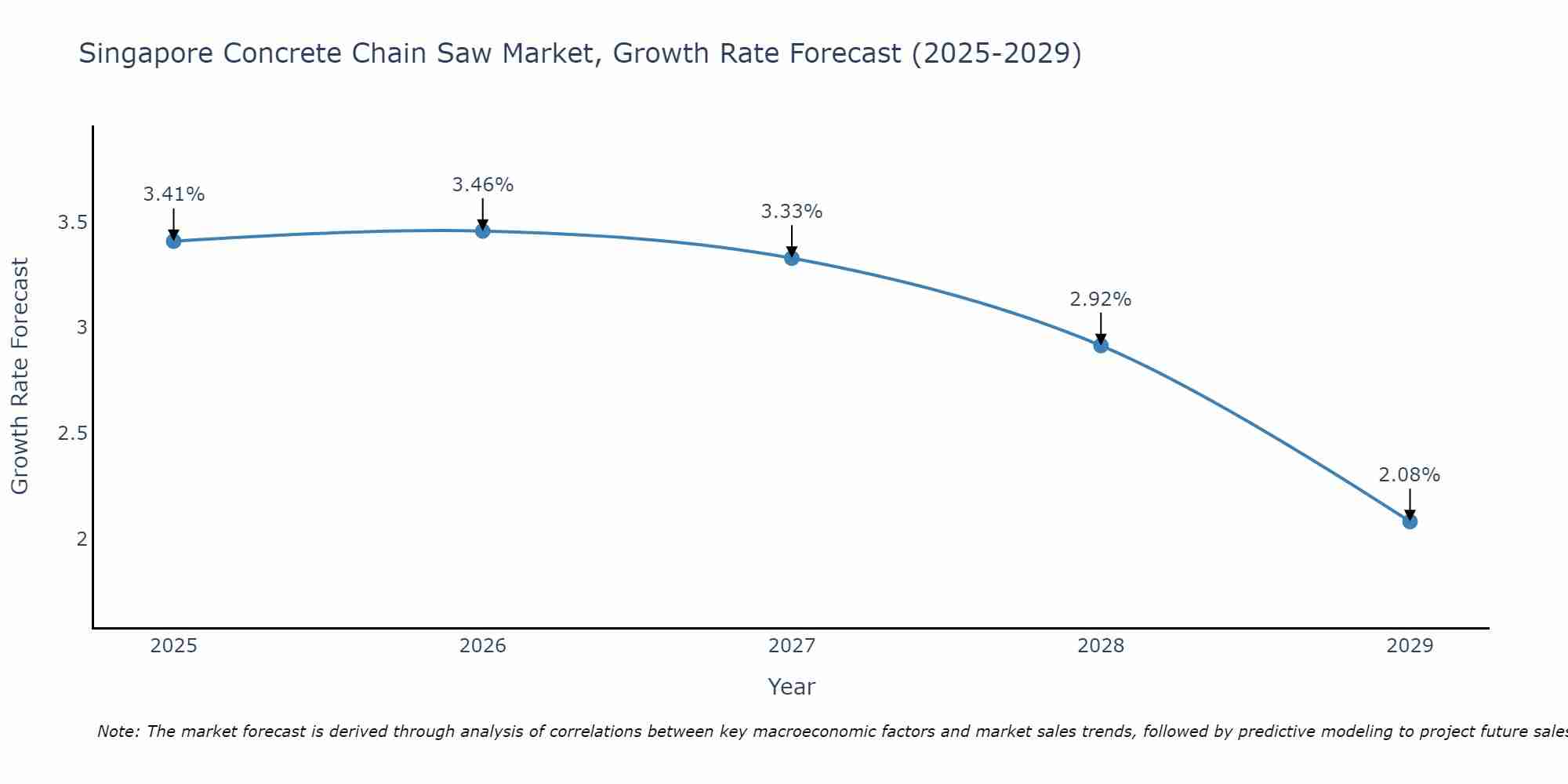
The Singapore Concrete Chain Saw Market is projected to witness mixed growth rate patterns during 2025 to 2029. Starting at 3.41% in 2025, the market peaks at 3.46% in 2026, and settles at 2.08% by 2029.
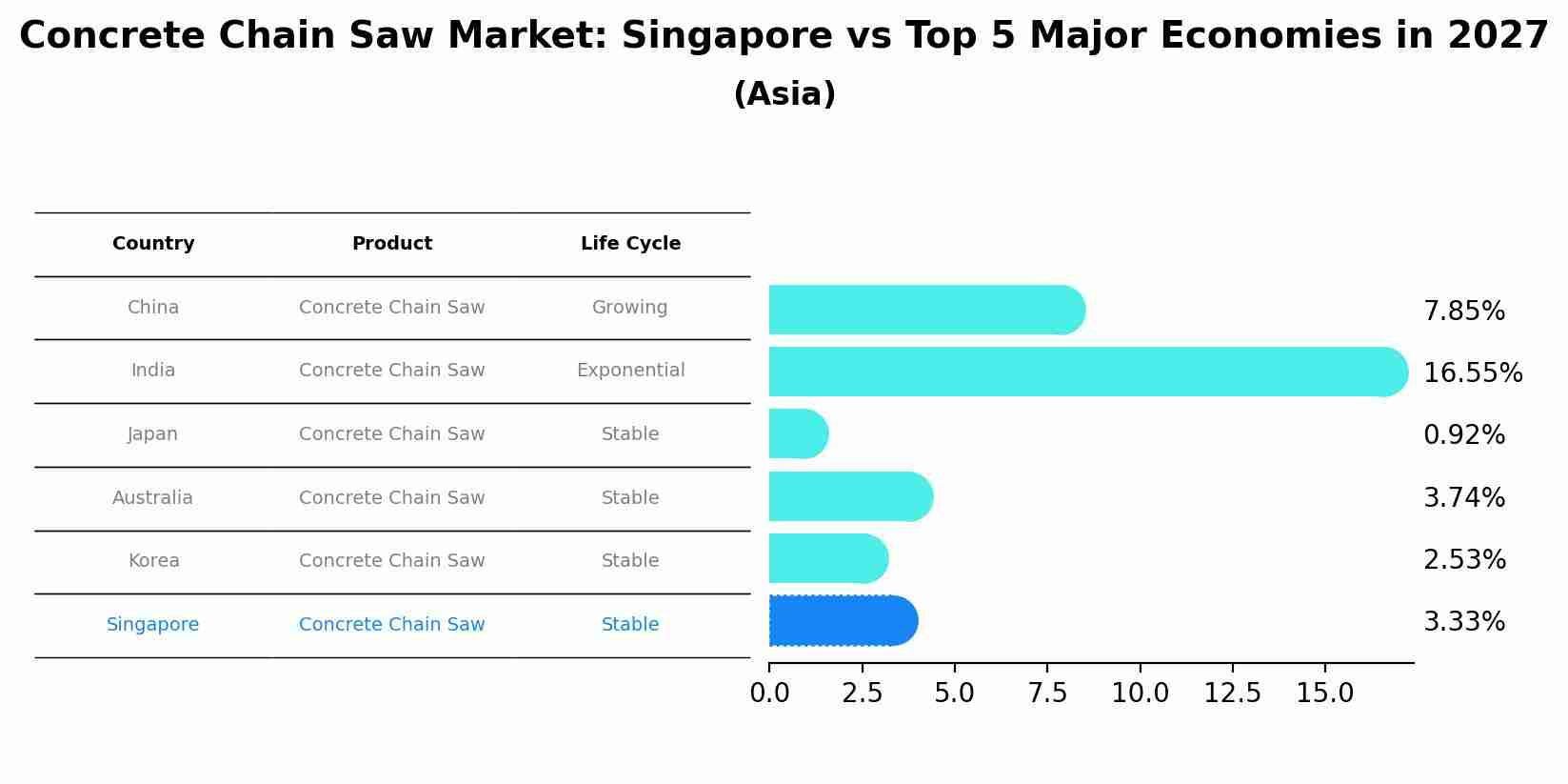
Concrete Chain Saw Market: Singapore vs Top 5 Major Economies in 2027 (Asia)
In the Asia region, the Concrete Chain Saw market in Singapore is projected to expand at a stable growth rate of 3.33% by 2027. The largest economy is China, followed by India, Japan, Australia and South Korea.
Singapore Concrete Chain Saw Market Synopsis
The Singapore concrete chain saw market is experiencing growth due to construction and infrastructure development projects in the region. Concrete chain saws are essential tools for cutting through concrete, masonry, and other hard materials, making them integral to construction and demolition activities. The market outlook remains positive as urbanization and development projects continue to drive demand for efficient and precise cutting solutions. Singapore emphasis on construction innovation and infrastructure development supports the growth of the concrete chain saw market.
Drivers of the Market
The Singapore concrete chain saw market is witnessing growth due to the expansion of the construction and demolition industry. Concrete chain saws are essential tools for cutting through concrete and masonry, making them indispensable in various construction and renovation projects. The construction of infrastructure projects, residential buildings, and commercial spaces is driving the demand for these tools. Additionally, the adoption of more efficient and lightweight concrete chain saws is enhancing productivity, further boosting market growth.
Challenges of the Market
The Singapore concrete chain saw market faces challenges related to safety and environmental regulations. Companies must ensure their products meet stringent safety standards, and noise and emissions regulations can impact the design of these machines. Additionally, competition from alternative construction methods adds pressure to innovate and offer cost-effective solutions.
COVID-19 Impact on the Market
The Singapore concrete chain saw market experienced a notable downturn due to the COVID-19 pandemic. The construction industry, a primary consumer of concrete chain saws, was significantly affected by lockdowns and restrictions on construction activities. Many construction projects were delayed or put on hold, leading to reduced demand for concrete cutting equipment. Additionally, supply chain disruptions and labor shortages further hampered the market. However, as construction activities gradually resumed and adapted to pandemic safety measures, the market began to recover. The emphasis on infrastructure development and the adoption of advanced concrete cutting technologies may offer growth opportunities in the post-pandemic era.
Key Players in the Market
The Singapore Concrete Chain Saw market showcases leading companies such as Husqvarna Group, STIHL Group, ICS Blount, Inc., Makita Corporation, and EDCO. These firms are recognized for their durable and high-performance concrete cutting equipment.
Key Highlights of the Report:
- Singapore Concrete Chain Saw Market Outlook
- Market Size of Singapore Concrete Chain Saw Market, 2024
- Forecast of Singapore Concrete Chain Saw Market, 2031
- Historical Data and Forecast of Singapore Concrete Chain Saw Revenues & Volume for the Period 2021-2031
- Singapore Concrete Chain Saw Market Trend Evolution
- Singapore Concrete Chain Saw Market Drivers and Challenges
- Singapore Concrete Chain Saw Price Trends
- Singapore Concrete Chain Saw Porter's Five Forces
- Singapore Concrete Chain Saw Industry Life Cycle
- Historical Data and Forecast of Singapore Concrete Chain Saw Market Revenues & Volume By Type for the Period 2021-2031
- Historical Data and Forecast of Singapore Concrete Chain Saw Market Revenues & Volume By Gas Chain Saw for the Period 2021-2031
- Historical Data and Forecast of Singapore Concrete Chain Saw Market Revenues & Volume By Hydraulic Chain Saw for the Period 2021-2031
- Historical Data and Forecast of Singapore Concrete Chain Saw Market Revenues & Volume By Pneumatic Chain Saw for the Period 2021-2031
- Singapore Concrete Chain Saw Import Export Trade Statistics
- Market Opportunity Assessment By Type
- Singapore Concrete Chain Saw Top Companies Market Share
- Singapore Concrete Chain Saw Competitive Benchmarking By Technical and Operational Parameters
- Singapore Concrete Chain Saw Company Profiles
- Singapore Concrete Chain Saw Key Strategic Recommendations






































