Singapore Electric lighting equipment Market Summary
The singapore electric lighting equipment market was estimated at USD 569 Million in 2025 and is projected to reach USD 812 Million by 2032, growing at a CAGR of 6.3% from 2026 to 2032.
Singapore Electric lighting equipment Market Year-wise Growth Rate and Key Drivers
This graph highlights how the Singapore Electric lighting equipment Market has steadily grown over the past five years, supported by major growth factors.
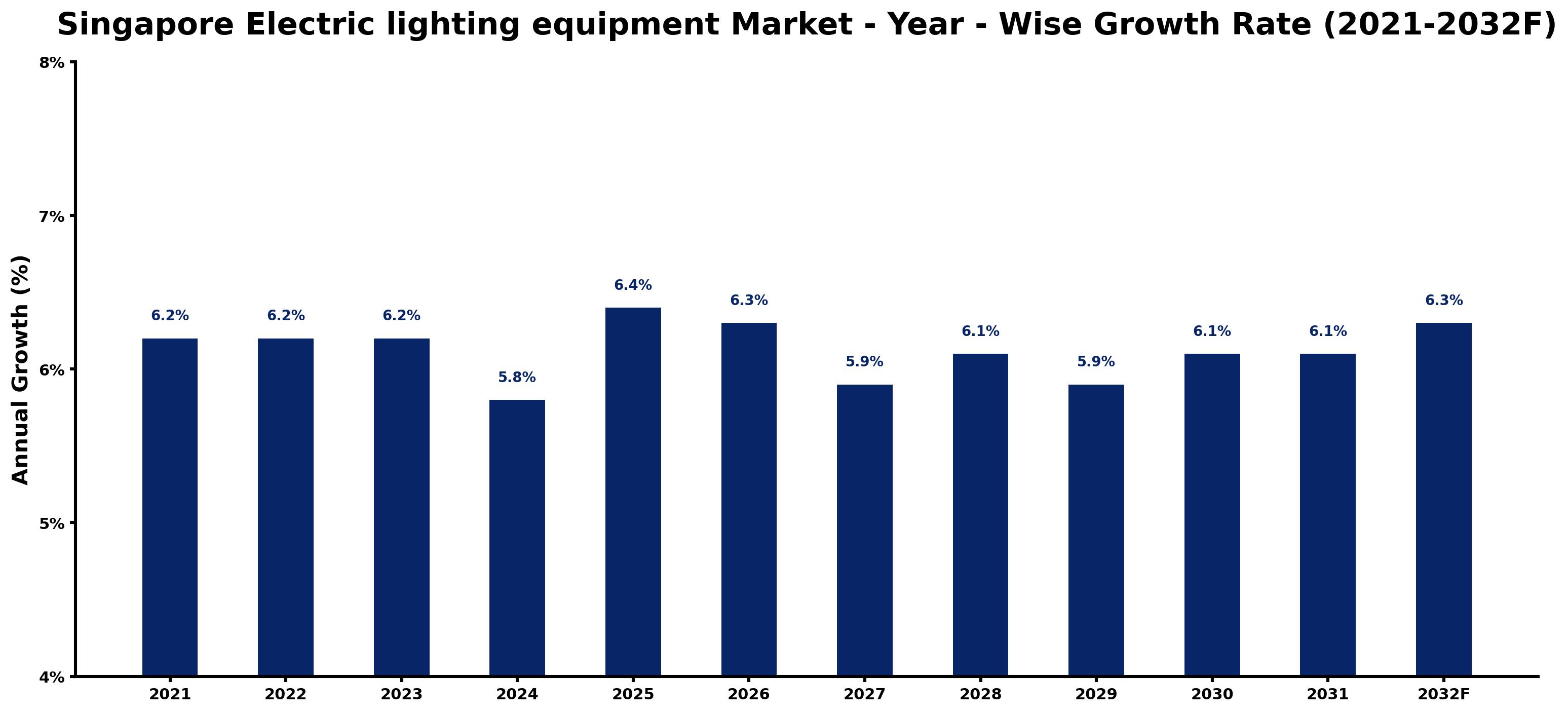
The table below presents the year wise growth rates along with the key drivers influencing the market
| Year | Growth Rate | Major Drivers |
| 2021 | 6.2% | Post-lockdown retail projects led to increased investment in modern lighting solutions. |
| 2022 | 6.2% | Energy-efficient technologies gained traction among commercial sectors seeking cost savings. |
| 2023 | 6.2% | Local manufacturers adapted to supply chain challenges, boosting domestic production capabilities. |
| 2024 | 5.8% | Smart city initiatives prompted enhanced integration of smart lighting systems across urban spaces. |
| 2025 | 6.4% | Home automation trends influenced residential consumers towards modern lighting installations. |
| 2026 | 6.3% | Increased awareness of sustainability prompted demand for eco-friendly lighting alternatives. |
| 2027 | 5.9% | Technological innovations improved product performance, attracting more consumers to premium offerings. |
| 2028 | 6.1% | The hospitality sector increasingly focused on ambiance, driving unique lighting projects forward. |
| 2029 | 5.9% | Construction sector expansion necessitated advanced lighting solutions for new developments. |
| 2030 | 6.1% | Collaboration between tech firms and lighting companies enabled pioneering product launches. |
| 2031 | 6.1% | Consumer preferences shifted towards customizable lighting options, enhancing market diversification. |
| 2032 | 6.3% | Urbanization trends fueled the need for efficient and adaptive lighting in growing cities. |
Note - Market size estimations and growth projections presented in this report are based on 6Wresearch's advanced forecasting approach, validated with industry datasets as of June 2026.
Singapore Electric lighting equipment Market Synopsis
The Singapore Electric lighting equipment Market is projected to reach 6.3% and witness significant growth during the forecast period (2026-2032). This growth trajectory is influenced by several key factors including escalating investments in smart lighting solutions, heightened awareness regarding energy efficiency, and proactive government initiatives aimed at fostering sustainable practices. The market is also expected to benefit from ongoing technological advancements and a notable shift towards LED lighting systems, which are seen as pivotal components in the modernization of urban infrastructure.
Singapore Electric lighting equipment Market Growth Drivers
The growth of the Singapore Electric lighting equipment Market is underpinned by various drivers that collectively enhance demand for advanced lighting solutions. Key factors include:
- Rising Investments in Smart Lighting: The Singapore government has committed substantial resources towards the development of smart cities, integrating Internet of Things (IoT) technologies into infrastructure. This initiative aims to create interconnected lighting systems that not only enhance urban aesthetics but also improve energy management.
- Increased Demand for Energy Efficient Solutions: With growing concerns about environmental sustainability, there is a concerted effort among both residential and commercial sectors to adopt energy-efficient lighting solutions. The shift towards LED technology is particularly notable, driven by its lower power consumption and longer lifespan.
- Government Initiatives Promoting Sustainability: The Singaporean government has launched various policies aimed at enhancing energy efficiency and reducing greenhouse gas emissions. These initiatives encourage the adoption of modern lighting technologies and provide incentives for sustainable practices.
- Technological Advancements: Continuous innovation in the electric lighting sector, including enhancements in LED technology and the emergence of smart lighting solutions, is fueling market growth. The development of high-fidelity lighting systems that are programmable and adaptable to user needs represents a significant trend.
- Urbanization and Infrastructure Development: As Singapore continues to urbanize, the demand for effective lighting solutions in residential, commercial, and public spaces increases. This trend necessitates investment in advanced lighting infrastructure, thereby contributing positively to market growth.
Singapore Electric lighting equipment Market Challenges and Restraints
Despite the positive outlook, the Singapore Electric lighting equipment Market faces several challenges that could impact its growth:
- High Initial Investment Costs: Transitioning from traditional lighting sources such as fluorescent lamps to modern LED solutions often incurs higher upfront costs. This financial barrier can deter end-users from making the switch, particularly in budget-sensitive applications.
- Limited Accessibility to Low Voltage Systems: In some regions of Singapore, the lack of low voltage wiring infrastructure restricts the deployment of efficient LED-based lighting solutions. This limitation hampers the overall development of the electric lighting equipment market.
- Market Saturation in Urban Areas: As urban areas in Singapore become increasingly saturated with existing lighting solutions, the opportunities for new installations may diminish, leading to slower growth rates in certain segments.
- Short Product Life Cycles: Rapid technological advancements in lighting solutions result in shorter product life cycles, compelling manufacturers to innovate continuously. This pressure can lead to increased costs and resource allocation challenges.
- Impact of Economic Downturns: Economic fluctuations can affect construction activities and investment in public infrastructure projects, which may subsequently impact the demand for electric lighting equipment.
Singapore Electric lighting equipment Market Government Investment and Initiatives
The Singapore government plays a crucial role in supporting the Electric lighting equipment Market through various investments and initiatives. Key strategies include the allocation of funding for smart city projects that incorporate advanced lighting systems, as well as public policies aimed at promoting energy efficiency across sectors. Additionally, the government is actively pursuing multinational partnerships to leverage expertise in smart technologies, further enhancing local capabilities. These initiatives not only stimulate market growth but also foster a competitive environment conducive to innovation in lighting technologies.
Singapore Electric lighting equipment Market Latest Developments (May 2025 - June 2026)
Recent developments within the Singapore Electric lighting equipment Market highlight an ongoing commitment to innovation and sustainability. Both public and private sectors have ramped up efforts in adopting and implementing smart lighting technologies. During this period, there has been a noticeable uptick in pilot projects aiming to integrate IoT-enabled lighting solutions in urban environments. Additionally, the push for energy-efficient lighting solutions continues to gain momentum, supported by various awareness campaigns and incentives from government bodies. These developments reflect a robust alignment with Singapore's broader environmental objectives and smart city vision.
Singapore Electric lighting equipment Market - Key Attractiveness of the Report
- 10 Years of Market Numbers
- Historical Data Starting from 2022 to 2025
- Base Year: 2025
- Forecast Data until 2032
- Key Performance Indicators Impacting the Market
- Major Upcoming Developments and Projects
Key Highlights of the Report:
- Singapore Electric lighting equipment Market Outlook
- Market Size of Singapore Electric lighting equipment Market, 2025
- Forecast of Singapore Electric lighting equipment Market, 2032F
- Historical Data and Forecast of Singapore Electric lighting equipment Revenues & Volume for the Period 2022-2032F
- Singapore Electric lighting equipment Market Trend Evolution
- Singapore Electric lighting equipment Market Drivers and Challenges
- Singapore Electric lighting equipment Price Trends
- Singapore Electric lighting equipment Porter's Five Forces
- Singapore Electric lighting equipment Industry Life Cycle
- Historical Data and Forecast of Singapore Electric lighting equipment Market Revenues & Volume By Type for the Period 2022-2032F
- Historical Data and Forecast of Singapore Electric lighting equipment Market Revenues & Volume By General Lighting for the Period 2022-2032F
- Historical Data and Forecast of Singapore Electric lighting equipment Market Revenues & Volume By Automotive Lighting for the Period 2022-2032F
- Historical Data and Forecast of Singapore Electric lighting equipment Market Revenues & Volume By Back Lighting for the Period 2022-2032F
- Historical Data and Forecast of Singapore Electric lighting equipment Market Revenues & Volume By Application for the Period 2022-2032F
- Historical Data and Forecast of Singapore Electric lighting equipment Market Revenues & Volume By Residential for the Period 2022-2032F
- Historical Data and Forecast of Singapore Electric lighting equipment Market Revenues & Volume By Commercial for the Period 2022-2032F
- Historical Data and Forecast of Singapore Electric lighting equipment Market Revenues & Volume By Automotive for the Period 2022-2032F
- Historical Data and Forecast of Singapore Electric lighting equipment Market Revenues & Volume By Others for the Period 2022-2032F
- Historical Data and Forecast of Singapore Electric lighting equipment Market Revenues & Volume By Sales Channel for the Period 2022-2032F
- Historical Data and Forecast of Singapore Electric lighting equipment Market Revenues & Volume By OEM for the Period 2022-2032F
- Historical Data and Forecast of Singapore Electric lighting equipment Market Revenues & Volume By Aftermarket? for the Period 2022-2032F
- Historical Data and Forecast of Singapore Electric lighting equipment Market Revenues & Volume By Mode for the Period 2022-2032F
- Historical Data and Forecast of Singapore Electric lighting equipment Market Revenues & Volume By Offline for the Period 2022-2032F
- Historical Data and Forecast of Singapore Electric lighting equipment Market Revenues & Volume By Online for the Period 2022-2032F
- Singapore Electric lighting equipment Import Export Trade Statistics
- Market Opportunity Assessment By Type
- Market Opportunity Assessment By Application
- Market Opportunity Assessment By Sales Channel
- Market Opportunity Assessment By Mode
- Singapore Electric lighting equipment Top Companies Market Share
- Singapore Electric lighting equipment Competitive Benchmarking By Technical and Operational Parameters
- Singapore Electric lighting equipment Company Profiles
- Singapore Electric lighting equipment Key Strategic Recommendations






































