Singapore Energy Efficient Lighting Market Size, Share & Growth Rate
The Singapore Energy Efficient Lighting Market was estimated at USD 1383 Million in 2025 and is projected to reach USD 1995 Million by 2032, growing at a CAGR of 5.4% from 2026 to 2032. This growth trajectory is driven by Singapore's unwavering commitment to sustainability and the ongoing integration of advanced lighting technologies. Key factors such as government initiatives, heightened environmental awareness, and technological innovations are collectively fostering a robust ecosystem for energy-efficient lighting solutions across various sectors.
Singapore Energy Efficient Lighting Market Year-wise Growth Rate and Key Drivers
This graph highlights how the Singapore Energy Efficient Lighting Market has steadily grown over the years, supported by major growth factors.
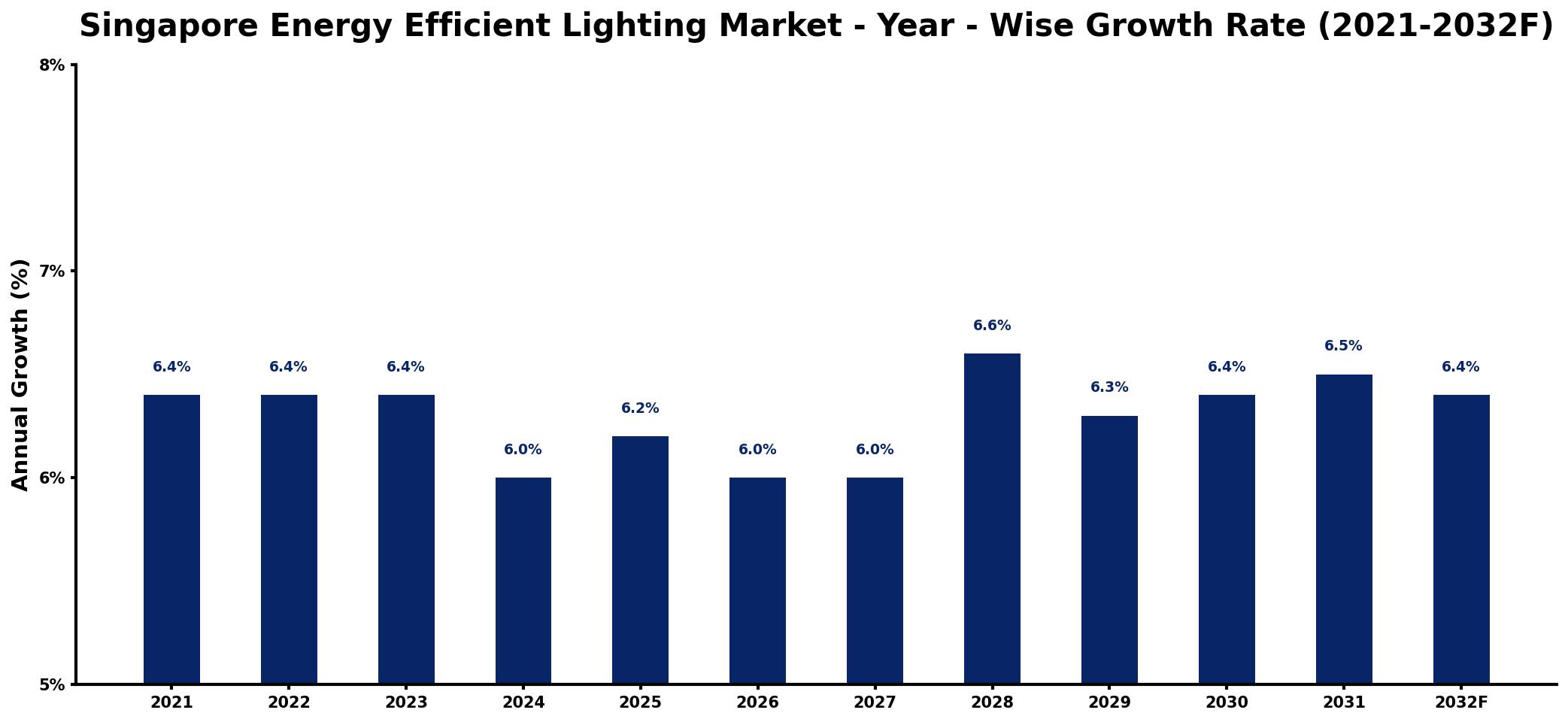
The table below presents the year‑wise growth rates along with the key drivers influencing the market
| Year | Growth Rate | Major Drivers |
| 2021 | 6.4% | Increased focus on sustainability initiatives |
| 2022 | 6.4% | Government incentives for green technologies |
| 2023 | 6.4% | Rising demand for smart solutions |
| 2024 | 6.0% | strengthening underlying market demand |
| 2025 | 6.2% | Growing awareness of climate change |
| 2026 | 6.0% | Expansion of urban development projects |
| 2027 | 6.0% | Shift towards eco-friendly practices |
| 2028 | 6.6% | Technological advancements in automation |
| 2029 | 6.3% | Enhanced regulations on carbon emissions |
| 2030 | 6.4% | increased overall sector activity |
| 2031 | 6.5% | Emergence of innovative financing models |
| 2032 | 6.4% | Adoption of circular economy principles |
Note: Market size estimations and growth projections presented in this report are based on 6Wresearch's proprietary forecasting methodology, utilizing the latest available industry data, government publications, and primary research inputs.
Singapore Energy Efficient Lighting Market Synopsis
The demand for energy-efficient lighting in Singapore is surging, particularly as commercial spaces strive to meet stringent environmental standards. LED lighting is at the forefront, revolutionizing illumination with its efficiency and longevity, making it an appealing choice for businesses and homeowners alike. The trend toward smart lighting systems, which enhance functionality and energy management, is further elevating the market.
Supply-side dynamics are also shifting, with an increasing number of manufacturers focusing on innovative designs and sustainable practices. This aligns with Singapore's ambition of becoming a smart city, where integrating cutting-edge technologies into urban infrastructure is crucial for energy conservation and improved quality of life.
Singapore Energy Efficient Lighting Market Key Takeaways
- LED technology dominates the market due to its superior efficiency and lifespan.
- Government policies are strongly supporting the transition to sustainable lighting solutions.
- Smart lighting systems are becoming a key trend, enhancing both energy management and user experience.
- Growing awareness of environmental sustainability is driving consumer demand across sectors.
- Investment in infrastructure and smart city initiatives is expected to create new growth opportunities.
Evaluation of Restraints in Singapore Energy Efficient Lighting Market
Despite the positive outlook, the Singapore Energy Efficient Lighting Market faces several restraints. One significant hurdle is the challenge of consumer education regarding the benefits of energy-efficient solutions. Many businesses and homeowners are still hesitant to invest in new technologies due to perceived high upfront costs, despite long-term savings. Additionally, coordinating large-scale projects, especially in public infrastructure, requires substantial investment and collaboration among diverse stakeholders, which can slow progress. Balancing cost-effectiveness with sustainability initiatives continues to be a pressing concern for the market.
Singapore Energy Efficient Lighting Market Trends
A notable trend within the Singapore Energy Efficient Lighting Market is the increasing adoption of smart technologies. Integrating IoT systems with lighting solutions is not only enhancing energy efficiency but also optimizing user experience. Moreover, there is a growing focus on sustainable design principles, pushing manufacturers to innovate beyond mere functionality and aesthetics. Another trend is the push toward modular lighting solutions, which offer flexibility and scalability to meet diverse consumer needs.
Singapore Energy Efficient Lighting Market Opportunities
The landscape for investment in energy-efficient lighting solutions is ripe with opportunities. As Singapore pursues its smart city agenda, there is substantial potential for collaborative projects that incorporate energy-efficient lighting into new developments. Additionally, sectors like hospitality and retail are actively seeking innovative lighting solutions to enhance customer experiences while reducing operational costs. The growing trend towards home automation also presents avenues for integrating energy-efficient lighting into residential settings, appealing to environmentally conscious consumers.
Government Initiatives in the Singapore Energy Efficient Lighting Market
The Singapore government is actively promoting energy-efficient lighting through various initiatives and policies. Programs aimed at raising awareness about the benefits of sustainable lighting solutions are in place, along with incentives for businesses transitioning to energy-efficient systems. Public spending on infrastructure projects increasingly incorporates energy-efficient lighting, aligning with the nations commitment to reducing carbon emissions. These strategic efforts are essential in facilitating a broader adoption of efficient lighting technologies across all sectors.
Future Insights of the Singapore Energy Efficient Lighting Market
Looking ahead to 2026-2032, the Singapore Energy Efficient Lighting Market is poised for substantial growth, driven by continuous innovation and heightened regulatory support. The emphasis on smart city initiatives will likely enhance the integration of lighting solutions into broader energy management systems, thereby improving overall efficiency. Furthermore, as consumer preferences shift toward sustainability, companies that prioritize eco-friendly practices and advanced technologies will find themselves well-positioned in this evolving landscape.
Singapore Energy Efficient Lighting Market Latest Developments (2025 - 2026)
Recent developments in the Singapore Energy Efficient Lighting Market indicate a pronounced shift toward smart lighting solutions and increased integration of IoT technologies. Companies are launching new products featuring advanced energy-saving capabilities, catering to the growing demand for sustainable options. Additionally, partnerships between public and private sectors are becoming more common, focusing on deploying energy-efficient lighting in urban projects and large-scale commercial spaces, further highlighting the market's evolving dynamics.
Singapore Energy Efficient Lighting Market - Key Attractiveness of the Report
- 10 Years of Market Numbers
- Historical Data Starting from 2022 to 2025
- Base Year: 2025
- Forecast Data until 2032
- Key Performance Indicators Impacting the Market
- Major Upcoming Developments and Projects
Key Highlights of the Report:
- Singapore Energy Efficient Lighting Market Outlook
- Market Size of Singapore Energy Efficient Lighting Market, 2025
- Forecast of Singapore Energy Efficient Lighting Market, 2032
- Historical Data and Forecast of Singapore Energy Efficient Lighting Revenues & Volume for the Period 2022-2032F
- Singapore Energy Efficient Lighting Market Trend Evolution
- Singapore Energy Efficient Lighting Market Drivers and Challenges
- Singapore Energy Efficient Lighting Price Trends
- Singapore Energy Efficient Lighting Porter's Five Forces
- Singapore Energy Efficient Lighting Industry Life Cycle
- Historical Data and Forecast of Singapore Energy Efficient Lighting Market Revenues & Volume By Product Type for the Period 2022-2032F
- Historical Data and Forecast of Singapore Energy Efficient Lighting Market Revenues & Volume By Incandescent Lamp for the Period 2022-2032F
- Historical Data and Forecast of Singapore Energy Efficient Lighting Market Revenues & Volume By Light Emitting Diode for the Period 2022-2032F
- Historical Data and Forecast of Singapore Energy Efficient Lighting Market Revenues & Volume By Arc Lamp for the Period 2022-2032F
- Historical Data and Forecast of Singapore Energy Efficient Lighting Market Revenues & Volume By Gas Discharge Lamps for the Period 2022-2032F
- Historical Data and Forecast of Singapore Energy Efficient Lighting Market Revenues & Volume By Application for the Period 2022-2032F
- Historical Data and Forecast of Singapore Energy Efficient Lighting Market Revenues & Volume By Commercial for the Period 2022-2032F
- Historical Data and Forecast of Singapore Energy Efficient Lighting Market Revenues & Volume By Residential for the Period 2022-2032F
- Historical Data and Forecast of Singapore Energy Efficient Lighting Market Revenues & Volume By Government for the Period 2022-2032F
- Historical Data and Forecast of Singapore Energy Efficient Lighting Market Revenues & Volume By Correlated Color Temperature for the Period 2022-2032F
- Historical Data and Forecast of Singapore Energy Efficient Lighting Market Revenues & Volume By 2700K-3000K for the Period 2022-2032F
- Historical Data and Forecast of Singapore Energy Efficient Lighting Market Revenues & Volume By 3500K??4000K for the Period 2022-2032F
- Historical Data and Forecast of Singapore Energy Efficient Lighting Market Revenues & Volume By 4000K-5000K for the Period 2022-2032F
- Historical Data and Forecast of Singapore Energy Efficient Lighting Market Revenues & Volume By 5000K-6500K for the Period 2022-2032F
- Historical Data and Forecast of Singapore Energy Efficient Lighting Market Revenues & Volume By More Than 6500K for the Period 2022-2032F
- Singapore Energy Efficient Lighting Import Export Trade Statistics
- Market Opportunity Assessment By Product Type
- Market Opportunity Assessment By Application
- Market Opportunity Assessment By Correlated Color Temperature
- Singapore Energy Efficient Lighting Top Companies Market Share
- Singapore Energy Efficient Lighting Competitive Benchmarking By Technical and Operational Parameters
- Singapore Energy Efficient Lighting Company Profiles
- Singapore Energy Efficient Lighting Key Strategic Recommendations






































