Singapore Exoskeleton Market: Import Trend Analysis
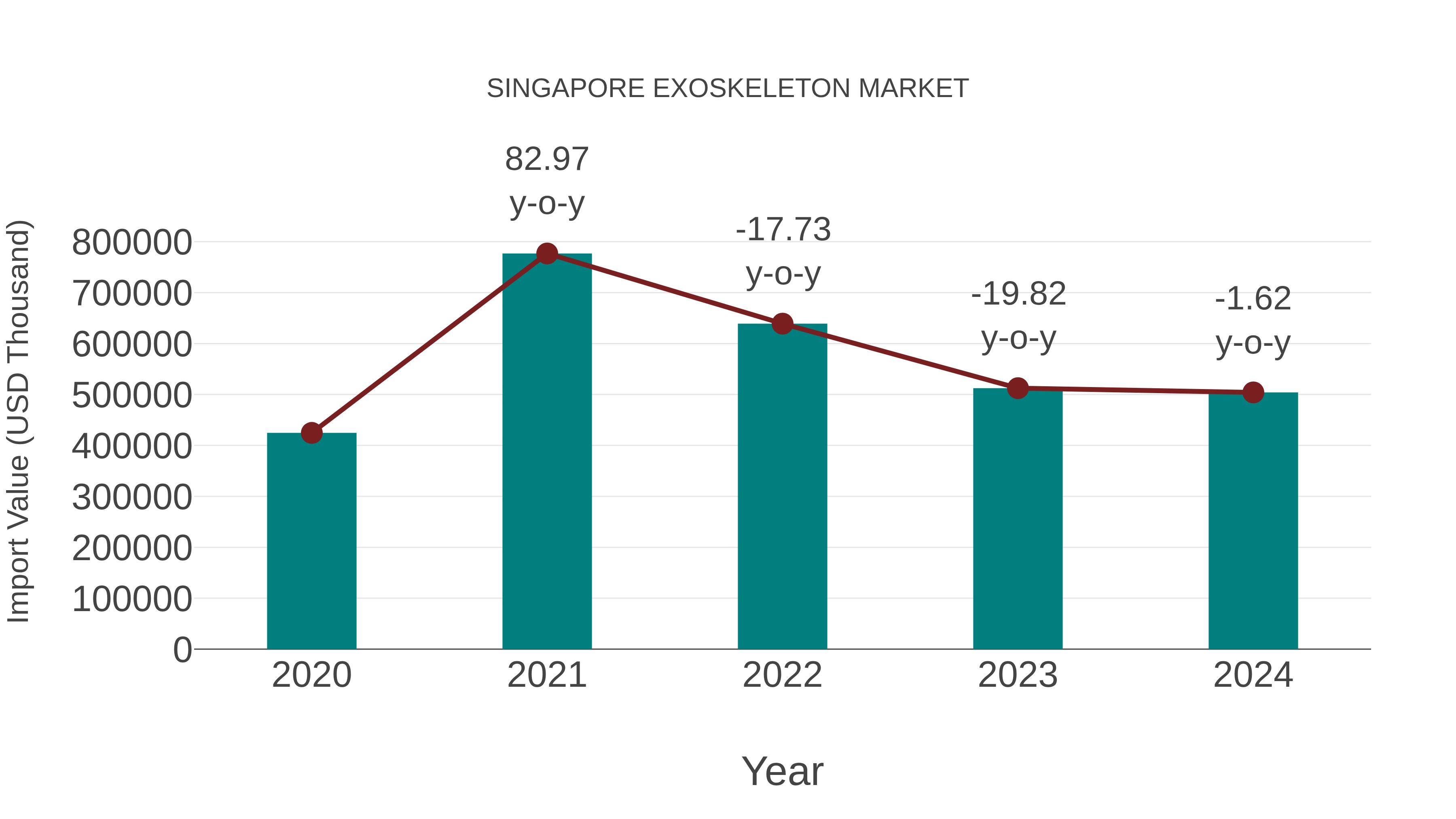
In the Singapore exoskeleton market, the import trend experienced a slight decline from 2023 to 2024, with a growth rate of -1.62%. However, the compound annual growth rate (CAGR) for the period 2020-2024 stood at 4.39%. This dip in import momentum could be attributed to shifts in demand patterns or evolving trade policies affecting market stability.
Singapore Exoskeleton Market Overview
The exoskeleton market in Singapore is witnessing rapid expansion, primarily due to advancements in technology and their application in various industries. Exoskeletons are being used to augment human capabilities, particularly in healthcare and industrial settings. The need for enhanced worker safety and productivity is a driving force behind the growth of this market, with a focus on ergonomic solutions.
Drivers of the Market
The Singapore exoskeleton market is driven by the nation`s dedication to enhancing the productivity and well-being of its workforce. Exoskeletons have applications in industries such as manufacturing, healthcare, and logistics, aligning with Singapore focus on innovation, technology adoption, and improving working conditions.
Challenges of the Market
The Singapore exoskeleton market is poised for growth, driven by applications in healthcare, manufacturing, and logistics. However, it faces a set of unique challenges. One of the foremost challenges is the cost of exoskeleton technology, which can be prohibitive for many potential users. Regulatory approval for medical applications and safety standards for industrial use also present hurdles. The market needs to address concerns related to user comfort and ergonomics, as well as the potential for long-term health impacts. Additionally, competition among exoskeleton manufacturers is intensifying, which may lead to pricing pressures and reduced profit margins. Overcoming these challenges will be essential for the widespread adoption of exoskeletons in Singapore.
Covid-19 impact of the Market
The COVID-19 pandemic had a significant impact on the Singapore Exoskeleton market. As the healthcare system faced increased pressure and a shortage of healthcare workers, exoskeletons found applications in assisting healthcare professionals. These wearable devices helped reduce physical strain, enhance mobility, and improve patient care. Additionally, exoskeletons gained importance in industries like manufacturing and logistics, where physical distancing and efficiency were critical. The pandemic accelerated the adoption of exoskeletons as companies and healthcare institutions recognized their potential benefits. Post-pandemic, the market is expected to expand as more sectors explore the advantages of exoskeleton technology.
Leading Players of the Market
In the Singapore Exoskeleton market, key players such as Ekso Bionics, Cyberdyne, and ReWalk Robotics contributed to the development of wearable exoskeleton solutions that supported rehabilitation, healthcare, and industrial applications.
Key Highlights of the Report:
- Singapore Exoskeleton Market Outlook
- Market Size of Singapore Exoskeleton Market, 2025
- Forecast of Singapore Exoskeleton Market, 2032
- Historical Data and Forecast of Singapore Exoskeleton Revenues & Volume for the Period 2022-2032F
- Singapore Exoskeleton Market Trend Evolution
- Singapore Exoskeleton Market Drivers and Challenges
- Singapore Exoskeleton Price Trends
- Singapore Exoskeleton Porter's Five Forces
- Singapore Exoskeleton Industry Life Cycle
- Historical Data and Forecast of Singapore Exoskeleton Market Revenues & Volume By Component for the Period 2022-2032F
- Historical Data and Forecast of Singapore Exoskeleton Market Revenues & Volume By Hardware for the Period 2022-2032F
- Historical Data and Forecast of Singapore Exoskeleton Market Revenues & Volume By Software for the Period 2022-2032F
- Historical Data and Forecast of Singapore Exoskeleton Market Revenues & Volume By Type for the Period 2022-2032F
- Historical Data and Forecast of Singapore Exoskeleton Market Revenues & Volume By Powered for the Period 2022-2032F
- Historical Data and Forecast of Singapore Exoskeleton Market Revenues & Volume By Passive for the Period 2022-2032F
- Historical Data and Forecast of Singapore Exoskeleton Market Revenues & Volume By Body Part for the Period 2022-2032F
- Historical Data and Forecast of Singapore Exoskeleton Market Revenues & Volume By Lower Extremities for the Period 2022-2032F
- Historical Data and Forecast of Singapore Exoskeleton Market Revenues & Volume By Upper Extremities for the Period 2022-2032F
- Historical Data and Forecast of Singapore Exoskeleton Market Revenues & Volume By Full Body for the Period 2022-2032F
- Historical Data and Forecast of Singapore Exoskeleton Market Revenues & Volume By Mobility for the Period 2022-2032F
- Historical Data and Forecast of Singapore Exoskeleton Market Revenues & Volume By Stationary for the Period 2022-2032F
- Historical Data and Forecast of Singapore Exoskeleton Market Revenues & Volume By Mobile for the Period 2022-2032F
- Historical Data and Forecast of Singapore Exoskeleton Market Revenues & Volume By Structure for the Period 2022-2032F
- Historical Data and Forecast of Singapore Exoskeleton Market Revenues & Volume By Rigid Exoskeletons for the Period 2022-2032F
- Historical Data and Forecast of Singapore Exoskeleton Market Revenues & Volume By Soft Exoskeletons for the Period 2022-2032F
- Historical Data and Forecast of Singapore Exoskeleton Market Revenues & Volume By Vertical for the Period 2022-2032F
- Historical Data and Forecast of Singapore Exoskeleton Market Revenues & Volume By Healthcare for the Period 2022-2032F
- Historical Data and Forecast of Singapore Exoskeleton Market Revenues & Volume By Defense for the Period 2022-2032F
- Historical Data and Forecast of Singapore Exoskeleton Market Revenues & Volume By Industrial for the Period 2022-2032F
- Historical Data and Forecast of Singapore Exoskeleton Market Revenues & Volume By Others for the Period 2022-2032F
- Singapore Exoskeleton Import Export Trade Statistics
- Market Opportunity Assessment By Component
- Market Opportunity Assessment By Type
- Market Opportunity Assessment By Body Part
- Market Opportunity Assessment By Mobility
- Market Opportunity Assessment By Structure
- Market Opportunity Assessment By Vertical
- Singapore Exoskeleton Top Companies Market Share
- Singapore Exoskeleton Competitive Benchmarking By Technical and Operational Parameters
- Singapore Exoskeleton Company Profiles
- Singapore Exoskeleton Key Strategic Recommendations






































