Singapore Flash Led Market Size, Share & Growth Rate
The Singapore Flash Led Market was estimated at USD 237 Million in 2025 and is projected to reach USD 309 Million by 2032, growing at a CAGR of 3.9% from 2026 to 2032. This robust growth trajectory is fueled by the rising popularity of high-quality smartphone photography and the increasing integration of flash LEDs in portable electronic devices. As outdoor activities gain traction and consumer demand for superior photography experiences continues to evolve, the market for flash LEDs in Singapore remains vibrant and poised for further development.
Singapore Flash Led Market Year-wise Growth Rate and Key Drivers
This graph highlights how the Singapore Flash Led Market has steadily grown over the years, supported by major growth factors.
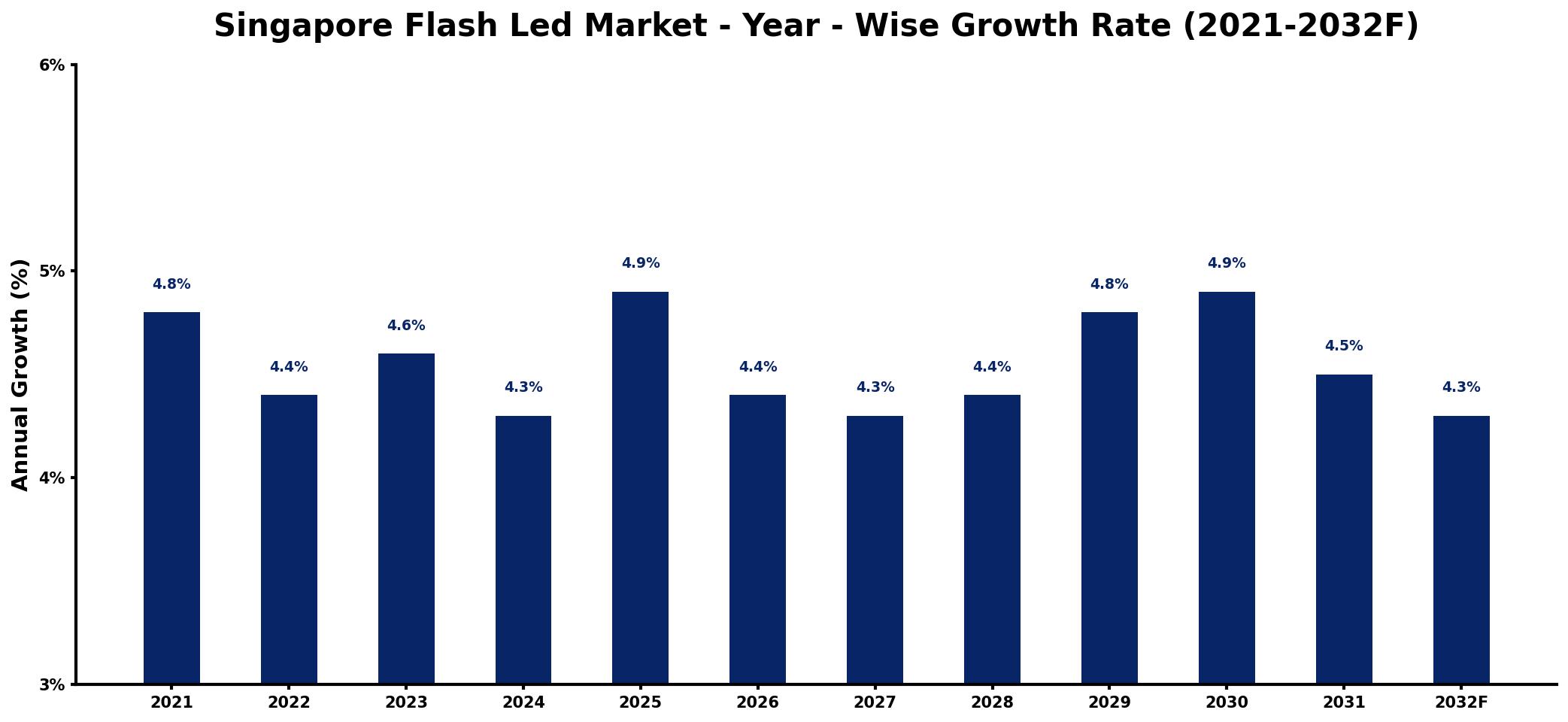
The table below presents the year‑wise growth rates along with the key drivers influencing the market
| Year | Growth Rate | Major Drivers |
| 2021 | 4.8% | Rising demand for energy efficiency |
| 2022 | 4.4% | Increased investment in smart technology |
| 2023 | 4.6% | Growing popularity of outdoor events |
| 2024 | 4.3% | Expansion of urban infrastructure projects |
| 2025 | 4.9% | Surge in renewable energy initiatives |
| 2026 | 4.4% | Advancements in manufacturing processes |
| 2027 | 4.3% | Heightened focus on sustainability practices |
| 2028 | 4.4% | growing automotive sector requirements |
| 2029 | 4.8% | Growth in home automation systems |
| 2030 | 4.9% | Rising consumer interest in aesthetics |
| 2031 | 4.5% | Technological innovations in lighting design |
| 2032 | 4.3% | expanding industrial usage applications |
Note: Market size estimations and growth projections presented in this report are based on 6Wresearch's proprietary forecasting methodology, utilizing the latest available industry data, government publications, and primary research inputs.
Singapore Flash Led Market Synopsis
In Singapore, flash LEDs play a critical role in enhancing the quality of photography, particularly for mobile phones and digital cameras. With the countrys strong emphasis on technology and innovation, the integration of advanced LED solutions in consumer electronics has become increasingly prevalent, positioning flash LEDs as key components in achieving superior image quality.
Moreover, the growth of outdoor recreational activities in Singapore has led to a sustained demand for portable lighting solutions. Consumers are increasingly seeking high-performance flash LED products that deliver bright, energy-efficient lighting, ensuring that both manufacturers and consumers have a vested interest in the ongoing development of this dynamic market.
Singapore Flash Led Market Key Takeaways
- The flash LED market is experiencing growth driven by the high demand for mobile photography and portable lighting solutions.
- Energy efficiency and performance are critical factors influencing consumer and manufacturer preferences in this market.
- Technological advancements in LED solutions are enhancing the capabilities of flash LEDs across various applications.
- Outdoor activities and the smartphone photography trend are significantly shaping market demand.
- Key industry players are adapting to market shifts by providing innovative and efficient lighting solutions.
Evaluation of Restraints in Singapore Flash Led Market
Despite the positive growth outlook, the Singapore flash LED market faces certain constraints. There is a growing pressure on manufacturers to deliver energy-efficient solutions that meet the evolving standards of performance and longevity. As consumers become more environmentally conscious, the demand for sustainable lighting solutions has risen, challenging manufacturers to balance efficiency with innovation. Additionally, intense competition within the sector necessitates continuous adaptation and collaboration with consumer electronics brands to align product offerings with market expectations.
Singapore Flash Led Market Trends
Current trends in the Singapore flash LED market are heavily influenced by advancements in technology and consumer behavior. The increasing use of social media platforms, where high-quality images are paramount, has spurred demand for flash LEDs that enhance smartphone camera capabilities. Furthermore, the emergence of new outdoor recreational activities has led to an uptick in portable lighting solution requirements, driving innovation in flash LED design and functionality. As manufacturers focus on delivering compact and powerful LED options, the market is poised to see exciting technological developments.
Singapore Flash Led Market Opportunities
Significant growth opportunities lie within the intersection of consumer electronics and outdoor activities in Singapore. As more consumers engage in photography while participating in outdoor pursuits, the need for high-performance flash LEDs will only increase. Manufacturers who can deliver innovative, energy-efficient solutions that cater to this burgeoning demand are well-positioned to capture market share. Additionally, collaborations with smartphone manufacturers present further avenues for growth, as integrated lighting solutions become a vital aspect of product design.
Government Initiatives in the Singapore Flash Led Market
The Singaporean government has been proactive in promoting initiatives that support sustainable technology and energy efficiency. Policies aimed at enhancing energy standards in consumer electronics indirectly benefit the flash LED market by encouraging manufacturers to prioritize energy-efficient solutions. Furthermore, public spending on technology innovation programs and initiatives to boost the local electronics industry reflect a commitment to fostering a conducive environment for growth in the flash LED segment.
Future Insights of the Singapore Flash Led Market
Looking ahead to the period from 2026 to 2032, the Singapore flash LED market is set to experience consistent growth. Driven by technological advancements and an increasing focus on high-quality photography, the demand for innovative LED solutions will likely accelerate. Moreover, the ongoing convergence of portable lighting technology with consumer electronics will create a fertile ground for new applications. As energy efficiency becomes a core priority, manufacturers who invest in research and development are expected to lead the market forward, catering to the evolving needs of consumers.
Singapore Flash Led Market Latest Developments (2025 - 2026)
Recent developments in the Singapore flash LED market reflect a shift towards enhanced technological offerings, with manufacturers focusing on energy-efficient components tailored for high-performance applications. The increasing integration of flash LEDs in various electronic devices is driving innovation, while consumer demand for sustainable lighting options is prompting companies to develop eco-friendly solutions. Additionally, partnerships between technology firms and consumer electronics brands are on the rise, aimed at optimizing flash LED use in smartphones and camera systems.
Singapore Flash Led Market - Key Attractiveness of the Report
- 10 Years of Market Numbers
- Historical Data Starting from 2022 to 2025
- Base Year: 2025
- Forecast Data until 2032
- Key Performance Indicators Impacting the Market
- Major Upcoming Developments and Projects
Key Highlights of the Report:
- Singapore Flash Led Market Outlook
- Market Size of Singapore Flash Led Market, 2025
- Forecast of Singapore Flash Led Market, 2032
- Historical Data and Forecast of Singapore Flash Led Revenues & Volume for the Period 2022-2032F
- Singapore Flash Led Market Trend Evolution
- Singapore Flash Led Market Drivers and Challenges
- Singapore Flash Led Price Trends
- Singapore Flash Led Porter's Five Forces
- Singapore Flash Led Industry Life Cycle
- Historical Data and Forecast of Singapore Flash Led Market Revenues & Volume By Power Consumption for the Period 2022-2032F
- Historical Data and Forecast of Singapore Flash Led Market Revenues & Volume By Less than 1 A for the Period 2022-2032F
- Historical Data and Forecast of Singapore Flash Led Market Revenues & Volume By More than or Equal to 1 A for the Period 2022-2032F
- Historical Data and Forecast of Singapore Flash Led Market Revenues & Volume By Types for the Period 2022-2032F
- Historical Data and Forecast of Singapore Flash Led Market Revenues & Volume By Smartphone for the Period 2022-2032F
- Historical Data and Forecast of Singapore Flash Led Market Revenues & Volume By Feature phone for the Period 2022-2032F
- Historical Data and Forecast of Singapore Flash Led Market Revenues & Volume By Other for the Period 2022-2032F
- Singapore Flash Led Import Export Trade Statistics
- Market Opportunity Assessment By Power Consumption
- Market Opportunity Assessment By Types
- Singapore Flash Led Top Companies Market Share
- Singapore Flash Led Competitive Benchmarking By Technical and Operational Parameters
- Singapore Flash Led Company Profiles
- Singapore Flash Led Key Strategic Recommendations






































