Singapore Food Retail Market Summary
The singapore food retail market was estimated at USD 530 Million in 2025 and is projected to reach USD 985 Million by 2032, growing at a CAGR of 10.7% from 2026 to 2032.
Singapore Food Retail Market Year-wise Growth Rate and Key Drivers
This graph highlights how the Singapore Food Retail Market has steadily grown over the past five years, supported by major growth factors.
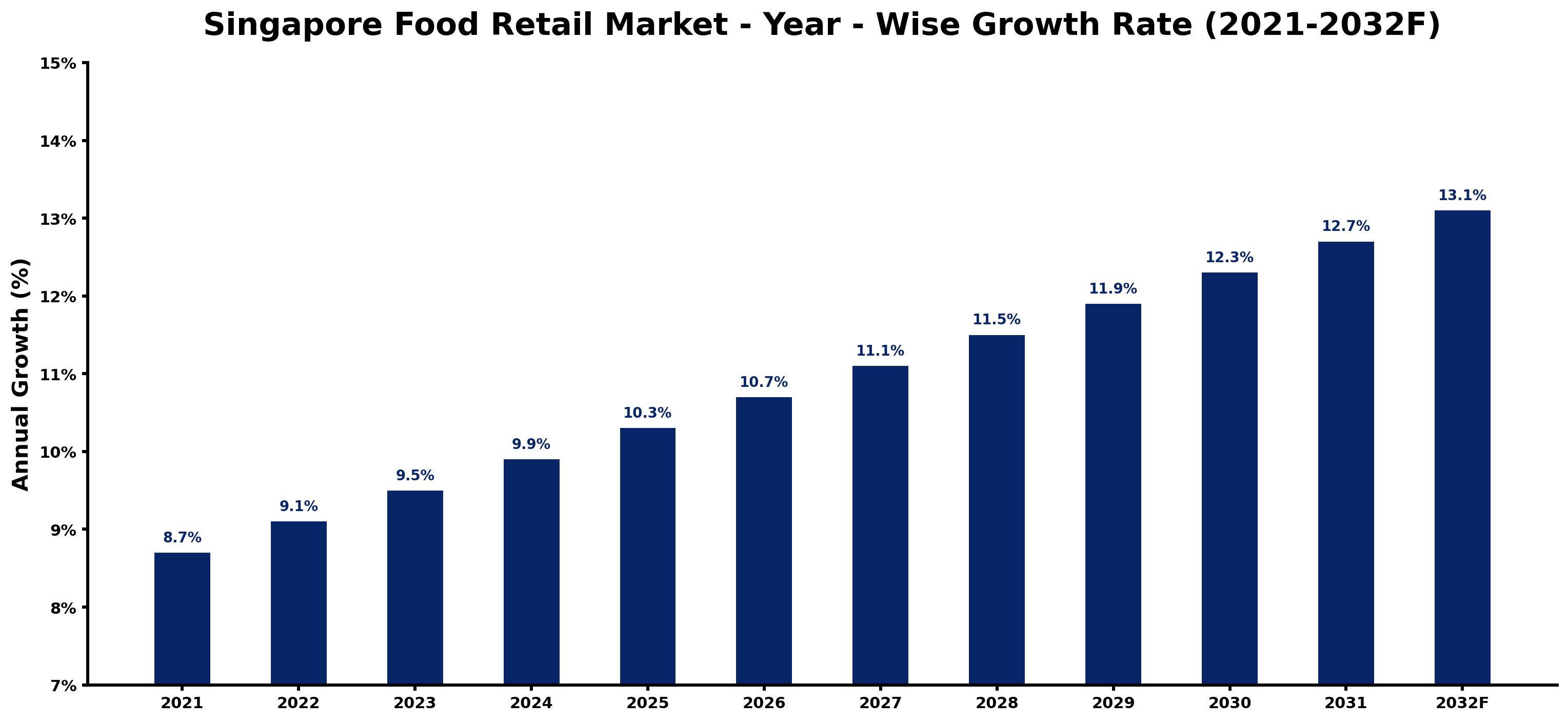
The table below presents the year wise growth rates along with the key drivers influencing the market
| Year | Growth Rate | Major Drivers |
| 2021 | 8.7% | Consumer preferences shifted towards online grocery shopping and contactless payments. |
| 2022 | 9.1% | Sustainability concerns prompted retailers to adopt eco-friendly packaging solutions. |
| 2023 | 9.5% | Food safety regulations intensified, enhancing quality control measures in the market. |
| 2024 | 9.9% | Local sourcing trends gained traction, boosting demand for farm-to-table options. |
| 2025 | 10.3% | Technology integration in operations streamlined supply chains and optimized inventory management. |
| 2026 | 10.7% | Health-conscious consumers led to a surge in organic and plant-based product offerings. |
| 2027 | 11.1% | Advanced analytics tools enabled retailers to personalize promotions and enhance customer experience. |
| 2028 | 11.5% | Increased international trade agreements diversified product ranges available to consumers. |
| 2029 | 11.9% | Shift towards urbanization resulted in smaller-format stores catering to convenience-focused shoppers. |
| 2030 | 12.3% | Consumer education on nutrition fostered demand for transparency in food labeling. |
| 2031 | 12.7% | Emerging food trends inspired innovative product developments and niche market growth. |
| 2032 | 13.1% | Collaboration with local artisans allowed retailers to enrich their unique product portfolio. |
Note - Market size estimations and growth projections presented in this report are based on 6Wresearch's advanced forecasting approach, validated with industry datasets as of June 2026.
Singapore Food Retail Market Synopsis
The Singapore Food Retail Market is projected to reach USD 17.38 billion and witness significant growth during the forecast period (2026-2032). This market is characterized by a robust demand for grocery stores and supermarkets, which have become essential for consumers seeking convenience in their shopping experiences. As lifestyle dynamics change, Singaporeans are increasingly turning to e-commerce options, which have proliferated in recent years. Retailers are recognizing these shifts, leading to heightened competition and the introduction of promotional strategies aimed at attracting and retaining customers.
Singapore Food Retail Market Growth Drivers
The primary drivers propelling the Singapore Food Retail Market include:
- Increasing Disposable Income: The rise in disposable income among households in Singapore is compelling consumers to invest more in premium food items. This trend is particularly evident in the growing preference for high-quality fruits, vegetables, and specialty condiments, enhancing revenue generation in the food retail sector.
- Shift Towards Online Shopping: The rapid adoption of online grocery shopping platforms has transformed consumer behavior in Singapore. Major e-commerce players offer a diverse range of products, allowing consumers to shop conveniently from their homes.
- Health Consciousness: Urban consumers are becoming more health-conscious, leading to greater demand for organic and specialty products. This paradigm shift drives sales for retailers that focus on premium quality offerings.
- Promotional Campaigns: Increased competition among food retailers has prompted them to launch various promotional campaigns and discounts, effectively benefiting consumers and encouraging higher spending.
- Urbanization: The urban lifestyle in Singapore often leaves consumers with limited time for grocery shopping, which fosters reliance on supermarkets and convenience stores that cater to their busy schedules.
Singapore Food Retail Market Challenges and Restraints
While the Singapore Food Retail Market is poised for growth, it faces certain challenges:
- High Competition from Unorganized Retail: Smaller, unorganized local stores provide tough competition to larger supermarkets. These small stores often attract customers with lower pricing, albeit with varying standards of quality.
- Supply Chain Disruptions: External factors, such as global supply chain issues, can adversely affect the availability of products and increase operational costs for retailers.
- Fluctuating Consumer Preferences: Rapid changes in consumer behavior, particularly towards healthier and sustainable products, necessitate constant adaptation by retailers to keep up with market trends.
- Regulatory Compliance: Stringent regulations regarding food safety and quality assurance impose challenges on retailers, particularly for those aiming to expand their product offerings.
- Impact of E-commerce Growth: The rapid rise of e-commerce platforms could lead to market share erosion for traditional brick-and-mortar stores if they do not effectively integrate online and offline retail strategies.
Singapore Food Retail Market Government Investment and Initiatives
The Singapore government has taken proactive steps to support the food retail sector through various policies and initiatives aimed at sustainability and digital transformation. Investment in technology is a focal point, with support for retailers to adopt e-commerce solutions and improve supply chain efficiencies. Moreover, government programs encourage the growth of local food production, aimed at reducing dependence on imports and enhancing food security. Initiatives promoting public-private partnerships are also underway, designed to stimulate innovation within the food retail space. Additionally, the government prioritizes sustainable practices within food retail to address environmental concerns, which further aligns with consumers' increasing preference for eco-friendly products.
Singapore Food Retail Market Latest Developments (May 2025 - June 2026)
Recent developments within the Singapore Food Retail Market have exemplified key trends driving the evolution of this sector. The integration of technology continues to play a significant role, with retailers enhancing their online platforms to provide customers with improved shopping experiences. Promotions and loyalty programs have been employed extensively to attract consumers, especially in an increasingly competitive market. The emphasis on health and wellness products has gained traction, with retailers expanding their offerings to include more organic and specialty items to cater to the health-conscious demographic. Furthermore, sustainability initiatives have gained momentum, with retailers increasingly focused on environmentally friendly practices, echoing the evolving consumer demand for sustainable products. The ongoing challenges posed by the pandemic have also prompted a reevaluation of supply chains to ensure more resilient operations moving forward.
Singapore Food Retail Market - Key Attractiveness of the Report
- 10 Years of Market Numbers
- Historical Data Starting from 2022 to 2025
- Base Year: 2025
- Forecast Data until 2032
- Key Performance Indicators Impacting the Market
- Major Upcoming Developments and Projects
Key Highlights of the Report:
- Singapore Food Retail Market Outlook
- Market Size of Singapore Food Retail Market, 2025
- Forecast of Singapore Food Retail Market, 2032F
- Historical Data and Forecast of Singapore Food Retail Revenues & Volume for the Period 2022-2032F
- Singapore Food Retail Market Trend Evolution
- Singapore Food Retail Market Drivers and Challenges
- Singapore Food Retail Price Trends
- Singapore Food Retail Porter's Five Forces
- Singapore Food Retail Industry Life Cycle
- Historical Data and Forecast of Singapore Food Retail Market Revenues & Volume By Product Types for the Period 2022-2032F
- Historical Data and Forecast of Singapore Food Retail Market Revenues & Volume By Unpackaged Food for the Period 2022-2032F
- Historical Data and Forecast of Singapore Food Retail Market Revenues & Volume By Packaged Food for the Period 2022-2032F
- Historical Data and Forecast of Singapore Food Retail Market Revenues & Volume By Drinks for the Period 2022-2032F
- Historical Data and Forecast of Singapore Food Retail Market Revenues & Volume By Household Products for the Period 2022-2032F
- Historical Data and Forecast of Singapore Food Retail Market Revenues & Volume By Packaging Types for the Period 2022-2032F
- Historical Data and Forecast of Singapore Food Retail Market Revenues & Volume By Boxes for the Period 2022-2032F
- Historical Data and Forecast of Singapore Food Retail Market Revenues & Volume By Cans for the Period 2022-2032F
- Historical Data and Forecast of Singapore Food Retail Market Revenues & Volume By Cellophane Wrapping for the Period 2022-2032F
- Historical Data and Forecast of Singapore Food Retail Market Revenues & Volume By Cylindrical Cardboard for the Period 2022-2032F
- Singapore Food Retail Import Export Trade Statistics
- Market Opportunity Assessment By Product Types
- Market Opportunity Assessment By Packaging Types
- Singapore Food Retail Top Companies Market Share
- Singapore Food Retail Competitive Benchmarking By Technical and Operational Parameters
- Singapore Food Retail Company Profiles
- Singapore Food Retail Key Strategic Recommendations






































