Singapore Government Cloud Market Size & Growth Rate (2026-2032)
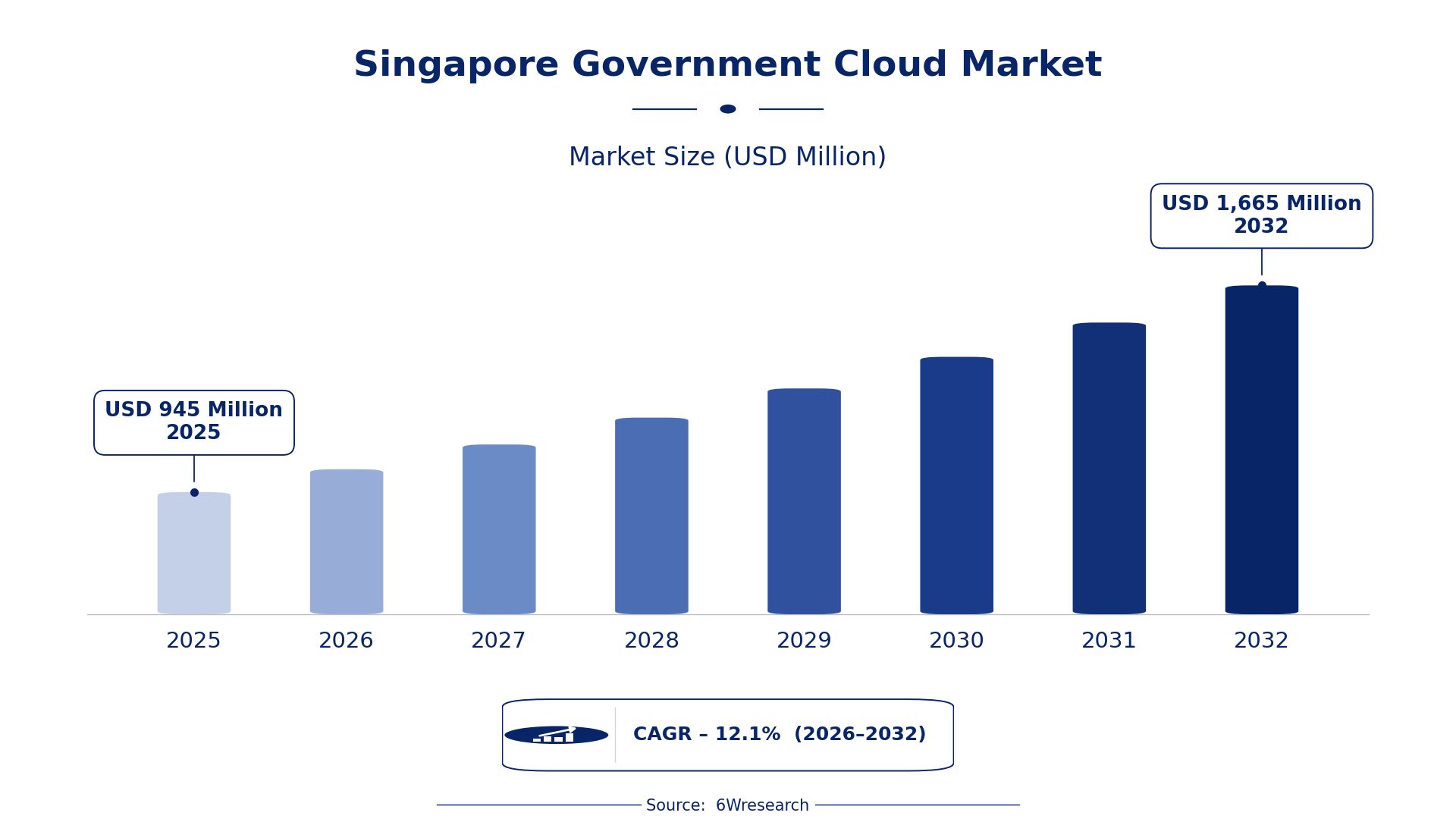
The Singapore Government Cloud Market was estimated at USD 945 Million in 2025 and is projected to reach USD 1665 Million by 2032, growing at a CAGR of 12.1% from 2026 to 2032.
Singapore Government Cloud Market Synopsis
The Singapore Government Cloud Market is rapidly evolving as public sector agencies increasingly recognize the advantages of cloud technologies. These technologies not only enhance service delivery but also enable better resource management, allowing agencies to operate more efficiently and responsively.
As the government prioritizes digital transformation, significant investments are being made in cloud infrastructure. This shift is aimed at improving operational effectiveness and fostering greater citizen engagement, creating a competitive environment for cloud service providers.
Singapore Government Cloud Market Year-wise Growth Rate and Key Drivers
This graph illustrates the annual growth rates of the Singapore Government Cloud Market from 2021 to 2032, highlighting a steady upward trajectory and projected expansion over the forecast period.
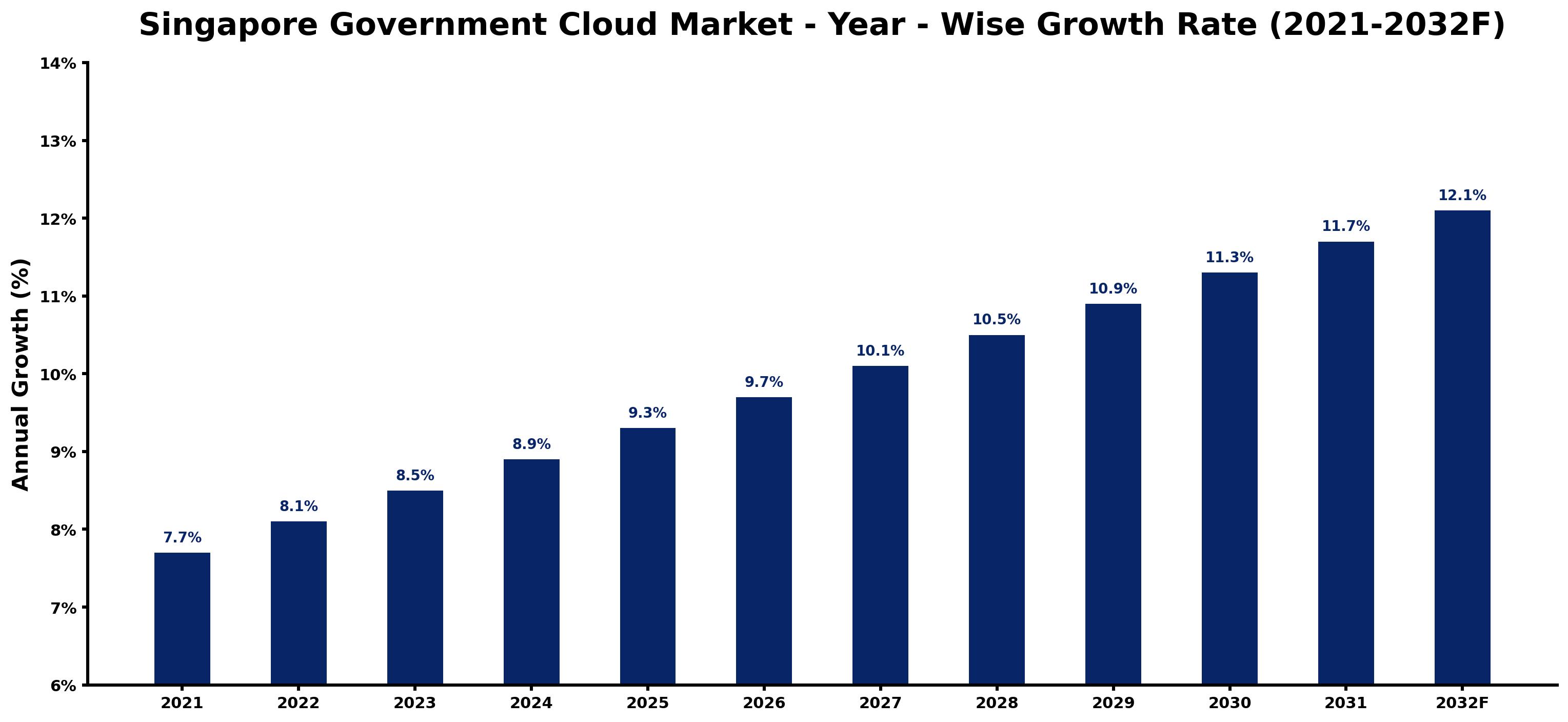
The table below presents the year‑wise growth rates along with the key drivers influencing the market
| Year | Growth Rate | Major Drivers |
| 2021 | 7.7% | Smart Nation initiative enhancing digital government capabilities. |
| 2022 | 8.1% | G-cloud strategy accelerating public sector cloud adoption. |
| 2023 | 8.5% | Increased cybersecurity mandates driving secure cloud solutions. |
| 2024 | 8.9% | Government focus on data analytics fortifying cloud infrastructure. |
| 2025 | 9.3% | Enhanced interoperability standards encouraging public sector migration. |
| 2026 | 9.7% | Strong demand for digital transformation in government services. |
| 2027 | 10.1% | Public sector cloud investment bolstered by budget surpluses. |
| 2028 | 10.5% | Singapore’s AI strategy promoting cloud-based AI solutions. |
| 2029 | 10.9% | Sustainability goals driving green cloud technology initiatives. |
| 2030 | 11.3% | Regional digital economy growth increasing cloud service reliance. |
| 2031 | 11.7% | E-government initiatives expanding scope of cloud requirements. |
| 2032 | 12.1% | National cybersecurity strategy enhancing trust in cloud solutions. |
Note: Market size estimations and growth projections presented in this report are based on 6Wresearch's proprietary forecasting methodology, utilizing the latest available industry data, government publications, and primary research inputs.
Singapore Government Cloud Market Key Takeaways
Below are some of the specific key takeaways from the market, including:
- Government agencies are increasingly adopting cloud solutions to streamline operations.
- Data security and compliance remain top priorities amid the cloud transition.
- The COVID-19 pandemic has accelerated the adoption of cloud technologies in the public sector.
- Investment in cloud infrastructure is essential for enhancing citizen services.
- Local providers are competing fiercely with global cloud giants for government contracts.
Evaluation of Restraints in Singapore Government Cloud Market
Despite the positive momentum, several constraints hinder the growth of the Singapore Government Cloud Market. Data privacy concerns loom large, as government agencies must ensure sensitive citizen information is adequately protected in a cloud environment. The need for regulatory compliance complicates this further, as agencies navigate local laws while striving to implement efficient cloud solutions. Building trust with citizens remains a critical challenge, as agencies must demonstrate that cloud services are secure and reliable.
Singapore Government Cloud Market Trends
A notable trend in the Singapore Government Cloud Market is the increasing integration of artificial intelligence and machine learning into cloud solutions. These technologies are enhancing data analytics capabilities, providing agencies with valuable insights to improve service delivery. on top of that, there's a growing emphasis on multi-cloud strategies, allowing agencies to diversify their cloud service providers for enhanced security and resilience. Another trend is the push for green cloud solutions, aligning with Singapore's sustainability goals, as agencies seek to minimize their environmental impact.
Singapore Government Cloud Market Opportunities
The market presents numerous opportunities for growth and innovation. As agencies continue their digital transformation journeys, there is a demand for tailored cloud solutions that address specific operational challenges. This opens avenues for niche providers specializing in sectors such as healthcare or education. Additionally, partnerships between government agencies and cloud service providers could lead to the development of advanced, secure cloud solutions. Emerging technologies such as edge computing also offer potential for enhancing service delivery in remote areas.
Government Initiatives in the Singapore Government Cloud Market
The Singapore government actively shapes the cloud market through targeted initiatives aimed at enhancing public service delivery. With a strong focus on digital transformation, policies are being implemented to streamline cloud adoption across agencies. Regulatory frameworks are being established to ensure data privacy and security while fostering innovation in cloud services.
- A national digital infrastructure upgrade programme was launched to enhance cloud connectivity across government agencies.
- Currently ongoing is a comprehensive review of existing cloud policies to strengthen data sovereignty and compliance measures.
- A planned public-private initiative aims to expand cloud training for government employees by 2026.
- A regulatory framework introduced in 2024 mandates greater transparency in cloud service billing practices.
- An initiative focused on integrating AI capabilities into government cloud services is expected to begin in early 2026.
Future Insights of the Singapore Government Cloud Market
Looking ahead to 2026-2032, the Singapore Government Cloud Market is set to witness substantial advancements driven by increasing digitalization efforts. The government's commitment to enhancing public service delivery through cloud solutions will continue to fuel growth. As agencies adopt more sophisticated technologies, they will require flexible, scalable cloud services that can adapt to their evolving needs. This focus on innovation will likely attract both local and international providers looking to capitalize on the burgeoning demand.
Singapore Government Cloud Market Latest Developments
Recent months have seen significant activity in the Singapore Government Cloud Market, with various initiatives aimed at bolstering cloud capabilities across the public sector. The urgency to enhance service delivery amid rising citizen expectations has prompted rapid developments in cloud infrastructure and services.
- A major technology vendor announced the rollout of a new cloud service tailored for public sector applications, which began in early 2023 and is expected to enhance data processing capabilities.
- An initiative to upgrade data security measures for existing cloud services was launched in mid-2023 and remains underway, aiming to bolster citizen trust.
- A partnership between regional cloud providers and government agencies is set to begin in late 2023, focusing on developing cloud solutions for healthcare services.
- A pilot programme for integrating AI into public service applications has been initiated in Q2 2024, with plans for a wider rollout by 2025.
- Upcoming is a comprehensive cloud service assessment expected to commence in early 2025, which aims to identify gaps and recommend improvements.
Singapore Government Cloud Market - Key Attractiveness of the Report
- 10 Years of Market Numbers
- Historical Data Starting from 2022 to 2025
- Base Year: 2025
- Forecast Data until 2032
- Key Performance Indicators Impacting the Market
- Major Upcoming Developments and Projects
Key Highlights of the Report:
- Singapore Government Cloud Market Outlook
- Market Size of Singapore Government Cloud Market, 2025
- Forecast of Singapore Government Cloud Market, 2032
- Historical Data and Forecast of Singapore Government Cloud Revenues & Volume for the Period 2022-2032F
- Singapore Government Cloud Market Trend Evolution
- Singapore Government Cloud Market Drivers and Challenges
- Singapore Government Cloud Price Trends
- Singapore Government Cloud Porter's Five Forces
- Singapore Government Cloud Industry Life Cycle
- Historical Data and Forecast of Singapore Government Cloud Market Revenues & Volume By Solutions for the Period 2022-2032F
- Historical Data and Forecast of Singapore Government Cloud Market Revenues & Volume By Cloud Storage for the Period 2022-2032F
- Historical Data and Forecast of Singapore Government Cloud Market Revenues & Volume By Disaster Recovery for the Period 2022-2032F
- Historical Data and Forecast of Singapore Government Cloud Market Revenues & Volume By Identity and Access Management (IAM) for the Period 2022-2032F
- Historical Data and Forecast of Singapore Government Cloud Market Revenues & Volume By Risk and compliance management for the Period 2022-2032F
- Historical Data and Forecast of Singapore Government Cloud Market Revenues & Volume By Others (reporting and analytics, and security and vulnerability) for the Period 2022-2032F
- Historical Data and Forecast of Singapore Government Cloud Market Revenues & Volume By Services for the Period 2022-2032F
- Historical Data and Forecast of Singapore Government Cloud Market Revenues & Volume By Training, consulting, and education for the Period 2022-2032F
- Historical Data and Forecast of Singapore Government Cloud Market Revenues & Volume By Support and Maintenance for the Period 2022-2032F
- Historical Data and Forecast of Singapore Government Cloud Market Revenues & Volume By Integration and Migration for the Period 2022-2032F
- Historical Data and Forecast of Singapore Government Cloud Market Revenues & Volume By Service Model for the Period 2022-2032F
- Historical Data and Forecast of Singapore Government Cloud Market Revenues & Volume By Infrastructure as a Service (IaaS) for the Period 2022-2032F
- Historical Data and Forecast of Singapore Government Cloud Market Revenues & Volume By Platform as a Service (PaaS) for the Period 2022-2032F
- Historical Data and Forecast of Singapore Government Cloud Market Revenues & Volume By Software as a Service (SaaS) for the Period 2022-2032F
- Historical Data and Forecast of Singapore Government Cloud Market Revenues & Volume By Deployment Model for the Period 2022-2032F
- Historical Data and Forecast of Singapore Government Cloud Market Revenues & Volume By Public Cloud for the Period 2022-2032F
- Historical Data and Forecast of Singapore Government Cloud Market Revenues & Volume By Private Cloud for the Period 2022-2032F
- Historical Data and Forecast of Singapore Government Cloud Market Revenues & Volume By Hybrid Cloud for the Period 2022-2032F
- Singapore Government Cloud Import Export Trade Statistics
- Market Opportunity Assessment By Solutions
- Market Opportunity Assessment By Services
- Market Opportunity Assessment By Service Model
- Market Opportunity Assessment By Deployment Model
- Singapore Government Cloud Top Companies Market Share
- Singapore Government Cloud Competitive Benchmarking By Technical and Operational Parameters
- Singapore Government Cloud Company Profiles
- Singapore Government Cloud Key Strategic Recommendations






































