Singapore Groceries Market Summary
The singapore groceries market was estimated at USD 508 Million in 2025 and is projected to reach USD 727 Million by 2032, growing at a CAGR of 6.3% from 2026 to 2032.
Singapore Groceries Market Year-wise Growth Rate and Key Drivers
This graph highlights how the Singapore Groceries Market has steadily grown over the past five years, supported by major growth factors.
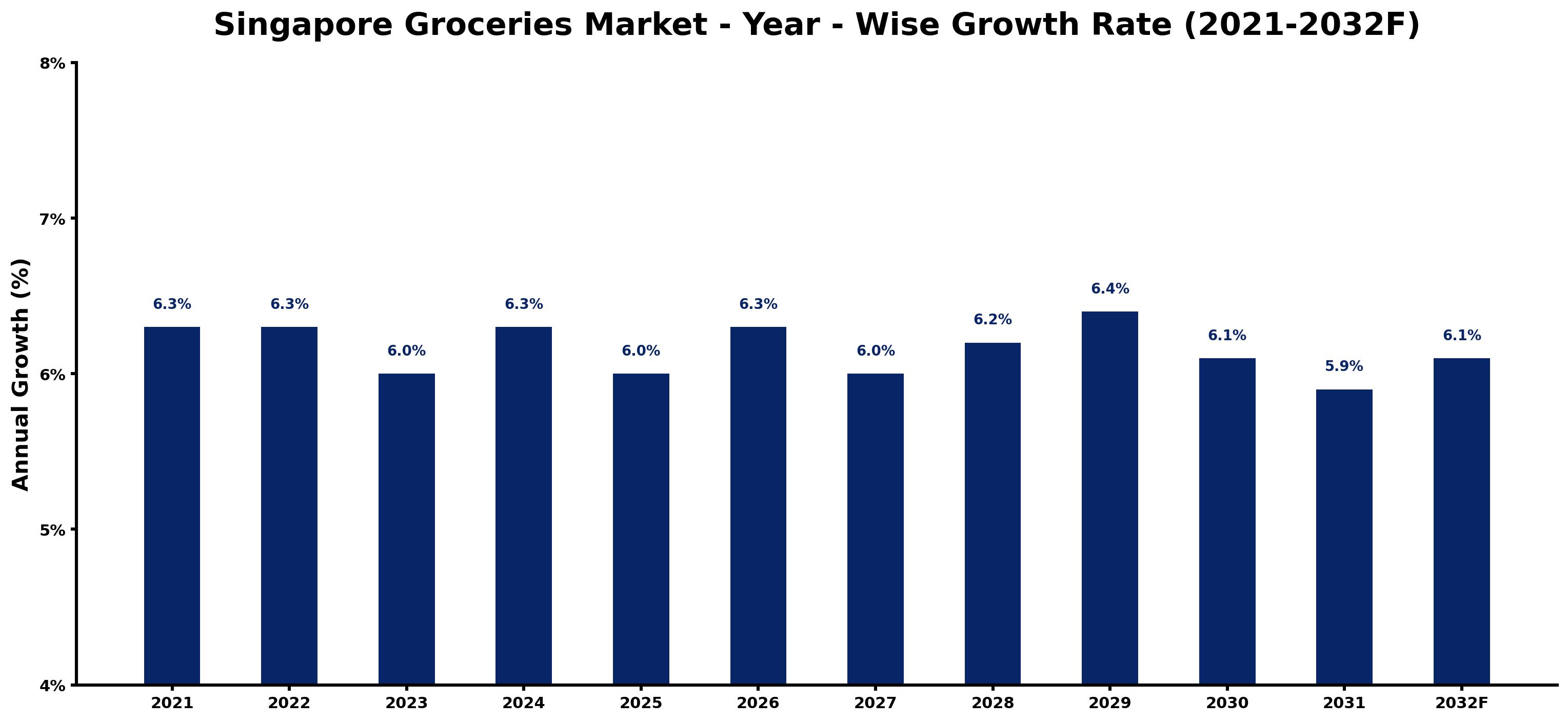
The table below presents the year wise growth rates along with the key drivers influencing the market
| Year | Growth Rate | Major Drivers |
| 2021 | 6.3% | Post-lockdown retail projects prompted technological innovation in grocery distribution models. |
| 2022 | 6.3% | Consumer preferences shifted towards online shopping, amplifying digital grocery solutions. |
| 2023 | 6.0% | Sustainable practices gained traction, influencing local sourcing and packaging strategies. |
| 2024 | 6.3% | Urbanization led to increased demand for convenient grocery delivery services. |
| 2025 | 6.0% | Health-conscious trends shaped product offerings, favoring organic and nutritious options. |
| 2026 | 6.3% | Technological advancements in supply chain management improved operational efficiencies extensively. |
| 2027 | 6.0% | Increased competition among retailers fostered unique marketing strategies and promotions. |
| 2028 | 6.2% | Demographic changes prompted diverse product assortments catering to multicultural consumers. |
| 2029 | 6.4% | Rising disposable incomes allowed consumers to explore premium grocery alternatives. |
| 2030 | 6.1% | Local businesses emerged, enhancing community engagement through personalized shopping experiences. |
| 2031 | 5.9% | E-commerce platforms expanded, integrating AI for tailored shopping recommendations and solutions. |
| 2032 | 6.1% | Sustainability became a core value proposition for brands, influencing consumer loyalty heavily. |
Note - Market size estimations and growth projections presented in this report are based on 6Wresearch's advanced forecasting approach, validated with industry datasets as of June 2026.
Singapore Groceries Market Synopsis
The Singapore Groceries Market is projected to reach 6.3% and witness significant growth during the forecast period (2026-2032). As urbanization intensifies and consumer preferences evolve, this market is expected to benefit from a multitude of growth drivers including an increasing population and higher disposable incomes. Additionally, the expansion of e-commerce is reshaping how consumers access and purchase grocery items, facilitating a more convenient shopping experience.
Singapore Groceries Market Growth Drivers
Several factors are significantly driving the growth of the Singapore groceries market. The following are key considerations:
- The growing population in Singapore signifies an expanding customer base for grocery items, stimulating demand across various demographics.
- Changing demographic patterns, notably increased urbanization and higher female employment rates, contribute to a shift in grocery purchasing behavior, further enhancing demand.
- Rising disposable incomes across different socioeconomic segments empower consumers to spend more on essential goods, including premium grocery products.
- The uptake of e-commerce platforms allows for better accessibility of grocery items, including fresh produce, which caters to the time-crunched urban consumer.
- Health-conscious consumer preferences have led to a notable shift towards organic and healthy food products, which is positively influencing market dynamics.
Singapore Groceries Market Challenges and Restraints
Despite the vibrant growth trajectories, the Singapore groceries market faces a range of challenges that could potentially impede its overall performance:
- The competitive landscape among grocery retailers is intense, often leading to price wars that can erode profit margins, particularly for smaller entities with limited capital.
- Shifts in wholesale business models towards convenience store formats may disrupt traditional retail practices, compelling players to adapt rapidly to changing consumer needs.
- Fluctuating supply chain dynamics, influenced by global economic conditions, can lead to inconsistent availability of products, impacting consumer satisfaction.
- Changes in regulations related to food safety and quality standards necessitate constant compliance efforts from businesses, diverting resources from growth initiatives.
- Consumer trends are shifting rapidly, necessitating agility from retailers to meet evolving preferences and demands, which can strain operational capabilities.
Singapore Groceries Market E-commerce Impact
The influence of e-commerce on the Singapore groceries market cannot be overstated. With advancements in technology and improved internet penetration rates, consumers are increasingly opting for online shopping experiences:
- Shoppers benefit from the convenience of online ordering, allowing them to purchase groceries from the comfort of their homes, thus reshaping traditional shopping habits.
- Online platforms offer a wider range of products, including specialty items and organic goods that may not be readily available in brick-and-mortar stores.
- The significant growth in mobile payments and digital wallets enhances the online shopping experience, making transactions faster and more secure.
- Retailers are leveraging data analytics to tailor their offerings and marketing strategies based on consumer preferences, thereby increasing engagement and sales.
- Delivery services associated with e-commerce have improved, providing customers with timely access to groceries, essential for maintaining freshness and quality.
Singapore Groceries Market Government Investment and Initiatives
The Singapore government has recognized the importance of a robust groceries market in enhancing food security and supporting economic growth. Various initiatives and investments have been put in place to bolster this sector:
- Government policies promoting digital transformation in retail are encouraging grocery businesses to adopt e-commerce solutions and enhance their digital presence.
- Investment in infrastructure improvements, including logistics and transportation, supports the efficient distribution of grocery products throughout the region.
- Public-private partnerships foster innovation in agricultural practices, ultimately enhancing the freshness and quality of grocery offerings available to consumers.
- The government is providing financial support in the form of grants and subsidies to assist SMEs in overcoming challenges posed by the competitive landscape.
- Regulatory frameworks are being updated to ensure the safety and quality of food products, thereby improving consumer confidence in grocery purchases.
Singapore Groceries Market Latest Developments (May 2025 - June 2026)
Recent developments within the Singapore groceries market indicate a forward momentum amid evolving consumer dynamics:
- Companies are increasingly adopting omnichannel strategies, integrating both online and offline shopping experiences to cater to diverse consumer preferences.
- An uptick in collaborations between grocery retailers and local farms has emerged, aimed at promoting fresh produce and sustainability in the supply chain.
- The rise of subscription services in grocery delivery has gained traction, offering consumers convenient and regular access to their preferred products.
- Health and wellness trends are being embraced more broadly, with grocery retailers expanding their assortments of organic and nutritionally-focused products.
- Innovative marketing campaigns utilizing social media platforms are being deployed to engage younger consumers, ensuring relevance in a digital-first world.
Singapore Groceries Market - Key Attractiveness of the Report
- 10 Years of Market Numbers
- Historical Data Starting from 2022 to 2025
- Base Year: 2025
- Forecast Data until 2032
- Key Performance Indicators Impacting the Market
- Major Upcoming Developments and Projects
Key Highlights of the Report:
- Singapore Groceries Market Outlook
- Market Size of Singapore Groceries Market, 2025
- Forecast of Singapore Groceries Market, 2032F
- Historical Data and Forecast of Singapore Groceries Revenues & Volume for the Period 2022-2032F
- Singapore Groceries Market Trend Evolution
- Singapore Groceries Market Drivers and Challenges
- Singapore Groceries Price Trends
- Singapore Groceries Porter's Five Forces
- Singapore Groceries Industry Life Cycle
- Historical Data and Forecast of Singapore Groceries Market Revenues & Volume By Product Types for the Period 2022-2032F
- Historical Data and Forecast of Singapore Groceries Market Revenues & Volume By Packaged Food for the Period 2022-2032F
- Historical Data and Forecast of Singapore Groceries Market Revenues & Volume By Unpackaged Food for the Period 2022-2032F
- Historical Data and Forecast of Singapore Groceries Market Revenues & Volume By Drinks for the Period 2022-2032F
- Historical Data and Forecast of Singapore Groceries Market Revenues & Volume By Tobacco for the Period 2022-2032F
- Historical Data and Forecast of Singapore Groceries Market Revenues & Volume By Household Products for the Period 2022-2032F
- Historical Data and Forecast of Singapore Groceries Market Revenues & Volume By Others for the Period 2022-2032F
- Historical Data and Forecast of Singapore Groceries Market Revenues & Volume By Distribution Channel for the Period 2022-2032F
- Historical Data and Forecast of Singapore Groceries Market Revenues & Volume By Supermarkets & Hypermarkets for the Period 2022-2032F
- Historical Data and Forecast of Singapore Groceries Market Revenues & Volume By Convenience Store for the Period 2022-2032F
- Historical Data and Forecast of Singapore Groceries Market Revenues & Volume By Online for the Period 2022-2032F
- Singapore Groceries Import Export Trade Statistics
- Market Opportunity Assessment By Product Types
- Market Opportunity Assessment By Distribution Channel
- Singapore Groceries Top Companies Market Share
- Singapore Groceries Competitive Benchmarking By Technical and Operational Parameters
- Singapore Groceries Company Profiles
- Singapore Groceries Key Strategic Recommendations






































