Singapore Hepatitis Vaccine Market Size, Share & Growth Rate
The Singapore Hepatitis Vaccine Market was estimated at USD 512 Million in 2025 and is projected to reach USD 744 Million by 2032, growing at a CAGR of 5.5% from 2026 to 2032. This upward trajectory is driven by the government's persistent commitment to public health initiatives and the increasing prevalence of international travel, which necessitates vaccination against hepatitis A and B. Additionally, rising awareness about hepatitis prevention among the population significantly fuels demand for these critical vaccines.
Singapore Hepatitis Vaccine Market Year-wise Growth Rate and Key Drivers
This graph highlights how the Singapore Hepatitis Vaccine Market has steadily grown over the years, supported by major growth factors.
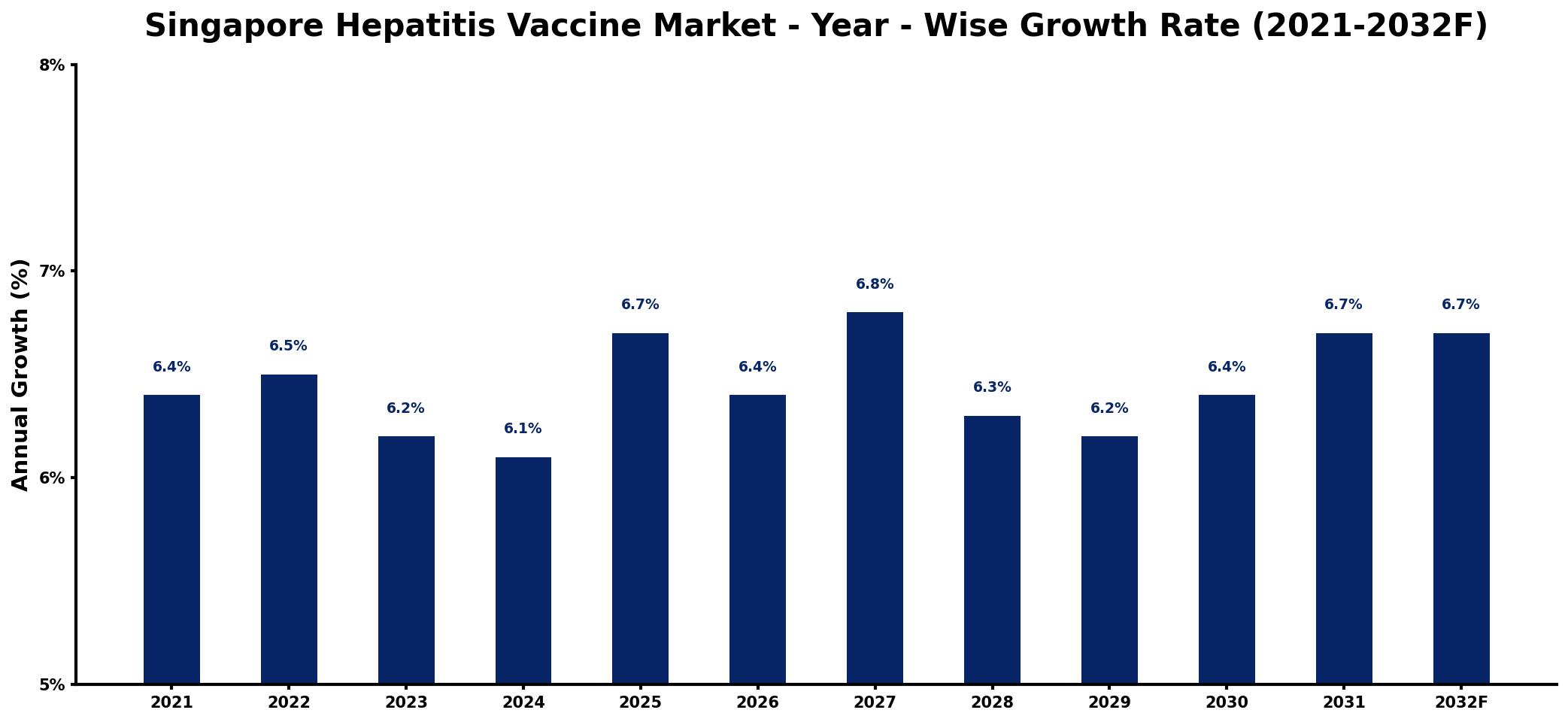
The table below presents the year‑wise growth rates along with the key drivers influencing the market
| Year | Growth Rate | Major Drivers |
| 2021 | 6.4% | Rising healthcare investment trends |
| 2022 | 6.5% | Increased public health awareness |
| 2023 | 6.2% | Growing demand for preventative care |
| 2024 | 6.1% | Expansion of healthcare infrastructure |
| 2025 | 6.7% | Enhanced government health initiatives |
| 2026 | 6.4% | Technological advancements in healthcare |
| 2027 | 6.8% | Stronger partnerships with NGOs |
| 2028 | 6.3% | Increased focus on disease prevention |
| 2029 | 6.2% | Higher funding for medical research |
| 2030 | 6.4% | Growing interest in global health |
| 2031 | 6.7% | Emerging markets for healthcare solutions |
| 2032 | 6.7% | Improved access to healthcare services |
Note: Market size estimations and growth projections presented in this report are based on 6Wresearch's proprietary forecasting methodology, utilizing the latest available industry data, government publications, and primary research inputs.
Singapore Hepatitis Vaccine Market Synopsis
In Singapore, the hepatitis vaccine market has become an essential pillar of the nations public health strategy. With effective vaccination programs already in place, the country aims to protect its citizens from both hepatitis A and hepatitis B infections, which remain significant health concerns.
The collaborative effort between government bodies and healthcare providers ensures that hepatitis vaccines are widely accessible. This united approach not only promotes immunization rates but also increases public consciousness about the importance of preventing hepatitis, paving the way for a healthier population.
Singapore Hepatitis Vaccine Market Key Takeaways
- The market is crucial in Singapore's public health strategy to combat hepatitis infections.
- Government vaccination programs significantly enhance access and awareness among the population.
- International travel requirements further elevate the demand for hepatitis vaccines.
- Ongoing R&D efforts aim to improve vaccine efficacy and broaden coverage.
- The market is poised for steady growth, underscoring the importance of immunization.
Evaluation of Restraints in Singapore Hepatitis Vaccine Market
Despite its robust framework, the Singapore hepatitis vaccine market faces several constraints. One significant challenge is the ongoing need to increase public awareness about hepatitis, especially given that many infections are asymptomatic in their early stages. Coupled with competition from other healthcare priorities and vaccines, maintaining a focus on hepatitis prevention becomes crucial. Additionally, the regulatory landscape, concerns about vaccine safety, and rising vaccine hesitancy among certain demographics could impede vaccination uptake and stall the markets growth potential.
Singapore Hepatitis Vaccine Market Trends
Current trends influencing the Singapore hepatitis vaccine market include an increasing focus on preventive healthcare and a growing recognition of the importance of vaccination among healthcare professionals and the general populace. The rise of telehealth services also plays a role, making consultations and vaccination schedules more accessible to individuals. Furthermore, the development of combination vaccines and improved distribution channels enhances market offerings, thereby fostering greater vaccination rates.
Singapore Hepatitis Vaccine Market Opportunities
There are substantial growth opportunities within the Singapore hepatitis vaccine market, particularly in the realm of research and development. Expanding partnerships between biotech firms and government agencies can lead to innovation in vaccine technology and novel delivery methods. Additionally, as Singapore enhances its position as a travel hub in Asia, there is a potential to increase vaccination campaigns tailored to both residents and tourists, further solidifying vaccination as a key public health initiative.
Government Initiatives in the Singapore Hepatitis Vaccine Market
The Singapore government actively champions vaccination as part of its public health policy, emphasizing the need for comprehensive immunization programs. By allocating resources to vaccination campaigns aimed at high-risk groups and young children, the government seeks to elevate the overall vaccination coverage. Additionally, efforts to provide public education about the benefits of hepatitis vaccination are integral to these initiatives, fostering a more informed citizenry.
Future Insights of the Singapore Hepatitis Vaccine Market
Looking ahead to 2026-2032, the Singapore hepatitis vaccine market is expected to witness sustained growth driven by continued government support and heightened public awareness of vaccination. The integration of innovative vaccine technologies and the expansion of access through digital healthcare platforms will likely enhance immunization rates further. As Singapore pursues its ambition to remain a leader in public health, the hepatitis vaccine market will play a pivotal role in achieving these health outcomes.
Singapore Hepatitis Vaccine Market Latest Developments (2025 - 2026)
Recent developments in the Singapore hepatitis vaccine market indicate a progressive shift towards more comprehensive vaccination strategies. Health authorities are actively enhancing outreach programs to cover underserved populations, while new partnerships are forming to streamline vaccine distribution. Moreover, there is an increased emphasis on public education campaigns aimed at addressing vaccine hesitancy, thus promoting higher uptake among diverse demographic groups.
Singapore Hepatitis Vaccine Market - Key Attractiveness of the Report
- 10 Years of Market Numbers
- Historical Data Starting from 2022 to 2025
- Base Year: 2025
- Forecast Data until 2032
- Key Performance Indicators Impacting the Market
- Major Upcoming Developments and Projects
Key Highlights of the Report:
- Singapore Hepatitis Vaccine Market Outlook
- Market Size of Singapore Hepatitis Vaccine Market, 2025
- Forecast of Singapore Hepatitis Vaccine Market, 2032
- Historical Data and Forecast of Singapore Hepatitis Vaccine Revenues & Volume for the Period 2022-2032F
- Singapore Hepatitis Vaccine Market Trend Evolution
- Singapore Hepatitis Vaccine Market Drivers and Challenges
- Singapore Hepatitis Vaccine Price Trends
- Singapore Hepatitis Vaccine Porter's Five Forces
- Singapore Hepatitis Vaccine Industry Life Cycle
- Historical Data and Forecast of Singapore Hepatitis Vaccine Market Revenues & Volume By Indication for the Period 2022-2032F
- Historical Data and Forecast of Singapore Hepatitis Vaccine Market Revenues & Volume By Hepatitis A for the Period 2022-2032F
- Historical Data and Forecast of Singapore Hepatitis Vaccine Market Revenues & Volume By Hepatitis B for the Period 2022-2032F
- Historical Data and Forecast of Singapore Hepatitis Vaccine Market Revenues & Volume By Vaccine Type for the Period 2022-2032F
- Historical Data and Forecast of Singapore Hepatitis Vaccine Market Revenues & Volume By Recombinant Vaccine for the Period 2022-2032F
- Historical Data and Forecast of Singapore Hepatitis Vaccine Market Revenues & Volume By Inactivated Vaccine for the Period 2022-2032F
- Historical Data and Forecast of Singapore Hepatitis Vaccine Market Revenues & Volume By Distribution Channel for the Period 2022-2032F
- Historical Data and Forecast of Singapore Hepatitis Vaccine Market Revenues & Volume By Hospitals for the Period 2022-2032F
- Historical Data and Forecast of Singapore Hepatitis Vaccine Market Revenues & Volume By Retail Pharmacy for the Period 2022-2032F
- Historical Data and Forecast of Singapore Hepatitis Vaccine Market Revenues & Volume By Online Pharmacy for the Period 2022-2032F
- Singapore Hepatitis Vaccine Import Export Trade Statistics
- Market Opportunity Assessment By Indication
- Market Opportunity Assessment By Vaccine Type
- Market Opportunity Assessment By Distribution Channel
- Singapore Hepatitis Vaccine Top Companies Market Share
- Singapore Hepatitis Vaccine Competitive Benchmarking By Technical and Operational Parameters
- Singapore Hepatitis Vaccine Company Profiles
- Singapore Hepatitis Vaccine Key Strategic Recommendations






































