Singapore High Strength Steel Market Size, Share & Growth Rate
The Singapore High Strength Steel Market was estimated at USD 259 Million in 2025 and is projected to reach USD 344 Million by 2032, growing at a CAGR of 4.1% from 2026 to 2032. This growth trajectory is underpinned by the increasing demand for lightweight materials across various applications, particularly in automotive manufacturing and construction. As industries in Singapore prioritize efficiency and performance, high-strength steel emerges as a vital component for innovation and sustainable practices.
Singapore High Strength Steel Market Year-wise Growth Rate and Key Drivers
This graph highlights how the Singapore High Strength Steel Market has steadily grown over the years, supported by major growth factors.
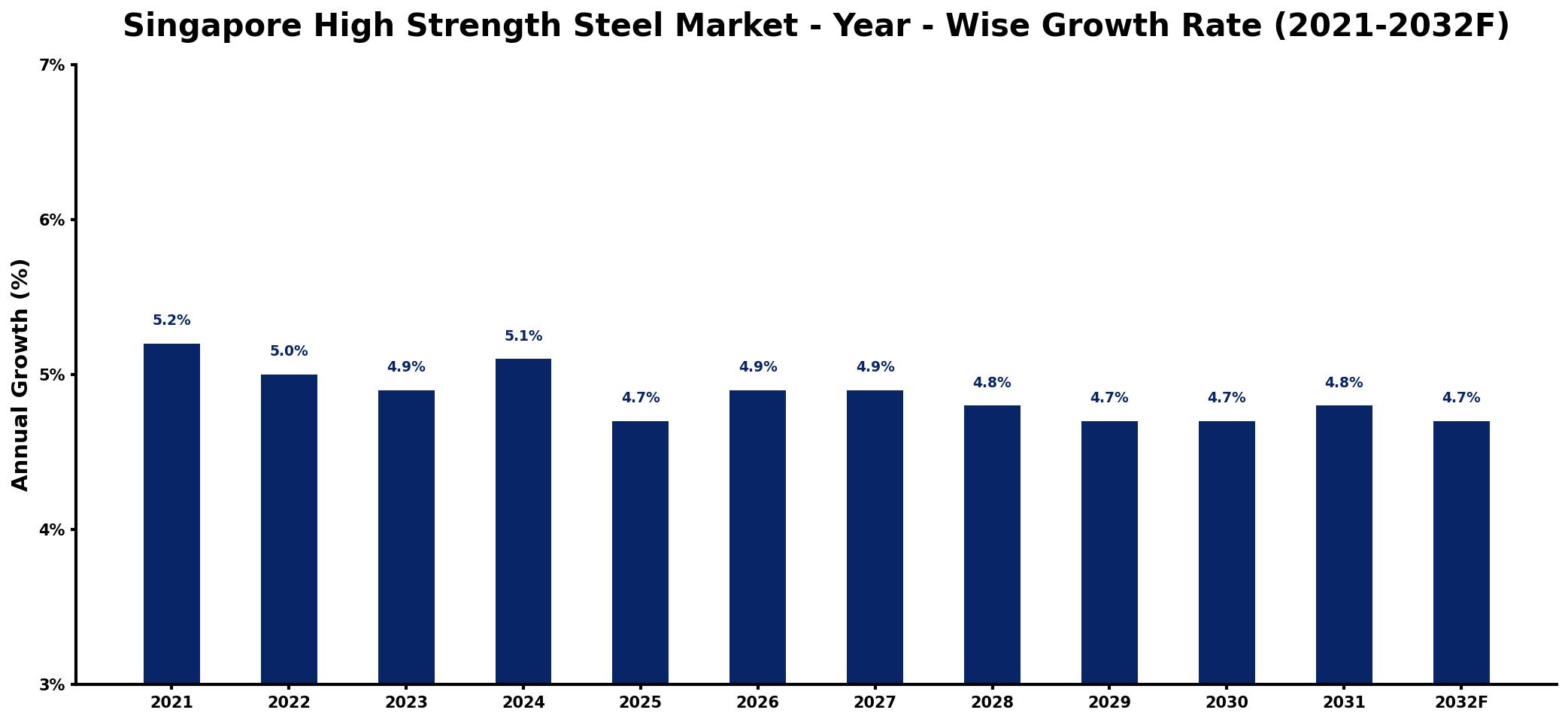
The table below presents the year‑wise growth rates along with the key drivers influencing the market
| Year | Growth Rate | Major Drivers |
| 2021 | 5.2% | Infrastructure investments drive demand growth |
| 2022 | 5.0% | Manufacturing sector expansion boosts needs |
| 2023 | 4.9% | Construction projects increase material usage |
| 2024 | 5.1% | Automotive industry growth enhances requirements |
| 2025 | 4.7% | Technological advancements raise production efficiency |
| 2026 | 4.9% | Renewable energy projects stimulate investments |
| 2027 | 4.9% | Urbanization trends elevate construction activities |
| 2028 | 4.8% | Export opportunities broaden market access |
| 2029 | 4.7% | R&D initiatives enhance application versatility |
| 2030 | 4.7% | Government policies promote sustainable practices |
| 2031 | 4.8% | Logistics improvements optimize supply chains |
| 2032 | 4.7% | Global demand shifts drive innovation |
Note: Market size estimations and growth projections presented in this report are based on 6Wresearch's proprietary forecasting methodology, utilizing the latest available industry data, government publications, and primary research inputs.
Singapore High Strength Steel Market Synopsis
In recent years, the Singapore high-strength steel market has gained momentum, driven by the need for advanced materials that offer both strength and reduced weight. This demand is propelled by the growing sectors of aerospace and automotive, where high-performance standards are essential. However, looking ahead, the market is positioned for steady growth, influenced by technological advancements and the rising emphasis on fuel efficiency.
As industries increasingly lean towards high-strength steel solutions, the market is set to evolve. With the Singapore government's push for innovation in engineering and manufacturing, the future seems bright. Continued research and development will play a crucial role in meeting the stringent demands of modern applications, further solidifying the market's position in the region.
Singapore High Strength Steel Market Key Takeaways
- The market is poised for growth, primarily driven by advancements in engineering and manufacturing.
- High-strength steel is integral for various sectors, including automotive, aerospace, and shipbuilding.
- Innovation in material fabrication techniques is essential for meeting industry standards.
- Cost-effectiveness and material consistency remain critical areas for improvement.
- The post-pandemic recovery phase is providing renewed focus on efficiency and sustainability in high-strength steel applications.
Evaluation of Restraints in Singapore High Strength Steel Market
Despite the promising outlook, the Singapore high-strength steel market encounters several restraints. Ensuring material strength consistency is paramount, as fluctuations can undermine the reliability of applications. Additionally, the complexities associated with fabricating high-strength steel can lead to increased costs, posing challenges for manufacturers. These factors necessitate innovative solutions that can streamline production while maintaining quality standards. Addressing these restraints is crucial for leveraging the full potential of high-strength steel within the industry.
Singapore High Strength Steel Market Trends
Current trends indicate a strong shift towards lightweight materials that enhance fuel efficiency and structural integrity in vehicles and structures. Advanced manufacturing technologies, such as 3D printing and automated fabrication processes, are being integrated into the production of high-strength steel, further driving innovation. Additionally, there is a growing focus on recycling and sustainability, with companies exploring environmentally-friendly production methods. These trends reflect a broader industry movement towards more efficient and responsible material usage.
Singapore High Strength Steel Market Opportunities
As the demand for high-strength steel continues to rise, opportunities abound in various sectors. The automotive industry, in particular, is expected to see significant growth as manufacturers seek to produce lighter and more fuel-efficient vehicles. Furthermore, the aerospace sector's demand for materials that can withstand rigorous conditions presents a unique opportunity for high-strength steel suppliers. Investing in research and development, as well as forming strategic partnerships, could lead to innovative applications that enhance market reach.
Government Initiatives in the Singapore High Strength Steel Market
The Singapore government has recognized the importance of advanced materials, including high-strength steel, in driving economic growth and innovation. Initiatives aimed at enhancing research capabilities in materials science, coupled with funding programs for sustainable manufacturing practices, are gaining traction. Furthermore, public investments in infrastructure development are likely to bolster demand for high-strength steel applications across various construction projects, reinforcing the governments commitment to advancing this critical industry.
Future Insights of the Singapore High Strength Steel Market
Looking ahead to 2026-2032, the Singapore high-strength steel market is expected to evolve significantly, with a focus on sustainability and innovation. As industries adapt to stricter environmental regulations, the shift towards eco-friendly manufacturing processes will likely amplify. Additionally, the ongoing integration of digital technologies in manufacturing will facilitate the development of more advanced steel formulations. Overall, the market's trajectory appears robust, driven by a combination of technological advancements and changing consumer preferences.
Singapore High Strength Steel Market Latest Developments (2025 - 2026)
Recent developments in the Singapore high-strength steel market have included collaborations focused on enhancing material properties and manufacturing efficiencies. Companies have begun exploring innovative applications of high-strength steel, particularly in sectors like automotive and aerospace. Furthermore, there is a noticeable trend towards incorporating smart technologies into the manufacturing process, which aims to improve precision and reduce waste. These initiatives are setting the stage for future advancements in the high-strength steel landscape.
Singapore High Strength Steel Market - Key Attractiveness of the Report
- 10 Years of Market Numbers
- Historical Data Starting from 2022 to 2025
- Base Year: 2025
- Forecast Data until 2032
- Key Performance Indicators Impacting the Market
- Major Upcoming Developments and Projects
Key Highlights of the Report:
- Singapore High Strength Steel Market Outlook
- Market Size of Singapore High Strength Steel Market, 2025
- Forecast of Singapore High Strength Steel Market, 2032
- Historical Data and Forecast of Singapore High Strength Steel Revenues & Volume for the Period 2022-2032F
- Singapore High Strength Steel Market Trend Evolution
- Singapore High Strength Steel Market Drivers and Challenges
- Singapore High Strength Steel Price Trends
- Singapore High Strength Steel Porter's Five Forces
- Singapore High Strength Steel Industry Life Cycle
- Historical Data and Forecast of Singapore High Strength Steel Market Revenues & Volume By Product Type for the Period 2022-2032F
- Historical Data and Forecast of Singapore High Strength Steel Market Revenues & Volume By Dual Phase Steel for the Period 2022-2032F
- Historical Data and Forecast of Singapore High Strength Steel Market Revenues & Volume By Bake Hardenable Steel for the Period 2022-2032F
- Historical Data and Forecast of Singapore High Strength Steel Market Revenues & Volume By Carbon Manganese Steel for the Period 2022-2032F
- Historical Data and Forecast of Singapore High Strength Steel Market Revenues & Volume By Other Product Types for the Period 2022-2032F
- Historical Data and Forecast of Singapore High Strength Steel Market Revenues & Volume By Application for the Period 2022-2032F
- Historical Data and Forecast of Singapore High Strength Steel Market Revenues & Volume By Automotive for the Period 2022-2032F
- Historical Data and Forecast of Singapore High Strength Steel Market Revenues & Volume By Construction for the Period 2022-2032F
- Historical Data and Forecast of Singapore High Strength Steel Market Revenues & Volume By Yellow Goods and Mining Equipment for the Period 2022-2032F
- Historical Data and Forecast of Singapore High Strength Steel Market Revenues & Volume By Aviation and Marine for the Period 2022-2032F
- Historical Data and Forecast of Singapore High Strength Steel Market Revenues & Volume By Other Applications for the Period 2022-2032F
- Singapore High Strength Steel Import Export Trade Statistics
- Market Opportunity Assessment By Product Type
- Market Opportunity Assessment By Application
- Singapore High Strength Steel Top Companies Market Share
- Singapore High Strength Steel Competitive Benchmarking By Technical and Operational Parameters
- Singapore High Strength Steel Company Profiles
- Singapore High Strength Steel Key Strategic Recommendations






































