Singapore Hollow Section Steel Market Size, Share & Growth Rate
The Singapore Hollow Section Steel Market was estimated at USD 419 Million in 2025 and is projected to reach USD 595 Million by 2032, growing at a CAGR of 5.1% from 2026 to 2032. This upward trend is driven by the continuous demand from construction and infrastructure projects, which increasingly prioritize lightweight and versatile structural materials. As both residential and commercial developments escalate, the hollow section steel market is well-positioned to meet the evolving needs of the industry.
Singapore Hollow Section Steel Market Year-wise Growth Rate and Key Drivers
This graph highlights how the Singapore Hollow Section Steel Market has steadily grown over the years, supported by major growth factors.
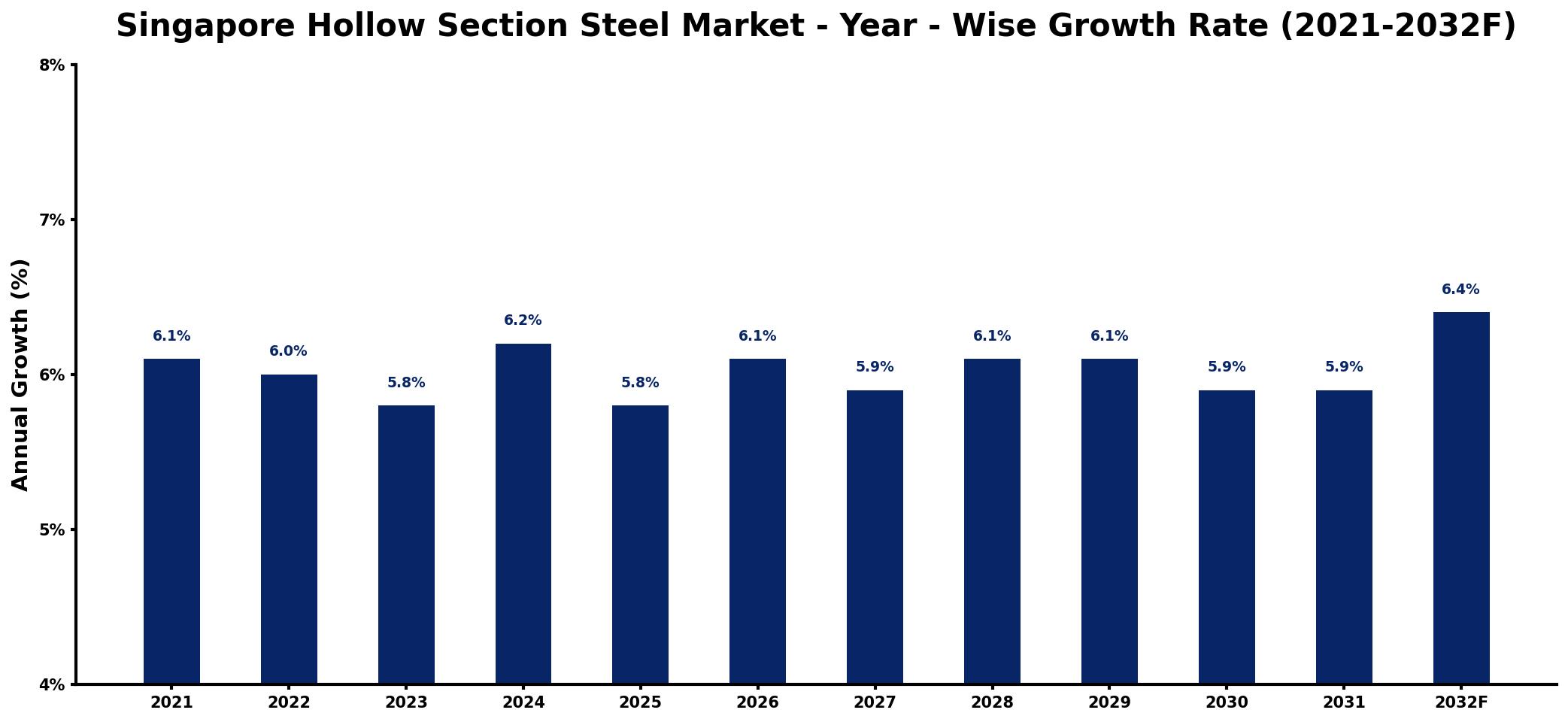
The table below presents the year‑wise growth rates along with the key drivers influencing the market
| Year | Growth Rate | Major Drivers |
| 2021 | 6.1% | Infrastructure projects increase demand |
| 2022 | 6.0% | Construction sector shows resilience |
| 2023 | 5.8% | Renewable energy investments rise |
| 2024 | 6.2% | Manufacturing sector expansion continues |
| 2025 | 5.8% | Urban development drives consumption |
| 2026 | 6.1% | Transportation infrastructure upgrades planned |
| 2027 | 5.9% | Government initiatives support construction |
| 2028 | 6.1% | Technological advancements enhance efficiency |
| 2029 | 6.1% | Real estate market remains robust |
| 2030 | 5.9% | Export opportunities expand globally |
| 2031 | 5.9% | Sustainability trends influence investments |
| 2032 | 6.4% | Public-private partnerships foster growth |
Note: Market size estimations and growth projections presented in this report are based on 6Wresearch's proprietary forecasting methodology, utilizing the latest available industry data, government publications, and primary research inputs.
Singapore Hollow Section Steel Market Synopsis
The hollow section steel market in Singapore is experiencing a renaissance, fueled by a flurry of construction and infrastructure initiatives. Recent momentum reflects a robust demand for hollow section steel, which is fundamental for a myriad of structural applications, ranging from building frameworks to bridges.
Looking ahead, the market's trajectory appears increasingly promising as urban development projects gain pace. Stakeholders in the construction sector are emphasizing the use of innovative materials like hollow section steel to enhance the efficiency and safety of their projects, highlighting a future that blends strength with sustainability.
Singapore Hollow Section Steel Market Key Takeaways
- The market is set for significant growth due to heightened construction and infrastructure development.
- Demand for lightweight and versatile materials is shaping industry trends, with hollow section steel taking center stage.
- Technological advancements in steel manufacturing are further bolstering product offerings.
- Market players are focusing on quality and customization to meet diverse client needs.
- The impact of governmental policies and public investment will play a critical role in shaping future dynamics.
Evaluation of Restraints in Singapore Hollow Section Steel Market
Despite the favorable growth outlook, the Singapore hollow section steel market faces certain restraints that could influence its trajectory. Fluctuations in demand tied to the volatile nature of construction and infrastructure investment introduce a level of uncertainty. Additionally, the market's heavy reliance on government initiatives means that shifts in policy or budget allocations can create challenges for manufacturers. Balancing supply and demand while maintaining cost competitiveness is paramount for sustained growth.
Singapore Hollow Section Steel Market Trends
Several trends are shaping the Singapore hollow section steel market today. Increased adoption of sustainable construction practices is driving demand for eco-friendly materials, including hollow sections that offer durability and recyclability. Moreover, innovation in manufacturing processes is enabling the production of high-strength steel that meets stringent safety standards while reducing weight. These advancements are pivotal in reinforcing the sector's focus on quality and performance.
Singapore Hollow Section Steel Market Opportunities
Opportunities abound within the Singapore hollow section steel market as both public and private sector investments in infrastructure continue to grow. The push for smart city developments and green buildings presents unique avenues for expansion. As stakeholders seek to incorporate advanced materials into their projects, hollow section steel is increasingly viewed as an optimal solution, positioning the market for robust investment and development initiatives.
Government Initiatives in the Singapore Hollow Section Steel Market
The Singaporean government has been instrumental in driving the growth of the hollow section steel market through various initiatives. Public spending on infrastructure projects, including transportation and urban development, has created a favorable environment for the industry. Policies aimed at promoting sustainable construction practices further incentivize the use of hollow section steel as a material of choice, aligning with national goals for innovation and sustainability in the construction sector.
Future Insights of the Singapore Hollow Section Steel Market
Looking toward the future, the Singapore hollow section steel market is anticipated to maintain its upward trajectory from 2026 to 2032. Continued urbanization, combined with an increasing emphasis on infrastructure resilience and sustainability, will drive ongoing demand. As technological advancements improve manufacturing capabilities, stakeholders can expect a broader range of applications and enhanced product offerings that cater to the evolving needs of the construction and engineering sectors.
Singapore Hollow Section Steel Market Latest Developments (2025 - 2026)
Recent industry developments indicate a growing focus on collaboration among key market players to enhance product quality and service offerings. Innovation remains a priority, with companies investing in research and development to meet the specific requirements of the construction sector. Additionally, a renewed emphasis on customization and specialized products is emerging, enabling manufacturers to cater to the unique demands of various infrastructure projects.
Singapore Hollow Section Steel Market - Key Attractiveness of the Report
- 10 Years of Market Numbers
- Historical Data Starting from 2022 to 2025
- Base Year: 2025
- Forecast Data until 2032
- Key Performance Indicators Impacting the Market
- Major Upcoming Developments and Projects
Key Highlights of the Report:
- Singapore Hollow Section Steel Market Outlook
- Market Size of Singapore Hollow Section Steel Market, 2025
- Forecast of Singapore Hollow Section Steel Market, 2032
- Historical Data and Forecast of Singapore Hollow Section Steel Revenues & Volume for the Period 2022-2032F
- Singapore Hollow Section Steel Market Trend Evolution
- Singapore Hollow Section Steel Market Drivers and Challenges
- Singapore Hollow Section Steel Price Trends
- Singapore Hollow Section Steel Porter's Five Forces
- Singapore Hollow Section Steel Industry Life Cycle
- Historical Data and Forecast of Singapore Hollow Section Steel Market Revenues & Volume By Type for the Period 2022-2032F
- Historical Data and Forecast of Singapore Hollow Section Steel Market Revenues & Volume By Rectangular Hollow Section for the Period 2022-2032F
- Historical Data and Forecast of Singapore Hollow Section Steel Market Revenues & Volume By Square Hollow Section for the Period 2022-2032F
- Historical Data and Forecast of Singapore Hollow Section Steel Market Revenues & Volume By Circular Hollow Section for the Period 2022-2032F
- Historical Data and Forecast of Singapore Hollow Section Steel Market Revenues & Volume By Other for the Period 2022-2032F
- Historical Data and Forecast of Singapore Hollow Section Steel Market Revenues & Volume By Application for the Period 2022-2032F
- Historical Data and Forecast of Singapore Hollow Section Steel Market Revenues & Volume By Agricultural for the Period 2022-2032F
- Historical Data and Forecast of Singapore Hollow Section Steel Market Revenues & Volume By Construction for the Period 2022-2032F
- Historical Data and Forecast of Singapore Hollow Section Steel Market Revenues & Volume By General Engineering for the Period 2022-2032F
- Historical Data and Forecast of Singapore Hollow Section Steel Market Revenues & Volume By Mechanical Application for the Period 2022-2032F
- Historical Data and Forecast of Singapore Hollow Section Steel Market Revenues & Volume By Others for the Period 2022-2032F
- Historical Data and Forecast of Singapore Hollow Section Steel Market Revenues & Volume By Global Hollow Section Steel Market dynamics for the Period 2022-2032F
- Historical Data and Forecast of Singapore Hollow Section Steel Market Revenues & Volume By Global Hollow Section Steel Market size for the Period 2022-2032F
- Historical Data and Forecast of Singapore Hollow Section Steel Market Revenues & Volume By Supply & Demand for the Period 2022-2032F
- Singapore Hollow Section Steel Import Export Trade Statistics
- Market Opportunity Assessment By Type
- Market Opportunity Assessment By Application
- Singapore Hollow Section Steel Top Companies Market Share
- Singapore Hollow Section Steel Competitive Benchmarking By Technical and Operational Parameters
- Singapore Hollow Section Steel Company Profiles
- Singapore Hollow Section Steel Key Strategic Recommendations






































