Singapore Industrial Machinery Market Size, Share & Growth Rate
The Singapore Industrial Machinery Market was estimated at USD 225 Million in 2025 and is projected to reach USD 248 Million by 2032, growing at a CAGR of 1.4% from 2026 to 2032. The trajectory of growth is largely driven by the increasing demand for automation and advanced manufacturing processes within the region's robust manufacturing sector. As local industries strive to enhance operational efficiency and product quality, the integration of innovative machinery becomes imperative.
Singapore Industrial Machinery Market Year-wise Growth Rate and Key Drivers
This graph highlights how the Singapore Industrial Machinery Market has steadily grown over the years, supported by major growth factors.
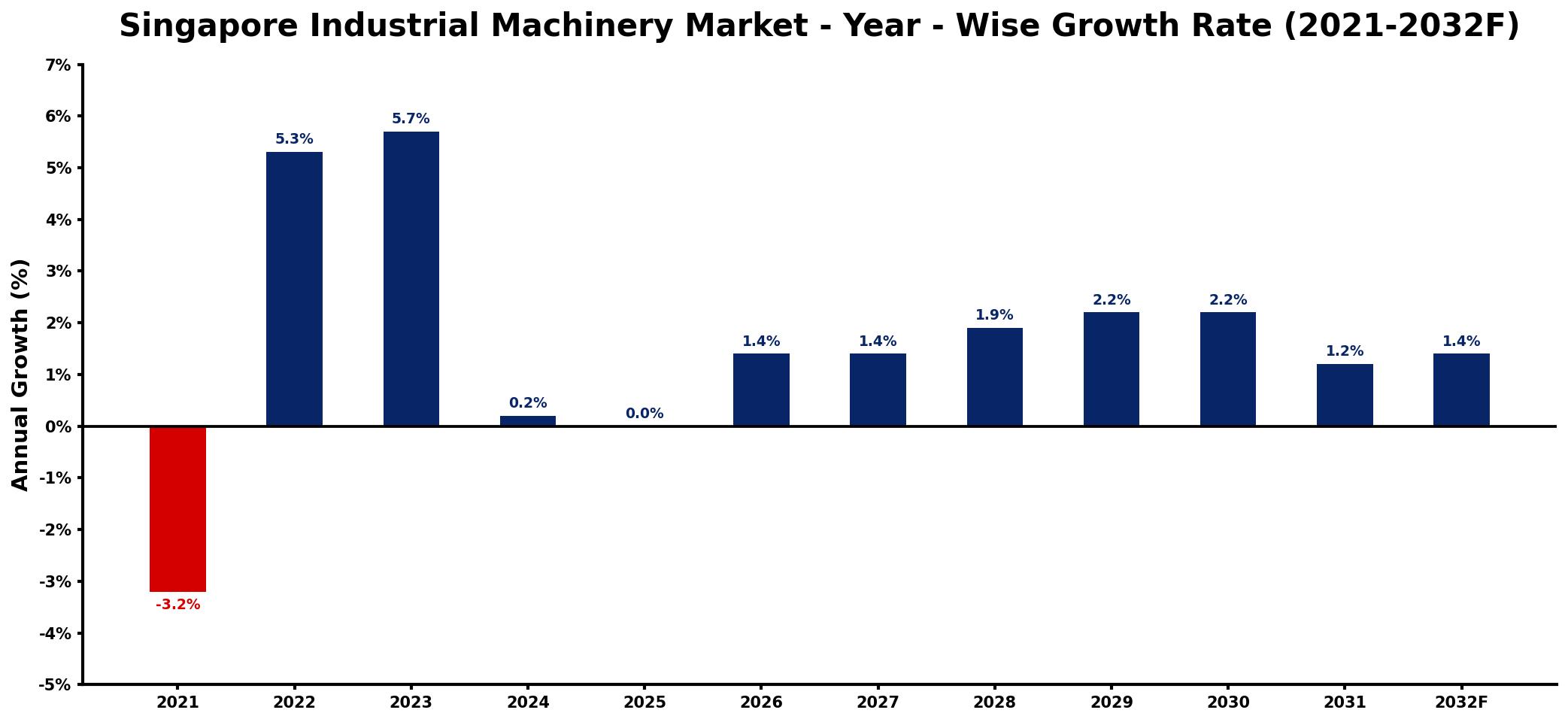
The table below presents the year‑wise growth rates along with the key drivers influencing the market
| Year | Growth Rate | Major Drivers |
| 2021 | -3.2% | reduced investments in manufacturing sector |
| 2022 | 5.3% | increased demand for automation solutions |
| 2023 | 5.7% | expansion of renewable energy projects |
| 2024 | 0.2% | growing interest in smart technology |
| 2025 | 0.0% | rising construction activity nationwide |
| 2026 | 1.4% | enhanced focus on sustainability initiatives |
| 2027 | 1.4% | stronger distribution network expansion |
| 2028 | 1.9% | increased adoption of digital tools |
| 2029 | 2.2% | growth in export-oriented production |
| 2030 | 2.2% | rising investments in infrastructure development |
| 2031 | 1.2% | emerging trends in robotics applications |
| 2032 | 1.4% | improved processing technologies adoption |
Note: Market size estimations and growth projections presented in this report are based on 6Wresearch's proprietary forecasting methodology, utilizing the latest available industry data, government publications, and primary research inputs.
Singapore Industrial Machinery Market Synopsis
Automation stands as the strongest force shaping the Singapore Industrial Machinery Market today. Companies are increasingly turning to advanced machinery solutions to optimize production and keep pace with global competitiveness, thereby fueling demand across various sectors such as manufacturing and construction.
The market is also influenced by Singapores strategic position as a technological hub in Southeast Asia. As industries undergo rapid digital transformation, the continuous evolution of machinery to meet sophisticated operational requirements is becoming essential, driving significant investment in state-of-the-art equipment.
Singapore Industrial Machinery Market Key Takeaways
- Automation and advanced manufacturing processes are primary growth drivers.
- The market is adapting to increasing demand for efficiency and quality in production.
- Innovation and technological integration are critical for staying competitive.
- Sustainability initiatives are influencing machinery development and operational practices.
- Government policies and programs support the growth of the industrial machinery sector.
Evaluation of Restraints in Singapore Industrial Machinery Market
Despite promising growth, the Singapore Industrial Machinery Market is hindered by certain restraints. The challenge lies in delivering advanced, efficient machinery solutions that align with the rapidly evolving needs of industries. Manufacturers face pressure to innovate continually while integrating sustainable practices into production processes. Additionally, market players must navigate fluctuating demand as industries adapt to new technologies and economic conditions, creating a complex landscape to operate within.
Singapore Industrial Machinery Market Trends
Several key trends are shaping the Singapore Industrial Machinery Market. The ongoing push towards Industry 4.0 is revolutionizing machinery design, emphasizing connectivity, and data-driven processes. Moreover, the focus on sustainability is fostering the development of eco-friendly equipment, aligning with global environmental goals. As industries embrace smart technologies, the integration of AI and IoT in machinery is becoming increasingly common, enhancing operational efficiency and predictive maintenance capabilities.
Singapore Industrial Machinery Market Opportunities
The opportunities within the Singapore Industrial Machinery Market are abundant. As companies continue to invest in automation and digitization, there is a significant demand for customized machinery that caters to specific industry needs. Additionally, the expansion of the green economy presents avenues for innovation in sustainable machinery solutions. The local push for smart manufacturing also offers potential for partnerships and collaborations to create cutting-edge technological advancements.
Government Initiatives in the Singapore Industrial Machinery Market
The Singaporean government is actively supporting the industrial machinery sector through various initiatives and programs aimed at enhancing the country's manufacturing capabilities. Investments in research and development are being prioritized, alongside policies that encourage technology adoption and workforce training. Public spending on infrastructure projects also serves to bolster demand for industrial machinery, ensuring a conducive environment for growth within the market.
Future Insights of the Singapore Industrial Machinery Market
Looking ahead to 2026-2032, the Singapore Industrial Machinery Market is positioned for a period of transformation and growth. As automation and advanced manufacturing processes continue to penetrate various sectors, businesses that embrace innovation and technological integration are likely to thrive. Enhanced focus on sustainability will push the boundaries of machine development, leading to more eco-friendly solutions that align with global standards. In this evolving landscape, the adaptability of machinery manufacturers will be critical for capturing future market opportunities.
Singapore Industrial Machinery Market Latest Developments (2025 - 2026)
Recent developments in the Singapore Industrial Machinery Market indicate a shift towards more sophisticated machinery solutions that incorporate AI and IoT technologies. Industry players are increasingly investing in R&D to create smarter equipment that enhances operational efficiencies. Furthermore, collaborations between technology firms and machinery manufacturers are fostering innovation, paving the way for advanced industrial solutions tailored to specific industry requirements.
Singapore Industrial Machinery Market - Key Attractiveness of the Report
- 10 Years of Market Numbers
- Historical Data Starting from 2022 to 2025
- Base Year: 2025
- Forecast Data until 2032
- Key Performance Indicators Impacting the Market
- Major Upcoming Developments and Projects
Key Highlights of the Report:
- Singapore Industrial Machinery Market Outlook
- Market Size of Singapore Industrial Machinery Market, 2025
- Forecast of Singapore Industrial Machinery Market, 2032
- Historical Data and Forecast of Singapore Industrial Machinery Revenues & Volume for the Period 2022-2032F
- Singapore Industrial Machinery Market Trend Evolution
- Singapore Industrial Machinery Market Drivers and Challenges
- Singapore Industrial Machinery Price Trends
- Singapore Industrial Machinery Porter's Five Forces
- Singapore Industrial Machinery Industry Life Cycle
- Historical Data and Forecast of Singapore Industrial Machinery Market Revenues & Volume By Application for the Period 2022-2032F
- Historical Data and Forecast of Singapore Industrial Machinery Market Revenues & Volume By Agriculture for the Period 2022-2032F
- Historical Data and Forecast of Singapore Industrial Machinery Market Revenues & Volume By Construction for the Period 2022-2032F
- Historical Data and Forecast of Singapore Industrial Machinery Market Revenues & Volume By Packaging for the Period 2022-2032F
- Historical Data and Forecast of Singapore Industrial Machinery Market Revenues & Volume By Food Processing for the Period 2022-2032F
- Historical Data and Forecast of Singapore Industrial Machinery Market Revenues & Volume By Mining for the Period 2022-2032F
- Historical Data and Forecast of Singapore Industrial Machinery Market Revenues & Volume By Semiconductor Manufacturing for the Period 2022-2032F
- Singapore Industrial Machinery Import Export Trade Statistics
- Market Opportunity Assessment By Application
- Singapore Industrial Machinery Top Companies Market Share
- Singapore Industrial Machinery Competitive Benchmarking By Technical and Operational Parameters
- Singapore Industrial Machinery Company Profiles
- Singapore Industrial Machinery Key Strategic Recommendations






































