Singapore Kefir Market Size, Share & Growth Rate
The Singapore Kefir Market was estimated at USD 220 Million in 2025 and is projected to reach USD 301 Million by 2032, growing at a CAGR of 4.6% from 2026 to 2032. This growth trajectory is being driven by a heightened awareness of gut health and the increasing popularity of probiotic-rich foods. Consumers are actively seeking alternatives to traditional dairy products, particularly those that offer enhanced health benefits, which further supports the market's expansion.
Singapore Kefir Market Year-wise Growth Rate and Key Drivers
This graph highlights how the Singapore Kefir Market has steadily grown over the years, supported by major growth factors.
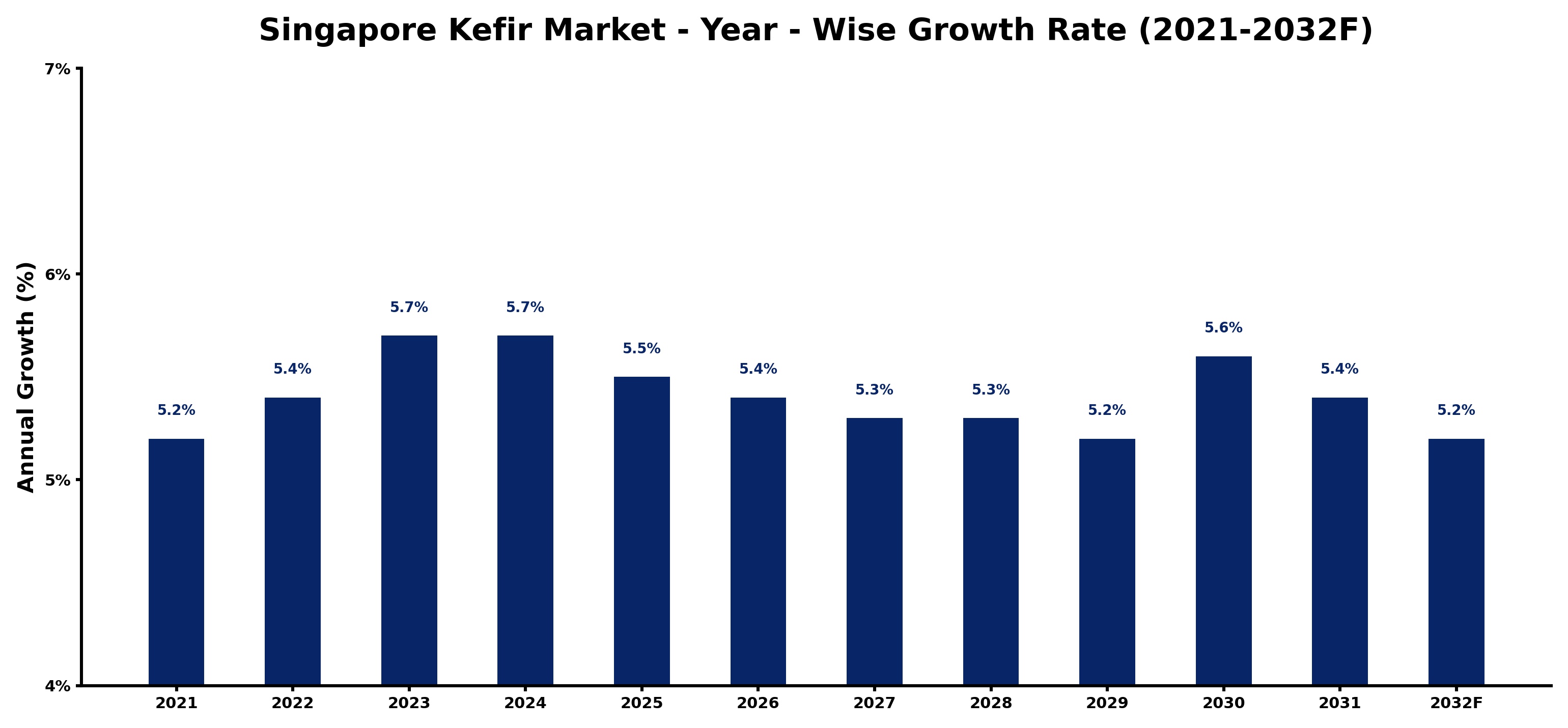
The table below presents the year‑wise growth rates along with the key drivers influencing the market
| Year | Growth Rate | Major Drivers |
| 2021 | 5.2% | Health benefits gained consumer attention |
| 2022 | 5.4% | Increased awareness of probiotics benefits |
| 2023 | 5.7% | Diverse flavor offerings attracted consumers |
| 2024 | 5.7% | Growing demand for functional foods |
| 2025 | 5.5% | Sustainable packaging initiatives gained traction |
| 2026 | 5.4% | Local production expanded market reach |
| 2027 | 5.3% | Innovative marketing strategies engaged consumers |
| 2028 | 5.3% | E-commerce platforms enhanced accessibility |
| 2029 | 5.2% | Collaborations with health influencers increased |
| 2030 | 5.6% | Product innovation attracted new customers |
| 2031 | 5.4% | Cultural acceptance of kefir grew |
| 2032 | 5.2% | Health-conscious lifestyle trends continued rising |
Note - Market size estimations and growth projections presented in this report are based on 6Wresearch’s advanced forecasting approach, validated with industry datasets as of June 2026.
Singapore Kefir Market Synopsis
The strongest force shaping the Singapore Kefir Market right now is the growing consumer inclination towards health and wellness products. With rising awareness of digestive health, kefir has emerged as a go-to fermented option that resonates with health-conscious individuals.
Additionally, the market is benefitting from the proliferation of plant-based diets, as consumers explore non-dairy kefir options made from various alternative ingredients. This versatility is attracting a diverse consumer base eager to incorporate functional foods into their daily diets.
Singapore Kefir Market Key Takeaways
- The market is experiencing a notable shift towards health-centric probiotic products, particularly among millennials and young professionals.
- Diverse product offerings, including flavored and non-dairy variants, are expanding consumer appeal.
- Increased focus on clean-label and natural ingredients aligns with consumer demand for transparency and quality.
- Education and awareness initiatives are crucial for differentiating kefir from traditional yogurt alternatives.
- The recovery of the foodservice sector post-pandemic presents new avenues for kefir market growth.
Evaluation of Restraints in Singapore Kefir Market
Despite its promising potential, the Singapore Kefir Market faces several restraints that may hinder its growth. One notable challenge is the consumer acceptance rate; many individuals are still unfamiliar with kefir and its health benefits, resulting in limited trial and adoption. Furthermore, competition from established yogurt brands that dominate the dairy market presents a significant hurdle. Maintaining high quality and consistency in kefir production is also essential, as any fluctuations could adversely affect consumer trust and repeat purchases.
Singapore Kefir Market Trends
The Singapore Kefir Market is currently witnessing several trends that are shaping demand. A substantial increase in interest towards gut health and immunity-boosting foods is leading consumers to explore kefir's rich probiotic content. Additionally, there is a rising trend for convenient, on-the-go beverage options that cater to busy lifestyles. This demand is prompting innovation in product formats and packaging, making kefir accessible for a wider audience. Environmental consciousness also plays a role; consumers are increasingly favoring brands that prioritize sustainable sourcing and packaging.
Singapore Kefir Market Opportunities
Significant growth opportunities lie in expanding the product range, particularly in non-dairy kefir options. As more consumers opt for plant-based diets, brands that can innovate around alternative ingredients will likely capture additional market share. Furthermore, increased educational campaigns about the health benefits of kefir can foster greater consumer acceptance. Leveraging digital marketing and e-commerce platforms offers a way to reach health-conscious consumers effectively, particularly during a time when online shopping is increasingly preferred.
Government Initiatives in the Singapore Kefir Market
The Singaporean government is actively promoting health and nutrition, which indirectly supports the kefir market. Policies aimed at encouraging the production and consumption of functional foods are being implemented. Furthermore, funding initiatives for research and development in health-promoting food products are available, which can benefit local producers looking to innovate. Efforts to enhance food safety standards also ensure that consumers can trust the quality of probiotic products available in the market.
Future Insights of the Singapore Kefir Market
Looking ahead from 2026 to 2032, the Singapore Kefir Market is poised for continued growth, driven by an ever-increasing emphasis on health and wellness. The acceptance of kefir as a staple in health-conscious diets is likely to solidify as educational efforts bear fruit. Moreover, the anticipated rise in health awareness post-pandemic will spur demand for functional foods. Brands that adapt quickly to changing consumer preferences and leverage technology for product innovation will thrive in this dynamic market environment.
Singapore Kefir Market Latest Developments (May 2025 - June 2026)
Recently, the Singapore Kefir Market has seen a wave of innovation, with several brands introducing new kefir-based products aimed at both health enthusiasts and casual consumers. The market is also witnessing increased collaboration between producers and retailers to enhance distribution and visibility of kefir products in supermarkets and online. Additionally, promotional campaigns focusing on the health benefits of kefir have begun to gain traction, aiming to elevate consumer understanding and trial of this versatile beverage.
Singapore Kefir Market - Key Attractiveness of the Report
- 10 Years of Market Numbers
- Historical Data Starting from 2022 to 2025
- Base Year: 2025
- Forecast Data until 2032
- Key Performance Indicators Impacting the Market
- Major Upcoming Developments and Projects
Key Highlights of the Report:
- Singapore Kefir Market Outlook
- Market Size of Singapore Kefir Market, 2025
- Forecast of Singapore Kefir Market, 2032
- Historical Data and Forecast of Singapore Kefir Revenues & Volume for the Period 2022-2032F
- Singapore Kefir Market Trend Evolution
- Singapore Kefir Market Drivers and Challenges
- Singapore Kefir Price Trends
- Singapore Kefir Porter's Five Forces
- Singapore Kefir Industry Life Cycle
- Historical Data and Forecast of Singapore Kefir Market Revenues & Volume By Nature for the Period 2022-2032F
- Historical Data and Forecast of Singapore Kefir Market Revenues & Volume By Organic for the Period 2022-2032F
- Historical Data and Forecast of Singapore Kefir Market Revenues & Volume By Conventional for the Period 2022-2032F
- Historical Data and Forecast of Singapore Kefir Market Revenues & Volume By Product Types for the Period 2022-2032F
- Historical Data and Forecast of Singapore Kefir Market Revenues & Volume By Flavored for the Period 2022-2032F
- Historical Data and Forecast of Singapore Kefir Market Revenues & Volume By Unflavored for the Period 2022-2032F
- Historical Data and Forecast of Singapore Kefir Market Revenues & Volume By Applications for the Period 2022-2032F
- Historical Data and Forecast of Singapore Kefir Market Revenues & Volume By Foods and beverages for the Period 2022-2032F
- Historical Data and Forecast of Singapore Kefir Market Revenues & Volume By Pharmaceutical for the Period 2022-2032F
- Historical Data and Forecast of Singapore Kefir Market Revenues & Volume By Source for the Period 2022-2032F
- Historical Data and Forecast of Singapore Kefir Market Revenues & Volume By Animal milk for the Period 2022-2032F
- Historical Data and Forecast of Singapore Kefir Market Revenues & Volume By Soy milk for the Period 2022-2032F
- Historical Data and Forecast of Singapore Kefir Market Revenues & Volume By Coconut milk for the Period 2022-2032F
- Historical Data and Forecast of Singapore Kefir Market Revenues & Volume By Others for the Period 2022-2032F
- Singapore Kefir Import Export Trade Statistics
- Market Opportunity Assessment By Nature
- Market Opportunity Assessment By Product Types
- Market Opportunity Assessment By Applications
- Market Opportunity Assessment By Source
- Singapore Kefir Top Companies Market Share
- Singapore Kefir Competitive Benchmarking By Technical and Operational Parameters
- Singapore Kefir Company Profiles
- Singapore Kefir Key Strategic Recommendations






































