Singapore Lead Chemicals Market Size, Share & Growth Rate
The Singapore Lead Chemicals Market was estimated at USD 1485 Million in 2025 and is projected to reach USD 2112 Million by 2032, growing at a CAGR of 5.2% from 2026 to 2032. This growth is primarily fueled by the ongoing demand for lead-acid batteries, particularly in the automotive and energy sectors. As Singapore continues to bolster its renewable energy initiatives, the need for efficient energy storage solutions using lead chemicals remains vital, despite prevailing environmental concerns.
Singapore Lead Chemicals Market Year-wise Growth Rate and Key Drivers
This graph highlights how the Singapore Lead Chemicals Market has steadily grown over the years, supported by major growth factors.
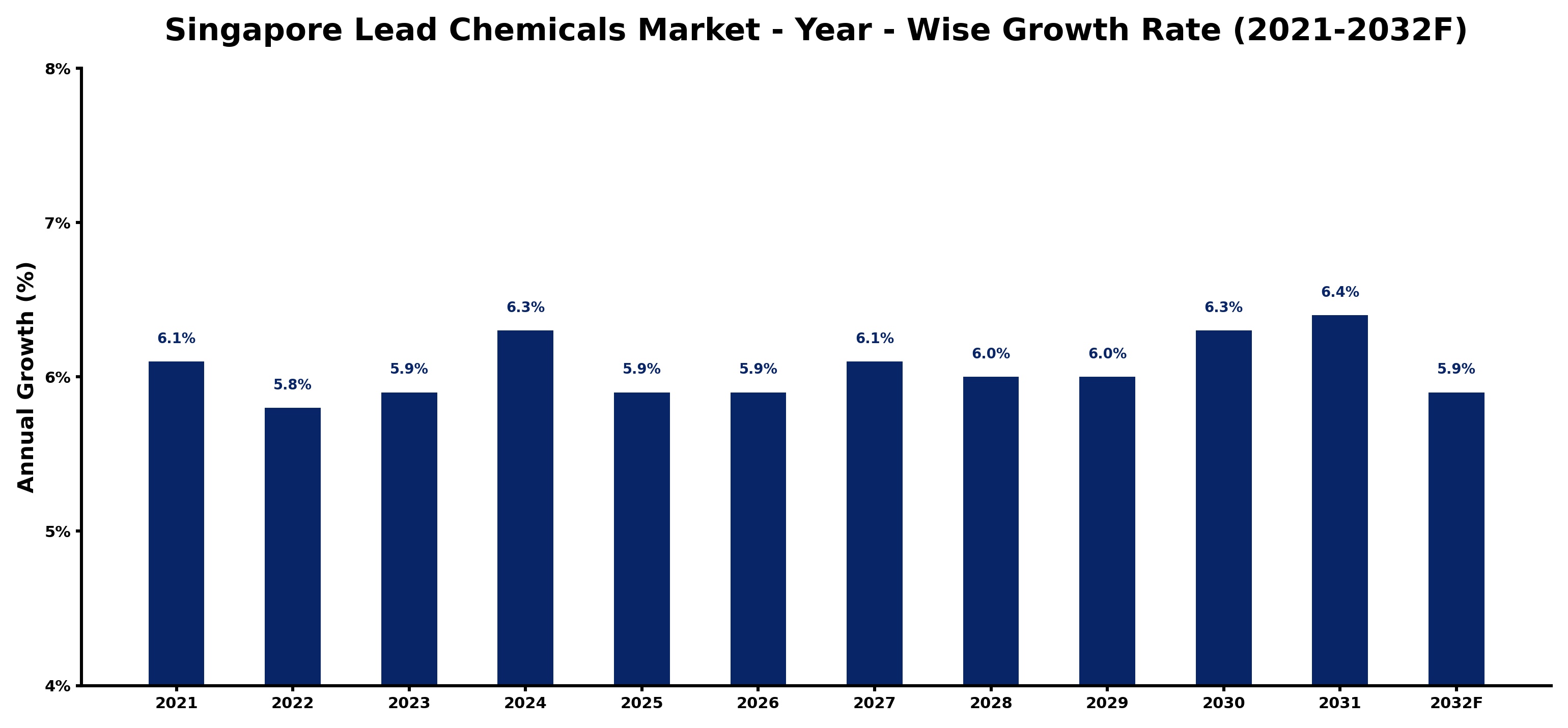
The table below presents the year‑wise growth rates along with the key drivers influencing the market
| Year | Growth Rate | Major Drivers |
| 2021 | 6.1% | Sustainable practices gained traction |
| 2022 | 5.8% | Regulatory support enhanced innovation |
| 2023 | 5.9% | Technological advancements improved efficiency |
| 2024 | 6.3% | Market demand for eco-friendly products |
| 2025 | 5.9% | Increased investment in R&D |
| 2026 | 5.9% | Collaborations with local manufacturers |
| 2027 | 6.1% | Export opportunities expanded significantly |
| 2028 | 6.0% | Consumer awareness of lead benefits |
| 2029 | 6.0% | Infrastructure development supported growth |
| 2030 | 6.3% | Government initiatives promoted sustainability |
| 2031 | 6.4% | Rising demand for specialty chemicals |
| 2032 | 5.9% | Emerging markets increased consumption |
Note - Market size estimations and growth projections presented in this report are based on 6Wresearch's advanced forecasting approach, validated with industry datasets as of June 2026.
Singapore Lead Chemicals Market Synopsis
The strongest force shaping the Singapore Lead Chemicals Market is the increasing regulatory pressure related to environmental sustainability. These regulations are pushing industries that have traditionally depended on lead-based products to explore more eco-friendly alternatives. Consequently, while the market is expected to stabilize, a gradual decline in demand for lead chemicals is anticipated.
Despite these challenges, Singapore's chemical industry is evolving, with a concerted effort towards innovation. Companies are not only adhering to stricter environmental standards but are also actively seeking to develop lead chemical products that align with these new regulations, potentially opening doors for sustainable growth.
Singapore Lead Chemicals Market Key Takeaways
- Demand for lead-acid batteries in automotive and energy sectors remains a significant driver.
- Environmental regulations are pushing the industry towards lead-free alternatives.
- Investment in cleaner technologies is essential for sustaining market growth.
- Opportunities exist for innovative lead chemical products that meet stringent standards.
- The gradual decline in traditional lead-based product usage signals a shift in market dynamics.
Evaluation of Restraints in Singapore Lead Chemicals Market
The Singapore Lead Chemicals Market faces several restraints due to the stringent regulations surrounding lead usage. These regulations are driven by significant health and environmental concerns related to lead exposure, which limits the market's operational flexibility. Additionally, competition from alternative materials and the urgent need for lead-free technologies exacerbate these challenges, forcing businesses to rethink their strategies. The balancing act of fostering innovation while complying with these stringent regulatory frameworks remains a critical hurdle for the market.
Singapore Lead Chemicals Market Trends
Current trends indicate a marked shift toward sustainability, with an increasing emphasis on lead-free alternatives. Industries are exploring innovative formulations and technologies to reduce their dependence on lead chemicals. Furthermore, advancements in battery technology, particularly with the rise of electric vehicles, are also influencing market demand. Companies are investing in research and development to create eco-friendly lead chemical products that align with evolving consumer preferences and regulatory requirements.
Singapore Lead Chemicals Market Opportunities
Genuine growth opportunities lie in developing advanced lead-acid batteries that incorporate enhanced recycling processes and cleaner production methods. The push for sustainable energy storage solutions presents a unique chance for innovation in lead chemicals, particularly in renewable energy applications. Additionally, the market can benefit from collaborations aimed at creating eco-friendly alternatives that maintain performance while adhering to environmental standards.
Government Initiatives in the Singapore Lead Chemicals Market
The Singapore government is actively promoting policies aimed at reducing the environmental impact of chemicals, including lead. Initiatives focus on encouraging research into alternative materials, enhancing recycling efforts, and imposing stricter regulations on hazardous substances. Programs are also in place to support industries transitioning toward sustainable practices, which may involve funding for research and development projects that seek to mitigate lead usage in various applications.
Future Insights of the Singapore Lead Chemicals Market
Looking ahead to 2026-2032, the Singapore Lead Chemicals Market is expected to navigate a landscape influenced by stringent environmental mandates and the shift toward sustainability. Companies that successfully adapt to these changes by innovating and developing compliant products will likely see growth. The integration of advanced technologies in energy storage solutions will be a pivotal factor in shaping the future of this market, as the demand for more sustainable alternatives to traditional lead applications continues to grow.
Singapore Lead Chemicals Market Latest Developments (May 2025 - June 2026)
Recent industry developments indicate a steady commitment to innovation amid the regulatory landscape. Companies are increasingly focusing on research initiatives aimed at creating lead-free products that comply with stringent environmental regulations. Collaborative efforts between academia and industry players are becoming more common, signifying a collective response to the challenges posed by traditional lead chemicals. Moreover, there has been a noticeable increase in investment aimed at enhancing battery recycling processes and developing eco-friendly chemical alternatives.
Singapore Lead Chemicals Market - Key Attractiveness of the Report
- 10 Years of Market Numbers
- Historical Data Starting from 2022 to 2025
- Base Year: 2025
- Forecast Data until 2032
- Key Performance Indicators Impacting the Market
- Major Upcoming Developments and Projects
Key Highlights of the Report:
- Singapore Lead Chemicals Market Outlook
- Market Size of Singapore Lead Chemicals Market, 2025
- Forecast of Singapore Lead Chemicals Market, 2032
- Historical Data and Forecast of Singapore Lead Chemicals Revenues & Volume for the Period 2022-2032F
- Singapore Lead Chemicals Market Trend Evolution
- Singapore Lead Chemicals Market Drivers and Challenges
- Singapore Lead Chemicals Price Trends
- Singapore Lead Chemicals Porter's Five Forces
- Singapore Lead Chemicals Industry Life Cycle
- Historical Data and Forecast of Singapore Lead Chemicals Market Revenues & Volume By Types for the Period 2022-2032F
- Historical Data and Forecast of Singapore Lead Chemicals Market Revenues & Volume By Lead Nitrate for the Period 2022-2032F
- Historical Data and Forecast of Singapore Lead Chemicals Market Revenues & Volume By Lead Acetate for the Period 2022-2032F
- Historical Data and Forecast of Singapore Lead Chemicals Market Revenues & Volume By Lead Stabilizers for the Period 2022-2032F
- Historical Data and Forecast of Singapore Lead Chemicals Market Revenues & Volume By Lead Chloride for the Period 2022-2032F
- Historical Data and Forecast of Singapore Lead Chemicals Market Revenues & Volume By Others for the Period 2022-2032F
- Historical Data and Forecast of Singapore Lead Chemicals Market Revenues & Volume By Applications for the Period 2022-2032F
- Historical Data and Forecast of Singapore Lead Chemicals Market Revenues & Volume By Mining for the Period 2022-2032F
- Historical Data and Forecast of Singapore Lead Chemicals Market Revenues & Volume By PVC Stabilizers for the Period 2022-2032F
- Historical Data and Forecast of Singapore Lead Chemicals Market Revenues & Volume By Dyes for the Period 2022-2032F
- Historical Data and Forecast of Singapore Lead Chemicals Market Revenues & Volume By Pigment for the Period 2022-2032F
- Historical Data and Forecast of Singapore Lead Chemicals Market Revenues & Volume By Others for the Period 2022-2032F
- Singapore Lead Chemicals Import Export Trade Statistics
- Market Opportunity Assessment By Types
- Market Opportunity Assessment By Applications
- Singapore Lead Chemicals Top Companies Market Share
- Singapore Lead Chemicals Competitive Benchmarking By Technical and Operational Parameters
- Singapore Lead Chemicals Company Profiles
- Singapore Lead Chemicals Key Strategic Recommendations






































