Singapore LED Professional Lighting Market Summary
The singapore led professional lighting market was estimated at USD 1073 Million in 2025 and is projected to reach USD 1562 Million by 2032, growing at a CAGR of 6.7% from 2026 to 2032.
Singapore LED Professional Lighting Market Year-wise Growth Rate and Key Drivers
This graph highlights how the Singapore LED Professional Lighting Market has steadily grown over the past five years, supported by major growth factors.
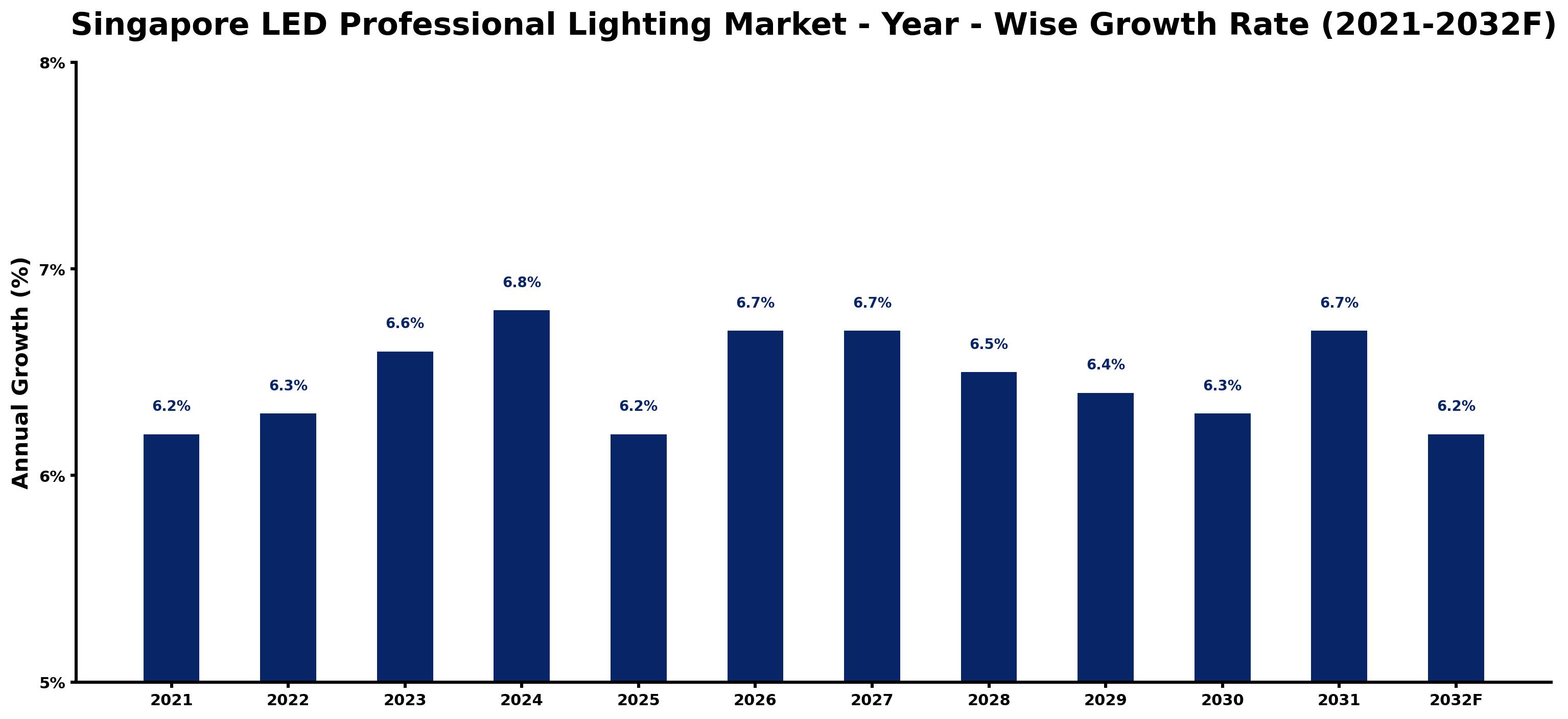
The table below presents the year wise growth rates along with the key drivers influencing the market
| Year | Growth Rate | Major Drivers |
| 2021 | 6.2% | Post-lockdown retail projects initiated significant upgrades to energy-efficient lighting systems. |
| 2022 | 6.3% | Corporate sustainability commitments spurred investments in eco-friendly LED lighting solutions. |
| 2023 | 6.6% | Increased urbanization catalyzed demand for smart lighting across commercial spaces. |
| 2024 | 6.8% | Technological innovations in LED efficiency reduced operational costs for businesses significantly. |
| 2025 | 6.2% | Higher energy prices motivated companies to switch to cost-effective LED lighting. |
| 2026 | 6.7% | Sector-specific design trends emerged, emphasizing aesthetics alongside functional lighting applications. |
| 2027 | 6.7% | The hospitality industry embraced integrated lighting for enhancing guest experiences and ambiance. |
| 2028 | 6.5% | Retail environments increasingly adopted dynamic lighting to influence consumer buying behavior. |
| 2029 | 6.4% | Smart city initiatives fostered partnerships between municipalities and LED lighting manufacturers. |
| 2030 | 6.3% | A shift towards sustainable designs in architecture prioritized LED installations in new developments. |
| 2031 | 6.7% | Technological convergence led to enhanced lighting controls with IoT integrations for efficiency. |
| 2032 | 6.2% | As environmental awareness escalated, public spaces upgraded to energy-efficient LED solutions. |
Note - Market size estimations and growth projections presented in this report are based on 6Wresearch's advanced forecasting approach, validated with industry datasets as of June 2026.
Singapore LED Professional Lighting Market Synopsis
The Singapore LED Professional Lighting Market is projected to reach 6.7% and witness significant growth during the forecast period (2026-2032). This growth trajectory is largely attributed to the escalating demand for energy-efficient lighting solutions across multiple sectors, particularly in commercial lighting applications. Furthermore, government initiatives aimed at promoting the adoption of LED technology are anticipated to bolster market expansion. Investment from both private and public sectors, such as the National Environment Agency (NEA), reflects a growing commitment to enhancing energy efficiency standards, which propels the usage of LED lighting as a preferred choice over traditional lighting systems.
Singapore LED Professional Lighting Market Growth Drivers
Several key factors are driving the Singapore LED Professional Lighting Market, reinforcing its robust growth potential:
- The demand for energy-efficient lighting solutions is on the rise, as businesses and consumers increasingly prioritize sustainability and operational cost savings.
- Commercial lighting applications are experiencing a significant uptick in LED adoption due to their long lifespan and lower energy consumption compared to conventional lighting options.
- Government-led initiatives aimed at promoting LED technology are creating a conducive environment for market growth, facilitating increased awareness and acceptance among end-users.
- Investments from private entities, including venture capitalists, bolster R&D and the introduction of advanced LED technologies, enhancing product offerings within the market.
- Stringent energy consumption regulations set by authorities spur developments in green technologies, leading to a shift from traditional lighting systems to LED alternatives, thereby augmenting market demand.
Singapore LED Professional Lighting Market Trends and Opportunities
The landscape of the Singapore LED Professional Lighting Market is characterized by several notable trends and opportunities:
- The integration of smart technology in LED lighting solutions is gaining traction, with features such as remote control capabilities and advanced connectivity options enhancing user experience.
- There is an increasing emphasis on innovative designs and customizable lighting solutions that cater to diverse commercial and residential applications, further expanding the market's reach.
- As sustainability becomes a corporate priority, organizations are increasingly investing in LED solutions that align with environmental goals, creating opportunities for market players to target eco-conscious consumers.
- Collaborations between technology firms and lighting manufacturers are likely to yield advancements in product efficiency and functionality, setting the stage for market growth.
- The expansion of urban infrastructure projects presents a lucrative opportunity for LED lighting solutions in public spaces, transportation systems, and recreational areas, enhancing overall market demand.
Singapore LED Professional Lighting Market Challenges and Restraints
Despite the promising growth trajectory, the Singapore LED Professional Lighting Market faces several challenges and constraints:
- High initial costs associated with the transition to LED lighting can deter some businesses from making the switch, especially small and medium enterprises (SMEs) with limited budgets.
- The rapid pace of technological advancements can lead to obsolescence, requiring continuous investment in product innovation and adaptation to market needs.
- The market may experience competitive pressures from alternative lighting technologies, which could impact the overall demand for LED solutions.
- Awareness and perception barriers regarding the benefits of LED lighting may still exist among certain consumer segments, hindering wider adoption.
- Supply chain disruptions and fluctuating raw material prices can affect production costs and availability, posing challenges for market participants.
Singapore LED Professional Lighting Market Government Investment and Initiatives
The Singapore Government has been proactive in fostering the growth of the LED Professional Lighting Market through various investment and policy initiatives:
- Public spending on energy-efficient technologies has increased significantly, with a commitment to enhancing the nation's overall sustainability profile through effective lighting solutions.
- Government agencies are implementing subsidy programs aimed at encouraging the adoption of LED technologies among businesses and consumers, thereby enhancing their market penetration.
- Initiatives focused on green building certifications emphasize the importance of energy-efficient lighting, promoting LED usage in new constructions and renovations.
- Public outreach campaigns aimed at educating stakeholders about the benefits of LED lighting contribute to a more informed market landscape, facilitating greater acceptance.
- The alignment of local regulations with international energy efficiency standards has resulted in stricter guidelines for lighting products, promoting increased usage of LED technology.
Singapore LED Professional Lighting Market Latest Developments (May 2025 - June 2026)
In recent months, the Singapore LED Professional Lighting Market has witnessed several noteworthy developments:
- Industry stakeholders have been focusing on enhancing product offerings with advanced functionalities, leading to the launch of smart LED systems equipped with IoT capabilities.
- Increased collaboration between local governments and technology firms has facilitated the development of innovative lighting solutions that are both cost-effective and environmentally friendly.
- Several public initiatives aimed at retrofitting existing infrastructure with LED lighting solutions have gained momentum, reflecting a commitment to sustainability and energy efficiency.
- Research and development efforts have intensified, resulting in progress towards more energy-efficient conversion technologies and improved luminaire designs.
- Market players are actively pursuing strategic partnerships and alliances to expand their geographical footprint and enhance their service offerings, ensuring competitiveness in a rapidly evolving sector.
Singapore LED Professional Lighting Market - Key Attractiveness of the Report
- 10 Years of Market Numbers
- Historical Data Starting from 2022 to 2025
- Base Year: 2025
- Forecast Data until 2032
- Key Performance Indicators Impacting the Market
- Major Upcoming Developments and Projects
Key Highlights of the Report:
- Singapore LED Professional Lighting Market Outlook
- Market Size of Singapore LED Professional Lighting Market, 2025
- Forecast of Singapore LED Professional Lighting Market, 2032
- Historical Data and Forecast of Singapore LED Professional Lighting Revenues & Volume for the Period 2022-2032
- Singapore LED Professional Lighting Market Trend Evolution
- Singapore LED Professional Lighting Market Drivers and Challenges
- Singapore LED Professional Lighting Price Trends
- Singapore LED Professional Lighting Porter's Five Forces
- Singapore LED Professional Lighting Industry Life Cycle
- Historical Data and Forecast of Singapore LED Professional Lighting Market Revenues & Volume By Product Type for the Period 2022-2032
- Historical Data and Forecast of Singapore LED Professional Lighting Market Revenues & Volume By LED Bulbs for the Period 2022-2032
- Historical Data and Forecast of Singapore LED Professional Lighting Market Revenues & Volume By LED Fixtures for the Period 2022-2032
- Historical Data and Forecast of Singapore LED Professional Lighting Market Revenues & Volume By Bare LED Tubes for the Period 2022-2032
- Historical Data and Forecast of Singapore LED Professional Lighting Market Revenues & Volume By LED Down lights for the Period 2022-2032
- Historical Data and Forecast of Singapore LED Professional Lighting Market Revenues & Volume By Applications for the Period 2022-2032
- Historical Data and Forecast of Singapore LED Professional Lighting Market Revenues & Volume By Indoor for the Period 2022-2032
- Historical Data and Forecast of Singapore LED Professional Lighting Market Revenues & Volume By Outdoor for the Period 2022-2032
- Historical Data and Forecast of Singapore LED Professional Lighting Market Revenues & Volume By Automotive for the Period 2022-2032
- Historical Data and Forecast of Singapore LED Professional Lighting Market Revenues & Volume By Backlighting for the Period 2022-2032
- Singapore LED Professional Lighting Import Export Trade Statistics
- Market Opportunity Assessment By Product Type
- Market Opportunity Assessment By Applications
- Singapore LED Professional Lighting Top Companies Market Share
- Singapore LED Professional Lighting Competitive Benchmarking By Technical and Operational Parameters
- Singapore LED Professional Lighting Company Profiles
- Singapore LED Professional Lighting Key Strategic Recommendations
Market Covered
This report offers a comprehensive study of the subsequent market segments:
By Product Type
- LED Bulbs
- LED Fixtures
- Bare LED Tubes
- LED Down lights
By Applications
- Indoor, Outdoor
- Automotive
- Backlighting






































