Singapore Mobile Marketing Market Size & Growth Rate (2026-2032)
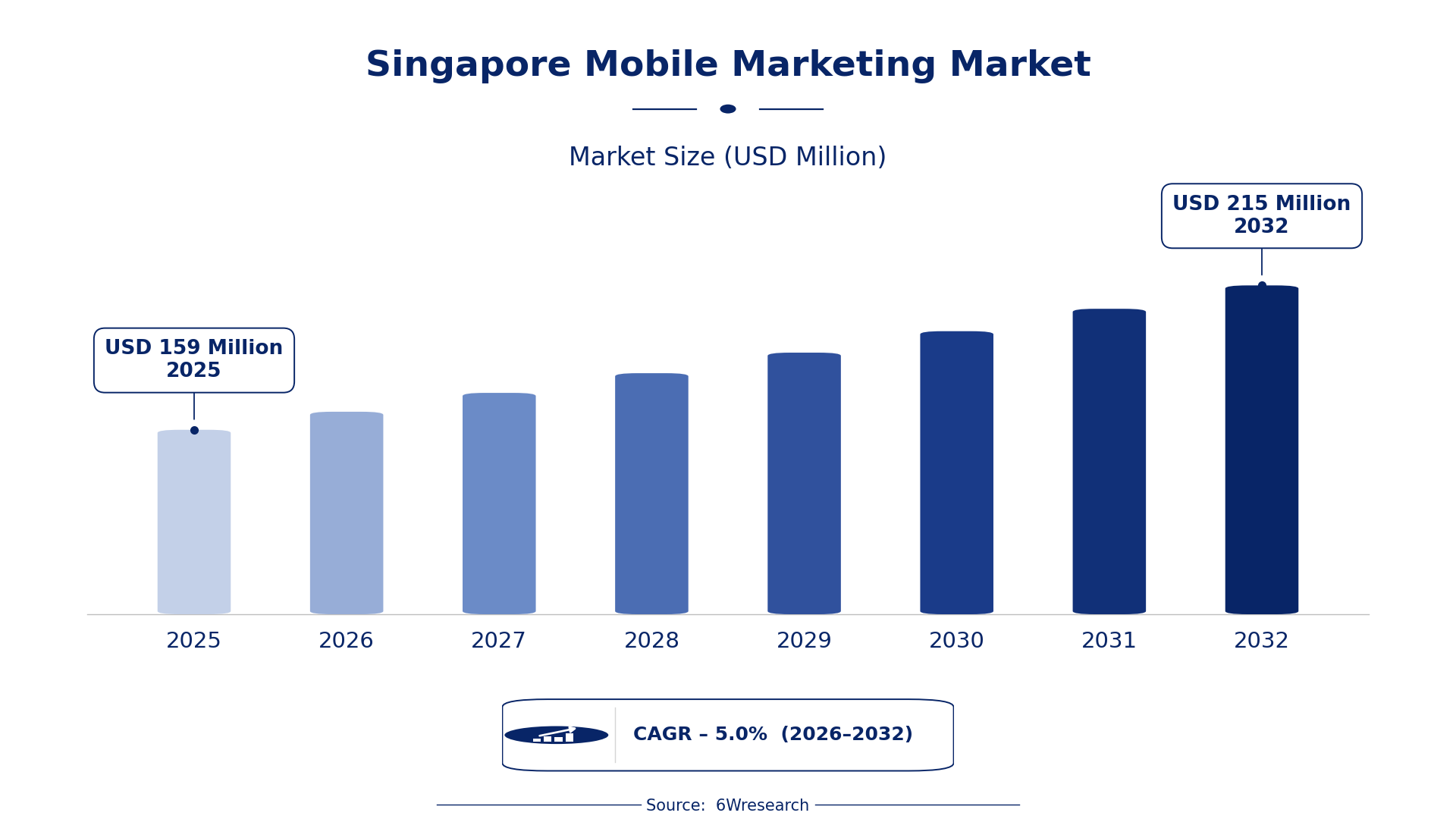
The Singapore Mobile Marketing Market was estimated at USD 159 Million in 2025 and is projected to reach USD 215 Million by 2032, growing at a CAGR of 5.0% from 2026 to 2032.
Singapore Mobile Marketing Market Synopsis
In Singapore, mobile marketing is driven by an exceptionally high smartphone penetration rate, with nearly the entire population connected. This reality creates a unique playground for marketers looking to engage consumers directly on their devices, leveraging advanced technology to craft personalized experiences.
As mobile data consumption continues to rise, Singaporeans are increasingly turning to their mobile devices for entertainment, shopping, and social interactions. This trend has prompted businesses to invest heavily in mobile marketing strategies, adapting to evolving consumer expectations for instant access and high-speed connectivity.
Singapore Mobile Marketing Market Year-wise Growth Rate and Key Drivers
This graph illustrates the annual growth rates of the Singapore Mobile Marketing Market from 2021 to 2032, highlighting a steady upward trajectory and projected expansion over the forecast period.
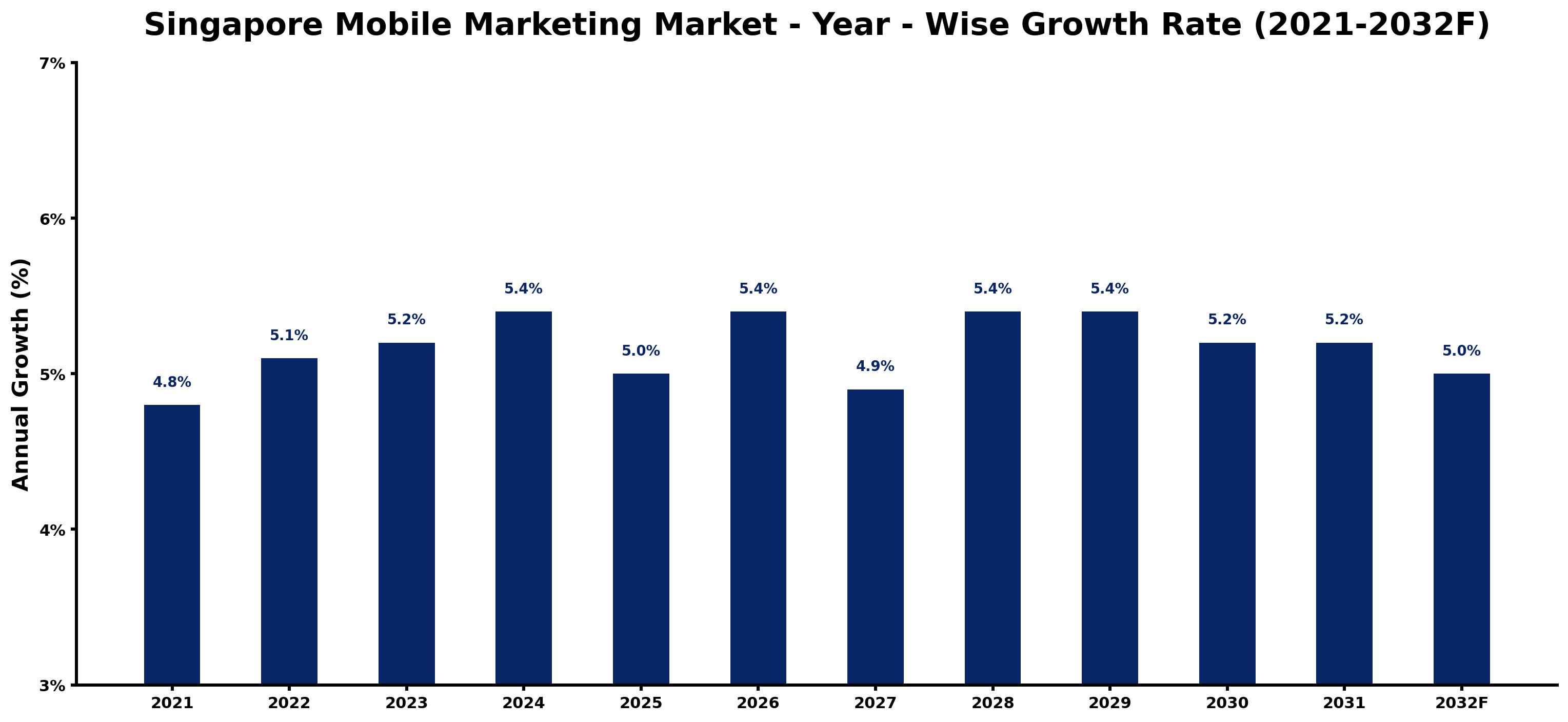
The table below presents the year‑wise growth rates along with the key drivers influencing the market
| Year | Growth Rate | Major Drivers |
| 2021 | 4.8% | Launch of Smart Nation initiative boosting digital engagement. |
| 2022 | 5.1% | Increased focus on personalized mobile advertising strategies. |
| 2023 | 5.2% | Rise in e-commerce driving mobile marketing investments. |
| 2024 | 5.4% | Growing smartphone penetration among senior demographics. |
| 2025 | 5.0% | Post-pandemic recovery increasing mobile ad budgets. |
| 2026 | 5.4% | Government incentives for digital transformation initiatives. |
| 2027 | 4.9% | Shift towards mobile wallets enhancing payment marketing. |
| 2028 | 5.4% | Emergence of localized content favoring local marketers. |
| 2029 | 5.4% | Rise in digital literacy improving mobile ad effectiveness. |
| 2030 | 5.2% | Sustainable marketing practices aligning with consumer preferences. |
| 2031 | 5.2% | Integration of augmented reality in mobile campaigns. |
| 2032 | 5.0% | Proliferation of mobile apps driving targeted advertising growth. |
Note: Market size estimations and growth projections presented in this report are based on 6Wresearch's proprietary forecasting methodology, utilizing the latest available industry data, government publications, and primary research inputs.
Singapore Mobile Marketing Market Key Takeaways
Below are some of the specific key takeaways from the market, including:
- The market's growth reflects the increasing consumer reliance on mobile devices for daily activities.
- Ongoing investment in 5G infrastructure is enhancing mobile marketing capabilities.
- Marketers are emphasizing data privacy and user consent in their strategies.
- Businesses are increasingly utilizing app-based marketing techniques to engage with users effectively.
- There is a growing trend towards integrating mobile payments into marketing campaigns.
Evaluation of Restraints in Singapore Mobile Marketing Market
The Singapore Mobile Marketing Market encounters notable restraints primarily revolving around user privacy and data protection concerns. As mobile marketing relies heavily on user data for targeted advertising, companies face the challenge of complying with stringent regulations while still delivering personalized experiences. The constant evolution of mobile technology demands that marketers stay agile, but this rapid pace can strain resources and lead to missed opportunities if not properly managed. Balancing data-driven marketing with the need for privacy is becoming increasingly essential as regulatory scrutiny intensifies.
Singapore Mobile Marketing Market Trends
A key trend shaping the Singapore Mobile Marketing Market is the integration of artificial intelligence and machine learning into advertising strategies. This technology is helping marketers analyze user behavior more effectively and refine their campaigns for better results. Additionally, the shift towards immersive experiences, such as augmented reality (AR) in mobile ads, is gaining traction, allowing brands to engage consumers in more interactive ways.
Another critical trend is the increased focus on mobile-first strategies, as businesses recognize the necessity of optimizing content for mobile devices. With the growing acceptance of mobile wallets and contactless payment methods, integrating payment systems directly into marketing efforts is also becoming standard practice, encouraging seamless transactions and enhancing consumer satisfaction.
Singapore Mobile Marketing Market Opportunities
Opportunities abound in the Singapore Mobile Marketing Market, particularly in sectors that can harness advanced analytics to better understand consumer preferences. Companies that adopt innovative approaches to engage users through mobile apps and targeted advertising can tap into a goldmine of potential customers. Furthermore, collaborations between mobile carriers and brands offer avenues to enhance marketing reach, especially as 5G technology becomes more widespread, enabling richer content delivery.
Another promising area for growth lies in the rise of mobile commerce. As more consumers embrace online shopping through their smartphones, the demand for tailored marketing strategies to drive sales will surge. In addition, tapping into the youth demographic, which is notably tech-savvy, presents a unique opportunity for brands willing to invest in fresh, engaging content.
Government Initiatives in the Singapore Mobile Marketing Market
The Singapore government plays a crucial role in shaping the mobile marketing environment through various initiatives focused on enhancing digital infrastructure and ensuring data protection. The regulatory framework is designed to encourage innovation while safeguarding consumer privacy, which is essential for building trust in mobile marketing practices.
- A recently completed initiative established clearer guidelines on data privacy for marketers, aiming to enhance consumer confidence.
- Currently underway is a national digital infrastructure upgrade programme designed to improve connectivity and support mobile marketing activities across different sectors.
- Planned for the upcoming year is a public-private partnership expected to enhance mobile payment systems, making them more accessible and secure.
- The government is also investing in educational programs that focus on digital skills, preparing the workforce to engage effectively in the mobile marketing sphere.
Future Insights of the Singapore Mobile Marketing Market
From 2026 to 2032, the Singapore Mobile Marketing Market is set to experience substantial growth driven by advancements in mobile technology and changing consumer behaviors. Brands that adapt to these shifts will find success in personalizing marketing efforts and utilizing data analytics to gain insights into customer preferences. The continuous expansion of 5G will likely open new avenues for immersive advertising experiences, further engaging users and boosting marketing effectiveness.
Singapore Mobile Marketing Market Latest Developments
Over the past year, the Singapore Mobile Marketing Market has seen an influx of developments aimed at enhancing the effectiveness of mobile strategies. As businesses strive to keep pace with consumer demands, many are pivoting towards innovative solutions and integrating new technologies into their marketing efforts.
- A major technology vendor launched a new analytics platform in early 2025 that allows marketers to track mobile campaign performance in real-time.
- An ongoing initiative by a leading regional operator is focused on expanding its 5G network to support richer mobile marketing capabilities, expected to enhance advertising formats by mid-2026.
- A partnership formed between digital marketing firms and e-commerce platforms, which began in Q3 2025, aims to leverage mobile advertising for improving customer acquisition.
- Plans for a new mobile app specifically designed for personalized shopping experiences are set to kick off in late 2026, targeting the rapidly growing m-commerce segment.
Singapore Mobile Marketing Market - Key Attractiveness of the Report
- 10 Years of Market Numbers
- Historical Data Starting from 2022 to 2025
- Base Year: 2025
- Forecast Data until 2032
- Key Performance Indicators Impacting the Market
- Major Upcoming Developments and Projects
Key Highlights of the Report:
- Singapore Mobile Marketing Market Outlook
- Market Size of Singapore Mobile Marketing Market, 2025
- Forecast of Singapore Mobile Marketing Market, 2032
- Historical Data and Forecast of Singapore Mobile Marketing Revenues & Volume for the Period 2022-2032F
- Singapore Mobile Marketing Market Trend Evolution
- Singapore Mobile Marketing Market Drivers and Challenges
- Singapore Mobile Marketing Price Trends
- Singapore Mobile Marketing Porter's Five Forces
- Singapore Mobile Marketing Industry Life Cycle
- Historical Data and Forecast of Singapore Mobile Marketing Market Revenues & Volume By Component for the Period 2022-2032F
- Historical Data and Forecast of Singapore Mobile Marketing Market Revenues & Volume By Platform for the Period 2022-2032F
- Historical Data and Forecast of Singapore Mobile Marketing Market Revenues & Volume By Services for the Period 2022-2032F
- Historical Data and Forecast of Singapore Mobile Marketing Market Revenues & Volume By Organization Size for the Period 2022-2032F
- Historical Data and Forecast of Singapore Mobile Marketing Market Revenues & Volume By SMES for the Period 2022-2032F
- Historical Data and Forecast of Singapore Mobile Marketing Market Revenues & Volume By Large Enterprises for the Period 2022-2032F
- Historical Data and Forecast of Singapore Mobile Marketing Market Revenues & Volume By Vertical for the Period 2022-2032F
- Historical Data and Forecast of Singapore Mobile Marketing Market Revenues & Volume By Retail and eCommerce for the Period 2022-2032F
- Historical Data and Forecast of Singapore Mobile Marketing Market Revenues & Volume By Travel and Logistics for the Period 2022-2032F
- Historical Data and Forecast of Singapore Mobile Marketing Market Revenues & Volume By Automotive for the Period 2022-2032F
- Historical Data and Forecast of Singapore Mobile Marketing Market Revenues & Volume By BFSI for the Period 2022-2032F
- Historical Data and Forecast of Singapore Mobile Marketing Market Revenues & Volume By Telecom and IT for the Period 2022-2032F
- Historical Data and Forecast of Singapore Mobile Marketing Market Revenues & Volume By Media and Entertainment for the Period 2022-2032F
- Historical Data and Forecast of Singapore Mobile Marketing Market Revenues & Volume By Healthcare for the Period 2022-2032F
- Historical Data and Forecast of Singapore Mobile Marketing Market Revenues & Volume By Others (includes energy, education, real estate, and utilities and power) for the Period 2022-2032F
- Historical Data and Forecast of Singapore Mobile Marketing Market Revenues & Volume By Channel for the Period 2022-2032F
- Historical Data and Forecast of Singapore Mobile Marketing Market Revenues & Volume By Messaging for the Period 2022-2032F
- Historical Data and Forecast of Singapore Mobile Marketing Market Revenues & Volume By Push notification for the Period 2022-2032F
- Historical Data and Forecast of Singapore Mobile Marketing Market Revenues & Volume By Mobile Emails for the Period 2022-2032F
- Historical Data and Forecast of Singapore Mobile Marketing Market Revenues & Volume By Quick Response (QR) Code for the Period 2022-2032F
- Historical Data and Forecast of Singapore Mobile Marketing Market Revenues & Volume By Location-based Marketing for the Period 2022-2032F
- Historical Data and Forecast of Singapore Mobile Marketing Market Revenues & Volume By In-app Messages for the Period 2022-2032F
- Historical Data and Forecast of Singapore Mobile Marketing Market Revenues & Volume By Mobile Web for the Period 2022-2032F
- Historical Data and Forecast of Singapore Mobile Marketing Market Revenues & Volume By Others for the Period 2022-2032F
- Singapore Mobile Marketing Import Export Trade Statistics
- Market Opportunity Assessment By Component
- Market Opportunity Assessment By Organization Size
- Market Opportunity Assessment By Vertical
- Market Opportunity Assessment By Channel
- Singapore Mobile Marketing Top Companies Market Share
- Singapore Mobile Marketing Competitive Benchmarking By Technical and Operational Parameters
- Singapore Mobile Marketing Company Profiles
- Singapore Mobile Marketing Key Strategic Recommendations






































