Singapore Motors and Generators Market: Import Trend Analysis
In 2024, Singapore`s import of motors and generators showed a steady increase, driven by growing industrial demand. The market witnessed a notable rise in imported motor and generator units, reflecting the country`s reliance on foreign suppliers for meeting domestic needs.
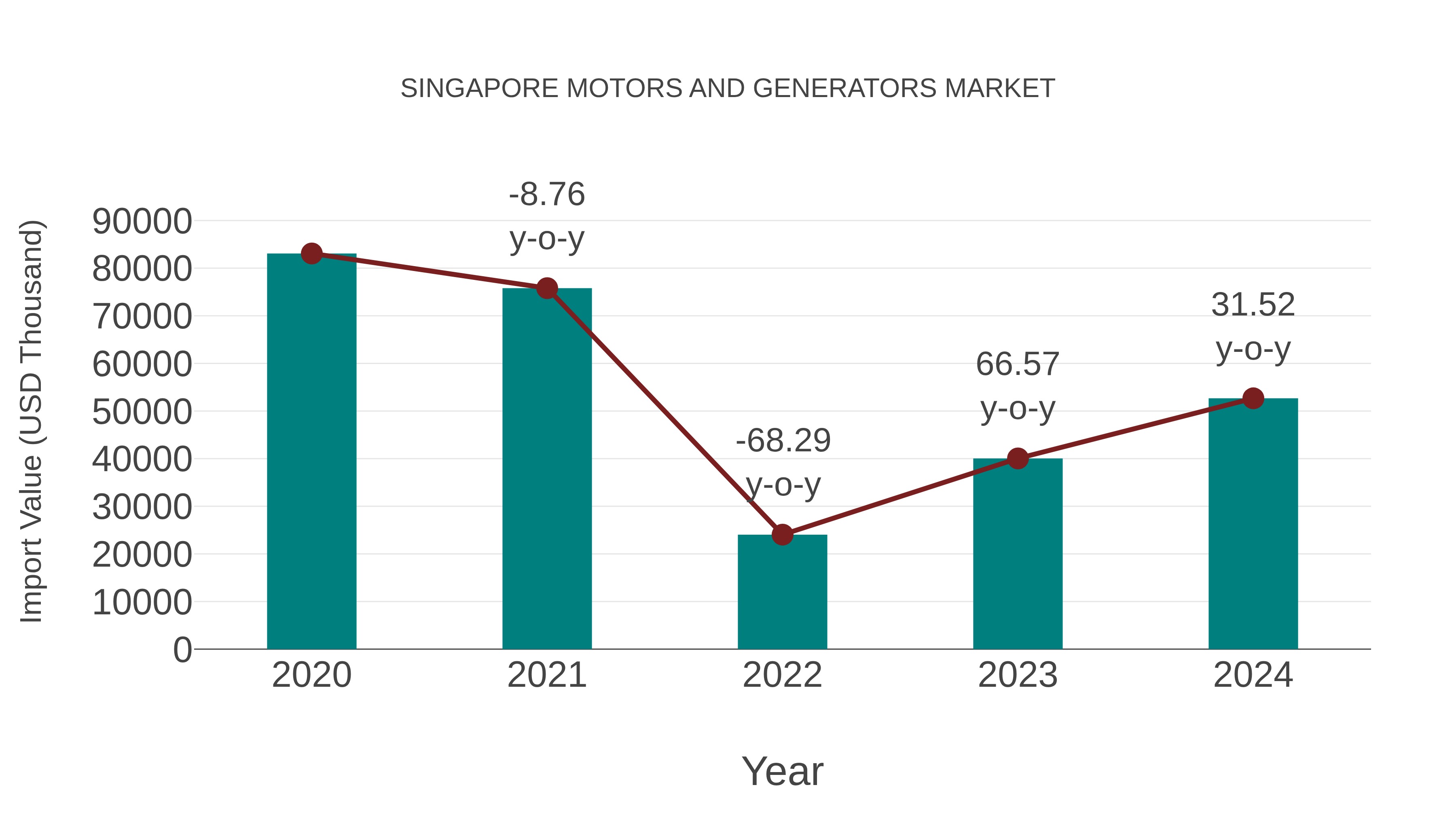
Singapore Motors and Generators Market Synopsis
The Singapore Motors and Generators market is projected to grow at a CAGR of 5.5% during the forecast period 2020-2026. The growth in the demand for electric vehicles, increase in industrialization and the rise in investments in renewable energy sources are some of the major factors driving the motors and generators market in Singapore.
Market Drivers
Increasing Demand for Electric Vehicles: Electric vehicle sales have been witnessing an increase due to government support as well as increasing environmental concern amongst customers. This has resulted into increased demand for efficient motors which will be launched by automakers over time leading to increased demand for motor & generator manufacturing companies operating within this country. Rise In Investments In Renewable Energy Sources: Government initiatives encouraging investors to invest more funds into renewable energy sources such as solar, wind ETC, has led to a surge in investments directed towards these sectors resulting into higher production capacity thereby creating a need for high efficiency motors & generators used across various applications including residential, commercial and industrial purposes.
Market challenges
High Cost of Acquisition Associated With Motors & Generators: Low cost associated with crude oil based products such as automobiles play an important role when it comes to consumer buying behavior however acquisition of motors & generators require large capital amounts thus limiting its adoption rate among end users especially from low income group households or businesses that lack proper financing options available at their disposal.
Key players
Some of the key players operating within Singapore Motors & Generator Market include ABB Ltd., Siemens AG, ASEA Brown Boveri (ABB), Hitachi Ltd., Mitsubishi Heavy Industries (MHI) Group, Denso Corporation, Toshiba International Corporation, Hyundai Electric&Energy Systems Co., Ltd., WEG SA, Kirloskar Electric Company Limited ETC
Covid-19 Impact
COVID -19 pandemic has caused disruption throughout automotive supply chains globally resulting into decreased automobile sales hence leading manufacturers either shut down or operate at reduced capacities gradually allowing them sufficient liquidity while trying not to lay off employees directly involved with production activities causing uncertainty amidst investors regarding future outlooks on spending capabilities post lockdown periods being imposed by governments around the world.
Key Highlights of the Report:
- Singapore Motors and Generators Market Outlook
- Market Size of Singapore Motors and Generators Market, 2023
- Forecast of Singapore Motors and Generators Market, 2030
- Historical Data and Forecast of Singapore Motors and Generators Revenues & Volume for the Period 2020-2030
- Singapore Motors and Generators Market Trend Evolution
- Singapore Motors and Generators Market Drivers and Challenges
- Singapore Motors and Generators Price Trends
- Singapore Motors and Generators Porter's Five Forces
- Singapore Motors and Generators Industry Life Cycle
- Historical Data and Forecast of Singapore Motors and Generators Market Revenues & Volume By Type for the Period 2020-2030
- Historical Data and Forecast of Singapore Motors and Generators Market Revenues & Volume By Motor Manufacturing for the Period 2020-2030
- Historical Data and Forecast of Singapore Motors and Generators Market Revenues & Volume By Generator Manufacturing for the Period 2020-2030
- Historical Data and Forecast of Singapore Motors and Generators Market Revenues & Volume By End-User for the Period 2020-2030
- Historical Data and Forecast of Singapore Motors and Generators Market Revenues & Volume By Industrial for the Period 2020-2030
- Historical Data and Forecast of Singapore Motors and Generators Market Revenues & Volume By Commercial for the Period 2020-2030
- Historical Data and Forecast of Singapore Motors and Generators Market Revenues & Volume By Residential for the Period 2020-2030
- Singapore Motors and Generators Import Export Trade Statistics
- Market Opportunity Assessment By Type
- Market Opportunity Assessment By End-User
- Singapore Motors and Generators Top Companies Market Share
- Singapore Motors and Generators Competitive Benchmarking By Technical and Operational Parameters
- Singapore Motors and Generators Company Profiles
- Singapore Motors and Generators Key Strategic Recommendations






































