Singapore Peer-to-peer (P2P) lending Market Size, Share & Growth Rate
The Singapore Peer-to-peer (P2P) lending Market was estimated at USD 317 Million in 2025 and is projected to reach USD 419 Million by 2032, growing at a CAGR of 4.1% from 2026 to 2032. This upward trajectory is driven by increasing digitalization, which facilitates greater access to financing for individuals and small businesses, thus broadening the borrower base. Additionally, the demand for higher returns from investors is fostering more competition among P2P lending platforms, enhancing market dynamism.
Singapore Peer-to-peer (P2P) lending Market Year-wise Growth Rate and Key Drivers
This graph highlights how the Singapore Peer-to-peer (P2P) lending Market has steadily grown over the years, supported by major growth factors.
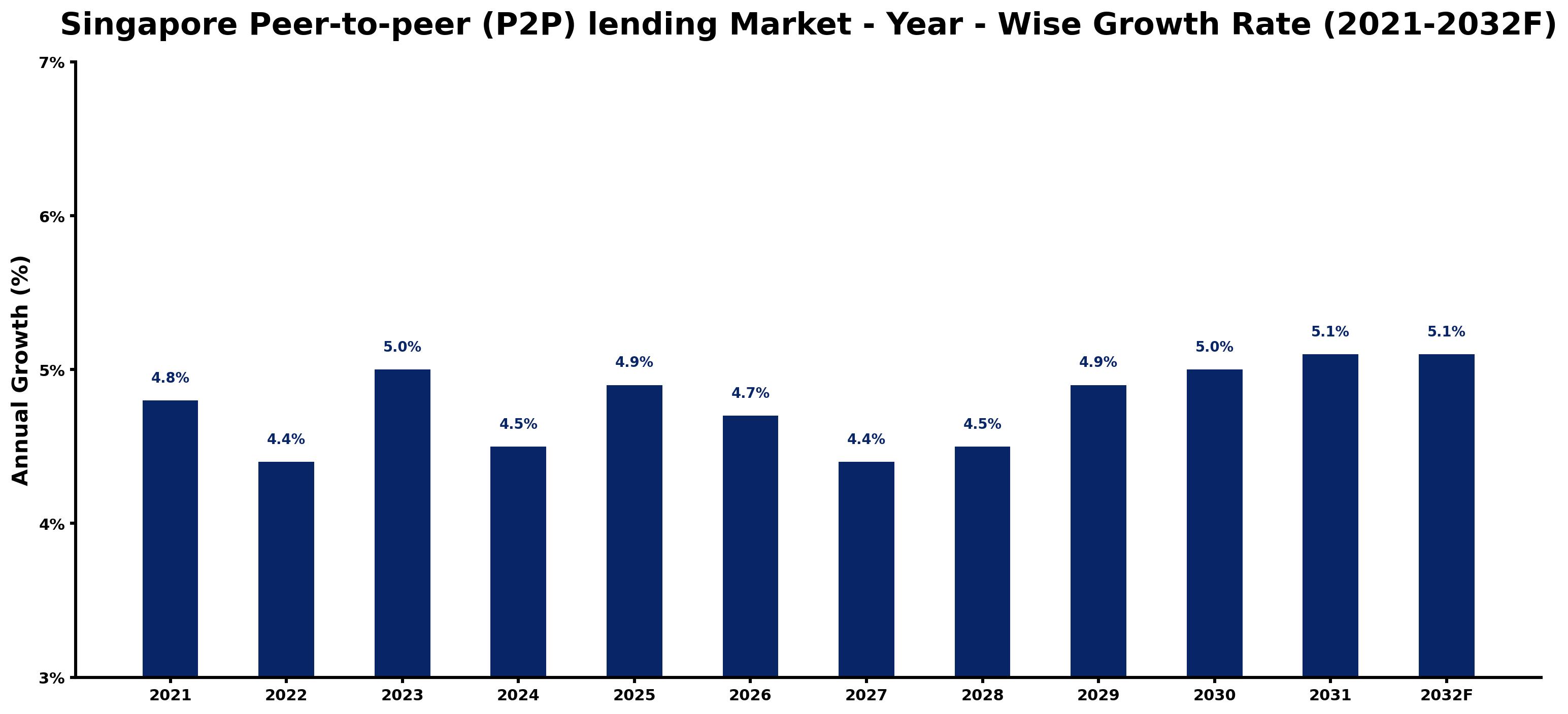
The table below presents the year‑wise growth rates along with the key drivers influencing the market
| Year | Growth Rate | Major Drivers |
| 2021 | 4.8% | Increasing industrial infrastructure investments |
| 2022 | 4.4% | Expansion of transportation and logistics networks |
| 2023 | 5.0% | Increasing smart city development projects |
| 2024 | 4.5% | Expansion of manufacturing activities |
| 2025 | 4.9% | Increasing industrial automation investments |
| 2026 | 4.7% | Expansion of manufacturing activities |
| 2027 | 4.4% | Increasing smart city development projects |
| 2028 | 4.5% | Rapid growth in telecom and data center sectors |
| 2029 | 4.9% | Government infrastructure modernization initiatives |
| 2030 | 5.0% | Rising electricity demand across industries |
| 2031 | 5.1% | Increasing industrial automation investments |
| 2032 | 5.1% | Increasing industrial infrastructure investments |
Note - Market size estimations and growth projections presented in this report are based on 6Wresearch’s advanced forecasting approach, validated with industry datasets as of June 2026.
Singapore Peer-to-peer (P2P) lending Market Synopsis
Recent momentum in Singapore's P2P lending sector has established it as a viable alternative to traditional financing options. However, as the market matures, it is poised for further growth as both borrowers and investors increasingly embrace the advantages of online platforms.
While initial adoption was fueled by a need for accessible funding, the landscape is evolving with advanced technologies enhancing user experience and safety. The interplay of risk assessment innovations and investor appetite will shape the future dynamics of the P2P lending ecosystem.
Singapore Peer-to-peer (P2P) lending Market Key Takeaways
- P2P lending platforms provide accessible financing options, especially for SMEs and individuals with limited traditional banking access.
- Investor opportunities are growing as P2P lending potentially offers higher returns than conventional savings vehicles.
- The rise of digitalization and fintech adoption is revolutionizing how borrowers and lenders connect.
- Regulatory landscapes continue to evolve, posing both challenges and opportunities for market participants.
- COVID-19 has altered credit risk perceptions, influencing both lender confidence and borrower behavior.
Evaluation of Restraints in Singapore Peer-to-peer (P2P) lending Market
Despite its promising trajectory, the Singapore P2P lending market faces significant restraints. High risk and default rates remain concerning, as they can deter potential investors, leading to tighter funding conditions. Additionally, the existing regulatory frameworks are under continuous scrutiny, as balancing protective measures for investors and borrowers with the need for innovation is a delicate task. Furthermore, information asymmetry poses challenges, hindering informed lending decisions and potentially leading to misguided expectations on both sides.
Singapore Peer-to-peer (P2P) lending Market Trends
Current trends indicate an increasing reliance on advanced data analytics and machine learning tools for credit assessment, allowing lenders to make more informed decisions. Additionally, we observe a notable rise in platforms focusing on niche markets, catering to specific borrower demographics or needs. Collaborative models, where P2P lending coexists with traditional financial institutions, are also emerging, indicating a shift toward hybrid financing solutions that leverage the strengths of both sectors.
Singapore Peer-to-peer (P2P) lending Market Opportunities
Significant growth opportunities lie in expanding the borrower base through targeted marketing strategies aimed at underserved demographics. Moreover, as fintech evolves, the integration of blockchain technology for enhanced transparency and security presents an avenue for innovation. Investors are increasingly interested in socially responsible lending, allowing P2P platforms to introduce ethical investment options that could resonate with a growing segment of the market.
Government Initiatives in the Singapore Peer-to-peer (P2P) lending Market
The Singapore government has been proactive in fostering a conducive environment for P2P lending through various initiatives. Regulatory bodies are actively refining policies to ensure investor protection while promoting healthy market growth. Public spending aimed at enhancing digital infrastructure has supported the rise of fintech solutions, further encouraging the evolution of P2P lending platforms. Programs aimed at educating both borrowers and lenders about the dynamics of P2P lending reflect a commitment to market stability and transparency.
Future Insights of the Singapore Peer-to-peer (P2P) lending Market
Looking ahead to 2026-2032, the Singapore P2P lending market is expected to experience significant transformations. The integration of AI and big data analytics will likely lead to enhanced risk assessment techniques, refining credit evaluation processes. The anticipated rise in digital finance literacy among the population will further drive platform engagement. Additionally, evolving regulatory frameworks will likely create a more robust environment that balances innovation with investor protection, ultimately fostering a more resilient P2P lending ecosystem.
Singapore Peer-to-peer (P2P) lending Market Latest Developments (May 2025 - June 2026)
The Singapore P2P lending market is undergoing notable transformations, with platforms increasingly leveraging digital technologies to enhance user experience and streamline operations. Recent developments have seen the introduction of innovative lending products tailored for niche sectors, as well as enhanced risk management protocols. Collaboration between P2P platforms and regulatory bodies is strengthening compliance frameworks while addressing investor concerns, signaling a maturing market landscape.
Singapore Peer-to-peer (P2P) lending Market - Key Attractiveness of the Report
- 10 Years of Market Numbers
- Historical Data Starting from 2022 to 2025
- Base Year: 2025
- Forecast Data until 2032
- Key Performance Indicators Impacting the Market
- Major Upcoming Developments and Projects
Key Highlights of the Report:
- Singapore Peer-to-peer (P2P) lending Market Outlook
- Market Size of Singapore Peer-to-peer (P2P) lending Market, 2025
- Forecast of Singapore Peer-to-peer (P2P) lending Market, 2032F
- Historical Data and Forecast of Singapore Peer-to-peer (P2P) lending Revenues & Volume for the Period 2022-2032F
- Singapore Peer-to-peer (P2P) lending Market Trend Evolution
- Singapore Peer-to-peer (P2P) lending Market Drivers and Challenges
- Singapore Peer-to-peer (P2P) lending Price Trends
- Singapore Peer-to-peer (P2P) lending Porter's Five Forces
- Singapore Peer-to-peer (P2P) lending Industry Life Cycle
- Historical Data and Forecast of Singapore Peer-to-peer (P2P) lending Market Revenues & Volume By Business Model for the Period 2022-2032F
- Historical Data and Forecast of Singapore Peer-to-peer (P2P) lending Market Revenues & Volume By Alternate Marketplace Lending for the Period 2022-2032F
- Historical Data and Forecast of Singapore Peer-to-peer (P2P) lending Market Revenues & Volume By Traditional Lending for the Period 2022-2032F
- Historical Data and Forecast of Singapore Peer-to-peer (P2P) lending Market Revenues & Volume By Type for the Period 2022-2032F
- Historical Data and Forecast of Singapore Peer-to-peer (P2P) lending Market Revenues & Volume By Consumer Lending for the Period 2022-2032F
- Historical Data and Forecast of Singapore Peer-to-peer (P2P) lending Market Revenues & Volume By Business Lending for the Period 2022-2032F
- Historical Data and Forecast of Singapore Peer-to-peer (P2P) lending Market Revenues & Volume By End User for the Period 2022-2032F
- Historical Data and Forecast of Singapore Peer-to-peer (P2P) lending Market Revenues & Volume By Consumer Credit Loans for the Period 2022-2032F
- Historical Data and Forecast of Singapore Peer-to-peer (P2P) lending Market Revenues & Volume By Small Business Loans for the Period 2022-2032F
- Historical Data and Forecast of Singapore Peer-to-peer (P2P) lending Market Revenues & Volume By Student Loans for the Period 2022-2032F
- Historical Data and Forecast of Singapore Peer-to-peer (P2P) lending Market Revenues & Volume By Real Estate Loans for the Period 2022-2032F
- Singapore Peer-to-peer (P2P) lending Import Export Trade Statistics
- Market Opportunity Assessment By Business Model
- Market Opportunity Assessment By Type
- Market Opportunity Assessment By End User
- Singapore Peer-to-peer (P2P) lending Top Companies Market Share
- Singapore Peer-to-peer (P2P) lending Competitive Benchmarking By Technical and Operational Parameters
- Singapore Peer-to-peer (P2P) lending Company Profiles
- Singapore Peer-to-peer (P2P) lending Key Strategic Recommendations






































