Singapore Polio Vaccine Market Size, Share & Growth Rate
The Singapore Polio Vaccine Market was estimated at USD 477 Million in 2025 and is projected to reach USD 632 Million by 2032, growing at a CAGR of 4.1% from 2026 to 2032. This growth trajectory reflects Singapore's unwavering commitment to public health and the proactive measures taken to ensure widespread immunization against poliovirus. As health authorities and organizations intensify vaccination campaigns, the demand for effective and reliable polio vaccines is expected to rise steadily, reinforcing the nations polio-free status.
Singapore Polio Vaccine Market Year-wise Growth Rate and Key Drivers
This graph highlights how the Singapore Polio Vaccine Market has steadily grown over the years, supported by major growth factors.
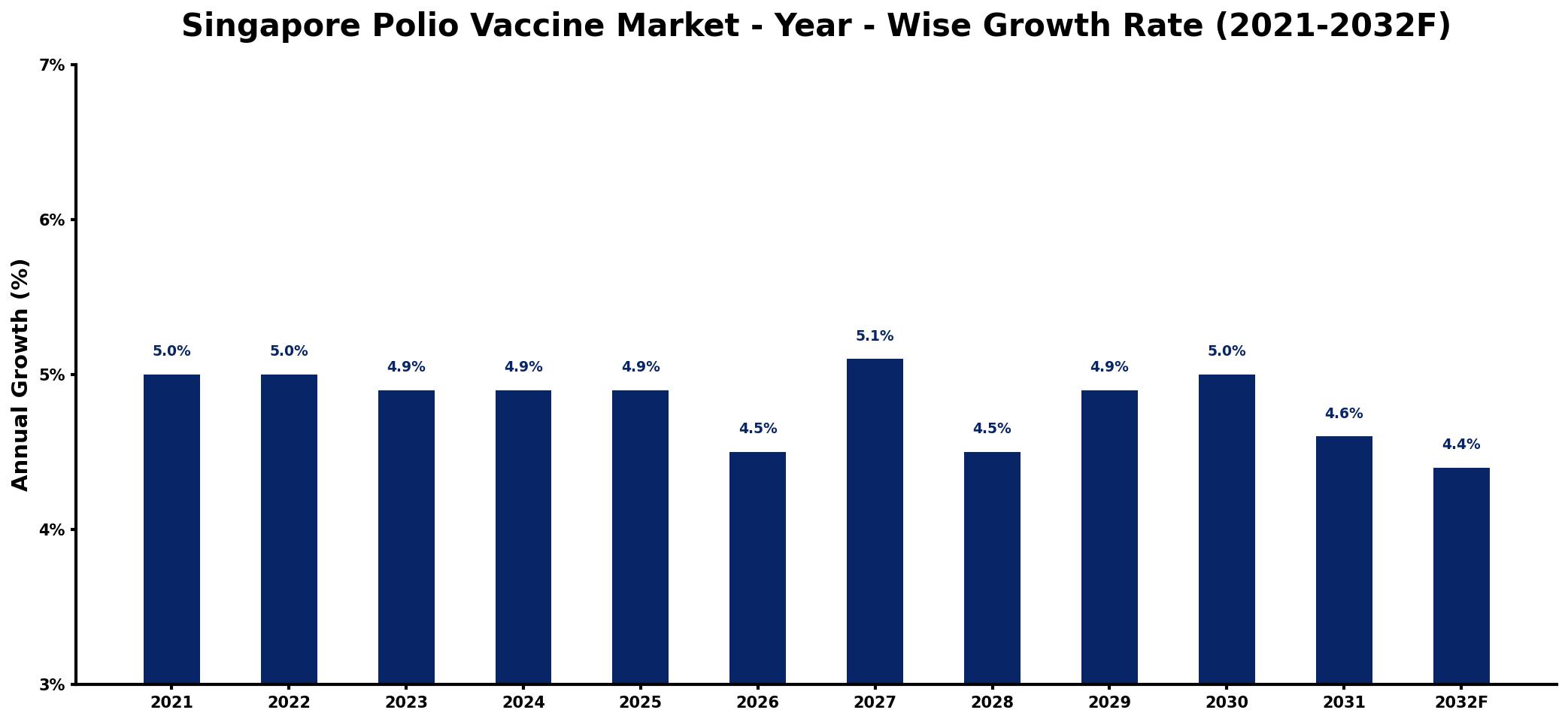
The table below presents the year‑wise growth rates along with the key drivers influencing the market
| Year | Growth Rate | Major Drivers |
| 2021 | 5.0% | Rising healthcare expenditure supports demand |
| 2022 | 5.0% | Increased public awareness initiatives launched |
| 2023 | 4.9% | Government funding for preventive measures |
| 2024 | 4.9% | Expansion of healthcare infrastructure projects |
| 2025 | 4.9% | Growing population health consciousness trend |
| 2026 | 4.5% | Investment in research and development |
| 2027 | 5.1% | Emergence of new healthcare partnerships |
| 2028 | 4.5% | Strengthened international health collaborations |
| 2029 | 4.9% | Advancements in distribution networks established |
| 2030 | 5.0% | Increased focus on childhood immunization |
| 2031 | 4.6% | Enhanced community health education programs |
| 2032 | 4.4% | Strengthened regulatory frameworks implemented |
Note: Market size estimations and growth projections presented in this report are based on 6Wresearch's proprietary forecasting methodology, utilizing the latest available industry data, government publications, and primary research inputs.
Singapore Polio Vaccine Market Synopsis
Recent initiatives in Singapore underscore the critical importance of polio vaccination as a public health imperative. With ongoing global efforts to eradicate poliovirus, Singapore's healthcare system emphasizes vaccinations as essential to protecting its population and maintaining the nation's health status. Public awareness campaigns are increasingly prevalent, educating citizens on the importance of immunization to combat potential outbreaks.
The polio vaccine market is a vital component of Singapore's broader public health strategy. The active involvement of healthcare organizations in promoting vaccination has led to robust participation rates. Key stakeholders, including pharmaceutical companies and government bodies, are collaborating to ensure that the population remains informed and engaged in vaccination efforts, especially in the face of vaccine hesitancy.
Singapore Polio Vaccine Market Key Takeaways
- Public health campaigns play a pivotal role in maintaining high vaccination rates and combating misinformation.
- Healthcare systems prioritize polio vaccinations as part of broader disease eradication strategies.
- The market demonstrates resilience, having adapted to challenges posed by the COVID-19 pandemic while continuing vaccination programs.
- Increased public awareness of the safety and efficacy of vaccines supports growth in the market.
- Pharmaceutical manufacturers are critical contributors, providing the vaccines necessary for continued public health success.
Evaluation of Restraints in Singapore Polio Vaccine Market
Despite the promising growth potential, the Singapore Polio Vaccine Market faces significant challenges, particularly in the realm of vaccine hesitancy. Misinformation regarding vaccine safety can lead to reluctance among specific demographics, creating barriers to achieving optimal vaccination rates. Furthermore, a fragmented communication landscape complicates the dissemination of accurate information, necessitating strategic public health campaigns to rebuild trust and underscore the importance of vaccination as a preventative measure.
Singapore Polio Vaccine Market Trends
Several key trends are emerging in the Singapore Polio Vaccine Market that will shape its future. Digital health initiatives are becoming increasingly prominent, leveraging technology to streamline vaccine distribution and enhance public engagement. Furthermore, an uptick in collaboration between the government and healthcare organizations facilitates innovative strategies to reach underserved populations. The ongoing evolution of vaccine formulations and delivery mechanisms is also contributing to enhanced immunization efforts.
Singapore Polio Vaccine Market Opportunities
Investment opportunities within the Singapore Polio Vaccine Market are abundant. The growing focus on public health and disease prevention creates avenues for new entrants and established companies to develop innovative vaccine solutions. Additionally, public-private partnerships can enhance resource allocation and knowledge sharing, fostering a robust environment for research and development. As healthcare providers pivot toward integrated vaccination programs, there is an increasing need for comprehensive strategies that promote both vaccine uptake and public education.
Government Initiatives in the Singapore Polio Vaccine Market
The Singaporean government has undertaken significant initiatives to promote polio vaccinations, reflecting its commitment to public health. Programs aimed at increasing awareness and accessibility are in place, with significant public spending dedicated to vaccine distribution and immunization campaigns. These efforts are often complemented by strategic partnerships with healthcare organizations, enabling a cohesive approach to eradication strategies and vaccine rollout.
Future Insights of the Singapore Polio Vaccine Market
Looking ahead to 2026-2032, the Singapore Polio Vaccine Market is poised for sustained growth as public health priorities continue to evolve. With ongoing efforts to eliminate poliovirus globally, Singapore's proactive vaccination strategies are expected to remain at the forefront. As vaccine technologies advance and public trust in vaccinations strengthens, the market will likely see increased participation and support, solidifying Singapore's status as a leader in health security.
Singapore Polio Vaccine Market Latest Developments (2025 - 2026)
In recent months, industry developments have focused on enhancing polio vaccination strategies and increasing community outreach programs. Health authorities have initiated collaborative efforts to ensure that vaccination drives reach all segments of the population, particularly targeting areas with lower vaccination rates. Additionally, there have been advancements in vaccine distribution logistics, ensuring that vaccines are available and accessible in a timely manner, even in challenging environments.
Singapore Polio Vaccine Market - Key Attractiveness of the Report
- 10 Years of Market Numbers
- Historical Data Starting from 2022 to 2025
- Base Year: 2025
- Forecast Data until 2032
- Key Performance Indicators Impacting the Market
- Major Upcoming Developments and Projects
Key Highlights of the Report:
- Singapore Polio Vaccine Market Outlook
- Market Size of Singapore Polio Vaccine Market, 2025
- Forecast of Singapore Polio Vaccine Market, 2032
- Historical Data and Forecast of Singapore Polio Vaccine Revenues & Volume for the Period 2022-2032F
- Singapore Polio Vaccine Market Trend Evolution
- Singapore Polio Vaccine Market Drivers and Challenges
- Singapore Polio Vaccine Price Trends
- Singapore Polio Vaccine Porter's Five Forces
- Singapore Polio Vaccine Industry Life Cycle
- Historical Data and Forecast of Singapore Polio Vaccine Market Revenues & Volume By Type for the Period 2022-2032F
- Historical Data and Forecast of Singapore Polio Vaccine Market Revenues & Volume By Oral Polio Vaccine (OPV) for the Period 2022-2032F
- Historical Data and Forecast of Singapore Polio Vaccine Market Revenues & Volume By Inactivated Poliomyelitis Vaccine (IPV) for the Period 2022-2032F
- Historical Data and Forecast of Singapore Polio Vaccine Market Revenues & Volume By Application for the Period 2022-2032F
- Historical Data and Forecast of Singapore Polio Vaccine Market Revenues & Volume By Public for the Period 2022-2032F
- Historical Data and Forecast of Singapore Polio Vaccine Market Revenues & Volume By Private for the Period 2022-2032F
- Singapore Polio Vaccine Import Export Trade Statistics
- Market Opportunity Assessment By Type
- Market Opportunity Assessment By Application
- Singapore Polio Vaccine Top Companies Market Share
- Singapore Polio Vaccine Competitive Benchmarking By Technical and Operational Parameters
- Singapore Polio Vaccine Company Profiles
- Singapore Polio Vaccine Key Strategic Recommendations






































