Singapore Printed Circuit Boards Market Summary
The singapore printed circuit boards market was estimated at USD 238 Million in 2025 and is projected to reach USD 322 Million by 2032, growing at a CAGR of 5.6% from 2026 to 2032.
Singapore Printed Circuit Boards Market Year-wise Growth Rate and Key Drivers
This graph highlights how the Singapore Printed Circuit Boards Market has steadily grown over the past five years, supported by major growth factors.
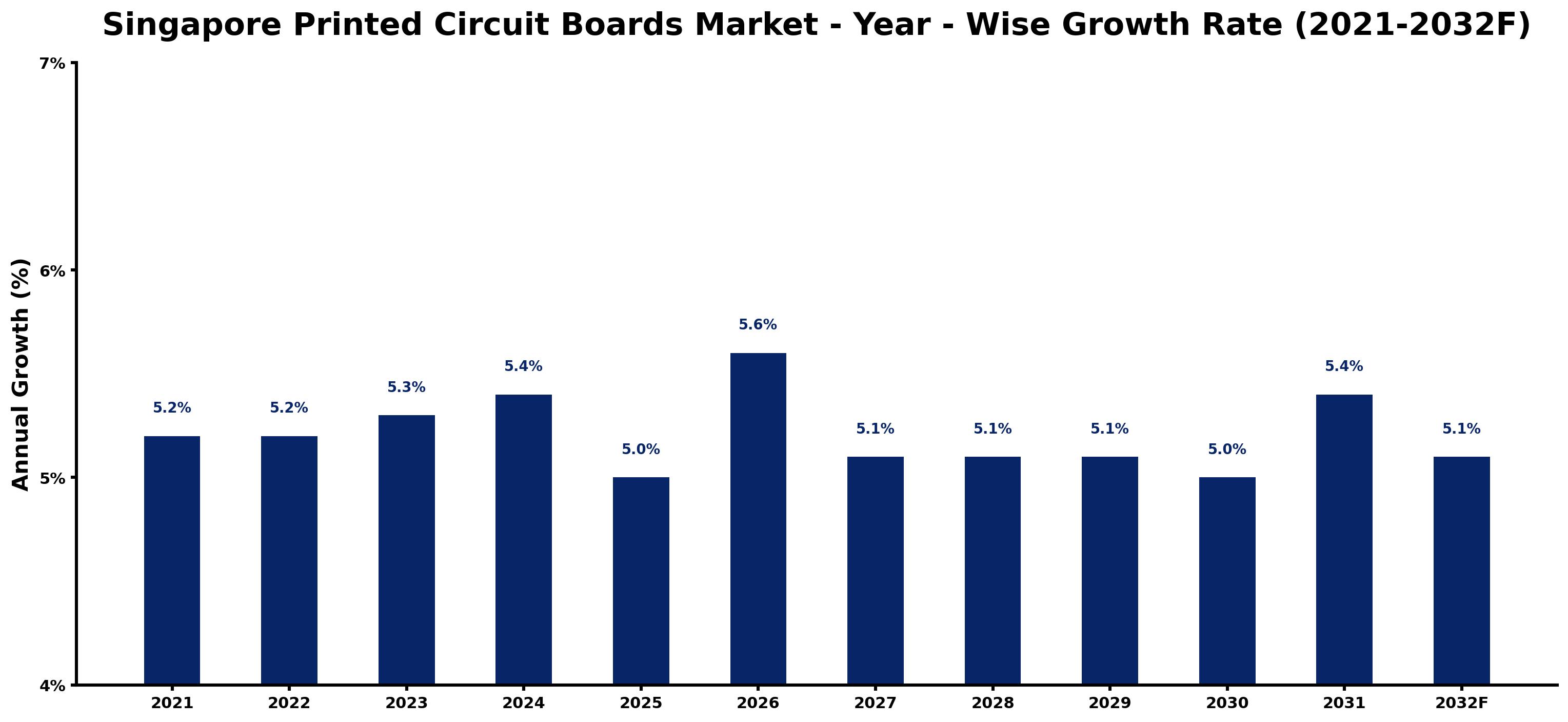
The table below presents the year wise growth rates along with the key drivers influencing the market
| Year | Growth Rate | Major Drivers |
| 2021 | 5.2% | Post-pandemic recovery fuels demand for electronics and circuit boards across industries. |
| 2022 | 5.2% | Technological innovations improve manufacturing processes and reduce production costs significantly. |
| 2023 | 5.3% | Corporate budgets increasingly focus on sustainable electronics, enhancing PCB market potential. |
| 2024 | 5.4% | Expansion of smart devices leads to higher complexity in PCB design requirements. |
| 2025 | 5.0% | Increased investment in 5G infrastructure drives demand for high-frequency circuit boards. |
| 2026 | 5.6% | Local production capabilities strengthen as companies prioritize supply chain resilience. |
| 2027 | 5.1% | Emerging AI applications necessitate advanced PCB technologies for efficient processing. |
| 2028 | 5.1% | The automotive sector's shift towards electric vehicles boosts demand for specialized PCBs. |
| 2029 | 5.1% | Consumer electronics innovation creates a surge in demand for multi-layered circuit boards. |
| 2030 | 5.0% | International partnerships enhance technology transfer, improving local PCB manufacturing quality. |
| 2031 | 5.4% | Sustainability initiatives compel manufacturers to adopt eco-friendly PCB materials and processes. |
| 2032 | 5.1% | Digital transformation across industries ensures continuous growth in PCB application sectors. |
Note - Market size estimations and growth projections presented in this report are based on 6Wresearch's advanced forecasting approach, validated with industry datasets as of June 2026.
Singapore Printed Circuit Boards Market Synopsis
The Singapore Printed Circuit Boards Market is projected to reach 5.6% and witness significant growth during the forecast period (2026-2032). This growth trajectory is primarily driven by the increasing demand for consumer electronic products, the expansion of the semiconductor industry, and the presence of prominent manufacturers within the region. The market is experiencing dynamic changes that will shape its future, influenced by various global and local factors.
Singapore Printed Circuit Boards Market Growth Drivers
The growth of the Singapore Printed Circuit Boards Market is underpinned by several key drivers that are integral to the industry's expansion.
- Rising Demand for Consumer Electronics: The robust demand for smartphones, tablets, and other consumer electronics is a pivotal factor driving the growth of the PCB market in Singapore. As consumers increasingly seek cutting-edge technology, the need for advanced PCBs that support these devices will rise accordingly.
- Advancements in Semiconductor Technology: The burgeoning semiconductor industry is propelling the demand for PCBs. Innovations and advancements in integrated circuits necessitate sophisticated PCB designs that can accommodate new technologies, driving further investment and development in the sector.
- Growth in Automotive Production: Increasing disposable incomes in Southeast Asia have led to a rise in vehicle production. This, in turn, fuels the demand for various automotive components, including advanced PCBs designed for automotive applications, enhancing the overall market landscape.
- Increased Investment in R&D: Companies are consistently investing in research and development activities to enhance product offerings and maintain competitiveness. This focus on R&D not only fosters innovation but also contributes significantly to improving manufacturing efficiencies within the PCB market.
- Technological Evolution of Manufacturing Processes: The adoption of automated and improved manufacturing processes enables PCB manufacturers to produce high-quality products while optimizing costs. This evolution is critical in meeting the growing demands without compromising on standards.
Singapore Printed Circuit Boards Market Challenges and Restraints
Despite the growth opportunities, the Singapore Printed Circuit Boards Market faces several challenges that could hamper its progress.
- High Cost of Automotive Components: The automotive sector faces stringent regulations regarding performance and emissions, leading to higher production costs. Manufacturers are pressured to balance performance and affordability, challenging profitability margins and affecting the supply chain.
- Intense Competition Among Manufacturers: With a multitude of players in the market, competition remains fierce. Companies need to differentiate their products, leading to increased marketing and operational costs, which can put pressure on profit margins.
- Supply Chain Disruptions: Global supply chain issues, exacerbated by events such as the COVID-19 pandemic, have created uncertainties in material availability and cost. These disruptions can lead to inventory pileups and affect overall market stability.
- Regulatory Challenges: Compliance with evolving regulations poses additional challenges for manufacturers. Companies must invest in ensuring that their products meet mandatory standards, thereby increasing operational complexity.
- Technological Changes: The rapid pace of technological change necessitates continuous adaptation from manufacturers. Failing to keep up with the latest advancements can result in loss of market competitiveness and obsolescence of products.
Singapore Printed Circuit Boards Market Investment Opportunities
Investment opportunities in the Singapore Printed Circuit Boards Market are significant and increasingly attractive.
- Expansion of Production Facilities: The ongoing demand for PCBs in various sectors suggests potential investment in expanding manufacturing capacities to meet future needs effectively.
- Emergence of Smart Technologies: The increasing integration of IoT and smart technologies opens avenues for PCB innovation, enabling manufacturers to explore investments in advanced PCB applications.
- Partnerships for Technological Advancements: Forming strategic partnerships can foster innovation and allow companies to leverage advanced technologies, streamlining processes and enhancing product offerings.
- Market Diversification: Expanding into new geographical markets or sectors can create additional revenue streams, especially as demand for electronics continues to grow globally.
- Focus on Sustainable Practices: Investments aimed at developing eco-friendly PCBs and sustainable manufacturing practices are becoming increasingly important, appealing to both consumers and regulatory bodies.
Singapore Printed Circuit Boards Market Government Investment and Initiatives
The Singapore government plays a crucial role in supporting the development of the Printed Circuit Boards Market through various initiatives and investments.
- Support for R&D: Government grants and incentives aimed at promoting research and development in the electronics sector enhance innovation capabilities among PCB manufacturers.
- Infrastructure Development: Investment in infrastructure improvements facilitates better logistics and connectivity for the manufacturing sector, reducing operational costs for PCB producers.
- Skill Development Programs: Initiatives to enhance workforce skills in advanced manufacturing and engineering help nurture talent necessary for advancements in PCB technology.
- Promotion of Sustainability: Policies encouraging environmentally friendly practices within manufacturing are being promoted to align with global sustainability goals, thus influencing PCB production standards.
- Trade Agreements: Strategic trade agreements designed to bolster the electronics sector can provide PCB manufacturers with better access to international markets.
Singapore Printed Circuit Boards Market Latest Developments (May 2025 - June 2026)
Over the period from May 2025 to June 2026, the Singapore Printed Circuit Boards Market has witnessed significant developments shaping its trajectory.
- Technological Advancements: Innovations in PCB manufacturing, including the adoption of high-density interconnection (HDI) technology, have become more prevalent, improving product performance and efficiency.
- Increased Demand for 5G Technology: The rollout of 5G services has resulted in a surge in demand for PCBs that can support high-speed data transmission, driving investments in this segment.
- Focus on Manufacturing Efficiency: Companies have increasingly adopted lean manufacturing practices and automation to enhance productivity and reduce production costs.
- Resilience in Supply Chains: Efforts to strengthen supply chain resilience have been prioritized, with manufacturers investing in diversified sourcing strategies to mitigate disruptions.
- Heightened Regulatory Focus: The introduction of new regulations aimed at enhancing environmental sustainability has nudged manufacturers toward adopting greener practices in PCB production.
Singapore Printed Circuit Boards Market - Key Attractiveness of the Report
- 10 Years of Market Numbers
- Historical Data Starting from 2022 to 2025
- Base Year: 2025
- Forecast Data until 2032
- Key Performance Indicators Impacting the Market
- Major Upcoming Developments and Projects
Key Highlights of the Report:
- Singapore Printed Circuit Boards Market Outlook
- Market Size of Singapore Printed Circuit Boards Market, 2025
- Forecast of Singapore Printed Circuit Boards Market, 2032F
- Historical Data and Forecast of Singapore Printed Circuit Boards Revenues & Volume for the Period 2022-2032F
- Singapore Printed Circuit Boards Market Trend Evolution
- Singapore Printed Circuit Boards Market Drivers and Challenges
- Singapore Printed Circuit Boards Price Trends
- Singapore Printed Circuit Boards Porter's Five Forces
- Singapore Printed Circuit Boards Industry Life Cycle
- Historical Data and Forecast of Singapore Printed Circuit Boards Market Revenues & Volume By Types for the Period 2022-2032F
- Historical Data and Forecast of Singapore Printed Circuit Boards Market Revenues & Volume By Single Sided for the Period 2022-2032F
- Historical Data and Forecast of Singapore Printed Circuit Boards Market Revenues & Volume By Double Sided for the Period 2022-2032F
- Historical Data and Forecast of Singapore Printed Circuit Boards Market Revenues & Volume By Multi-Layer for the Period 2022-2032F
- Historical Data and Forecast of Singapore Printed Circuit Boards Market Revenues & Volume By HDI for the Period 2022-2032F
- Historical Data and Forecast of Singapore Printed Circuit Boards Market Revenues & Volume By Substrate for the Period 2022-2032F
- Historical Data and Forecast of Singapore Printed Circuit Boards Market Revenues & Volume By Rigid for the Period 2022-2032F
- Historical Data and Forecast of Singapore Printed Circuit Boards Market Revenues & Volume By Flexible for the Period 2022-2032F
- Historical Data and Forecast of Singapore Printed Circuit Boards Market Revenues & Volume By Rigid-Flex for the Period 2022-2032F
- Historical Data and Forecast of Singapore Printed Circuit Boards Market Revenues & Volume By End-users for the Period 2022-2032F
- Historical Data and Forecast of Singapore Printed Circuit Boards Market Revenues & Volume By Industrial Electronics for the Period 2022-2032F
- Historical Data and Forecast of Singapore Printed Circuit Boards Market Revenues & Volume By Healthcare for the Period 2022-2032F
- Historical Data and Forecast of Singapore Printed Circuit Boards Market Revenues & Volume By Aerospace & Defense for the Period 2022-2032F
- Historical Data and Forecast of Singapore Printed Circuit Boards Market Revenues & Volume By Automotive for the Period 2022-2032F
- Historical Data and Forecast of Singapore Printed Circuit Boards Market Revenues & Volume By IT & Telecom for the Period 2022-2032F
- Historical Data and Forecast of Singapore Printed Circuit Boards Market Revenues & Volume By Consumer Electronics for the Period 2022-2032F
- Historical Data and Forecast of Singapore Printed Circuit Boards Market Revenues & Volume By Others for the Period 2022-2032F
- Singapore Printed Circuit Boards Import Export Trade Statistics
- Market Opportunity Assessment By Types
- Market Opportunity Assessment By Substrate
- Market Opportunity Assessment By End-users
- Singapore Printed Circuit Boards Top Companies Market Share
- Singapore Printed Circuit Boards Competitive Benchmarking By Technical and Operational Parameters
- Singapore Printed Circuit Boards Company Profiles
- Singapore Printed Circuit Boards Key Strategic Recommendations






































