Singapore Printing Market Summary
The singapore printing market was estimated at USD 1078 Million in 2025 and is projected to reach USD 1560 Million by 2032, growing at a CAGR of 6.0% from 2026 to 2032.
Singapore Printing Market Year-wise Growth Rate and Key Drivers
This graph highlights how the Singapore Printing Market has steadily grown over the past five years, supported by major growth factors.
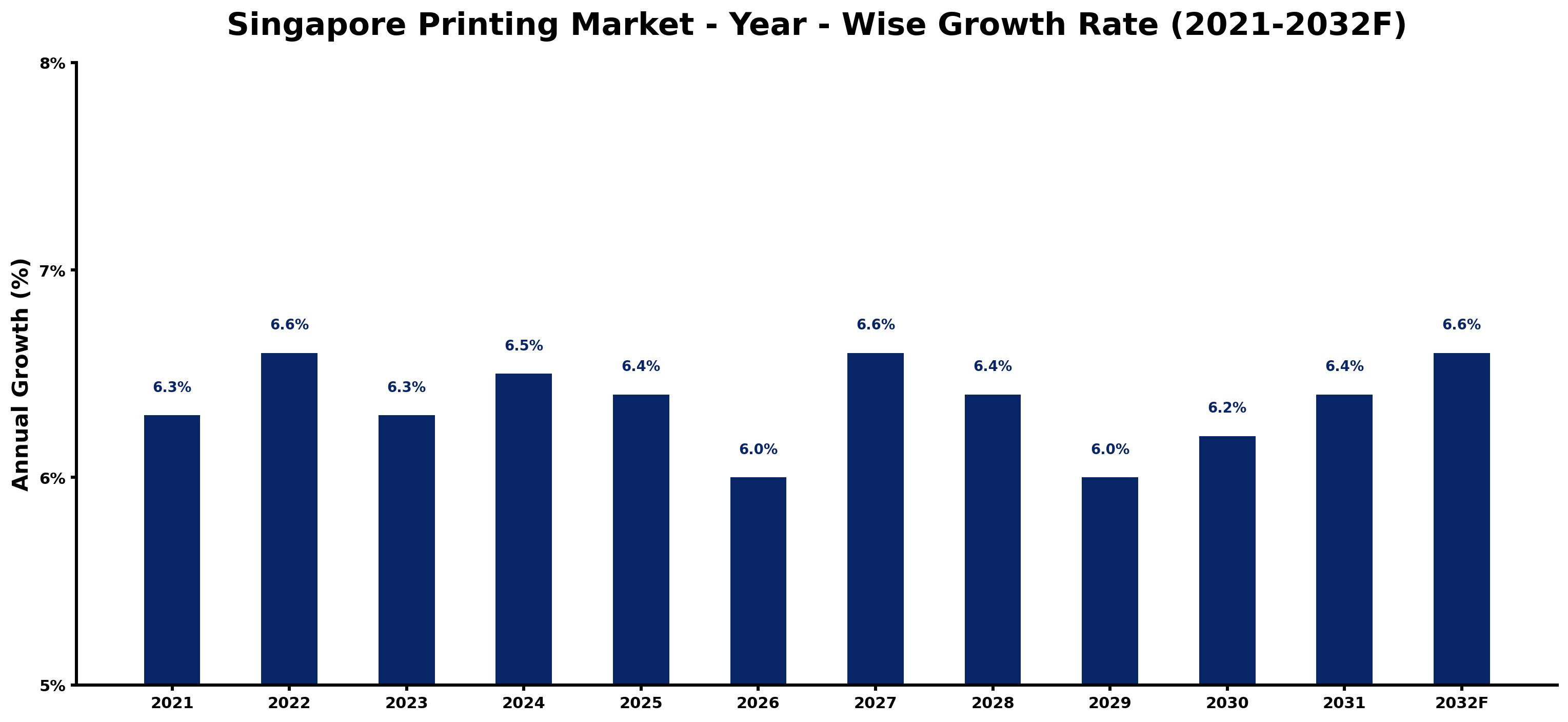
The table below presents the year wise growth rates along with the key drivers influencing the market
| Year | Growth Rate | Major Drivers |
| 2021 | 6.3% | Post-lockdown retail projects spurred a resurgence in local printing requirements. |
| 2022 | 6.6% | E-commerce growth led retailers to invest in customized packaging solutions. |
| 2023 | 6.3% | Corporate sustainability commitments increased demand for eco-friendly printing materials. |
| 2024 | 6.5% | Technological innovations enabled quicker turnaround times for production processes. |
| 2025 | 6.4% | The thriving tourism sector stimulated promotional printing for events and attractions. |
| 2026 | 6.0% | Consumer preference shifted towards personalized products, driving customized printing services. |
| 2027 | 6.6% | Emerging startups in Singapore focused on niche printing services, enhancing competition. |
| 2028 | 6.4% | Integration of digital solutions streamlined workflows, improving operational efficiencies. |
| 2029 | 6.0% | Corporate rebranding initiatives fueled demand for high-quality marketing collateral. |
| 2030 | 6.2% | Investments in local manufacturing facilities reduced reliance on imported printed goods. |
| 2031 | 6.4% | Increased collaboration between tech firms and printers resulted in innovative service offerings. |
| 2032 | 6.6% | Sustainable practices became a market standard, reshaping consumer expectations and preferences. |
Note - Market size estimations and growth projections presented in this report are based on 6Wresearch's advanced forecasting approach, validated with industry datasets as of June 2026.
Singapore Printing Market Synopsis
The Singapore Printing Market is projected to reach 6.0% and witness significant growth during the forecast period (2026-2032). The market is anticipated to expand at a compound annual growth rate (CAGR) of 4.4%, driven by strong demand for digital printing solutions across various sectors, including fast-moving consumer goods (FMCG), apparel, food beverage, education, and electronics. This growth is largely a response to increasing competition and the need for businesses to adopt innovative technologies that enhance operational efficiency while delivering cost-effective solutions.
Singapore Printing Market Growth Drivers
Several factors are contributing to the growth of the Singapore Printing Market, highlighting the evolving landscape:
- The rising demand for specialty printing services is notable, especially for customized packaging and short-run special color treatments. The use of advanced printing technologies, such as inkjet and laser engraving, is facilitating these services, which cater to consumer preferences for personalization.
- The adoption of digital printing technology is accelerating as firms seek to leverage its capabilities for efficient and high-quality production. Digital printing allows for quick turnaround times and minimal setup, making it an attractive option over traditional methods.
- A thriving economy in Singapore is another crucial driver, as it fosters investments in technological advancements. Companies are increasingly integrating innovative solutions to stay competitive in a fast-paced market.
- Environmental sustainability is becoming a priority in the printing sector. Businesses are investing in eco-friendly printing practices and materials, which are driving growth in demand for sustainable solutions.
- The burgeoning e-commerce sector is also contributing to the demand for packaging solutions, further spurring growth in the printing market as brands seek unique and eye-catching packaging to attract customers.
Singapore Printing Market Market Challenges and Restraints
Despite its positive growth trajectory, the Singapore Printing Market faces several challenges:
- One of the primary challenges is the high cost of investment associated with modern printing technologies. The initial capital requirement can be a barrier for smaller businesses operating on tight budgets, limiting their ability to upgrade equipment.
- There is a notable shortage of skilled professionals in the industry. The complexity of modern printing technologies necessitates expertise that is often lacking, hindering the potential for innovation and efficiency improvements within companies.
- The fluctuating demand for print materials in the digital age presents a market constraint. Several businesses are transitioning to digital solutions, which may reduce the volume of traditional print orders.
- Supply chain disruptions, particularly stemming from global events such as the COVID-19 pandemic, have caused uncertainty and operational delays in the printing sector.
- Intense competition in the market further pressures profit margins, making it difficult for some companies to invest in new technologies while maintaining competitiveness.
Singapore Printing Market Government Investment and Initiatives
The government of Singapore plays a significant role in fostering the growth of the printing sector through various investments and initiatives aimed at enhancing technological capabilities and innovation:
- The Singapore government has committed to supporting businesses through grants and subsidies to encourage the adoption of advanced printing technologies, aiding in the transition towards a more digitized economy.
- Public sector initiatives focusing on industry transformation projects are designed to upgrade existing printing infrastructure, aligning it with global standards and practices.
- There are efforts to promote sustainability in printing, including initiatives that encourage the use of eco-friendly materials and processes, reflecting the government's commitment to environmental responsibility.
- Skill development programs are being implemented to address the shortage of skilled professionals in the printing sector. These initiatives aim to train individuals in modern printing technologies and practices.
- Investment in research and development is being prioritized, aiming to stimulate innovation in printing technologies and enhance Singapore's reputation as a hub for technological advancements.
Singapore Printing Market Latest Developments (May 2025 - June 2026)
Between May 2025 and June 2026, the Singapore printing industry witnessed several significant developments that continue to shape its trajectory:
- A marked increase in collaborations between printing companies and tech startups aimed at integrating artificial intelligence into printing processes was observed, enhancing operational efficiencies and product quality.
- The ongoing expansion of e-commerce has forced traditional printing businesses to adapt rapidly, with many investing in logistics and packaging solutions tailored for online sales.
- Sustainability initiatives gained momentum, with more companies undertaking efforts to reduce waste and invest in green technologies, such as biodegradable inks and recyclable materials.
- The industry saw an increase in demand for on-demand printing services, allowing businesses to meet specific customer needs without incurring excessive inventory costs.
- Regional partnerships were strengthened, fostering collaboration between local printing firms and international players, thereby enhancing market competitiveness and sharing of best practices.
Singapore Printing Market - Key Attractiveness of the Report
- 10 Years of Market Numbers
- Historical Data Starting from 2022 to 2025
- Base Year: 2025
- Forecast Data until 2032
- Key Performance Indicators Impacting the Market
- Major Upcoming Developments and Projects
Key Highlights of the Report:
- Singapore Printing Market Outlook
- Market Size of Singapore Printing Market, 2025
- Forecast of Singapore Printing Market, 2032F
- Historical Data and Forecast of Singapore Printing Revenues & Volume for the Period 2022-2032F
- Singapore Printing Market Trend Evolution
- Singapore Printing Market Drivers and Challenges
- Singapore Printing Price Trends
- Singapore Printing Porter's Five Forces
- Singapore Printing Industry Life Cycle
- Historical Data and Forecast of Singapore Printing Market Revenues & Volume By Types for the Period 2022-2032F
- Historical Data and Forecast of Singapore Printing Market Revenues & Volume By Commercial Printing for the Period 2022-2032F
- Historical Data and Forecast of Singapore Printing Market Revenues & Volume By Commercial Screen Printing for the Period 2022-2032F
- Historical Data and Forecast of Singapore Printing Market Revenues & Volume By Books Printing for the Period 2022-2032F
- Historical Data and Forecast of Singapore Printing Market Revenues & Volume By Technology for the Period 2022-2032F
- Historical Data and Forecast of Singapore Printing Market Revenues & Volume By Flexography Printing for the Period 2022-2032F
- Historical Data and Forecast of Singapore Printing Market Revenues & Volume By Rotogravure Printing for the Period 2022-2032F
- Historical Data and Forecast of Singapore Printing Market Revenues & Volume By Digital Printing for the Period 2022-2032F
- Historical Data and Forecast of Singapore Printing Market Revenues & Volume By OffSet Printing for the Period 2022-2032F
- Historical Data and Forecast of Singapore Printing Market Revenues & Volume By Others for the Period 2022-2032F
- Singapore Printing Import Export Trade Statistics
- Market Opportunity Assessment By Types
- Market Opportunity Assessment By Technology
- Singapore Printing Top Companies Market Share
- Singapore Printing Competitive Benchmarking By Technical and Operational Parameters
- Singapore Printing Company Profiles
- Singapore Printing Key Strategic Recommendations






































