Singapore Seafood Processing Market Size, Share & Growth Rate
The Singapore Seafood Processing Market was estimated at USD 479 Million in 2025 and is projected to reach USD 655 Million by 2032, growing at a CAGR of 4.6% from 2026 to 2032. This growth trajectory is fueled by a robust demand for processed seafood products as consumer preferences shift towards convenience and quality. The ongoing trend of innovation in processing techniques and a rising export appetite are also significantly contributing to the market's expansion.
Singapore Seafood Processing Market Year-wise Growth Rate and Key Drivers
This graph highlights how the Singapore Seafood Processing Market has steadily grown over the years, supported by major growth factors.
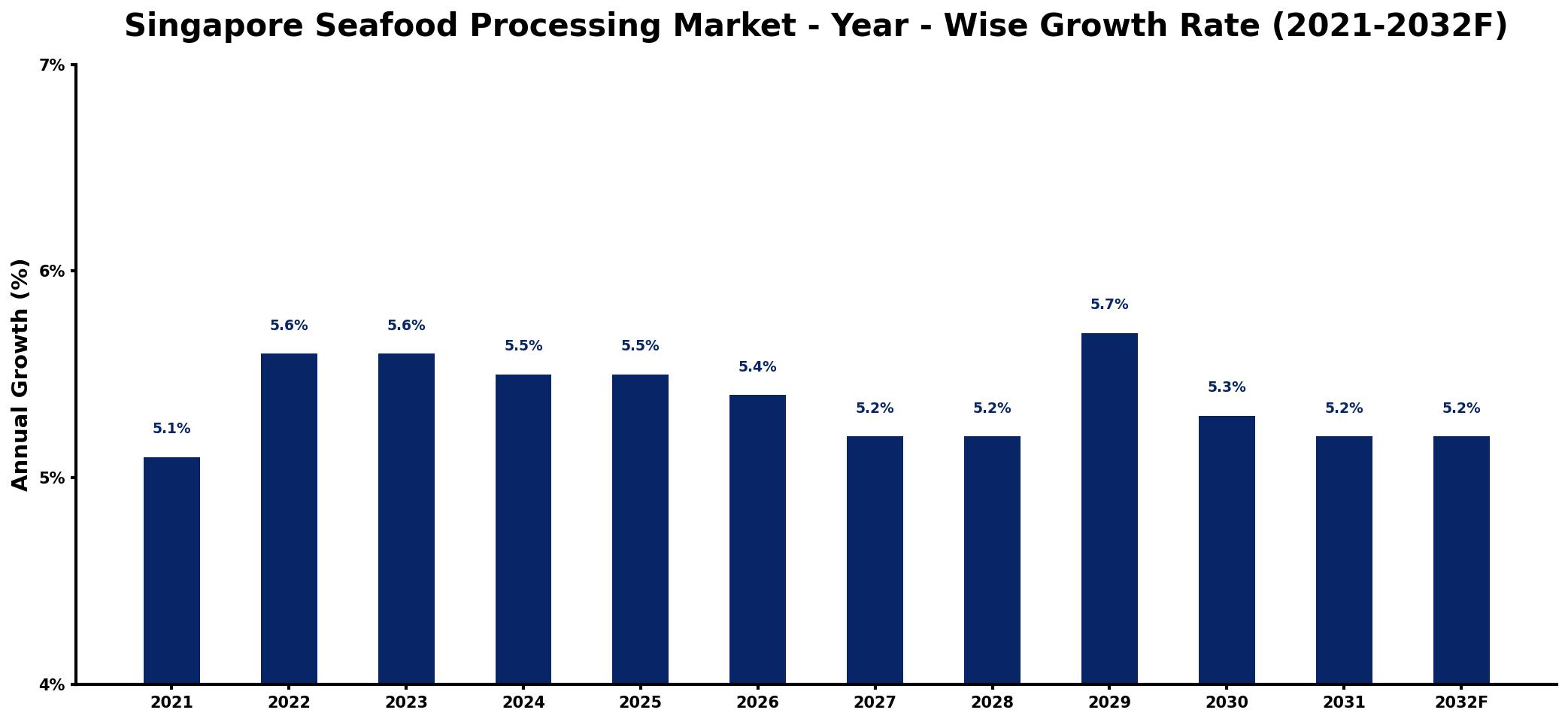
The table below presents the year‑wise growth rates along with the key drivers influencing the market
| Year | Growth Rate | Major Drivers |
| 2021 | 5.1% | Rising consumer health awareness |
| 2022 | 5.6% | Increased investment in technology |
| 2023 | 5.6% | Expansion of delivery services |
| 2024 | 5.5% | Growth in export opportunities |
| 2025 | 5.5% | Surge in online retail channels |
| 2026 | 5.4% | increased pharmaceutical industry usage |
| 2027 | 5.2% | Development of new markets |
| 2028 | 5.2% | Boost in culinary tourism interest |
| 2029 | 5.7% | Strengthening local supply chains |
| 2030 | 5.3% | Adoption of innovative packaging |
| 2031 | 5.2% | Focus on premium product offerings |
| 2032 | 5.2% | Collaboration with local chefs |
Note: Market size estimations and growth projections presented in this report are based on 6Wresearch's proprietary forecasting methodology, utilizing the latest available industry data, government publications, and primary research inputs.
Singapore Seafood Processing Market Synopsis
The demand for high-quality seafood processing services stands as the most powerful force shaping the Singapore seafood processing market today. As consumers increasingly opt for ready-to-eat and easy-to-prepare seafood products, processors are responding with a broad range of offerings, from fillets to canned goods, to meet these evolving preferences.
In addition to consumer demand, the export opportunities present within the seafood sector are vital for market growth. As Singapore establishes itself as a significant player in the global seafood trade, the focus on quality assurance and adherence to stringent food safety standards will only grow, solidifying the market's pivotal role in the supply chain.
Singapore Seafood Processing Market Key Takeaways
- The market is projected to achieve significant growth due to increasing consumer demand for convenience foods.
- Innovation in processing technologies is a key driver, enhancing product quality and variety.
- Strict food safety regulations necessitate robust quality assurance measures in processing.
- Resilience during COVID-19 highlighted the critical importance of efficient supply chains in the seafood sector.
- Export potential remains a primary focus, with opportunities for growth in international markets.
Evaluation of Restraints in Singapore Seafood Processing Market
While the Singapore seafood processing market is poised for growth, several restraints limit its potential. Key concerns include the challenge of sourcing sustainable seafood amidst rising demand, as well as the complexities of maintaining food safety standards across the processing spectrum. The need for consistent quality and flavor, coupled with technological advancements in processing methods, creates additional pressure on companies to innovate continually. The apprehensions surrounding food safety also demand rigorous adherence to regulations, which can sometimes impede operational flexibility and speed to market.
Singapore Seafood Processing Market Trends
Current trends in the Singapore seafood processing market include an increasing shift towards sustainable sourcing practices and the implementation of advanced processing technologies. Companies are exploring automation and robotics to enhance efficiency while reducing labor costs. Furthermore, the growing popularity of plant-based seafood alternatives is prompting processors to diversify their product lines, catering to the rising consumer interest in healthier and environmentally friendly options. Packaging innovations aimed at preserving freshness and enhancing convenience are also gaining traction as essential elements of market strategies.
Singapore Seafood Processing Market Opportunities
Significant growth and investment opportunities lie in the expansion of value-added products, such as ready-to-cook seafood meals that cater to busy lifestyles. The growing tourism industry in Singapore also presents avenues for increasing exports and establishing partnerships in foodservice sectors. Additionally, as consumers become more health-conscious, there is a clear demand for products that emphasize nutritional benefits, which processors can leverage for market differentiation.
Government Initiatives in the Singapore Seafood Processing Market
The Singaporean government plays a pivotal role in shaping the seafood processing market through various initiatives aimed at promoting sustainability and enhancing food safety standards. Programs that support the development of modern processing facilities, alongside investments in research and innovation, are designed to bolster the industrys global competitiveness. Incentives for companies adopting sustainable practices further encourage advancements in processing techniques, aligning with national priorities for food security and environmental conservation.
Future Insights of the Singapore Seafood Processing Market
Looking ahead to the 2026-2032 period, the Singapore seafood processing market is expected to continue its growth trajectory, driven by evolving consumer preferences and the increasing significance of export markets. The emphasis on product quality and safety will deepen, fostering greater investment in processing technologies and innovations. As the global seafood landscape evolves, Singapore is well-positioned to capitalize on emerging trends in sustainability and health consciousness, ensuring its relevance in the international seafood supply chain.
Singapore Seafood Processing Market Latest Developments (2025 - 2026)
Recent developments in the Singapore seafood processing market highlight a strong focus on improving operational efficiencies through technological advancements. Industry players are increasingly adopting cutting-edge processing equipment and digital solutions to streamline workflows and enhance product quality. The ongoing exploration of new export markets, particularly in Asia-Pacific regions, reflects the sector's adaptability to changing consumer demands and global market dynamics.
Singapore Seafood Processing Market - Key Attractiveness of the Report
- 10 Years of Market Numbers
- Historical Data Starting from 2022 to 2025
- Base Year: 2025
- Forecast Data until 2032
- Key Performance Indicators Impacting the Market
- Major Upcoming Developments and Projects
Key Highlights of the Report:
- Singapore Seafood Processing Market Outlook
- Market Size of Singapore Seafood Processing Market, 2025
- Forecast of Singapore Seafood Processing Market, 2032
- Historical Data and Forecast of Singapore Seafood Processing Revenues & Volume for the Period 2022-2032F
- Singapore Seafood Processing Market Trend Evolution
- Singapore Seafood Processing Market Drivers and Challenges
- Singapore Seafood Processing Price Trends
- Singapore Seafood Processing Porter's Five Forces
- Singapore Seafood Processing Industry Life Cycle
- Historical Data and Forecast of Singapore Seafood Processing Market Revenues & Volume By Equipment Type for the Period 2022-2032F
- Historical Data and Forecast of Singapore Seafood Processing Market Revenues & Volume By Gutting Equipment for the Period 2022-2032F
- Historical Data and Forecast of Singapore Seafood Processing Market Revenues & Volume By Sealing Equipment for the Period 2022-2032F
- Historical Data and Forecast of Singapore Seafood Processing Market Revenues & Volume By Filleting Equipment for the Period 2022-2032F
- Historical Data and Forecast of Singapore Seafood Processing Market Revenues & Volume By Deboning Equipment for the Period 2022-2032F
- Historical Data and Forecast of Singapore Seafood Processing Market Revenues & Volume By other Equipment for the Period 2022-2032F
- Historical Data and Forecast of Singapore Seafood Processing Market Revenues & Volume By Category for the Period 2022-2032F
- Historical Data and Forecast of Singapore Seafood Processing Market Revenues & Volume By Single-Function Equipment for the Period 2022-2032F
- Historical Data and Forecast of Singapore Seafood Processing Market Revenues & Volume By Multi-Function Equipment for the Period 2022-2032F
- Historical Data and Forecast of Singapore Seafood Processing Market Revenues & Volume By Seafood Type for the Period 2022-2032F
- Historical Data and Forecast of Singapore Seafood Processing Market Revenues & Volume By Fish for the Period 2022-2032F
- Historical Data and Forecast of Singapore Seafood Processing Market Revenues & Volume By Crustaceans for the Period 2022-2032F
- Historical Data and Forecast of Singapore Seafood Processing Market Revenues & Volume By Mollusks for the Period 2022-2032F
- Historical Data and Forecast of Singapore Seafood Processing Market Revenues & Volume By others for the Period 2022-2032F
- Singapore Seafood Processing Import Export Trade Statistics
- Market Opportunity Assessment By Equipment Type
- Market Opportunity Assessment By Category
- Market Opportunity Assessment By Seafood Type
- Singapore Seafood Processing Top Companies Market Share
- Singapore Seafood Processing Competitive Benchmarking By Technical and Operational Parameters
- Singapore Seafood Processing Company Profiles
- Singapore Seafood Processing Key Strategic Recommendations






































