Singapore Semiconductor Foundry Market Size, Share & Growth Rate
The Singapore Semiconductor Foundry Market was estimated at USD 308 Million in 2025 and is projected to reach USD 417 Million by 2032, growing at a CAGR of 4.4% from 2026 to 2032. This anticipated growth is underpinned by Singapore's robust focus on enhancing its semiconductor manufacturing capabilities and its strategic positioning within the electronics sector. Additionally, the increasing demand for advanced integrated circuits and microchips in various electronic devices further fuels the need for foundry services in the region.
Singapore Semiconductor Foundry Market Year-wise Growth Rate and Key Drivers
This graph highlights how the Singapore Semiconductor Foundry Market has steadily grown over the years, supported by major growth factors.
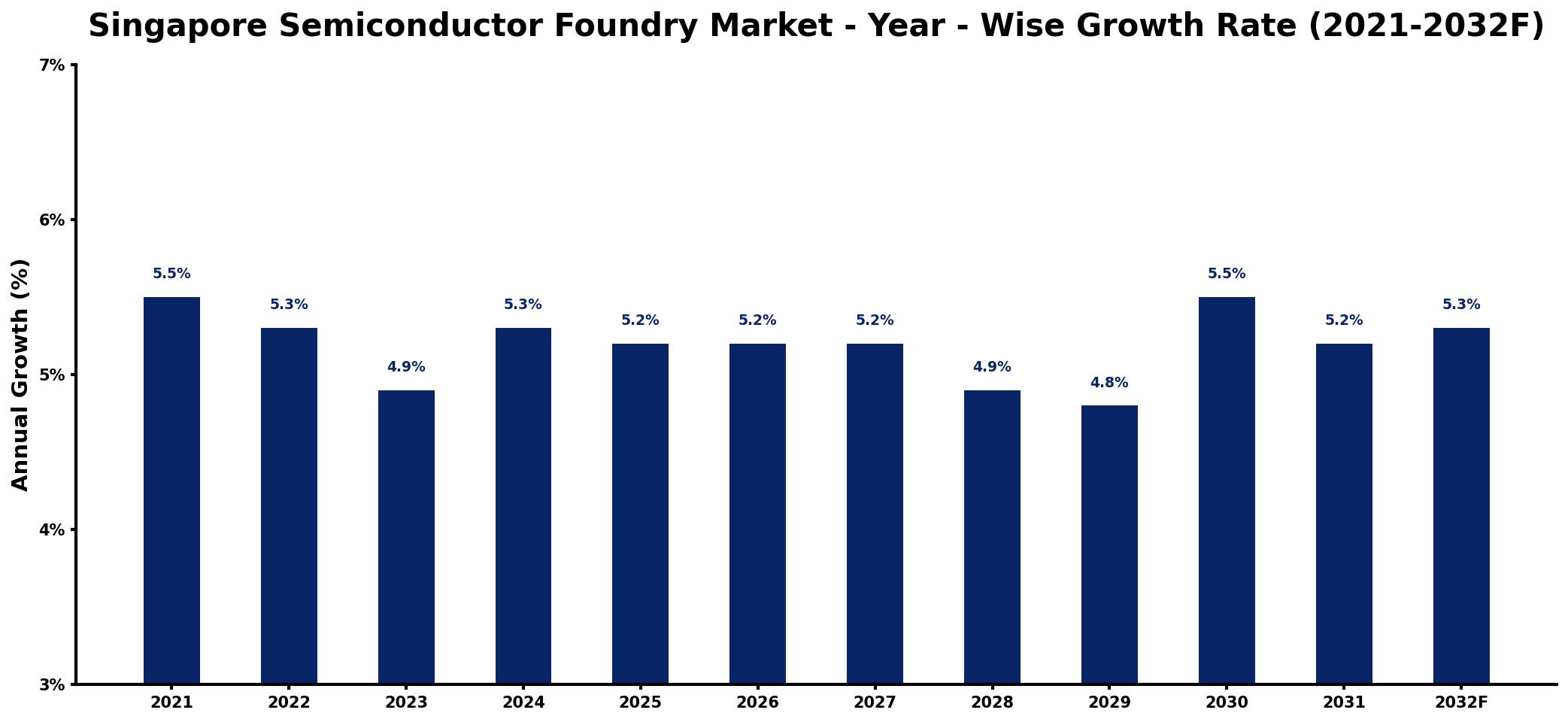
The table below presents the year‑wise growth rates along with the key drivers influencing the market
| Year | Growth Rate | Major Drivers |
| 2021 | 5.5% | Increased investments in technology sectors |
| 2022 | 5.3% | Rising demand for consumer electronics |
| 2023 | 4.9% | Growth in automotive electronics market |
| 2024 | 5.3% | Expansion of 5G infrastructure projects |
| 2025 | 5.2% | Higher adoption of IoT devices |
| 2026 | 5.2% | Demand surge in AI applications |
| 2027 | 5.2% | growing regional consumption patterns |
| 2028 | 4.9% | Increased focus on data centers |
| 2029 | 4.8% | Higher demand for mobile devices |
| 2030 | 5.5% | strengthening international trade flows |
| 2031 | 5.2% | growing emerging market penetration |
| 2032 | 5.3% | rising export shipment volumes |
Note: Market size estimations and growth projections presented in this report are based on 6Wresearch's proprietary forecasting methodology, utilizing the latest available industry data, government publications, and primary research inputs.
Singapore Semiconductor Foundry Market Synopsis
The driving force in the Singapore Semiconductor Foundry Market is the countrys unwavering commitment to becoming a global leader in semiconductor manufacturing. This is evidenced by substantial investments in state-of-the-art fabrication facilities and a thriving electronics ecosystem. As the demand for high-performance devices grows, foundries in Singapore are crucial in delivering innovative solutions that meet the industrys evolving needs.
Moreover, the semiconductor foundry market serves a diverse array of sectors, including consumer electronics, telecommunications, and automotive technology. This diversified customer base not only reinforces the market's resilience but also positions Singapore as a strategic hub in the global semiconductor supply chain, capable of responding to varying demand dynamics across multiple industries.
Singapore Semiconductor Foundry Market Key Takeaways
- The market is experiencing solid growth due to increased investments in semiconductor manufacturing.
- Continuous innovation and miniaturization in semiconductor technology drive demand for foundry services.
- The stability during the COVID-19 pandemic highlighted the essential role of foundries in maintaining supply chains.
- Key players are focusing on advanced technologies to remain competitive in a challenging landscape.
- The diverse application landscape enhances the market's resilience against sector-specific downturns.
Evaluation of Restraints in Singapore Semiconductor Foundry Market
While the Singapore Semiconductor Foundry Market holds considerable potential, it also faces significant challenges. One major constraint is the rapid pace of technological advancements, which requires foundries to continuously invest in cutting-edge technologies to stay relevant. Additionally, the pressures of semiconductor miniaturization place demands on manufacturing processes that may not be easily met. Global competition further intensifies these pressures, compelling local players to devise strategies that can effectively navigate both domestic and international landscapes.
Singapore Semiconductor Foundry Market Trends
Current trends indicate a shift towards greater adoption of advanced semiconductor technologies, particularly in areas like AI, 5G, and IoT. Foundries are increasingly focusing on the development of smaller, more efficient chips capable of supporting these innovations. Sustainability has also become a focal point, with a push towards greener manufacturing processes, which aligns with global initiatives to reduce environmental impact. Additionally, the growing trend towards vertical integration in supply chains is prompting foundries to enhance their service offerings, moving beyond traditional manufacturing to encompass design and packaging solutions.
Singapore Semiconductor Foundry Market Opportunities
Significant opportunities exist in the Singapore Semiconductor Foundry Market, particularly as industries increasingly pivot towards digital transformation and smart technologies. Investment in R&D can unlock new avenues for innovation, catering to emerging sectors like electric vehicles and renewable energy solutions. Furthermore, partnerships with research institutions and technology firms can enhance the capabilities of local foundries, driving collaboration and accelerating product development timelines. Overall, the market is ripe for investment, with numerous avenues for growth and expansion.
Government Initiatives in the Singapore Semiconductor Foundry Market
The Singaporean government has actively supported the semiconductor sector through various initiatives aimed at fostering growth and innovation. Programs that incentivize research and development in semiconductor technologies are in place, along with public funding aimed at upgrading manufacturing capabilities. Furthermore, strategic collaborations with international organizations and universities enhance the local talent pool, ensuring a skilled workforce is available to meet the industry's demands. These government efforts create a conducive environment for foundries to thrive.
Future Insights of the Singapore Semiconductor Foundry Market
Looking ahead to 2026-2032, the Singapore Semiconductor Foundry Market is expected to continue its upward trajectory, fueled by ongoing advancements in technology and an ever-increasing demand for integrated circuits. The continuous evolution of sectors such as automotive electronics and consumer goods will further stimulate growth. Moreover, as foundries increasingly adopt innovative manufacturing techniques and explore new business models, Singapore is likely to solidify its position as a critical player within the global semiconductor landscape.
Singapore Semiconductor Foundry Market Latest Developments (2025 - 2026)
Recent developments in the Singapore Semiconductor Foundry Market indicate a robust shift towards integrating advanced technologies. Many foundries are embracing automation and AI-driven manufacturing processes to enhance productivity and efficiency. There is also a noticeable trend towards collaboration between foundries and tech startups, fostering innovation and enabling quicker responses to market demands. These strategic initiatives signal a commitment to staying ahead in a rapidly evolving landscape.
Singapore Semiconductor Foundry Market - Key Attractiveness of the Report
- 10 Years of Market Numbers
- Historical Data Starting from 2022 to 2025
- Base Year: 2025
- Forecast Data until 2032
- Key Performance Indicators Impacting the Market
- Major Upcoming Developments and Projects
Key Highlights of the Report:
- Singapore Semiconductor Foundry Market Outlook
- Market Size of Singapore Semiconductor Foundry Market, 2025
- Forecast of Singapore Semiconductor Foundry Market, 2032
- Historical Data and Forecast of Singapore Semiconductor Foundry Revenues & Volume for the Period 2022-2032F
- Singapore Semiconductor Foundry Market Trend Evolution
- Singapore Semiconductor Foundry Market Drivers and Challenges
- Singapore Semiconductor Foundry Price Trends
- Singapore Semiconductor Foundry Porter's Five Forces
- Singapore Semiconductor Foundry Industry Life Cycle
- Historical Data and Forecast of Singapore Semiconductor Foundry Market Revenues & Volume By Technology Node for the Period 2022-2032F
- Historical Data and Forecast of Singapore Semiconductor Foundry Market Revenues & Volume By 10/7/5 nm for the Period 2022-2032F
- Historical Data and Forecast of Singapore Semiconductor Foundry Market Revenues & Volume By 16/14 nm for the Period 2022-2032F
- Historical Data and Forecast of Singapore Semiconductor Foundry Market Revenues & Volume By 20 nm for the Period 2022-2032F
- Historical Data and Forecast of Singapore Semiconductor Foundry Market Revenues & Volume By 28 nm for the Period 2022-2032F
- Historical Data and Forecast of Singapore Semiconductor Foundry Market Revenues & Volume By 45/40 nm for the Period 2022-2032F
- Historical Data and Forecast of Singapore Semiconductor Foundry Market Revenues & Volume By 65 nm for the Period 2022-2032F
- Historical Data and Forecast of Singapore Semiconductor Foundry Market Revenues & Volume By Other for the Period 2022-2032F
- Historical Data and Forecast of Singapore Semiconductor Foundry Market Revenues & Volume By Application for the Period 2022-2032F
- Historical Data and Forecast of Singapore Semiconductor Foundry Market Revenues & Volume By Consumer Electronics and Communication for the Period 2022-2032F
- Historical Data and Forecast of Singapore Semiconductor Foundry Market Revenues & Volume By Automotive for the Period 2022-2032F
- Historical Data and Forecast of Singapore Semiconductor Foundry Market Revenues & Volume By Industrial for the Period 2022-2032F
- Historical Data and Forecast of Singapore Semiconductor Foundry Market Revenues & Volume By HPC for the Period 2022-2032F
- Historical Data and Forecast of Singapore Semiconductor Foundry Market Revenues & Volume By Other Applications for the Period 2022-2032F
- Singapore Semiconductor Foundry Import Export Trade Statistics
- Market Opportunity Assessment By Technology Node
- Market Opportunity Assessment By Application
- Singapore Semiconductor Foundry Top Companies Market Share
- Singapore Semiconductor Foundry Competitive Benchmarking By Technical and Operational Parameters
- Singapore Semiconductor Foundry Company Profiles
- Singapore Semiconductor Foundry Key Strategic Recommendations






































