Singapore Spinning Machinery Market Size, Share & Growth Rate
The Singapore Spinning Machinery Market was estimated at USD 457 Million in 2025 and is projected to reach USD 632 Million by 2032, growing at a CAGR of 4.7% from 2026 to 2032. This anticipated growth is propelled by the increasing demand for high-quality textiles and the shift towards sustainable manufacturing practices within the textile sector. As manufacturers embrace advanced spinning technologies, the market is positioned for significant transformation and expansion.
Singapore Spinning Machinery Market Year-wise Growth Rate and Key Drivers
This graph highlights how the Singapore Spinning Machinery Market has steadily grown over the years, supported by major growth factors.
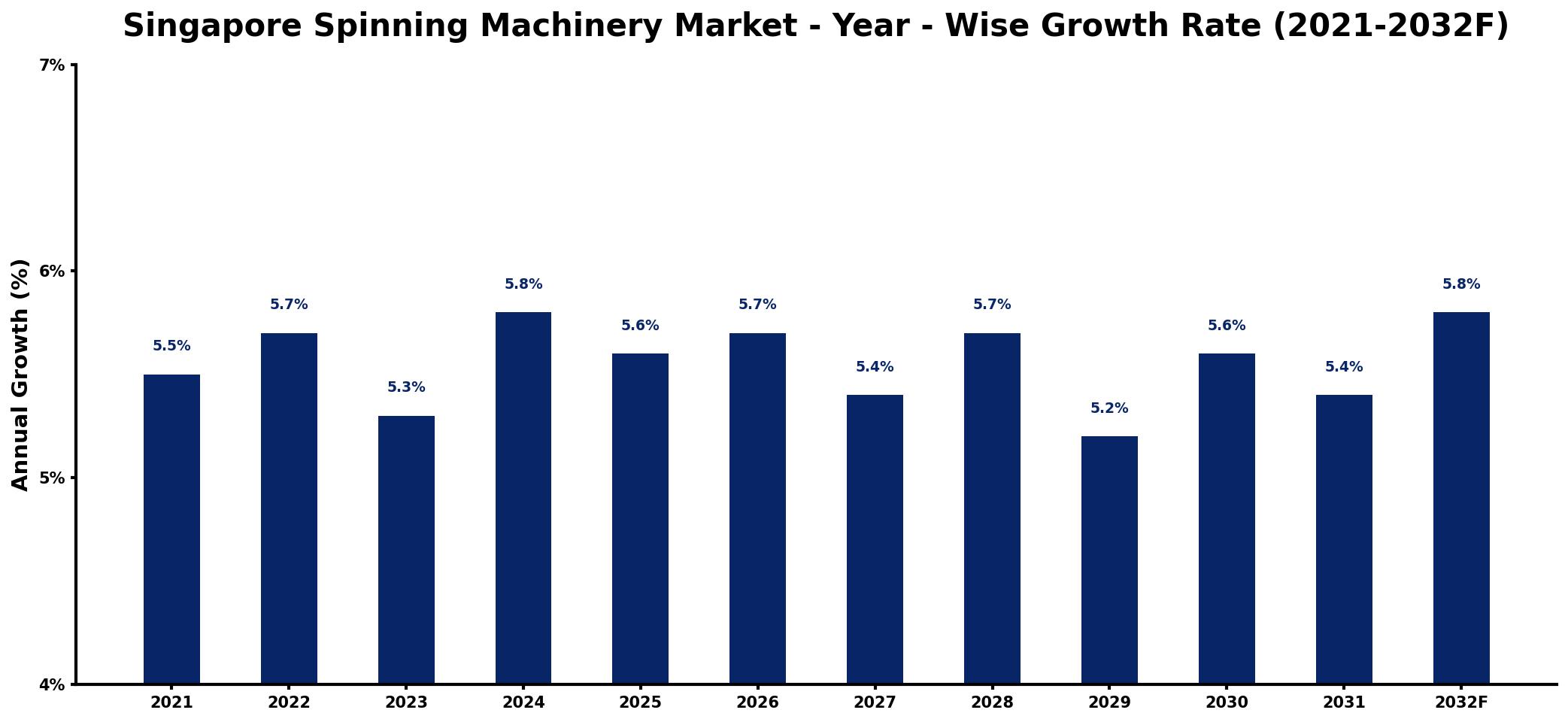
The table below presents the year‑wise growth rates along with the key drivers influencing the market
| Year | Growth Rate | Major Drivers |
| 2021 | 5.5% | Increased textile production capacity |
| 2022 | 5.7% | Growing demand for advanced textiles |
| 2023 | 5.3% | Expansion in apparel manufacturing sector |
| 2024 | 5.8% | Rising investments in automation technology |
| 2025 | 5.6% | Higher consumer spending on fashion |
| 2026 | 5.7% | Emergence of sustainable textile initiatives |
| 2027 | 5.4% | Boost in export opportunities globally |
| 2028 | 5.7% | Growth of smart textile applications |
| 2029 | 5.2% | Development of new textile materials |
| 2030 | 5.6% | Increase in regional trade partnerships |
| 2031 | 5.4% | Expansion of local textile enterprises |
| 2032 | 5.8% | Adoption of innovative production techniques |
Note: Market size estimations and growth projections presented in this report are based on 6Wresearch's proprietary forecasting methodology, utilizing the latest available industry data, government publications, and primary research inputs.
Singapore Spinning Machinery Market Synopsis
The primary force shaping the Singapore Spinning Machinery Market is the urgent need for innovation in textile manufacturing. With the global landscape becoming increasingly competitive, local manufacturers are investing in state-of-the-art spinning technologies to enhance production efficiency and product quality.
Moreover, the growing interest in technical textiles and smart fabrics is pushing companies to diversify their offerings and adopt more sophisticated machinery. This evolution is essential to meet consumer demands for sustainability and functionality in textiles, as well as to capitalize on emerging market trends.
Singapore Spinning Machinery Market Key Takeaways
- The market is driven by the demand for innovative, high-quality textiles amidst competitive pressures.
- Sustainability and automation are critical focus areas, pushing manufacturers toward advanced technological solutions.
- Investment in spinning machinery is essential for adapting to changing fashion trends and export opportunities.
- Post-pandemic recovery is marked by diversification into healthcare-related textiles and PPE manufacturing.
- Key players are enhancing their capabilities to address the evolving needs of the textile industry.
Evaluation of Restraints in Singapore Spinning Machinery Market
The Singapore Spinning Machinery Market faces noteworthy constraints primarily stemming from the rapid pace of technological change. Manufacturers are challenged to balance investments in automation and sustainable practices with the pressing need to remain cost-effective. Additionally, the initial outlay for upgrading machinery to align with eco-friendly standards often deters smaller textile manufacturers from transitioning. This creates a dichotomy between the need for modern equipment and the financial limitations that many face.
Singapore Spinning Machinery Market Trends
Several key trends are currently shaping the Singapore Spinning Machinery Market. A marked increase in the production of smart textiles and wearable technology is driving demand for more sophisticated spinning machinery. Additionally, the focus on sustainability is leading manufacturers to adopt energy-efficient and eco-friendly machinery options. Another emerging trend is the integration of automation in production lines, enhancing efficiency and enabling quicker response times to market changes.
Singapore Spinning Machinery Market Opportunities
The genuine growth opportunities lie in leveraging technological advancements to foster innovation in textile applications. As Singapore positions itself as a hub for fashion and textile innovation, investment in spinning machinery tailored for specialized fabrics will be critical. Furthermore, companies that can successfully navigate the transition to sustainable practices stand to gain a competitive edge in both local and global markets, opening avenues for export and new product lines.
Government Initiatives in the Singapore Spinning Machinery Market
The Singapore government has undertaken several initiatives aimed at revitalizing the textile manufacturing sector. This includes funding for research and development in sustainable textile practices and support for industry players to adopt advanced technologies. Public spending in infrastructure and training programs fosters skill development, thereby ensuring a robust workforce capable of navigating technological advancements in spinning machinery.
Future Insights of the Singapore Spinning Machinery Market
Looking ahead to the period from 2026 to 2032, the Singapore Spinning Machinery Market is set to evolve significantly. An increased emphasis on sustainability will drive innovations in eco-friendly spinning technologies. Furthermore, advancements in automation will facilitate higher efficiency and reduced operational costs, allowing manufacturers to remain competitive. As the textile industry embraces these changes, there is likely to be a stronger focus on developing specialized textiles, further propelling the markets growth trajectory.
Singapore Spinning Machinery Market Latest Developments (2025 - 2026)
In recent months, there has been a noticeable shift towards integrating digital technologies within the spinning machinery sector. Companies are increasingly adopting IoT solutions to enhance operational efficiency and improve maintenance protocols. Additionally, the focus on producing sustainable textiles has led to collaborative efforts between manufacturers and research institutions, aiming to innovate in eco-friendly spinning technologies. The industry's response to post-pandemic recovery continues to shape its strategic direction.
Singapore Spinning Machinery Market - Key Attractiveness of the Report
- 10 Years of Market Numbers
- Historical Data Starting from 2022 to 2025
- Base Year: 2025
- Forecast Data until 2032
- Key Performance Indicators Impacting the Market
- Major Upcoming Developments and Projects
Key Highlights of the Report:
- Singapore Spinning Machinery Market Outlook
- Market Size of Singapore Spinning Machinery Market, 2025
- Forecast of Singapore Spinning Machinery Market, 2032
- Historical Data and Forecast of Singapore Spinning Machinery Revenues & Volume for the Period 2022-2032F
- Singapore Spinning Machinery Market Trend Evolution
- Singapore Spinning Machinery Market Drivers and Challenges
- Singapore Spinning Machinery Price Trends
- Singapore Spinning Machinery Porter's Five Forces
- Singapore Spinning Machinery Industry Life Cycle
- Historical Data and Forecast of Singapore Spinning Machinery Market Revenues & Volume By Type for the Period 2022-2032F
- Historical Data and Forecast of Singapore Spinning Machinery Market Revenues & Volume By Ring for the Period 2022-2032F
- Historical Data and Forecast of Singapore Spinning Machinery Market Revenues & Volume By Rotor Spinning for the Period 2022-2032F
- Historical Data and Forecast of Singapore Spinning Machinery Market Revenues & Volume By Material for the Period 2022-2032F
- Historical Data and Forecast of Singapore Spinning Machinery Market Revenues & Volume By Natural for the Period 2022-2032F
- Historical Data and Forecast of Singapore Spinning Machinery Market Revenues & Volume By Synthetic for the Period 2022-2032F
- Historical Data and Forecast of Singapore Spinning Machinery Market Revenues & Volume By Others for the Period 2022-2032F
- Historical Data and Forecast of Singapore Spinning Machinery Market Revenues & Volume By End-Use Industry for the Period 2022-2032F
- Historical Data and Forecast of Singapore Spinning Machinery Market Revenues & Volume By Clothing for the Period 2022-2032F
- Historical Data and Forecast of Singapore Spinning Machinery Market Revenues & Volume By Textile for the Period 2022-2032F
- Historical Data and Forecast of Singapore Spinning Machinery Market Revenues & Volume By Other Industry for the Period 2022-2032F
- Singapore Spinning Machinery Import Export Trade Statistics
- Market Opportunity Assessment By Type
- Market Opportunity Assessment By Material
- Market Opportunity Assessment By End-Use Industry
- Singapore Spinning Machinery Top Companies Market Share
- Singapore Spinning Machinery Competitive Benchmarking By Technical and Operational Parameters
- Singapore Spinning Machinery Company Profiles
- Singapore Spinning Machinery Key Strategic Recommendations






































