Singapore Sports Nutrition Market Size, Share & Growth Rate
The Singapore Sports Nutrition Market was estimated at USD 1218 Million in 2025 and is projected to reach USD 1746 Million by 2032, growing at a CAGR of 5.3% from 2026 to 2032. This growth trajectory is underpinned by a significant rise in health-conscious consumer behavior, particularly among younger populations who prioritize fitness and wellness. Additionally, an increasing number of fitness centers and the growing influence of social media are fostering a vibrant environment for sports nutrition products.
Singapore Sports Nutrition Market Year-wise Growth Rate and Key Drivers
This graph highlights how the Singapore Sports Nutrition Market has steadily grown over the years, supported by major growth factors.
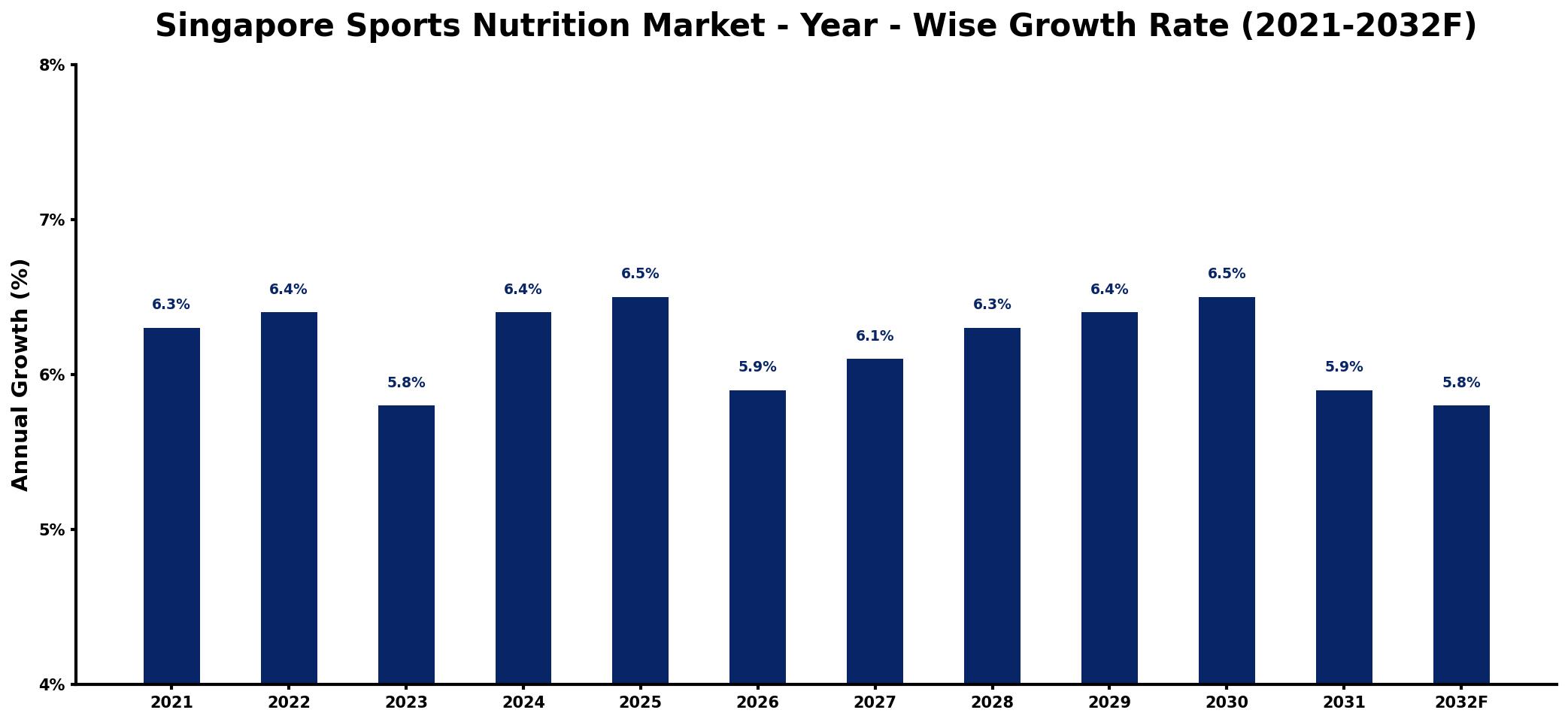
The table below presents the year‑wise growth rates along with the key drivers influencing the market
| Year | Growth Rate | Major Drivers |
| 2021 | 6.3% | Rising health consciousness among consumers |
| 2022 | 6.4% | Increased fitness facility memberships |
| 2023 | 5.8% | Growing online retail platforms |
| 2024 | 6.4% | Expansion of fitness influencer marketing |
| 2025 | 6.5% | Surge in corporate wellness programs |
| 2026 | 5.9% | Enhanced distribution channel partnerships |
| 2027 | 6.1% | Emergence of personalized fitness regimes |
| 2028 | 6.3% | Growth in health-focused events |
| 2029 | 6.4% | Increased investment in research |
| 2030 | 6.5% | Development of innovative product formulations |
| 2031 | 5.9% | increased production capacity utilization |
| 2032 | 5.8% | Rise in eco-friendly packaging initiatives |
Note: Market size estimations and growth projections presented in this report are based on 6Wresearch's proprietary forecasting methodology, utilizing the latest available industry data, government publications, and primary research inputs.
Singapore Sports Nutrition Market Synopsis
The demand for protein supplements and energy bars in Singapore has surged, reflecting a broader trend of health and wellness prioritization among consumers. With a notable increase in participation in sports and fitness activities, individuals are seeking nutritional support to enhance their performance and aid recovery.
As sports events and fitness trends evolve, the market is experiencing a shift towards innovative products that cater to specific dietary needs, including plant-based and clean-label options. This transformation is further complemented by the growing awareness and acceptance of nutritional supplements among the general public.
Singapore Sports Nutrition Market Key Takeaways
- Strong market growth driven by rising fitness trends and health consciousness.
- Increasing consumer demand for protein supplements and dietary products.
- Innovation in product formulations, including plant-based and clean-label options.
- Growth influenced by the expansion of fitness centers and social media marketing.
- Trust-building measures essential to overcoming consumer skepticism.
Evaluation of Restraints in Singapore Sports Nutrition Market
Despite the promising growth, the Singapore Sports Nutrition Market faces certain restraints that could impact its trajectory. Regulatory compliance is a significant concern, as products must meet stringent health and safety standards to gain consumer trust. Additionally, a portion of the population remains skeptical about the effectiveness and safety of nutritional supplements, necessitating the need for transparent marketing and scientific backing to enhance credibility. Manufacturers must navigate these complexities to leverage the full potential of this growing market.
Singapore Sports Nutrition Market Trends
Current trends in the Singapore Sports Nutrition Market include a growing preference for personalized nutrition solutions tailored to individual fitness goals. Additionally, the adoption of digital platforms for education and e-commerce is reshaping consumer engagement and purchasing behavior. Influencers and fitness experts on social media are playing a pivotal role in driving awareness and acceptance of new products, creating a dynamic environment for innovation in sports nutrition.
Singapore Sports Nutrition Market Opportunities
The Singapore Sports Nutrition Market presents several lucrative opportunities for investment and growth. With an increasing number of consumers seeking personalized and functional nutrition products, brands that innovate in this space can differentiate themselves. Moreover, collaborations with fitness centers and health professionals can enhance product credibility and market reach. As the demand for plant-based and clean-label options expands, companies that pivot towards sustainable sourcing and transparency in ingredient lists will likely find a receptive audience.
Government Initiatives in the Singapore Sports Nutrition Market
The Singaporean government has been proactive in promoting health and wellness initiatives that indirectly support the sports nutrition sector. Public campaigns aimed at increasing physical activity levels among citizens, alongside investments in sports infrastructure, create a favorable environment for sports nutrition products. Additionally, government agencies provide guidelines for nutritional standards, ensuring that products in the market are safe and effective, which contributes to overall consumer trust.
Future Insights of the Singapore Sports Nutrition Market
Looking ahead to 2026-2032, the Singapore Sports Nutrition Market is poised for significant evolution. As consumer preferences shift toward more holistic and personalized health solutions, companies will need to adapt their offerings to meet these demands. The integration of technology in nutrition, such as apps that track dietary intake and provide personalized recommendations, is expected to gain traction. Additionally, sustainability will play an increasingly important role, as consumers demand transparency and ethical sourcing in the products they consume.
Singapore Sports Nutrition Market Latest Developments (2025 - 2026)
Recent developments in the Singapore Sports Nutrition Market reflect a strong pivot towards innovation and digital engagement. Many companies have expanded their online presence, tapping into e-commerce channels to reach health-conscious consumers directly. Additionally, there is a notable increase in the launch of products aimed at specific dietary needs, such as vegan or gluten-free options, in response to consumer preferences. Marketing strategies are increasingly leveraging social media influencers, driving heightened awareness and brand loyalty among active individuals.
Singapore Sports Nutrition Market - Key Attractiveness of the Report
- 10 Years of Market Numbers
- Historical Data Starting from 2022 to 2025
- Base Year: 2025
- Forecast Data until 2032
- Key Performance Indicators Impacting the Market
- Major Upcoming Developments and Projects
Key Highlights of the Report:
- Singapore Sports Nutrition Market Outlook
- Market Size of Singapore Sports Nutrition Market, 2025
- Forecast of Singapore Sports Nutrition Market, 2032
- Historical Data and Forecast of Singapore Sports Nutrition Revenues & Volume for the Period 2022-2032F
- Singapore Sports Nutrition Market Trend Evolution
- Singapore Sports Nutrition Market Drivers and Challenges
- Singapore Sports Nutrition Price Trends
- Singapore Sports Nutrition Porter's Five Forces
- Singapore Sports Nutrition Industry Life Cycle
- Historical Data and Forecast of Singapore Sports Nutrition Market Revenues & Volume By Type for the Period 2022-2032F
- Historical Data and Forecast of Singapore Sports Nutrition Market Revenues & Volume By Sports Food for the Period 2022-2032F
- Historical Data and Forecast of Singapore Sports Nutrition Market Revenues & Volume By Sports Drinks for the Period 2022-2032F
- Historical Data and Forecast of Singapore Sports Nutrition Market Revenues & Volume By Sports Supplements for the Period 2022-2032F
- Historical Data and Forecast of Singapore Sports Nutrition Market Revenues & Volume By Distribution Channel for the Period 2022-2032F
- Historical Data and Forecast of Singapore Sports Nutrition Market Revenues & Volume By Supermarkets/Hypermarkets for the Period 2022-2032F
- Historical Data and Forecast of Singapore Sports Nutrition Market Revenues & Volume By Specialty Stores for the Period 2022-2032F
- Historical Data and Forecast of Singapore Sports Nutrition Market Revenues & Volume By Convenience Stores for the Period 2022-2032F
- Historical Data and Forecast of Singapore Sports Nutrition Market Revenues & Volume By Online Stores for the Period 2022-2032F
- Historical Data and Forecast of Singapore Sports Nutrition Market Revenues & Volume By Other Distribution Channels for the Period 2022-2032F
- Singapore Sports Nutrition Import Export Trade Statistics
- Market Opportunity Assessment By Type
- Market Opportunity Assessment By Distribution Channel
- Singapore Sports Nutrition Top Companies Market Share
- Singapore Sports Nutrition Competitive Benchmarking By Technical and Operational Parameters
- Singapore Sports Nutrition Company Profiles
- Singapore Sports Nutrition Key Strategic Recommendations






































