Singapore Talc and Steatite Market Size, Share & Growth Rate
The Singapore Talc and Steatite Market was estimated at USD 449 Million in 2025 and is projected to reach USD 638 Million by 2032, growing at a CAGR of 5.1% from 2026 to 2032. This growth trajectory is primarily fueled by increasing demand for talc in industries such as cosmetics, pharmaceuticals, and ceramics. As these sectors evolve and innovate, the need for high-quality talc and steatite is expected to rise, paving the way for a more robust market landscape.
Singapore Talc and Steatite Market Year-wise Growth Rate and Key Drivers
This graph highlights how the Singapore Talc and Steatite Market has steadily grown over the years, supported by major growth factors.
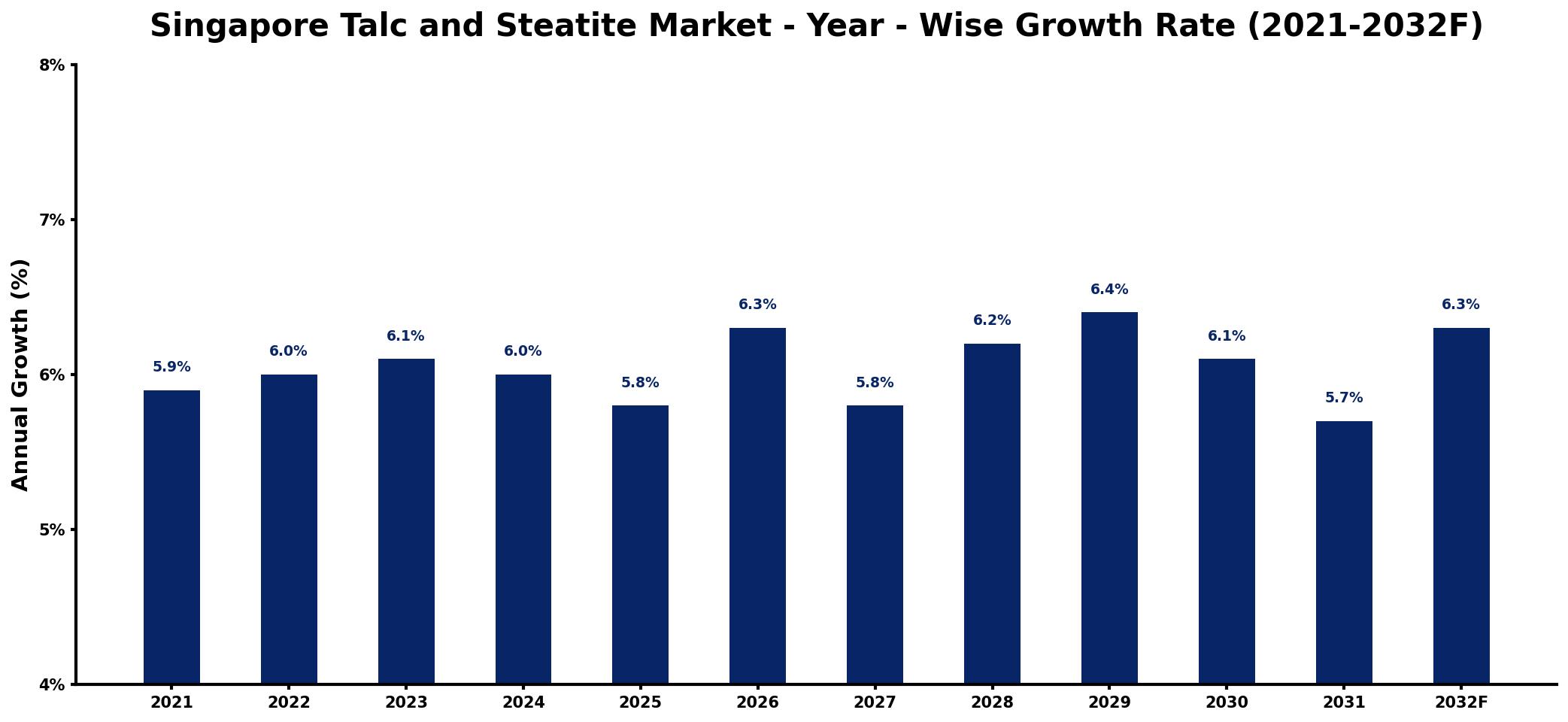
The table below presents the year‑wise growth rates along with the key drivers influencing the market
| Year | Growth Rate | Major Drivers |
| 2021 | 5.9% | Rising demand in cosmetics industry |
| 2022 | 6.0% | Increased use in pharmaceuticals sector |
| 2023 | 6.1% | Growth in construction material applications |
| 2024 | 6.0% | Expansion of personal care products |
| 2025 | 5.8% | Investment in industrial manufacturing processes |
| 2026 | 6.3% | Boost in paper production requirements |
| 2027 | 5.8% | Higher demand from food industry |
| 2028 | 6.2% | rising export shipment volumes |
| 2029 | 6.4% | Increased usage in agriculture applications |
| 2030 | 6.1% | Surge in automotive industry needs |
| 2031 | 5.7% | Rising popularity in electronics sector |
| 2032 | 6.3% | Expansion in healthcare product formulations |
Note: Market size estimations and growth projections presented in this report are based on 6Wresearch's proprietary forecasting methodology, utilizing the latest available industry data, government publications, and primary research inputs.
Singapore Talc and Steatite Market Synopsis
In Singapore, the talc and steatite market has become an essential part of industrial mineral supply, particularly for the manufacturing and cosmetics sectors. With an emphasis on responsible sourcing, suppliers are now focused on meeting strict quality controls to satisfy the diverse industrial applications that utilize these minerals.
As companies strive for innovation, the attributes of talc—such as softness and lubricating properties—are making it indispensable in formulations that prioritize performance and safety. Compliance with industry standards is becoming a key factor in determining supplier success in this evolving market.
Singapore Talc and Steatite Market Key Takeaways
- The market is projected to witness significant growth driven by increased applications in cosmetics and pharmaceuticals.
- Quality and purity assurance are paramount for suppliers aiming to meet stringent industrial demands.
- There is a growing trend toward sustainable and responsible sourcing of talc and steatite.
- The COVID-19 pandemic has underscored the critical role of talc in various applications, reinforcing its market importance.
- Key players in the market are focusing on product innovation to cater to the evolving needs of their customers.
Evaluation of Restraints in Singapore Talc and Steatite Market
Despite its growth potential, the Singapore talc and steatite market encounters several restraints. The primary concern lies in ensuring product quality and sourcing. Talc and steatite must meet high purity standards for them to be accepted across industries. This demand creates significant pressure on suppliers to maintain consistent quality and adhere to evolving regulations. Additionally, variability in sourcing options and fluctuating market prices can inhibit the ability to meet specific industrial requirements, posing challenges for market players.
Singapore Talc and Steatite Market Trends
Current trends indicate a marked shift towards sustainability within the Singapore talc and steatite market. Companies are increasingly prioritizing environmentally-friendly mining practices and supply chain transparency. Moreover, technological advancements are enhancing the processing techniques for these minerals, improving their performance in various applications. The cosmetics industry, in particular, is seeing a surge in demand for talc-based products that emphasize natural ingredients and safety, steering market focus toward innovative formulations.
Singapore Talc and Steatite Market Opportunities
The Singapore market presents multiple growth opportunities, particularly in the cosmetics and pharmaceutical sectors. As consumer preferences evolve, companies that invest in product development to meet the demand for safe, effective, and sustainable talc products stand to benefit. Furthermore, as manufacturers increasingly turn to talc for its unique properties, the exploration of new industrial applications could open additional avenues for growth and investment, signaling a promising future for the market.
Government Initiatives in the Singapore Talc and Steatite Market
The Singapore government is actively promoting initiatives aimed at enhancing the sustainable mining and processing of industrial minerals. This includes public spending on research and development to advance technologies in mineral extraction and processing, as well as incentives for companies adopting environmentally-friendly practices. Regulatory frameworks are evolving to ensure that suppliers adhere to strict quality and safety standards, further supporting the responsible growth of the talc and steatite market.
Future Insights of the Singapore Talc and Steatite Market
Looking ahead to 2026-2032, the Singapore talc and steatite market is expected to experience continuous growth, underpinned by ongoing innovation in product applications. As industries seek to enhance the performance of their offerings, the demand for high-quality talc and steatite is set to escalate. Additionally, the commitment to sustainable practices will likely shape market dynamics, as companies align with consumer preferences and regulatory expectations. Thus, the market is on a trajectory toward a more sustainable, quality-focused future.
Singapore Talc and Steatite Market Latest Developments (2025 - 2026)
Recent developments in the Singapore talc and steatite market reflect a growing emphasis on sustainability and product innovation. Suppliers are increasingly investing in advanced processing technologies to improve purity and performance. Additionally, collaborations between companies and research institutions are fostering innovative applications for talc in the cosmetics and pharmaceutical industries. This focus on R&D is expected to drive market dynamics, making it a crucial period for stakeholders within this sector.
Singapore Talc and Steatite Market - Key Attractiveness of the Report
- 10 Years of Market Numbers
- Historical Data Starting from 2022 to 2025
- Base Year: 2025
- Forecast Data until 2032
- Key Performance Indicators Impacting the Market
- Major Upcoming Developments and Projects
Key Highlights of the Report:
- Singapore Talc and Steatite Market Outlook
- Market Size of Singapore Talc and Steatite Market, 2025
- Forecast of Singapore Talc and Steatite Market, 2032
- Historical Data and Forecast of Singapore Talc and Steatite Revenues & Volume for the Period 2022-2032F
- Singapore Talc and Steatite Market Trend Evolution
- Singapore Talc and Steatite Market Drivers and Challenges
- Singapore Talc and Steatite Price Trends
- Singapore Talc and Steatite Porter's Five Forces
- Singapore Talc and Steatite Industry Life Cycle
- Historical Data and Forecast of Singapore Talc and Steatite Market Revenues & Volume By Product Type for the Period 2022-2032F
- Historical Data and Forecast of Singapore Talc and Steatite Market Revenues & Volume By Crushed for the Period 2022-2032F
- Historical Data and Forecast of Singapore Talc and Steatite Market Revenues & Volume By Powdered for the Period 2022-2032F
- Singapore Talc and Steatite Import Export Trade Statistics
- Market Opportunity Assessment By Product Type
- Singapore Talc and Steatite Top Companies Market Share
- Singapore Talc and Steatite Competitive Benchmarking By Technical and Operational Parameters
- Singapore Talc and Steatite Company Profiles
- Singapore Talc and Steatite Key Strategic Recommendations






































