Singapore Textiles Fibre Market Size, Share & Growth Rate
The Singapore Textiles Fibre Market was estimated at USD 492 Million in 2025 and is projected to reach USD 654 Million by 2032, growing at a CAGR of 4.1% from 2026 to 2032. This growth is spurred by a collective shift toward sustainable practices among consumers and manufacturers alike, as well as ongoing investments in innovative materials. The increasing awareness of environmental issues is guiding production processes and influencing purchasing behaviors, making sustainability a core pillar of market expansion.
Singapore Textiles Fibre Market Year-wise Growth Rate and Key Drivers
This graph highlights how the Singapore Textiles Fibre Market has steadily grown over the years, supported by major growth factors.
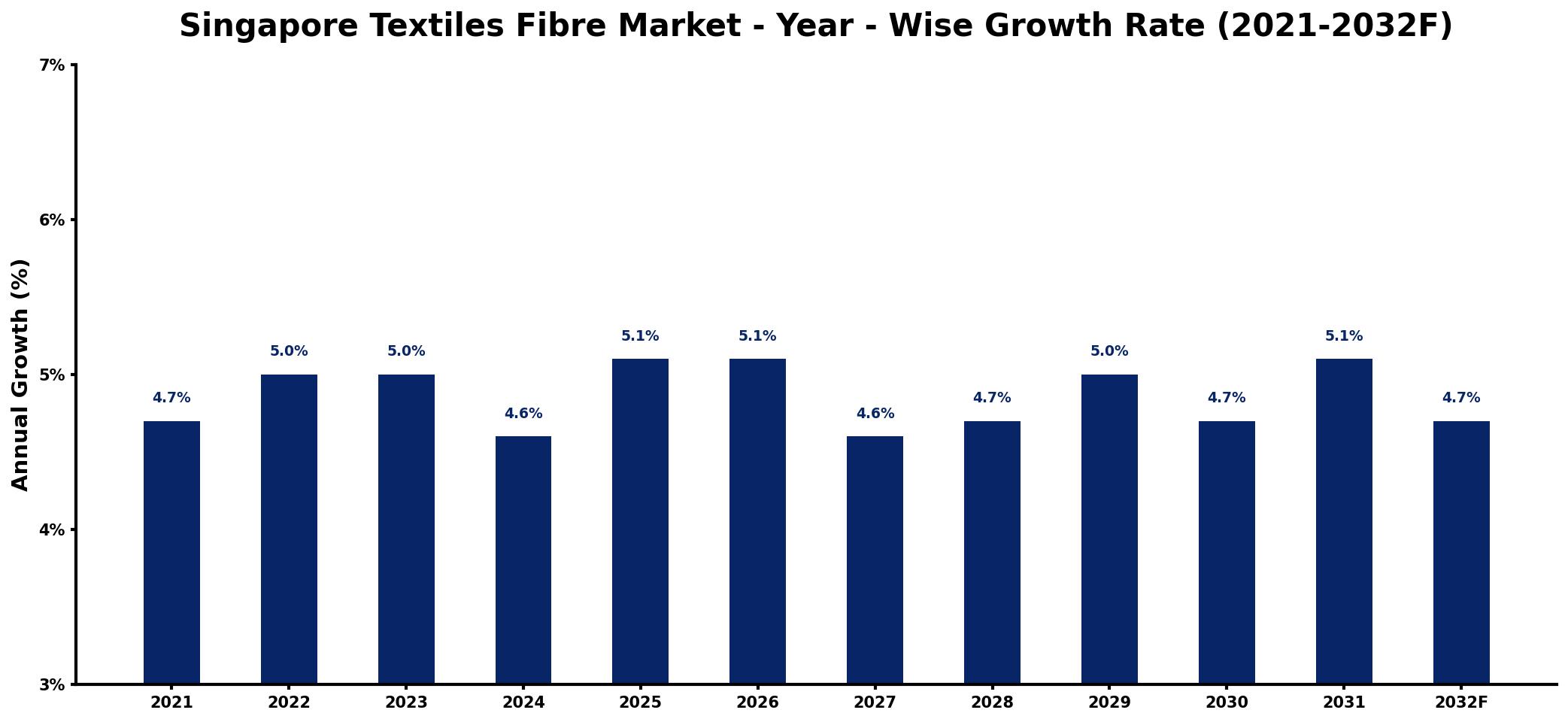
The table below presents the year‑wise growth rates along with the key drivers influencing the market
| Year | Growth Rate | Major Drivers |
| 2021 | 4.7% | Rising consumer fashion preferences |
| 2022 | 5.0% | Increased e-commerce adoption rates |
| 2023 | 5.0% | Growth in sustainable materials interest |
| 2024 | 4.6% | Expansion of local manufacturing capabilities |
| 2025 | 5.1% | Surge in export market opportunities |
| 2026 | 5.1% | Investment in innovative production technologies |
| 2027 | 4.6% | Demand for eco-friendly alternatives |
| 2028 | 4.7% | Strengthening regional trade agreements |
| 2029 | 5.0% | rising end-use demand growth |
| 2030 | 4.7% | Emergence of smart textile solutions |
| 2031 | 5.1% | Rise in customization and personalization |
| 2032 | 4.7% | Increased focus on circular economy |
Note: Market size estimations and growth projections presented in this report are based on 6Wresearch's proprietary forecasting methodology, utilizing the latest available industry data, government publications, and primary research inputs.
Singapore Textiles Fibre Market Synopsis
The strongest force currently shaping the Singapore textiles fibre market is the transition towards sustainability. As consumers demand eco-friendly options, manufacturers are embracing recycled fibers, organic cotton, and plant-based materials to meet these preferences. This transformation is not merely a trend but a necessary adaptation to ensure continued relevance in a competitive landscape.
Another critical aspect influencing the market is the collaboration between industry players, which is fostering innovation and driving advancements in textiles fiber technology. Government initiatives supporting sustainable practices also play a significant role, offering incentives that encourage investments in eco-conscious production methods.
Singapore Textiles Fibre Market Key Takeaways
- The market is poised for steady growth, driven by consumer demand for sustainable textile options.
- Innovations in recycled and plant-based fibers are transforming traditional textile production processes.
- Collaboration among industry stakeholders is essential for fostering advancements and competitiveness.
- Government support enhances the market's sustainability efforts and technological advancements.
- Robust R&D investments are critical to meet evolving consumer preferences and global competition.
Evaluation of Restraints in Singapore Textiles Fibre Market
Despite its growth trajectory, the Singapore textiles fibre market faces several constraints that could hinder progress. The presence of low-cost international competitors poses a significant challenge, affecting price sensitivity and profit margins for local manufacturers. Additionally, the ongoing need for significant investments in R&D to align with sustainability trends creates financial pressure for companies. Recent supply chain disruptions, particularly during the COVID-19 pandemic, have highlighted vulnerabilities, underscoring the necessity for robust and diversified supply chain management strategies.
Singapore Textiles Fibre Market Trends
Currently, there is a marked trend towards the utilization of advanced materials that not only meet performance standards but also emphasize sustainability. The increased adoption of digital technology in textiles manufacturing is another notable trend, enhancing efficiency and customization in production. Moreover, consumer education regarding sustainable practices is facilitating a paradigm shift, leading to higher demand for eco-friendly textiles across various applications, including fashion, home textiles, and industrial uses.
Singapore Textiles Fibre Market Opportunities
The most significant opportunities lie in the development of innovative textile fibers that align with sustainability goals. Companies investing in the R&D of recycled materials and organic alternatives are likely to capture a substantial share of the market. Additionally, as consumers increasingly prioritize comfort, versatility, and environmental impact, there is a growing scope for brands that can offer a combination of these attributes. Collaboration with academic and research institutions can further enhance innovation and market reach.
Government Initiatives in the Singapore Textiles Fibre Market
The Singapore government has implemented several initiatives aimed at fostering a more sustainable textiles industry. These include funding programs for research into sustainable materials, as well as policies encouraging the adoption of eco-friendly practices across manufacturing sectors. Additionally, public awareness campaigns are being launched to educate both consumers and manufacturers about the benefits of sustainable textiles, reinforcing the countrys commitment to environmental stewardship.
Future Insights of the Singapore Textiles Fibre Market
Looking ahead to the period between 2026 and 2032, the Singapore textiles fibre market is set to continue its transformation towards sustainability. Driven by regulatory support and growing consumer awareness, we expect to see a broader adoption of innovative, eco-conscious materials. As global trade stabilizes, local manufacturers will increasingly focus on resilience and adaptability in their supply chains, ensuring they meet evolving market demands while maintaining competitiveness in an ever-changing landscape.
Singapore Textiles Fibre Market Latest Developments (2025 - 2026)
Recently, the textiles fibre market in Singapore has seen a concerted push towards collaborations aimed at enhancing sustainable practices. Manufacturers are engaging in partnerships that leverage technology for improved fiber production efficiency and sustainability. These collaborative initiatives are likely to pave the way for new product developments, reflecting the industry's commitment to environmental responsibility and consumer demand for high-quality, sustainable textiles.
Singapore Textiles Fibre Market - Key Attractiveness of the Report
- 10 Years of Market Numbers
- Historical Data Starting from 2022 to 2025
- Base Year: 2025
- Forecast Data until 2032
- Key Performance Indicators Impacting the Market
- Major Upcoming Developments and Projects
Key Highlights of the Report:
- Singapore Textiles Fibre Market Outlook
- Market Size of Singapore Textiles Fibre Market, 2025
- Forecast of Singapore Textiles Fibre Market, 2032
- Historical Data and Forecast of Singapore Textiles Fibre Revenues & Volume for the Period 2022-2032F
- Singapore Textiles Fibre Market Trend Evolution
- Singapore Textiles Fibre Market Drivers and Challenges
- Singapore Textiles Fibre Price Trends
- Singapore Textiles Fibre Porter's Five Forces
- Singapore Textiles Fibre Industry Life Cycle
- Historical Data and Forecast of Singapore Textiles Fibre Market Revenues & Volume By Type for the Period 2022-2032F
- Historical Data and Forecast of Singapore Textiles Fibre Market Revenues & Volume By Natural Fiber for the Period 2022-2032F
- Historical Data and Forecast of Singapore Textiles Fibre Market Revenues & Volume By Synthetic Fiber for the Period 2022-2032F
- Historical Data and Forecast of Singapore Textiles Fibre Market Revenues & Volume By Application for the Period 2022-2032F
- Historical Data and Forecast of Singapore Textiles Fibre Market Revenues & Volume By Industrial for the Period 2022-2032F
- Historical Data and Forecast of Singapore Textiles Fibre Market Revenues & Volume By Filters for the Period 2022-2032F
- Historical Data and Forecast of Singapore Textiles Fibre Market Revenues & Volume By Tire Cords for the Period 2022-2032F
- Historical Data and Forecast of Singapore Textiles Fibre Market Revenues & Volume By Feminine & Baby Care Products for the Period 2022-2032F
- Historical Data and Forecast of Singapore Textiles Fibre Market Revenues & Volume By Surgical Gloves for the Period 2022-2032F
- Historical Data and Forecast of Singapore Textiles Fibre Market Revenues & Volume By Apparels for the Period 2022-2032F
- Historical Data and Forecast of Singapore Textiles Fibre Market Revenues & Volume By Bedding & Blankets for the Period 2022-2032F
- Historical Data and Forecast of Singapore Textiles Fibre Market Revenues & Volume By Others for the Period 2022-2032F
- Historical Data and Forecast of Singapore Textiles Fibre Market Revenues & Volume By End-Use Industry for the Period 2022-2032F
- Historical Data and Forecast of Singapore Textiles Fibre Market Revenues & Volume By Automotive for the Period 2022-2032F
- Historical Data and Forecast of Singapore Textiles Fibre Market Revenues & Volume By Building & Construction for the Period 2022-2032F
- Historical Data and Forecast of Singapore Textiles Fibre Market Revenues & Volume By Healthcare for the Period 2022-2032F
- Historical Data and Forecast of Singapore Textiles Fibre Market Revenues & Volume By Aerospace and Defense for the Period 2022-2032F
- Historical Data and Forecast of Singapore Textiles Fibre Market Revenues & Volume By Textile for the Period 2022-2032F
- Historical Data and Forecast of Singapore Textiles Fibre Market Revenues & Volume By Oil & Gas for the Period 2022-2032F
- Historical Data and Forecast of Singapore Textiles Fibre Market Revenues & Volume By Energy and Power for the Period 2022-2032F
- Historical Data and Forecast of Singapore Textiles Fibre Market Revenues & Volume By Others for the Period 2022-2032F
- Singapore Textiles Fibre Import Export Trade Statistics
- Market Opportunity Assessment By Type
- Market Opportunity Assessment By Application
- Market Opportunity Assessment By End-Use Industry
- Singapore Textiles Fibre Top Companies Market Share
- Singapore Textiles Fibre Competitive Benchmarking By Technical and Operational Parameters
- Singapore Textiles Fibre Company Profiles
- Singapore Textiles Fibre Key Strategic Recommendations






































