Singapore Tung Oil Market Size, Share & Growth Rate
The Singapore Tung Oil Market was estimated at USD 428 Million in 2025 and is projected to reach USD 573 Million by 2032, growing at a CAGR of 4.3% from 2026 to 2032. This growth trajectory is primarily driven by the increasing demand for sustainable and eco-friendly products across various sectors, including woodworking and coatings. Furthermore, the traditional use of tung oil in Asian lacquerware and furniture manufacturing is bolstering the market's expansion, as consumers and manufacturers alike seek durable and natural finishing options.
Singapore Tung Oil Market Year-wise Growth Rate and Key Drivers
This graph highlights how the Singapore Tung Oil Market has steadily grown over the years, supported by major growth factors.
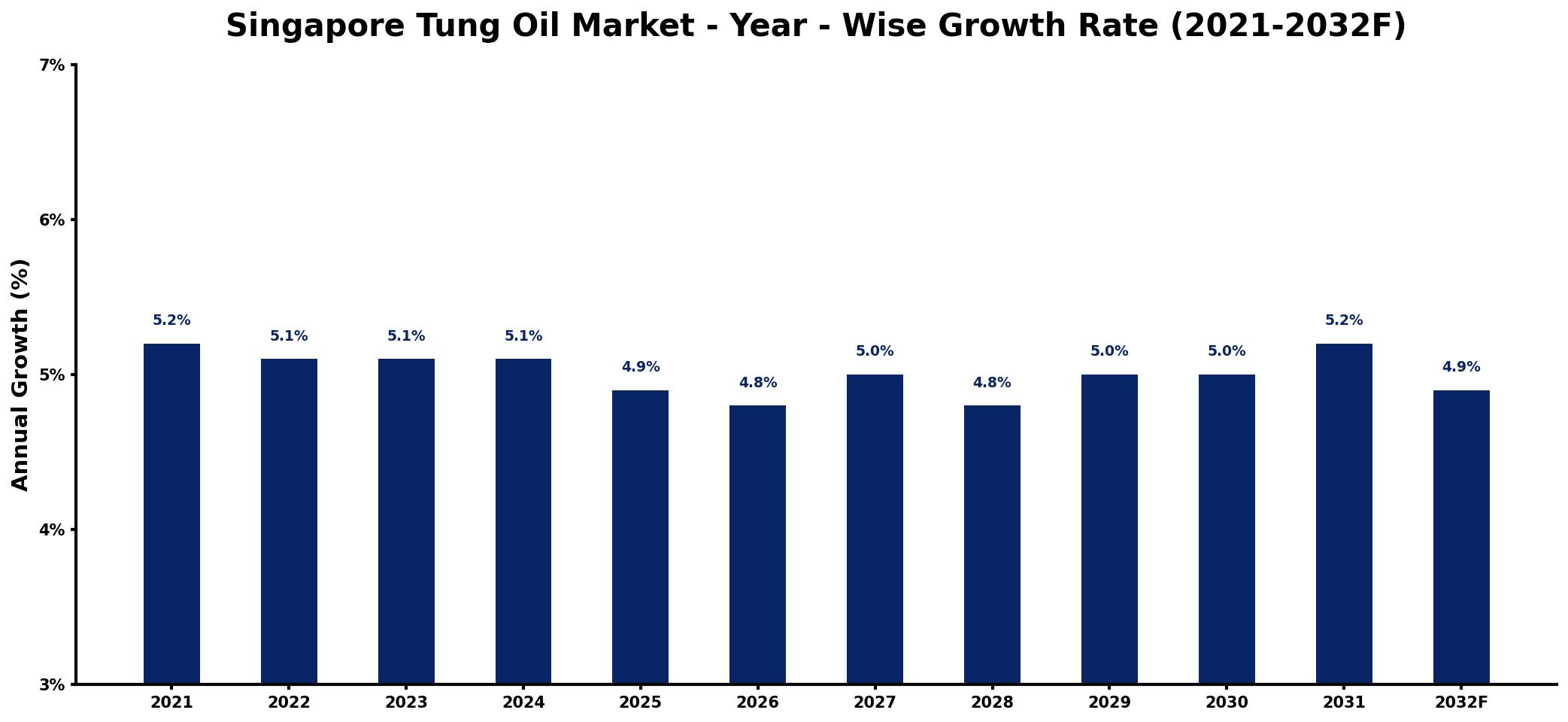
The table below presents the year‑wise growth rates along with the key drivers influencing the market
| Year | Growth Rate | Major Drivers |
| 2021 | 5.2% | Rising demand for eco-friendly products |
| 2022 | 5.1% | Increased investment in sustainable materials |
| 2023 | 5.1% | Growth in construction industry applications |
| 2024 | 5.1% | Expansion of furniture manufacturing sector |
| 2025 | 4.9% | Emerging markets driving consumption trends |
| 2026 | 4.8% | Adoption of green technologies increasing |
| 2027 | 5.0% | Higher focus on renewable resources |
| 2028 | 4.8% | Strengthening of export markets observed |
| 2029 | 5.0% | Innovation in product formulations rising |
| 2030 | 5.0% | Government incentives for sustainable practices |
| 2031 | 5.2% | Growing awareness of environmental benefits |
| 2032 | 4.9% | Diversification of applications in industries |
Note: Market size estimations and growth projections presented in this report are based on 6Wresearch's proprietary forecasting methodology, utilizing the latest available industry data, government publications, and primary research inputs.
Singapore Tung Oil Market Synopsis
The Singapore tung oil market has recently gained momentum, propelled by a rising consumer preference for sustainable materials. While the market has enjoyed steady growth in certain segments, challenges related to local production and competition from synthetic alternatives continue to influence its landscape. As companies pivot towards environmentally responsible sourcing and manufacturing practices, the outlook remains optimistic for the coming years.
In the context of global trends, Singapore's focus on innovation and quality in tung oil processing is vital. Initiatives aimed at enhancing extraction methods and improving product quality are expected to drive market growth. Moreover, the integration of tung oil in contemporary applications, such as cosmetics and personal care products, signals an evolving market landscape that responds to changing consumer preferences.
Singapore Tung Oil Market Key Takeaways
- The market is projected to experience a steady growth rate, influenced by a growing demand for eco-friendly products.
- Tung oil's unique properties, including durability and water resistance, make it highly sought after in woodworking and coatings.
- The traditional craft of Asian lacquerware manufacturing continues to support the market's expansion.
- Ongoing research and development initiatives aim to improve extraction processes and product quality.
- Multinational corporations are pivotal in establishing sustainable sourcing practices within the market.
Evaluation of Restraints in Singapore Tung Oil Market
Despite its growth potential, the Singapore tung oil market faces significant restraints. The limited local production capacity poses a considerable challenge, as tung trees are not native to Singapore's climate. This geographical limitation increases cultivation costs and complicates logistics. Additionally, the market competes with synthetic substitutes that can offer similar properties at lower prices, which may deter price-sensitive buyers. Fluctuations in global tung oil prices further complicate the landscape, creating uncertainty for stakeholders aiming for stable margins. To remain competitive, the market must navigate these challenges while adhering to stringent environmental standards, driven by the ongoing consumer push for sustainable practices.
Singapore Tung Oil Market Trends
Several trends are currently shaping the Singapore tung oil market. Firstly, the shift towards environmentally friendly and sustainable materials has significantly boosted the demand for tung oil in various applications. Additionally, advancements in extraction and processing technologies are allowing for higher quality and more efficient production of tung oil. There's also a notable rise in the popularity of artisanal and handmade products, especially in the furniture and crafting segments, which often utilize natural finishes like tung oil. This trend is complemented by growing consumer awareness about the health and environmental benefits associated with natural products.
Singapore Tung Oil Market Opportunities
The market presents various growth and investment opportunities. There is significant potential in developing innovative product formulations that incorporate tung oil for cosmetic and personal care uses, tapping into the rising consumer demand for natural beauty products. Moreover, investments in research to improve cultivation techniques could lead to more viable local production, reducing dependency on imports. Collaborations between industry stakeholders for sustainable sourcing and marketing strategies can also enhance market visibility and appeal to environmentally conscious consumers.
Government Initiatives in the Singapore Tung Oil Market
The Singaporean government has been actively promoting sustainable agricultural practices and eco-friendly product development through various initiatives. Policies supporting research and development in the agriculture sector can indirectly benefit the tung oil market by fostering innovation in cultivation and processing methods. Public spending on environmental sustainability projects encourages industries to adopt greener practices, potentially boosting local production and minimizing environmental impact. These initiatives align well with Singapore's broader goals of achieving food security and enhancing eco-conscious consumerism.
Future Insights of the Singapore Tung Oil Market
Looking ahead to 2026-2032, the Singapore tung oil market is poised for a transformative period of growth. As the demand for sustainable products continues to rise, manufacturers are likely to innovate and diversify their product offerings. Enhanced processing technologies will probably lead to better quality and more cost-effective solutions, making tung oil increasingly attractive across various industries. Furthermore, the cultural significance of traditional lacquerware and furniture in Singapore may drive niche market opportunities, ensuring that tung oil remains relevant amidst changing consumer preferences.
Singapore Tung Oil Market Latest Developments (2025 - 2026)
In recent months, the Singapore tung oil market has seen a concerted push towards sustainability, with several companies launching new initiatives focused on eco-friendly practices. Innovations in extraction techniques are being explored to enhance product efficiency and quality, while manufacturers are adapting to the evolving consumer landscape by introducing more natural product lines. Trade partnerships are also being strengthened to stabilize supply chains and mitigate the impacts of global price fluctuations, positioning the market for resilient growth.
Singapore Tung Oil Market - Key Attractiveness of the Report
- 10 Years of Market Numbers
- Historical Data Starting from 2022 to 2025
- Base Year: 2025
- Forecast Data until 2032
- Key Performance Indicators Impacting the Market
- Major Upcoming Developments and Projects
Key Highlights of the Report:
- Singapore Tung Oil Market Outlook
- Market Size of Singapore Tung Oil Market, 2025
- Forecast of Singapore Tung Oil Market, 2032
- Historical Data and Forecast of Singapore Tung Oil Revenues & Volume for the Period 2022-2032F
- Singapore Tung Oil Market Trend Evolution
- Singapore Tung Oil Market Drivers and Challenges
- Singapore Tung Oil Price Trends
- Singapore Tung Oil Porter's Five Forces
- Singapore Tung Oil Industry Life Cycle
- Historical Data and Forecast of Singapore Tung Oil Market Revenues & Volume By Product Type for the Period 2022-2032F
- Historical Data and Forecast of Singapore Tung Oil Market Revenues & Volume By Raw Tung Oil for the Period 2022-2032F
- Historical Data and Forecast of Singapore Tung Oil Market Revenues & Volume By Boiled Tung Oil for the Period 2022-2032F
- Historical Data and Forecast of Singapore Tung Oil Market Revenues & Volume By Application for the Period 2022-2032F
- Historical Data and Forecast of Singapore Tung Oil Market Revenues & Volume By Wood Finishing for the Period 2022-2032F
- Historical Data and Forecast of Singapore Tung Oil Market Revenues & Volume By Food and Beverage for the Period 2022-2032F
- Historical Data and Forecast of Singapore Tung Oil Market Revenues & Volume By Medicines for the Period 2022-2032F
- Historical Data and Forecast of Singapore Tung Oil Market Revenues & Volume By Others for the Period 2022-2032F
- Singapore Tung Oil Import Export Trade Statistics
- Market Opportunity Assessment By Product Type
- Market Opportunity Assessment By Application
- Singapore Tung Oil Top Companies Market Share
- Singapore Tung Oil Competitive Benchmarking By Technical and Operational Parameters
- Singapore Tung Oil Company Profiles
- Singapore Tung Oil Key Strategic Recommendations






































