Singapore Video Conferencing Market Size & Growth Rate (2026-2032)
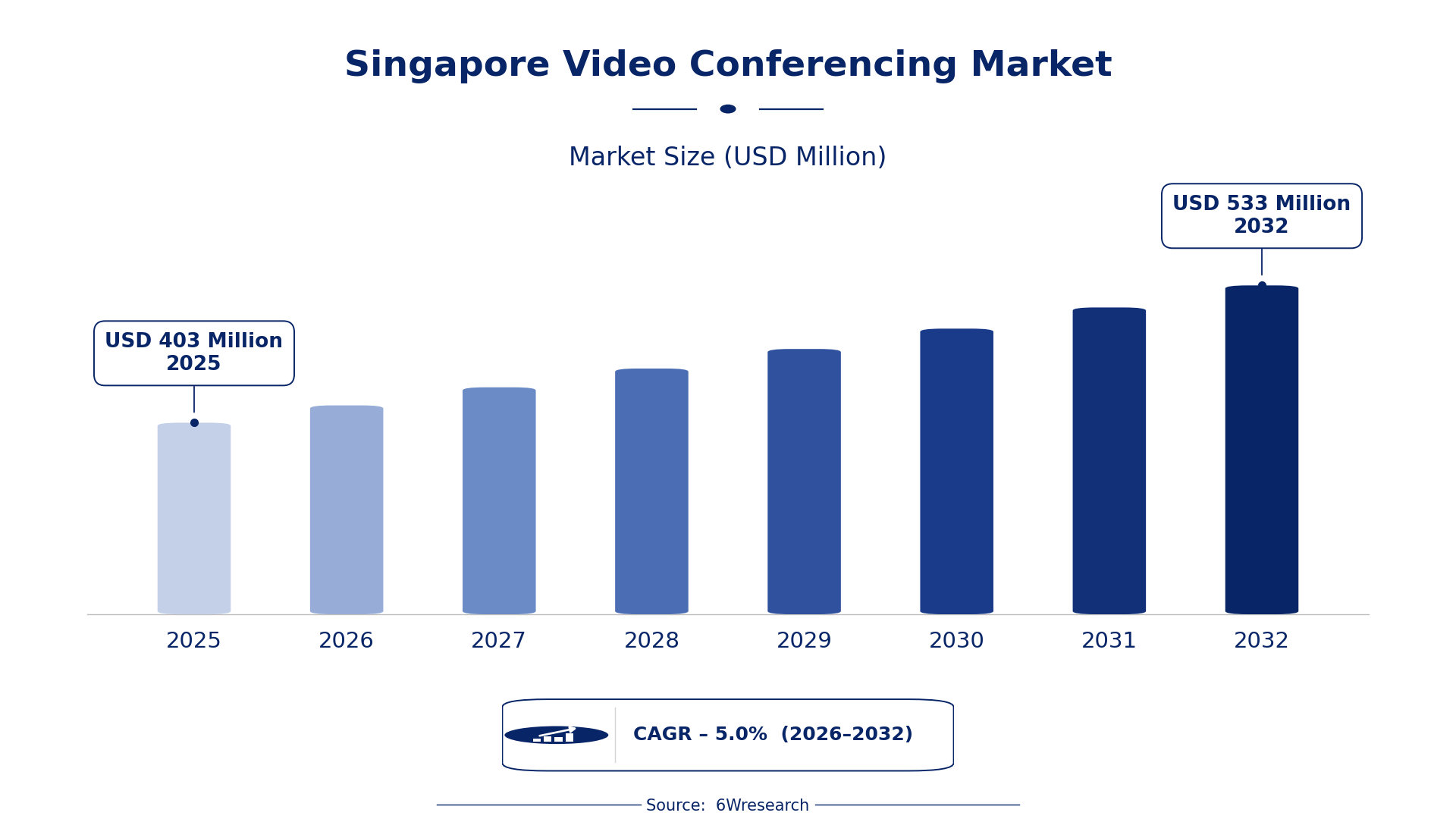
The Singapore Video Conferencing Market was estimated at USD 403 Million in 2025 and is projected to reach USD 533 Million by 2032, growing at a CAGR of 5.0% from 2026 to 2032.
Singapore Video Conferencing Market Synopsis
The Singapore Video Conferencing Market is undergoing a transformative phase, with remote work becoming a permanent fixture in many organizations. Businesses are increasingly turning to video conferencing solutions to maintain communication and collaboration across geographically dispersed teams, making it a cornerstone of modern work culture.
As Singapore positions itself as a regional technology hub, the market is evolving to incorporate advanced features such as enhanced security protocols and AI-driven tools. This evolution ensures that users can enjoy a rich communication experience while addressing the growing concerns around data privacy and connectivity.
Singapore Video Conferencing Market Year-wise Growth Rate and Key Drivers
This graph illustrates the annual growth rates of the Singapore Video Conferencing Market from 2021 to 2032, highlighting a steady upward trajectory and projected expansion over the forecast period.
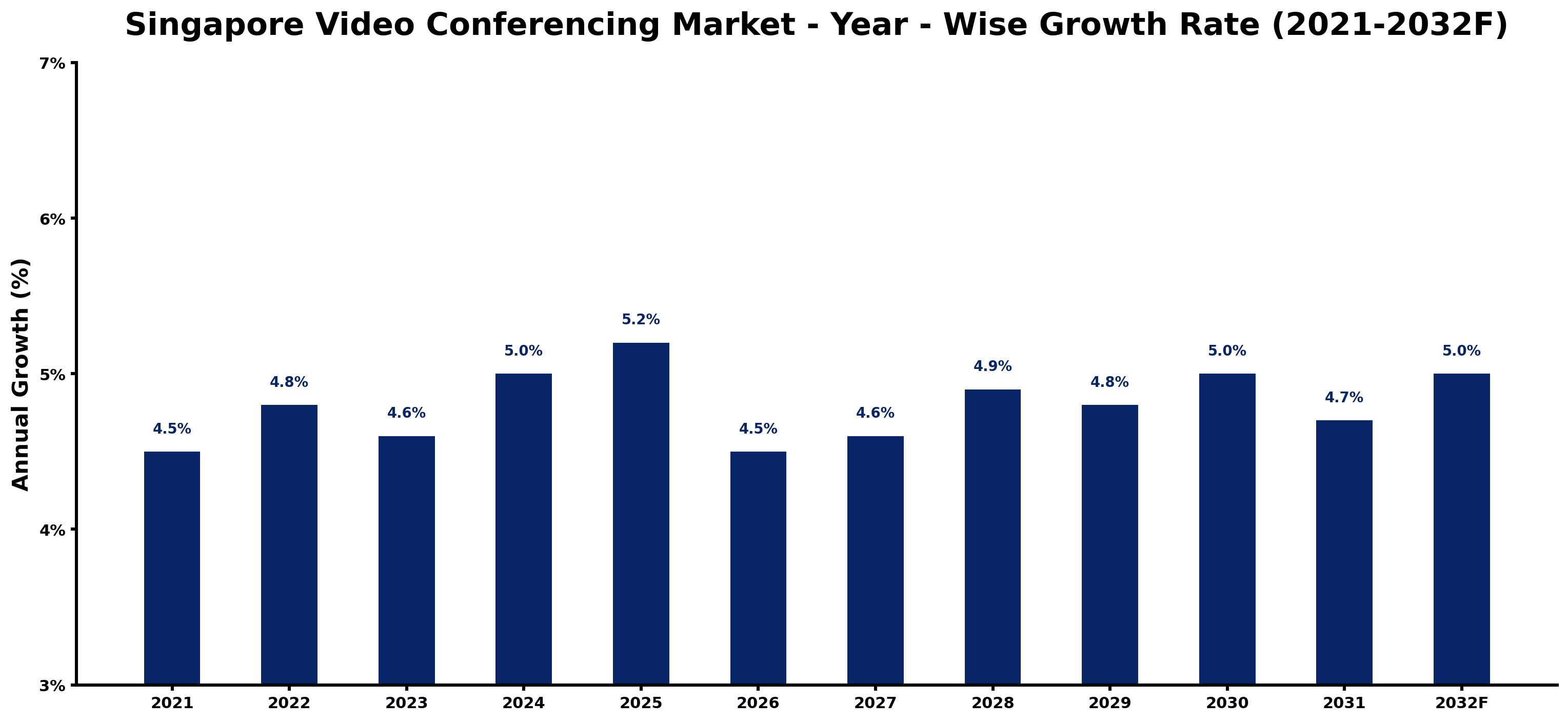
The table below presents the year‑wise growth rates along with the key drivers influencing the market
| Year | Growth Rate | Major Drivers |
| 2021 | 4.5% | Increase in remote work policies by Ministry of Manpower. |
| 2022 | 4.8% | Launch of Smart Nation initiative enhancing digital communication. |
| 2023 | 4.6% | Rise in hybrid work models across Singaporean corporations. |
| 2024 | 5.0% | Government support for digital infrastructure investments in businesses. |
| 2025 | 5.2% | Collaboration with local tech firms to improve user experience. |
| 2026 | 4.5% | Greater adoption of video conferencing in education sector. |
| 2027 | 4.6% | Continued increase in regional business expansions requiring remote solutions. |
| 2028 | 4.9% | Integration of AI tools for enhanced video conferencing capabilities. |
| 2029 | 4.8% | Local startups driving innovation in video mentoring platforms. |
| 2030 | 5.0% | Regulatory support for enhanced data protection in virtual meetings. |
| 2031 | 4.7% | Growing need for virtual collaboration in multinational firms. |
| 2032 | 5.0% | Strong push for digital transformation in public services. |
Note: Market size estimations and growth projections presented in this report are based on 6Wresearch's proprietary forecasting methodology, utilizing the latest available industry data, government publications, and primary research inputs.
Singapore Video Conferencing Market Key Takeaways
Below are some of the specific key takeaways from the market, including:
- The market is experiencing a steady shift towards hybrid work models, driving demand for effective video conferencing tools.
- Innovation in features such as improved security and user experience is becoming critical for competitive differentiation.
- Organizations are increasingly prioritizing data protection measures, influencing the selection of video conferencing platforms.
- The surge in remote learning and virtual events has further expanded the scope of the video conferencing market.
- Regulatory initiatives are shaping the market, ensuring compliance with local data protection laws.
Evaluation of Restraints in Singapore Video Conferencing Market
Despite its growth, the Singapore Video Conferencing Market faces notable constraints. The challenge of ensuring consistent video quality across different network environments remains significant, as fluctuating bandwidth can hinder communication experiences. Additionally, the rapid pace of technological advancement means that providers must continuously adapt to evolving standards, which can strain resources. Security concerns also persist, necessitating ongoing investments in safeguarding user data and privacy, which can be a barrier for smaller companies in the sector.
Singapore Video Conferencing Market Trends
Several trends are shaping the Singapore Video Conferencing Market. First, the integration of AI and machine learning into video conferencing platforms is enhancing user experiences through features like automated transcription and real-time translation. Second, businesses are leaning toward all-in-one solutions that combine video conferencing with project management and collaboration tools. Lastly, the demand for sustainable practices is leading companies to consider energy-efficient technologies in their conferencing setups, reflecting a broader commitment to corporate responsibility.
Singapore Video Conferencing Market Opportunities
The market presents numerous opportunities for growth and investment. With the ongoing emphasis on hybrid work, companies can innovate by developing niche solutions tailored to specific industries, such as healthcare or education. Additionally, the push for enhanced security features opens doors for businesses specializing in cybersecurity measures for video conferencing. As organizations expand their global footprint, there is also a growing need for localization services, further enhancing the market's potential.
Government Initiatives in the Singapore Video Conferencing Market
The Singaporean government is actively supporting the video conferencing market through various initiatives aimed at enhancing digital communication infrastructure. This regulatory focus is crucial as businesses increasingly rely on virtual collaboration tools. Policies promoting digital literacy and secure online practices are also essential for fostering a conducive environment for video conferencing solutions.
- A recently completed initiative aimed at improving broadband connectivity across urban and rural areas has enhanced access to high-quality video conferencing.
- Currently, the government is rolling out a digital skills training program to equip the workforce with necessary skills for effective remote communication.
- Upcoming regulatory frameworks are being developed to ensure data protection compliance for video conferencing platforms, expected to be introduced in 2026.
- A public-private partnership initiative is underway, focusing on enhancing cybersecurity measures for remote communication tools.
- Plans for a national digital infrastructure upgrade are being discussed, which will further bolster video conferencing capabilities nationwide.
Future Insights of the Singapore Video Conferencing Market
Looking ahead, the Singapore Video Conferencing Market is set to expand as businesses increasingly embrace hybrid models of work. Innovations driven by AI and machine learning are likely to become standard features, enhancing user experiences and streamlining operations. The emphasis on security and compliance will continue to shape the offerings available, ensuring that platforms evolve alongside regulatory requirements. As collaboration becomes more integral to business success, the market will adapt to meet the changing needs of organizations and individuals alike.
Singapore Video Conferencing Market Latest Developments
In the last 12-14 months, the Singapore Video Conferencing Market has seen a flurry of activity, with companies striving to enhance their offerings amidst rising demand. The focus has been on integrating innovative technologies and addressing user concerns regarding privacy and data security.
- A major technology vendor launched an upgraded platform with advanced security features in Q1 2025, addressing increasing privacy concerns.
- An ongoing partnership between leading firms is focused on developing AI-driven features for enhanced user engagement, with progress reported in early 2026.
- A regional operator is currently rolling out a new service package aimed at small businesses, which includes tailored video conferencing solutions that began in late 2025.
- A rollout expected to begin in mid-2026 will introduce a new user interface designed to improve accessibility for users with disabilities.
- By late 2026, a planned initiative will launch a series of webinars aimed at educating users on best practices for secure video conferencing.
Singapore Video Conferencing Market - Key Attractiveness of the Report
- 10 Years of Market Numbers
- Historical Data Starting from 2022 to 2025
- Base Year: 2025
- Forecast Data until 2032
- Key Performance Indicators Impacting the Market
- Major Upcoming Developments and Projects
Key Highlights of the Report:
- Singapore Video Conferencing Market Outlook
- Market Size of Singapore Video Conferencing Market, 2025
- Forecast of Singapore Video Conferencing Market, 2032
- Historical Data and Forecast of Singapore Video Conferencing Revenues & Volume for the Period 2022-2032F
- Singapore Video Conferencing Market Trend Evolution
- Singapore Video Conferencing Market Drivers and Challenges
- Singapore Video Conferencing Price Trends
- Singapore Video Conferencing Porter's Five Forces
- Singapore Video Conferencing Industry Life Cycle
- Historical Data and Forecast of Singapore Video Conferencing Market Revenues & Volume By Component for the Period 2022-2032F
- Historical Data and Forecast of Singapore Video Conferencing Market Revenues & Volume By Hardware for the Period 2022-2032F
- Historical Data and Forecast of Singapore Video Conferencing Market Revenues & Volume By Solutions for the Period 2022-2032F
- Historical Data and Forecast of Singapore Video Conferencing Market Revenues & Volume By Services for the Period 2022-2032F
- Historical Data and Forecast of Singapore Video Conferencing Market Revenues & Volume By Application for the Period 2022-2032F
- Historical Data and Forecast of Singapore Video Conferencing Market Revenues & Volume By Corporate Communications for the Period 2022-2032F
- Historical Data and Forecast of Singapore Video Conferencing Market Revenues & Volume By Training for the Period 2022-2032F
- Historical Data and Forecast of Singapore Video Conferencing Market Revenues & Volume By Development for the Period 2022-2032F
- Historical Data and Forecast of Singapore Video Conferencing Market Revenues & Volume By Marketing & Client Engagement for the Period 2022-2032F
- Historical Data and Forecast of Singapore Video Conferencing Market Revenues & Volume By Deployment Mode for the Period 2022-2032F
- Historical Data and Forecast of Singapore Video Conferencing Market Revenues & Volume By On-premises for the Period 2022-2032F
- Historical Data and Forecast of Singapore Video Conferencing Market Revenues & Volume By Cloud for the Period 2022-2032F
- Historical Data and Forecast of Singapore Video Conferencing Market Revenues & Volume By Vertical for the Period 2022-2032F
- Historical Data and Forecast of Singapore Video Conferencing Market Revenues & Volume By BFSI for the Period 2022-2032F
- Historical Data and Forecast of Singapore Video Conferencing Market Revenues & Volume By IT and Telecom for the Period 2022-2032F
- Historical Data and Forecast of Singapore Video Conferencing Market Revenues & Volume By Healthcare & Lifescience for the Period 2022-2032F
- Historical Data and Forecast of Singapore Video Conferencing Market Revenues & Volume By Education for the Period 2022-2032F
- Historical Data and Forecast of Singapore Video Conferencing Market Revenues & Volume By Media and Entertainment for the Period 2022-2032F
- Historical Data and Forecast of Singapore Video Conferencing Market Revenues & Volume By Other Verticals for the Period 2022-2032F
- Singapore Video Conferencing Import Export Trade Statistics
- Market Opportunity Assessment By Component
- Market Opportunity Assessment By Application
- Market Opportunity Assessment By Deployment Mode
- Market Opportunity Assessment By Vertical
- Singapore Video Conferencing Top Companies Market Share
- Singapore Video Conferencing Competitive Benchmarking By Technical and Operational Parameters
- Singapore Video Conferencing Company Profiles
- Singapore Video Conferencing Key Strategic Recommendations






































