Singapore Worldwide Rolling Stock Wheel Market Size, Share & Growth Rate
The Singapore Worldwide Rolling Stock Wheel Market was estimated at USD 849 Million in 2025 and is projected to reach USD 1223 Million by 2032, growing at a CAGR of 5.4% from 2026 to 2032. This growth trajectory is primarily fueled by Singapore's strategic positioning as a transportation hub in Southeast Asia, where a robust and reliable rail network is paramount. Furthermore, the nation's commitment to sustainability and enhancing energy efficiency is leading to increased demand for advanced, low-friction rolling stock wheels that minimize energy consumption and enhance operational reliability.
Singapore Worldwide Rolling Stock Wheel Market Year-wise Growth Rate and Key Drivers
This graph highlights how the Singapore Worldwide Rolling Stock Wheel Market has steadily grown over the years, supported by major growth factors.
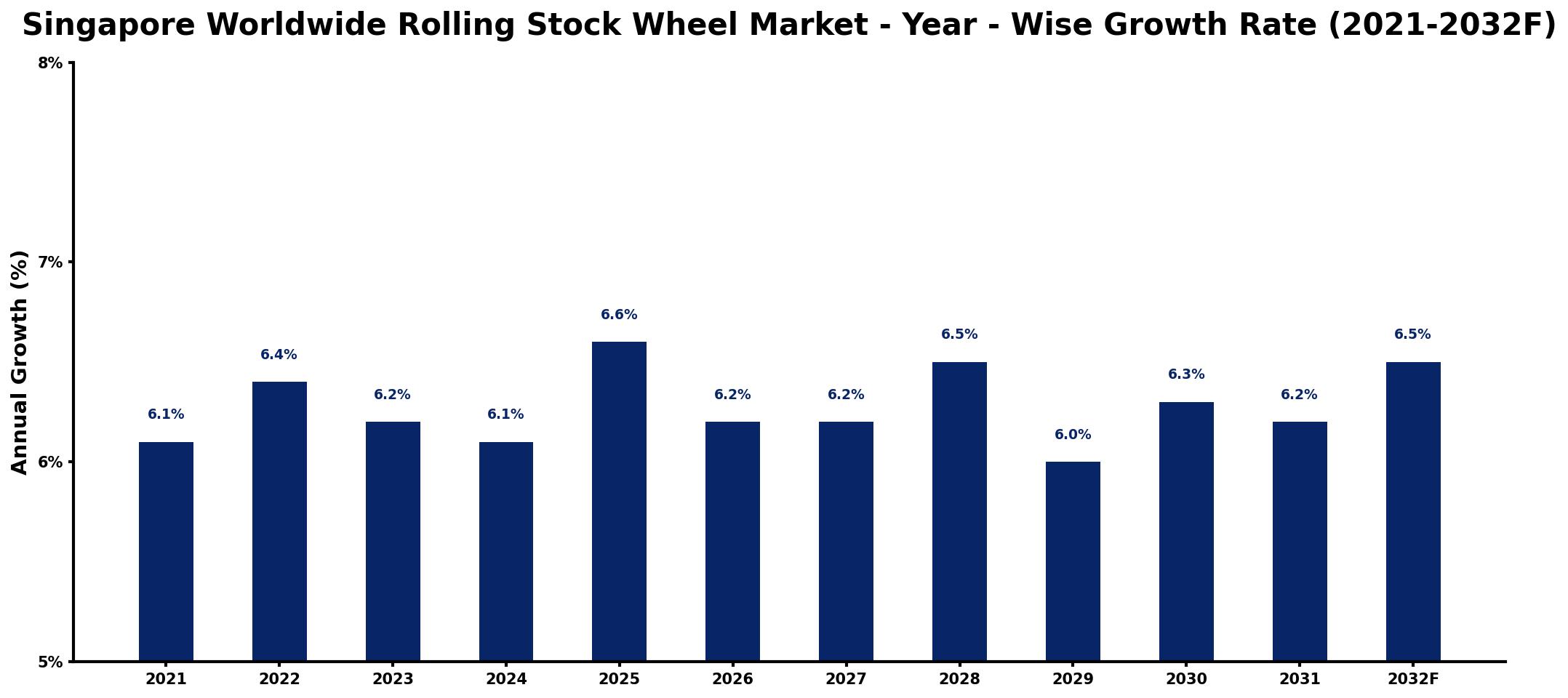
The table below presents the year‑wise growth rates along with the key drivers influencing the market
| Year | Growth Rate | Major Drivers |
| 2021 | 6.1% | increased urban transit investments |
| 2022 | 6.4% | growth in rail infrastructure projects |
| 2023 | 6.2% | rising demand for public transportation |
| 2024 | 6.1% | expansion of freight logistics networks |
| 2025 | 6.6% | enhanced focus on sustainability initiatives |
| 2026 | 6.2% | development of new manufacturing technologies |
| 2027 | 6.2% | boost in rail safety regulations |
| 2028 | 6.5% | increased collaboration between sectors |
| 2029 | 6.0% | growing need for efficient transport |
| 2030 | 6.3% | emphasis on passenger experience enhancements |
| 2031 | 6.2% | increased overall sector activity |
| 2032 | 6.5% | advancements in smart transportation systems |
Note: Market size estimations and growth projections presented in this report are based on 6Wresearch's proprietary forecasting methodology, utilizing the latest available industry data, government publications, and primary research inputs.
Singapore Worldwide Rolling Stock Wheel Market Synopsis
In Singapore, the rolling stock wheel market is vital for ensuring the smooth operation of both passenger and freight rail services. As the government continues to invest in upgrading and expanding rail infrastructure, the need for high-quality rolling stock wheels has become critical to maintain performance standards. These components are indispensable for reducing noise and friction while improving the lifespan and safety of trains.
The evolving demands of rail transportation also drive innovation within the rolling stock wheel sector. Manufacturers are increasingly leveraging advanced materials and precision engineering techniques to produce wheels that not only meet but exceed international safety standards, effectively supporting Singapore's ambitions for a world-class rail network. This focus on quality, combined with technological advancements, is shaping a vibrant market landscape.
Singapore Worldwide Rolling Stock Wheel Market Key Takeaways
- The market is driven by Singapore's strategic role as a logistics hub, necessitating efficient rail networks.
- Innovations in wheel design and materials are enhancing the performance and sustainability of rolling stock wheels.
- Continuous investment in rail infrastructure by the government supports market growth.
- Demand for energy-efficient solutions aligns with Singapores sustainability goals, fostering further market expansion.
- Technological advancements are improving the durability and safety features of rolling stock wheels.
Evaluation of Restraints in Singapore Worldwide Rolling Stock Wheel Market
Despite its promising outlook, the Singapore worldwide rolling stock wheel market faces specific restraints that could impede growth. Quality assurance remains a top priority, as manufacturers must consistently meet rigorous international safety standards. Additionally, fluctuations in global demand for rail services can create instability, impacting production and sales cycles. The highly competitive landscape also demands continuous innovation and cost-efficiency to retain market share against international manufacturers, creating additional pressure for local players.
Singapore Worldwide Rolling Stock Wheel Market Trends
Several trends are currently shaping the Singapore worldwide rolling stock wheel market. There is an increasing emphasis on the integration of smart technologies, such as predictive maintenance systems, which help optimize wheel performance and lifespan. Additionally, the push for eco-friendly solutions is leading to a greater adoption of lighter, more durable materials that improve energy efficiency. The shift towards automation in rail operations is also influencing the design of rolling stock wheels, as manufacturers seek to enhance safety and reduce operational costs.
Singapore Worldwide Rolling Stock Wheel Market Opportunities
Significant growth opportunities exist within the Singapore worldwide rolling stock wheel market, particularly in the realm of sustainability-focused innovations. Investment in energy-efficient wheels that minimize carbon footprints is critical as the government continues to prioritize environmental initiatives. Furthermore, expanding regional rail projects within Southeast Asia can open up new avenues for market players to supply advanced rolling stock solutions, thereby enhancing connectivity and bolstering trade.
Government Initiatives in the Singapore Worldwide Rolling Stock Wheel Market
The Singapore government plays a pivotal role in driving the growth of the worldwide rolling stock wheel market through its strategic initiatives. Public investments aimed at enhancing rail infrastructure reflect the nation's commitment to modernizing transport systems. Policies that promote sustainability, including grants and incentives for energy-efficient technologies, further encourage manufacturers to innovate and comply with rigorous environmental standards. Additionally, collaborations between government agencies and industry players facilitate research and development efforts, propelling advancements in rolling stock wheel technologies.
Future Insights of the Singapore Worldwide Rolling Stock Wheel Market
Looking ahead to 2026-2032, the Singapore worldwide rolling stock wheel market is poised for substantial growth, propelled by continued infrastructural advancements and the increasing prioritization of sustainability. As urbanization continues to rise and the demand for efficient public transportation intensifies, the need for high-performance rolling stock wheels will become even more pronounced. The ongoing integration of smart technologies and materials science advancements will further enhance the functionality and safety of these critical components, ensuring they meet the evolving needs of the rail industry.
Singapore Worldwide Rolling Stock Wheel Market Latest Developments (2025 - 2026)
Recent developments in the Singapore worldwide rolling stock wheel market highlight a shift towards advanced manufacturing techniques and sustainable materials. Manufacturers are increasingly collaborating with research institutions to enhance product offerings and comply with global safety standards. Additionally, projects aimed at improving public transportation efficiency are gaining momentum, setting the stage for increased demand for high-quality rolling stock wheels as the industry adapts to evolving market dynamics.
Singapore Worldwide Rolling Stock Wheel Market - Key Attractiveness of the Report
- 10 Years of Market Numbers
- Historical Data Starting from 2022 to 2025
- Base Year: 2025
- Forecast Data until 2032
- Key Performance Indicators Impacting the Market
- Major Upcoming Developments and Projects
Key Highlights of the Report:
- Singapore Worldwide Rolling Stock Wheel Market Outlook
- Market Size of Singapore Worldwide Rolling Stock Wheel Market, 2025
- Forecast of Singapore Worldwide Rolling Stock Wheel Market, 2032
- Historical Data and Forecast of Singapore Worldwide Rolling Stock Wheel Revenues & Volume for the Period 2022-2032F
- Singapore Worldwide Rolling Stock Wheel Market Trend Evolution
- Singapore Worldwide Rolling Stock Wheel Market Drivers and Challenges
- Singapore Worldwide Rolling Stock Wheel Price Trends
- Singapore Worldwide Rolling Stock Wheel Porter's Five Forces
- Singapore Worldwide Rolling Stock Wheel Industry Life Cycle
- Historical Data and Forecast of Singapore Worldwide Rolling Stock Wheel Market Revenues & Volume By Product Type for the Period 2022-2032F
- Historical Data and Forecast of Singapore Worldwide Rolling Stock Wheel Market Revenues & Volume By Casting for the Period 2022-2032F
- Historical Data and Forecast of Singapore Worldwide Rolling Stock Wheel Market Revenues & Volume By Forged for the Period 2022-2032F
- Historical Data and Forecast of Singapore Worldwide Rolling Stock Wheel Market Revenues & Volume By Applications for the Period 2022-2032F
- Historical Data and Forecast of Singapore Worldwide Rolling Stock Wheel Market Revenues & Volume By High Speed for the Period 2022-2032F
- Historical Data and Forecast of Singapore Worldwide Rolling Stock Wheel Market Revenues & Volume By Freight Wagons for the Period 2022-2032F
- Historical Data and Forecast of Singapore Worldwide Rolling Stock Wheel Market Revenues & Volume By Passenger Wagons for the Period 2022-2032F
- Historical Data and Forecast of Singapore Worldwide Rolling Stock Wheel Market Revenues & Volume By Locos for the Period 2022-2032F
- Singapore Worldwide Rolling Stock Wheel Import Export Trade Statistics
- Market Opportunity Assessment By Product Type
- Market Opportunity Assessment By Applications
- Singapore Worldwide Rolling Stock Wheel Top Companies Market Share
- Singapore Worldwide Rolling Stock Wheel Competitive Benchmarking By Technical and Operational Parameters
- Singapore Worldwide Rolling Stock Wheel Company Profiles
- Singapore Worldwide Rolling Stock Wheel Key Strategic Recommendations






































