Singapore X-Ray Tube Market Size, Share & Growth Rate
The Singapore X-Ray Tube Market was estimated at USD 1454 Million in 2025 and is projected to reach USD 2066 Million by 2032, growing at a CAGR of 5.1% from 2026 to 2032. This growth trajectory is largely driven by the increasing demand for advanced medical imaging services as healthcare institutions expand their capabilities. Moreover, the rise of industrial inspection requirements across sectors further bolsters the need for high-quality X-ray imaging technologies.
Singapore X-Ray Tube Market Year-wise Growth Rate and Key Drivers
This graph highlights how the Singapore X-Ray Tube Market has steadily grown over the years, supported by major growth factors.
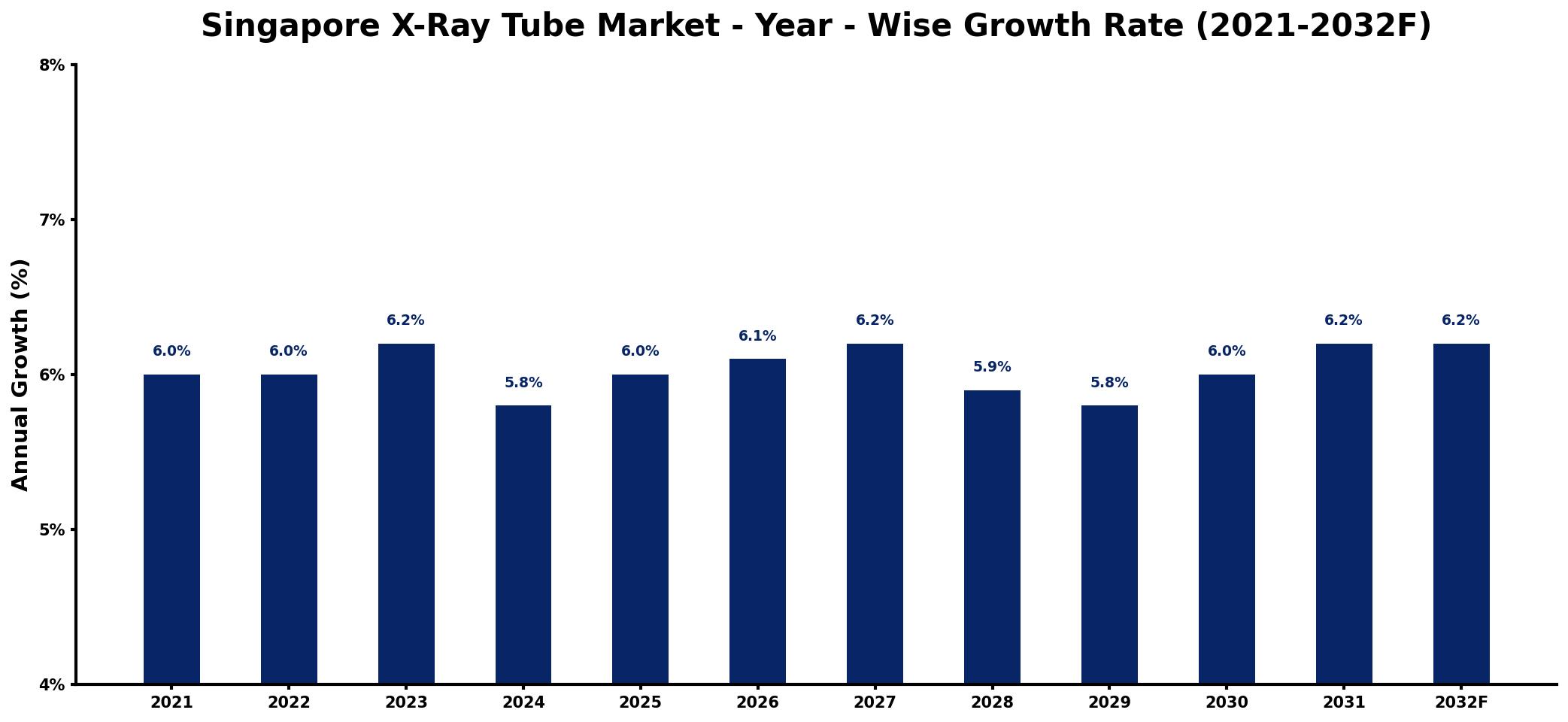
The table below presents the year‑wise growth rates along with the key drivers influencing the market
| Year | Growth Rate | Major Drivers |
| 2021 | 6.0% | Rising healthcare expenditure across sectors |
| 2022 | 6.0% | Growing adoption of advanced imaging |
| 2023 | 6.2% | Increased demand for diagnostic procedures |
| 2024 | 5.8% | Expansion of healthcare infrastructure projects |
| 2025 | 6.0% | Surge in public health investments |
| 2026 | 6.1% | Technological advancements in imaging systems |
| 2027 | 6.2% | Growing prevalence of chronic diseases |
| 2028 | 5.9% | Rising geriatric population requiring diagnostics |
| 2029 | 5.8% | Increased focus on preventive healthcare |
| 2030 | 6.0% | Investment in healthcare technology innovations |
| 2031 | 6.2% | growing automotive sector requirements |
| 2032 | 6.2% | Increased collaboration among healthcare providers |
Note: Market size estimations and growth projections presented in this report are based on 6Wresearch's proprietary forecasting methodology, utilizing the latest available industry data, government publications, and primary research inputs.
Singapore X-Ray Tube Market Synopsis
The critical force shaping the Singapore X-Ray Tube Market today is the surge in healthcare demand, which has been accelerated by the expansion of radiology departments. With innovations in X-ray technology paving the way for enhanced imaging solutions, the market is experiencing a significant transformation that caters to both medical and industrial applications.
Additionally, the increased adoption of digital radiography systems is redefining how X-ray tubes are utilized, ensuring that high-quality imaging is not only achieved but also maintained. As industries recognize the importance of reliable diagnostic tools, the X-ray tube market is positioned for promising growth in the coming years.
Singapore X-Ray Tube Market Key Takeaways
- The Singapore X-ray tube market is projected to grow at a CAGR of 5.1% from 2026 to 2032.
- Rising healthcare demands and advancements in X-ray technologies drive market expansion.
- X-ray tubes are essential for various applications, including medical diagnostics and industrial inspections.
- Ongoing innovations are enhancing tube durability and performance, particularly in response to pandemic needs.
- Key players in the market are focusing on delivering high-quality and efficient imaging solutions.
Evaluation of Restraints in Singapore X-Ray Tube Market
Despite its growth prospects, the Singapore X-Ray Tube Market is impeded by challenges related to durability and maintenance. X-ray tubes are subject to rigorous operational demands, requiring them to endure continuous usage without compromising performance. Ensuring the availability of affordable maintenance and replacement parts is crucial to minimize downtime and maintain operational efficiency. Without addressing these concerns, the overall growth potential of the market could be hindered.
Singapore X-Ray Tube Market Trends
Currently, one of the most significant trends in the Singapore X-Ray Tube Market is the shift towards digital radiography, which is enhancing imaging quality and efficiency. Additionally, the integration of artificial intelligence into imaging technologies is on the rise, enabling faster and more accurate diagnostics. Moreover, the growing emphasis on non-destructive testing methods in various industries is driving demand for innovative X-ray solutions.
Singapore X-Ray Tube Market Opportunities
The market presents substantial growth opportunities, particularly in the expansion of telemedicine and remote diagnostic services. As healthcare systems evolve, there is a growing need for portable and efficient imaging solutions that can cater to remote areas. Additionally, the ongoing investments in healthcare infrastructure and industrial inspection facilities will likely provide a fertile ground for innovations and product enhancements in X-ray tubes.
Government Initiatives in the Singapore X-Ray Tube Market
The Singapore government continues to promote advancements in healthcare technology through various policies and initiatives aimed at enhancing medical diagnostics and patient care. Public funding and incentives for research and development in the medical imaging sector are pivotal in driving innovation. Furthermore, initiatives focused on improving healthcare infrastructure provide a supportive backdrop for the growth of the X-ray tube market.
Future Insights of the Singapore X-Ray Tube Market
Looking ahead to 2026-2032, the Singapore X-Ray Tube Market is expected to experience sustained growth, driven by technological advancements and increasing healthcare demands. The focus on diagnostic accuracy and efficiency will likely lead to further innovations in X-ray tube designs and functionalities. With the continuous expansion of both medical and industrial applications, the market is set to evolve into a dynamic landscape of opportunities.
Singapore X-Ray Tube Market Latest Developments (2025 - 2026)
Recent developments in the Singapore X-Ray Tube Market have indicated a growing emphasis on enhancing tube durability and overall performance, especially in response to the heightened demand for diagnostic imaging solutions stemming from the pandemic. Manufacturers are increasingly integrating advanced materials and technologies to improve the efficiency and reliability of X-ray tubes. Additionally, collaborations between healthcare providers and technology firms are fostering innovations that are crucial for addressing the evolving needs of the medical sector.
Singapore X-Ray Tube Market - Key Attractiveness of the Report
- 10 Years of Market Numbers
- Historical Data Starting from 2022 to 2025
- Base Year: 2025
- Forecast Data until 2032
- Key Performance Indicators Impacting the Market
- Major Upcoming Developments and Projects
Key Highlights of the Report:
- Singapore X-Ray Tube Market Outlook
- Market Size of Singapore X-Ray Tube Market, 2025
- Forecast of Singapore X-Ray Tube Market, 2032
- Historical Data and Forecast of Singapore X-Ray Tube Revenues & Volume for the Period 2022-2032F
- Singapore X-Ray Tube Market Trend Evolution
- Singapore X-Ray Tube Market Drivers and Challenges
- Singapore X-Ray Tube Price Trends
- Singapore X-Ray Tube Porter's Five Forces
- Singapore X-Ray Tube Industry Life Cycle
- Historical Data and Forecast of Singapore X-Ray Tube Market Revenues & Volume By Type for the Period 2022-2032F
- Historical Data and Forecast of Singapore X-Ray Tube Market Revenues & Volume By Rotating Anode Tube for the Period 2022-2032F
- Historical Data and Forecast of Singapore X-Ray Tube Market Revenues & Volume By Stationary X-Ray Tube for the Period 2022-2032F
- Historical Data and Forecast of Singapore X-Ray Tube Market Revenues & Volume By End-user Industry for the Period 2022-2032F
- Historical Data and Forecast of Singapore X-Ray Tube Market Revenues & Volume By Manufacturing for the Period 2022-2032F
- Historical Data and Forecast of Singapore X-Ray Tube Market Revenues & Volume By Healthcare for the Period 2022-2032F
- Historical Data and Forecast of Singapore X-Ray Tube Market Revenues & Volume By Food for the Period 2022-2032F
- Historical Data and Forecast of Singapore X-Ray Tube Market Revenues & Volume By Aerospace and Defense for the Period 2022-2032F
- Historical Data and Forecast of Singapore X-Ray Tube Market Revenues & Volume By Other End-user Industries for the Period 2022-2032F
- Singapore X-Ray Tube Import Export Trade Statistics
- Market Opportunity Assessment By Type
- Market Opportunity Assessment By End-user Industry
- Singapore X-Ray Tube Top Companies Market Share
- Singapore X-Ray Tube Competitive Benchmarking By Technical and Operational Parameters
- Singapore X-Ray Tube Company Profiles
- Singapore X-Ray Tube Key Strategic Recommendations






































