Slovakia Apiculture Market Size, Share & Growth Rate
The Slovakia Apiculture Market was estimated at USD 229 Million in 2025 and is projected to reach USD 308 Million by 2032, growing at a CAGR of 4.3% from 2026 to 2032. This growth trajectory is being fueled by increasing consumer awareness of the health benefits associated with honey and bee products, alongside a growing preference for natural and organic options. Additionally, the governments initiatives to support sustainable beekeeping practices further bolster market expansion.
Slovakia Apiculture Market Year-wise Growth Rate and Key Drivers
This graph highlights how the Slovakia Apiculture Market has steadily grown over the years, supported by major growth factors.
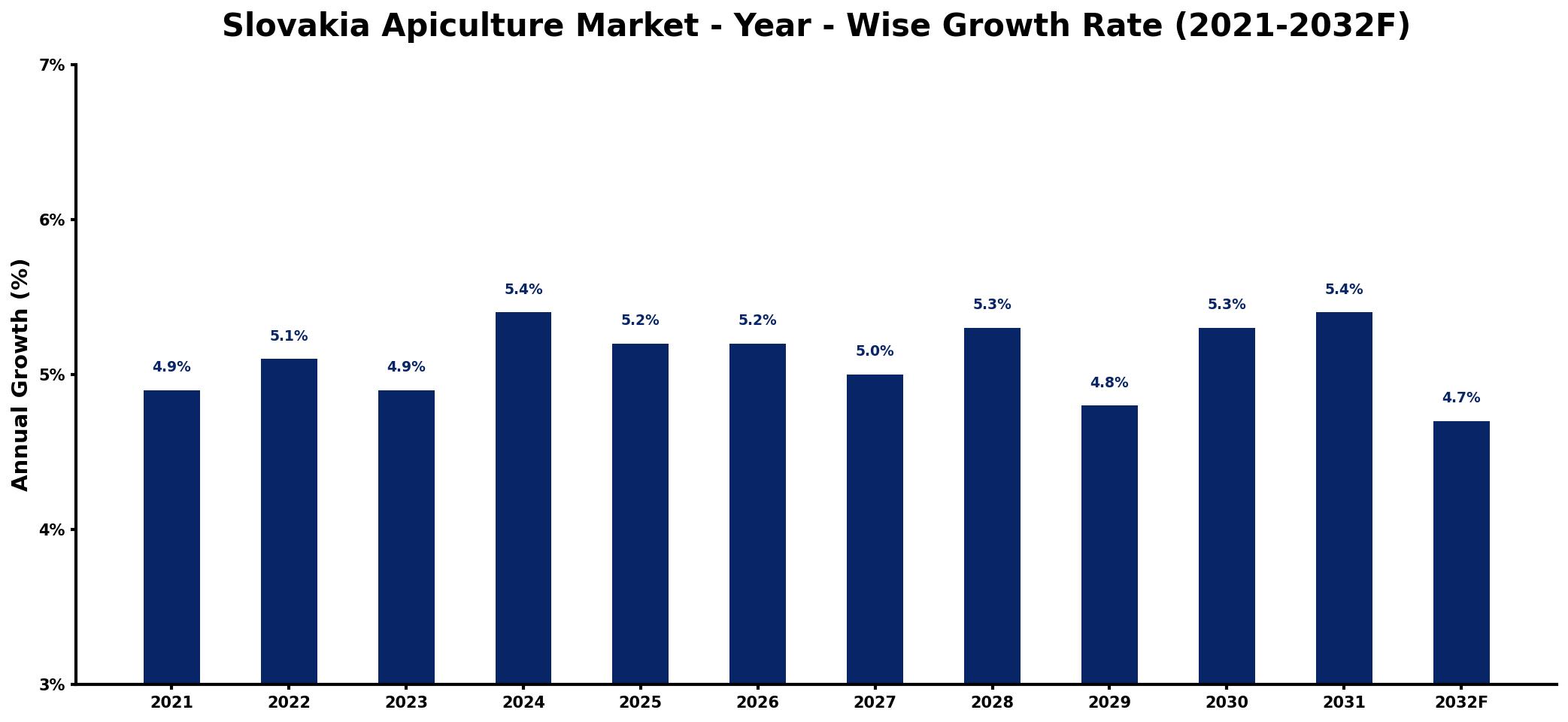
The table below presents the year‑wise growth rates along with the key drivers influencing the market
| Year | Growth Rate | Major Drivers |
| 2021 | 4.9% | Increased consumer health awareness |
| 2022 | 5.1% | Rising demand for natural products |
| 2023 | 4.9% | Expansion of organic farming practices |
| 2024 | 5.4% | Growing interest in sustainability initiatives |
| 2025 | 5.2% | Increase in local farmer cooperatives |
| 2026 | 5.2% | Higher investments in research funding |
| 2027 | 5.0% | Development of new distribution channels |
| 2028 | 5.3% | Surge in educational workshops offered |
| 2029 | 4.8% | Emergence of niche market segments |
| 2030 | 5.3% | Strengthening of export opportunities |
| 2031 | 5.4% | Growth in online sales platforms |
| 2032 | 4.7% | Increased regulatory support for practices |
Note: Market size estimations and growth projections presented in this report are based on 6Wresearch's proprietary forecasting methodology, utilizing the latest available industry data, government publications, and primary research inputs.
Slovakia Apiculture Market Synopsis
One of the strongest forces currently shaping the Slovakia Apiculture Market is the rising consumer demand for locally produced honey. As health-conscious consumers prioritize product origin and quality, Slovakian beekeepers are positioned to meet these preferences with a variety of high-quality honey products, including acacia, linden, and sunflower honey.
Furthermore, the increasing adoption of environmentally sustainable beekeeping practices is transforming the market landscape. Efforts to combat global bee population decline and the implementation of organic methods are not only improving the health of bee colonies but also enhancing the market appeal of Slovak honey products.
Slovakia Apiculture Market Key Takeaways
- Growing consumer awareness of the health benefits of honey is driving demand.
- Local honey production is experiencing a resurgence as consumers prefer domestically sourced products.
- Sustainable beekeeping practices are becoming increasingly important in market operations.
- The government actively supports the apiculture sector through various policies and financial incentives.
- Investment opportunities abound in modern technology and organic honey production.
Evaluation of Restraints in Slovakia Apiculture Market
Despite the optimistic outlook, the Slovakia Apiculture Market is not without its challenges. Climate change significantly impacts bee populations and honey yield, posing serious threats to the sustainability of beekeeping. Additionally, competition from imported honey products complicates market dynamics, often undermining local producers. There exists a considerable need for greater consumer awareness surrounding the importance of supporting local beekeepers, coupled with a necessity for ongoing investment in disease management to maintain healthy colonies. Regulatory hurdles also present a barrier, as compliance with stringent EU standards can be a significant challenge for smaller operators.
Slovakia Apiculture Market Trends
Current trends in the Slovakia Apiculture Market indicate a robust shift towards organic and sustainable beekeeping methods. Consumers are increasingly attracted to products that resonate with their values of health and environmental stewardship. The growing interest in apitherapy, utilizing bee products for therapeutic purposes, is expanding the market beyond traditional honey sales, creating new avenues for growth. This trend aligns with a broader cultural shift towards natural and holistic wellness solutions.
Slovakia Apiculture Market Opportunities
The Slovakia Apiculture Market presents numerous investment opportunities, particularly for those willing to innovate. Modernizing equipment and adopting advanced technology in honey production can enhance efficiency and output. Additionally, the increasing consumer shift towards organic products opens pathways for niche markets and specialized honey offerings. Collaborations with local beekeepers to improve infrastructure and funding research initiatives can lead to significant advancements within the sector, catering to the growing demand for quality and sustainability.
Government Initiatives in the Slovakia Apiculture Market
The Slovak government plays a crucial role in promoting the apiculture sector through various supportive policies and programs. Initiatives include financial support in the form of subsidies and grants aimed at fostering sustainable practices among beekeepers. Additionally, there are regulations in place to safeguard bee health and prevent disease spread, ensuring the quality and safety of honey production. Training programs for beekeepers on modern techniques further enhance productivity and support the longevity of this traditional industry.
Future Insights of the Slovakia Apiculture Market
Looking ahead to the years 2026-2032, the Slovakia Apiculture Market is set to flourish, driven by a strong consumer preference for natural products and sustainable practices. Government initiatives aimed at protecting bee populations and promoting apiculture will likely continue to strengthen the industry. While challenges related to climate change and competition persist, technological advancements and innovative practices are expected to pave the way for growth and diversification, ensuring a vibrant future for Slovak beekeepers.
Slovakia Apiculture Market Latest Developments (2025 - 2026)
Recent developments in the Slovakia Apiculture Market indicate a strategic focus on sustainability, with many beekeepers adopting organic practices in response to consumer demand. The government has initiated several new programs aimed at improving the health of bee colonies through better disease management. Additionally, local producers are increasingly collaborating to enhance distribution channels, ensuring that high-quality Slovak honey reaches both domestic and international markets more effectively.
Slovakia Apiculture Market - Key Attractiveness of the Report
- 10 Years of Market Numbers
- Historical Data Starting from 2022 to 2025
- Base Year: 2025
- Forecast Data until 2032
- Key Performance Indicators Impacting the Market
- Major Upcoming Developments and Projects
Key Highlights of the Report:
- Slovakia Apiculture Market Outlook
- Market Size of Slovakia Apiculture Market, 2025
- Forecast of Slovakia Apiculture Market, 2032
- Historical Data and Forecast of Slovakia Apiculture Revenues & Volume for the Period 2022-2032F
- Slovakia Apiculture Market Trend Evolution
- Slovakia Apiculture Market Drivers and Challenges
- Slovakia Apiculture Price Trends
- Slovakia Apiculture Porter's Five Forces
- Slovakia Apiculture Industry Life Cycle
- Historical Data and Forecast of Slovakia Apiculture Market Revenues & Volume By Product Type for the Period 2022-2032F
- Historical Data and Forecast of Slovakia Apiculture Market Revenues & Volume By Honey for the Period 2022-2032F
- Historical Data and Forecast of Slovakia Apiculture Market Revenues & Volume By Beeswax for the Period 2022-2032F
- Historical Data and Forecast of Slovakia Apiculture Market Revenues & Volume By Live-bees for the Period 2022-2032F
- Historical Data and Forecast of Slovakia Apiculture Market Revenues & Volume By Others for the Period 2022-2032F
- Historical Data and Forecast of Slovakia Apiculture Market Revenues & Volume By Application for the Period 2022-2032F
- Historical Data and Forecast of Slovakia Apiculture Market Revenues & Volume By Medical for the Period 2022-2032F
- Historical Data and Forecast of Slovakia Apiculture Market Revenues & Volume By Food Beverages for the Period 2022-2032F
- Historical Data and Forecast of Slovakia Apiculture Market Revenues & Volume By Cosmetics for the Period 2022-2032F
- Historical Data and Forecast of Slovakia Apiculture Market Revenues & Volume By Others for the Period 2022-2032F
- Slovakia Apiculture Import Export Trade Statistics
- Market Opportunity Assessment By Product Type
- Market Opportunity Assessment By Application
- Slovakia Apiculture Top Companies Market Share
- Slovakia Apiculture Competitive Benchmarking By Technical and Operational Parameters
- Slovakia Apiculture Company Profiles
- Slovakia Apiculture Key Strategic Recommendations






































