Slovakia Data Center Virtualization Market Size & Growth Rate (2026-2032)
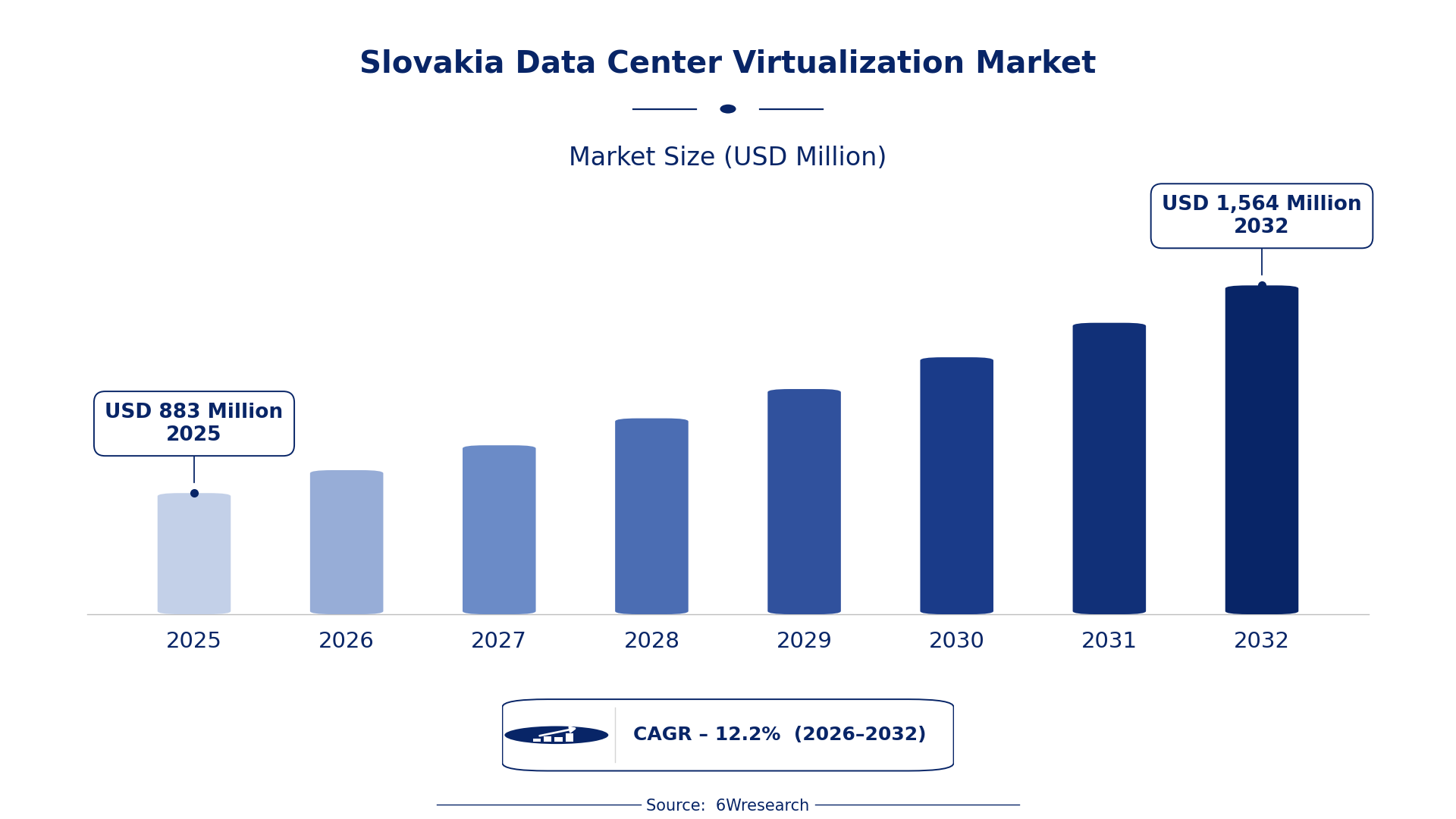
The Slovakia Data Center Virtualization Market was estimated at USD 883 Million in 2025 and is projected to reach USD 1564 Million by 2032, growing at a CAGR of 12.2% from 2026 to 2032.
Slovakia Data Center Virtualization Market Synopsis
The Slovakia Data Center Virtualization Market is witnessing an upward trajectory, fueled by a pressing need for efficient IT infrastructure. As businesses increasingly recognize the advantages of virtualization technologies, they are investing in solutions that enhance operational efficiency and scalability.
Key sectors, including finance and telecommunications, are leading this transformation. Companies are embracing software-defined data centers to streamline their operations, reduce costs, and improve agility in response to market demands.
Slovakia Data Center Virtualization Market Year-wise Growth Rate and Key Drivers
This graph illustrates the annual growth rates of the Slovakia Data Center Virtualization Market from 2021 to 2032, highlighting a steady upward trajectory and projected expansion over the forecast period.
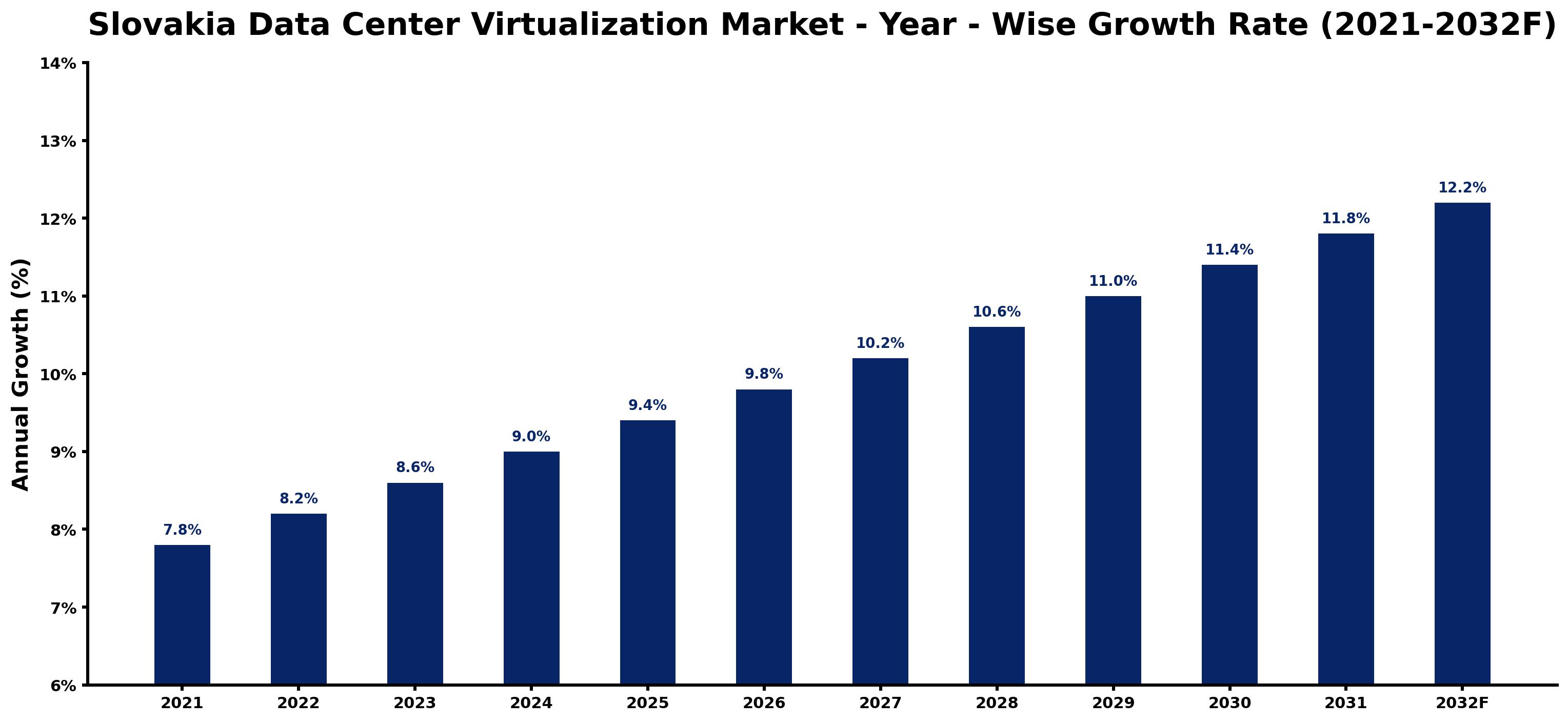
The table below presents the year‑wise growth rates along with the key drivers influencing the market
| Year | Growth Rate | Major Drivers |
| 2021 | 7.8% | EU budget support for digital transformation initiatives |
| 2022 | 8.2% | Increased demand from tech startups in Bratislava |
| 2023 | 8.6% | Slovak government's cloud-first strategy implementation |
| 2024 | 9.0% | Growing local demand for hybrid cloud solutions |
| 2025 | 9.4% | Strong interest in energy-efficient data center technologies |
| 2026 | 9.8% | Investment in local data center security regulations |
| 2027 | 10.2% | Rising adoption of IoT devices across industries |
| 2028 | 10.6% | Substantial foreign investments in tech sector expansion |
| 2029 | 11.0% | Emergence of AI-driven data analytics companies |
| 2030 | 11.4% | Regulatory incentives for sustainable data center operations |
| 2031 | 11.8% | Increase in remote work driving virtualization demand |
| 2032 | 12.2% | Development of regional data governance standards |
Note: Market size estimations and growth projections presented in this report are based on 6Wresearch's proprietary forecasting methodology, utilizing the latest available industry data, government publications, and primary research inputs.
Slovakia Data Center Virtualization Market Key Takeaways
Below are some of the specific key takeaways from the market, including:
- The market is driven by increasing demand for efficient resource utilization and cost reduction.
- Software-defined data centers are becoming the norm, enhancing flexibility and scalability.
- Hybrid cloud solutions are gaining traction among organizations seeking agility and resilience.
- Data security and compliance are top priorities, prompting investments in advanced virtualization technologies.
- Government policies are fostering an environment conducive to market growth and innovation.
Evaluation of Restraints in Slovakia Data Center Virtualization Market
Several challenges hinder the potential of the Slovakia Data Center Virtualization Market. High initial investment costs for virtualization technologies can deter smaller companies from adopting these solutions. Additionally, the complexity involved in integrating new virtualized environments with existing infrastructure creates barriers for organizations.
Compatibility issues between various virtualization platforms further complicate matters, as does the need for specialized skills to manage these environments effectively. Companies must prioritize strategic planning and training to overcome these obstacles.
Slovakia Data Center Virtualization Market Trends
Emerging trends within the Slovakia Data Center Virtualization Market reveal a strong shift toward software-defined data centers. Businesses are increasingly recognizing the value of virtualization technologies, such as storage and network virtualization, in optimizing their IT operations.
Additionally, the hybrid cloud model is becoming more popular as organizations seek to blend on-premises infrastructure with cloud services. This trend not only enhances resource flexibility but also supports a more agile response to evolving business needs.
Slovakia Data Center Virtualization Market Opportunities
The Slovakia Data Center Virtualization Market presents numerous investment opportunities, especially as digital transformation accelerates across sectors. Companies are actively seeking innovative virtualization solutions to streamline their operations and improve cost efficiency.
Investors should focus on technologies like software-defined networking and cloud computing services, which promise substantial returns as firms work to optimize their IT frameworks.
Government Initiatives in the Slovakia Data Center Virtualization Market
Government policy in Slovakia is playing a crucial role in shaping the Data Center Virtualization Market. By implementing supportive measures, authorities are creating a favorable environment for investment and innovation in virtualization technologies. The regulatory framework aims to enhance data security and privacy while promoting the growth of the sector.
- A recently completed initiative focused on tax incentives for data center operators, aimed at attracting foreign investment.
- Currently ongoing programs are enhancing the infrastructure for digital services to support virtualization adoption across industries.
- A planned public-private partnership is expected to launch by 2026 to bolster the development of data center infrastructure.
- New regulatory measures introduced in late 2025 are designed to streamline compliance processes for businesses adopting virtualization technologies.
Future Insights of the Slovakia Data Center Virtualization Market
Looking ahead to 2026-2032, the Slovakia Data Center Virtualization Market is set for sustained growth. The increasing reliance on cloud computing and big data analytics will drive demand for virtualization solutions that enhance efficiency and scalability. Organizations will continue to seek ways to modernize their IT infrastructure, paving the way for innovative virtualization technologies.
on top of that, the rise in remote work will further amplify the need for secure and agile IT environments, propelling market expansion and creating additional opportunities for service providers.
Slovakia Data Center Virtualization Market Latest Developments
The past year has seen significant activity in the Slovakia Data Center Virtualization Market, with various initiatives aimed at enhancing virtualization capabilities. Companies are increasingly investing in advanced technologies to keep pace with evolving demands and competitive pressures.
- A major technology vendor launched a new suite of virtualization tools in early 2025, designed to streamline cloud management for businesses.
- An ongoing project is focused on upgrading existing data center infrastructures to improve performance and security features.
- Plans for a new virtualization training program were announced in Q3 2025, aimed at addressing skill gaps in the workforce.
- A partnership between regional IT firms is currently underway to develop innovative solutions that enhance data center automation.
Slovakia Data Center Virtualization Market - Key Attractiveness of the Report
- 10 Years of Market Numbers
- Historical Data Starting from 2022 to 2025
- Base Year: 2025
- Forecast Data until 2032
- Key Performance Indicators Impacting the Market
- Major Upcoming Developments and Projects
Key Highlights of the Report:
- Slovakia Data Center Virtualization Market Outlook
- Market Size of Slovakia Data Center Virtualization Market, 2025
- Forecast of Slovakia Data Center Virtualization Market, 2032
- Historical Data and Forecast of Slovakia Data Center Virtualization Revenues & Volume for the Period 2022-2032F
- Slovakia Data Center Virtualization Market Trend Evolution
- Slovakia Data Center Virtualization Market Drivers and Challenges
- Slovakia Data Center Virtualization Price Trends
- Slovakia Data Center Virtualization Porter's Five Forces
- Slovakia Data Center Virtualization Industry Life Cycle
- Historical Data and Forecast of Slovakia Data Center Virtualization Market Revenues & Volume By Type for the Period 2022-2032F
- Historical Data and Forecast of Slovakia Data Center Virtualization Market Revenues & Volume By Advisory & Implementation Services for the Period 2022-2032F
- Historical Data and Forecast of Slovakia Data Center Virtualization Market Revenues & Volume By Optimization Services for the Period 2022-2032F
- Historical Data and Forecast of Slovakia Data Center Virtualization Market Revenues & Volume By Managed Services for the Period 2022-2032F
- Historical Data and Forecast of Slovakia Data Center Virtualization Market Revenues & Volume By Technical Support Services for the Period 2022-2032F
- Historical Data and Forecast of Slovakia Data Center Virtualization Market Revenues & Volume By Organization Size for the Period 2022-2032F
- Historical Data and Forecast of Slovakia Data Center Virtualization Market Revenues & Volume By Large Enterprises for the Period 2022-2032F
- Historical Data and Forecast of Slovakia Data Center Virtualization Market Revenues & Volume By SMEs for the Period 2022-2032F
- Historical Data and Forecast of Slovakia Data Center Virtualization Market Revenues & Volume By Vertical for the Period 2022-2032F
- Historical Data and Forecast of Slovakia Data Center Virtualization Market Revenues & Volume By IT & Telecommunication for the Period 2022-2032F
- Historical Data and Forecast of Slovakia Data Center Virtualization Market Revenues & Volume By Banking Financial Services & Insurance (BFSI) for the Period 2022-2032F
- Historical Data and Forecast of Slovakia Data Center Virtualization Market Revenues & Volume By Education for the Period 2022-2032F
- Historical Data and Forecast of Slovakia Data Center Virtualization Market Revenues & Volume By Healthcare for the Period 2022-2032F
- Historical Data and Forecast of Slovakia Data Center Virtualization Market Revenues & Volume By Government for the Period 2022-2032F
- Historical Data and Forecast of Slovakia Data Center Virtualization Market Revenues & Volume By Retail & SCM for the Period 2022-2032F
- Historical Data and Forecast of Slovakia Data Center Virtualization Market Revenues & Volume By Media &Entertainment for the Period 2022-2032F
- Historical Data and Forecast of Slovakia Data Center Virtualization Market Revenues & Volume By Manufacturing & Automotive for the Period 2022-2032F
- Slovakia Data Center Virtualization Import Export Trade Statistics
- Market Opportunity Assessment By Type
- Market Opportunity Assessment By Organization Size
- Market Opportunity Assessment By Vertical
- Slovakia Data Center Virtualization Top Companies Market Share
- Slovakia Data Center Virtualization Competitive Benchmarking By Technical and Operational Parameters
- Slovakia Data Center Virtualization Company Profiles
- Slovakia Data Center Virtualization Key Strategic Recommendations






































