Slovakia Formic Acid Market Size (2020-2030)
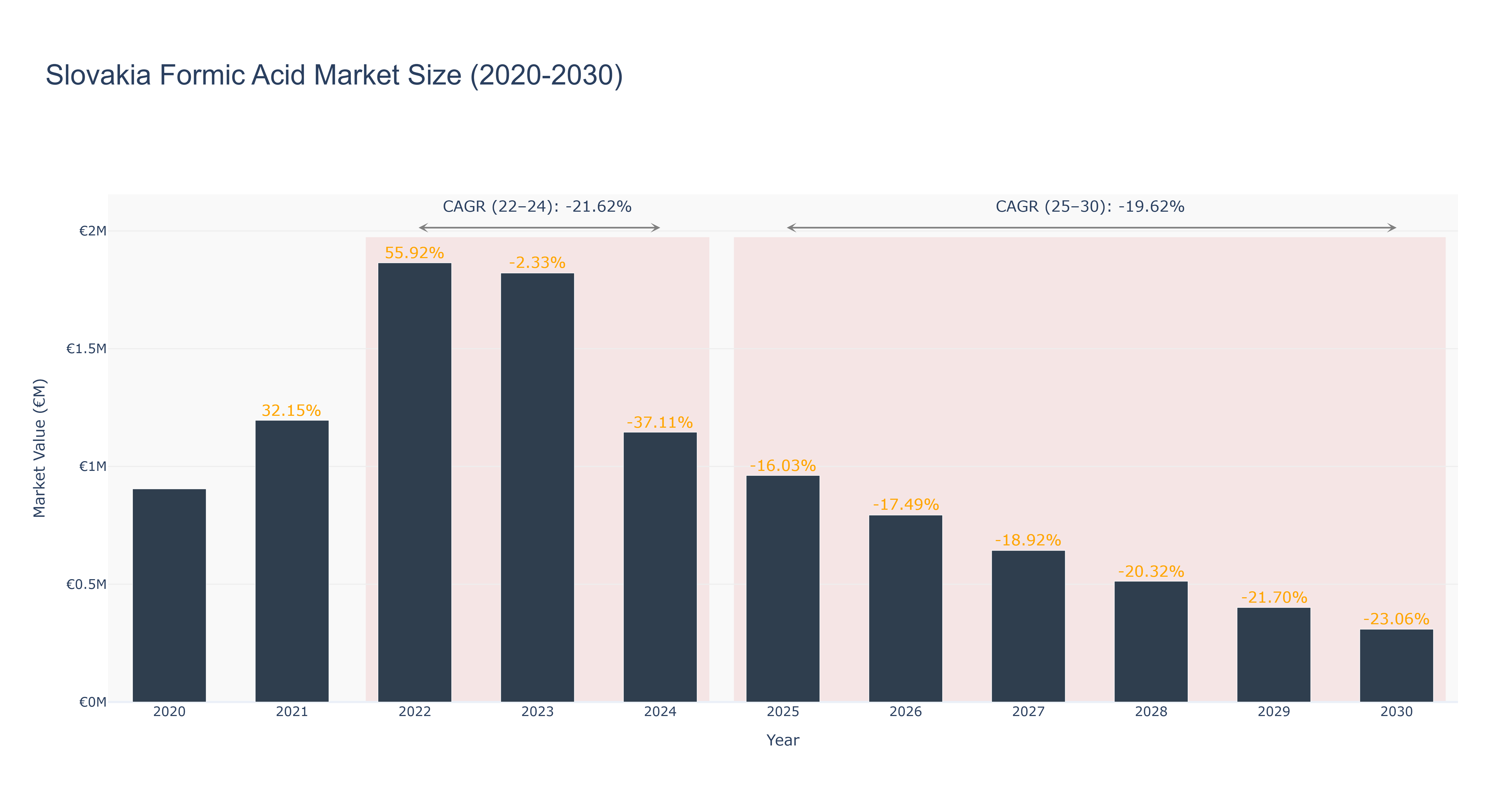
Slovakia's Formic Acid Market has seen a fluctuating trend in recent years. The peak market size of €1.86 million was observed in 2022, followed by a decline to €0.96 million in 2025. The market is forecasted to further decrease to €0.31 million by 2030, with a CAGR of -19.62% from 2025 to 2030. The decline can be attributed to various factors such as changes in demand patterns, global economic conditions, and technological advancements impacting production processes. Despite the downward trajectory, the industry drivers such as increasing applications in pharmaceuticals and agriculture are expected to sustain the market. In the near future, Slovakia's Formic Acid Market is set to witness advancements in sustainable production practices and enhanced product quality to meet evolving consumer needs and regulatory standards.
Slovakia Formic Acid Market: Production & Trade Performance (2019-2025)
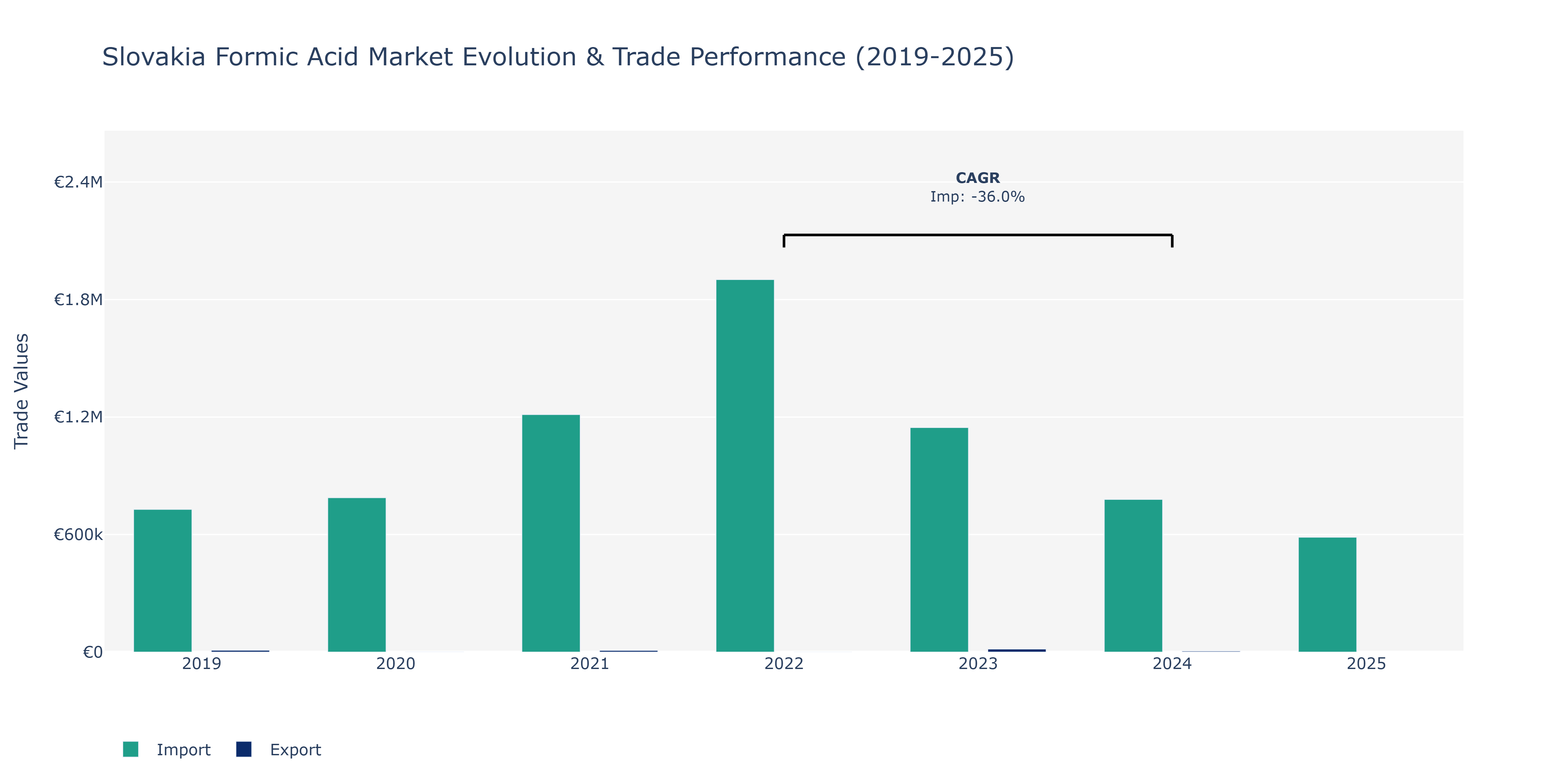
In the Slovakia Formic Acid Market, exports experienced fluctuating trends over the analyzed years. In 2019, exports reached €8.85 thousand, dipped sharply in 2020 to €546 thousand, and then rebounded in 2021 to €7.78 thousand. The peak export value was recorded in 2023 at €15.1 thousand before decreasing in 2024 to €4.66 thousand. Conversely, imports showed a more consistent pattern, increasing steadily from €728.3 thousand in 2019 to €11.46 million in 2023. A notable decrease occurred in 2024 with imports amounting to €779.22 thousand, followed by a slight uptick in 2025 to around €585.78 thousand. The substantial decrease in imports in 2024 could be attributed to various factors such as changes in domestic demand, global market conditions, or shifts in trade policies affecting the Formic Acid industry. These fluctuations emphasize the market's sensitivity to external factors, requiring stakeholders to stay informed and agile in their strategies to navigate such changes effectively.
Slovakia Formic Acid Market Overview
The Slovakia Formic Acid Market is experiencing steady growth driven by its diverse applications in various industries such as agriculture, leather production, and chemicals. Formic acid is widely used as a preservative and antibacterial agent in animal feed, as a coagulant in rubber production, and as a pH regulator in the textile industry. The market is also benefiting from the increasing demand for eco-friendly and sustainable solutions, as formic acid is considered a more environmentally friendly alternative to certain chemical compounds. Key players in the Slovakia Formic Acid Market include BASF SE, Perstorp Holding AB, and Eastman Chemical Company. The market is expected to continue its growth trajectory as industries increasingly adopt formic acid for its versatile properties and sustainable characteristics.
Slovakia Formic Acid Market Trends
In the Slovakia Formic Acid Market, there are several notable trends that are shaping the industry. One key trend is the increasing demand for formic acid in agriculture, particularly as a preservative in animal feed and as a pesticide. This is driven by a growing emphasis on sustainable farming practices and the need for effective solutions to improve crop yields. Additionally, the rising awareness about the antibacterial properties of formic acid is driving its use in various industrial applications such as leather tanning and textile processing. Another trend is the focus on developing eco-friendly production methods for formic acid, in line with the growing environmental concerns and regulations. Overall, these trends indicate a positive outlook for the Slovakia Formic Acid Market with opportunities for growth and innovation in various sectors.
Slovakia Formic Acid Market Challenges
In the Slovakia Formic Acid market, one of the key challenges is the fluctuating prices of raw materials, particularly methanol, which is a primary component in formic acid production. This volatility in input costs can impact the overall production cost and profitability for formic acid manufacturers. Additionally, competition from alternative organic acids and substitutes poses a challenge in terms of market share and pricing strategies. Regulatory changes and compliance requirements related to environmental standards and safety regulations also add complexity to the operating environment for formic acid producers in Slovakia. Adapting to these challenges by implementing efficient cost management strategies, diversifying product offerings, and ensuring compliance with evolving regulations will be crucial for companies operating in the Slovakia Formic Acid market.
Slovakia Formic Acid Market Investment Opportunities
The Slovakia Formic Acid Market presents promising investment opportunities due to its increasing demand across various industries such as agriculture, leather, textiles, and chemicals. Formic acid is widely used as a preservative, antibacterial agent, and coagulant in the animal feed industry, driving its market growth. Additionally, the rising awareness regarding the benefits of formic acid in food preservation and its eco-friendly nature further contribute to the market`s attractiveness. Investors can explore opportunities in formic acid production facilities, distribution networks, and research and development initiatives to capitalize on the growing demand for this versatile chemical compound in Slovakia and beyond. Conducting a thorough market analysis and understanding the regulatory landscape will be crucial for successful investment in the Slovakia Formic Acid Market.
Slovakia Formic Acid Market Government Policy
In Slovakia, the government has implemented policies aimed at regulating the production and use of formic acid to ensure environmental and human health protection. These policies include setting limits on emissions and waste disposal related to formic acid production facilities, as well as promoting the use of alternative, more sustainable production methods. The government also supports research and development initiatives to explore the potential benefits of formic acid in various industries, such as agriculture and pharmaceuticals. Additionally, there are regulations in place to ensure the safe handling and transportation of formic acid to prevent accidents and environmental contamination. Overall, the government`s policies in Slovakia regarding formic acid aim to balance the economic benefits of its production with environmental and public health considerations.
Slovakia Formic Acid Market Future Outlook
The future outlook for the Slovakia Formic Acid Market appears positive, driven by various factors such as increasing demand from end-use industries like agriculture, textiles, and leather. The market is expected to witness steady growth due to the rising awareness about the benefits of formic acid in various applications such as animal feed preservation, rubber production, and organic synthesis. Additionally, the focus on sustainable and environmentally friendly practices is likely to propel the demand for formic acid as it is considered a green chemical with versatile properties. However, market players may face challenges related to price volatility of raw materials and regulatory hurdles. Overall, with the growing applications and demand for formic acid in various industries, the Slovakia market is poised for expansion in the foreseeable future.
Key Highlights of the Report:
- Slovakia Formic Acid Market Outlook
- Market Size of Slovakia Formic Acid Market, 2021
- Forecast of Slovakia Formic Acid Market, 2031
- Historical Data and Forecast of Slovakia Formic Acid Revenues & Volume for the Period 2021 - 2031
- Slovakia Formic Acid Market Trend Evolution
- Slovakia Formic Acid Market Drivers and Challenges
- Slovakia Formic Acid Price Trends
- Slovakia Formic Acid Porter's Five Forces
- Slovakia Formic Acid Industry Life Cycle
- Historical Data and Forecast of Slovakia Formic Acid Market Revenues & Volume By Grade Type for the Period 2021 - 2031
- Historical Data and Forecast of Slovakia Formic Acid Market Revenues & Volume By 0.75 for the Period 2021 - 2031
- Historical Data and Forecast of Slovakia Formic Acid Market Revenues & Volume By 0.8 for the Period 2021 - 2031
- Historical Data and Forecast of Slovakia Formic Acid Market Revenues & Volume By 0.85 for the Period 2021 - 2031
- Historical Data and Forecast of Slovakia Formic Acid Market Revenues & Volume By 0.94 for the Period 2021 - 2031
- Historical Data and Forecast of Slovakia Formic Acid Market Revenues & Volume By 0.99 for the Period 2021 - 2031
- Historical Data and Forecast of Slovakia Formic Acid Market Revenues & Volume By Application for the Period 2021 - 2031
- Historical Data and Forecast of Slovakia Formic Acid Market Revenues & Volume By Animal Feed for the Period 2021 - 2031
- Historical Data and Forecast of Slovakia Formic Acid Market Revenues & Volume By Leather Tanning for the Period 2021 - 2031
- Historical Data and Forecast of Slovakia Formic Acid Market Revenues & Volume By Textile Dyeing and Finishing for the Period 2021 - 2031
- Historical Data and Forecast of Slovakia Formic Acid Market Revenues & Volume By Intermediary in Pharmaceuticals for the Period 2021 - 2031
- Historical Data and Forecast of Slovakia Formic Acid Market Revenues & Volume By Other Applications for the Period 2021 - 2031
- Slovakia Formic Acid Import Export Trade Statistics
- Market Opportunity Assessment By Grade Type
- Market Opportunity Assessment By Application
- Slovakia Formic Acid Top Companies Market Share
- Slovakia Formic Acid Competitive Benchmarking By Technical and Operational Parameters
- Slovakia Formic Acid Company Profiles
- Slovakia Formic Acid Key Strategic Recommendations






































