Slovakia Pasta And Noodles Market Size (2020-2030)
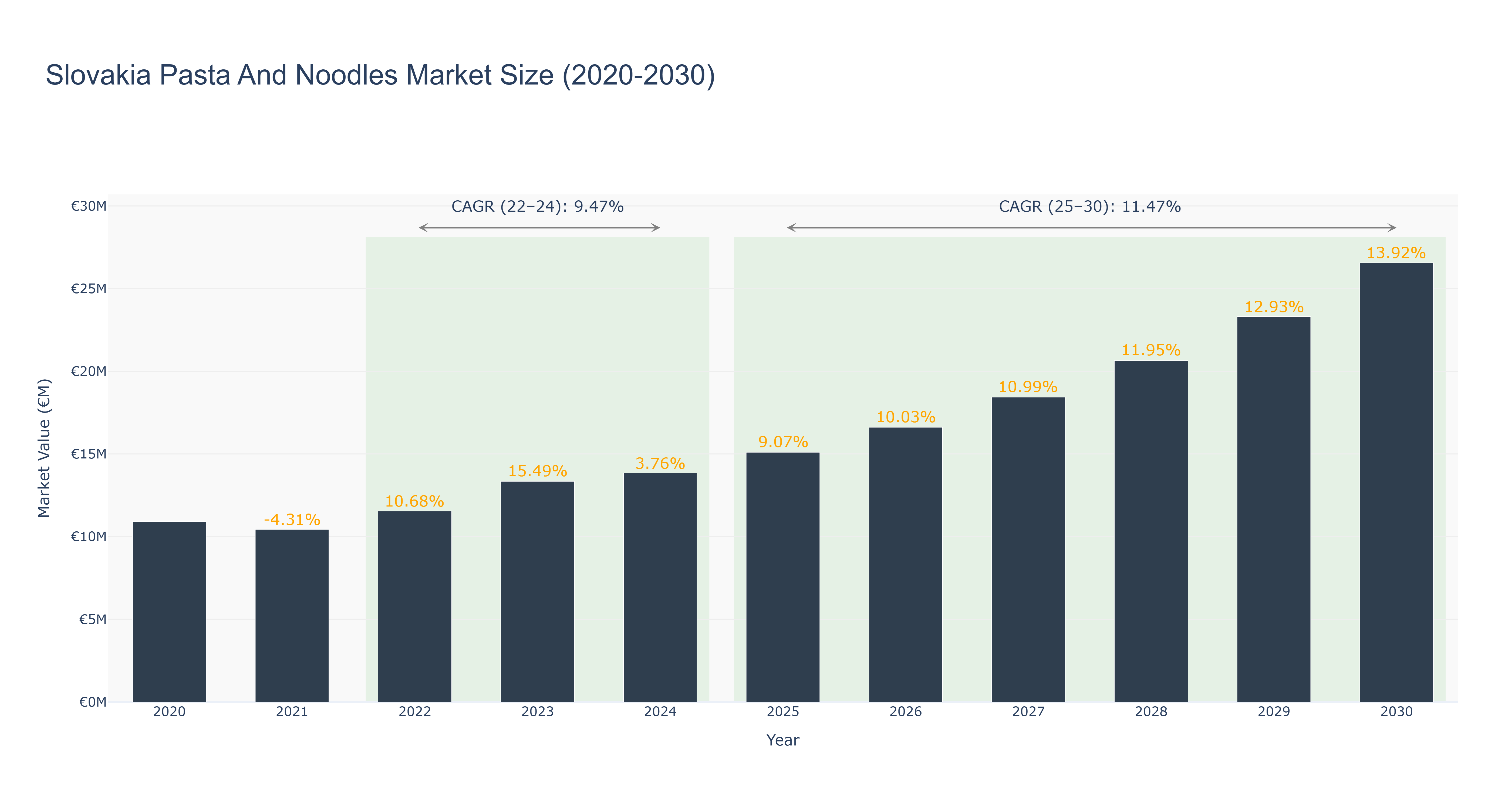
Slovakia Pasta And Noodles Market has shown a steady growth trajectory over the years. The market peaked at €26.56 million in 2030, with a notable increase in market size from 2020 to 2024, reaching €13.84 million in 2024. Forecasted market size from 2025 to 2030 shows a promising upward trend, with a CAGR of 11.47%. The CAGR during 2022-24 was 9.47%. This growth can be attributed to factors such as changing consumer preferences towards convenient food options and increasing disposable income levels in Slovakia. Moving forward, the market is expected to witness further expansion driven by innovative product offerings and strategic marketing initiatives. Recent developments in the market include partnerships with local farmers to source high-quality ingredients and plans to introduce gluten-free pasta variants to cater to the health-conscious consumer segment.
Slovakia Pasta And Noodles Market: Production & Trade Performance (2019-2025)
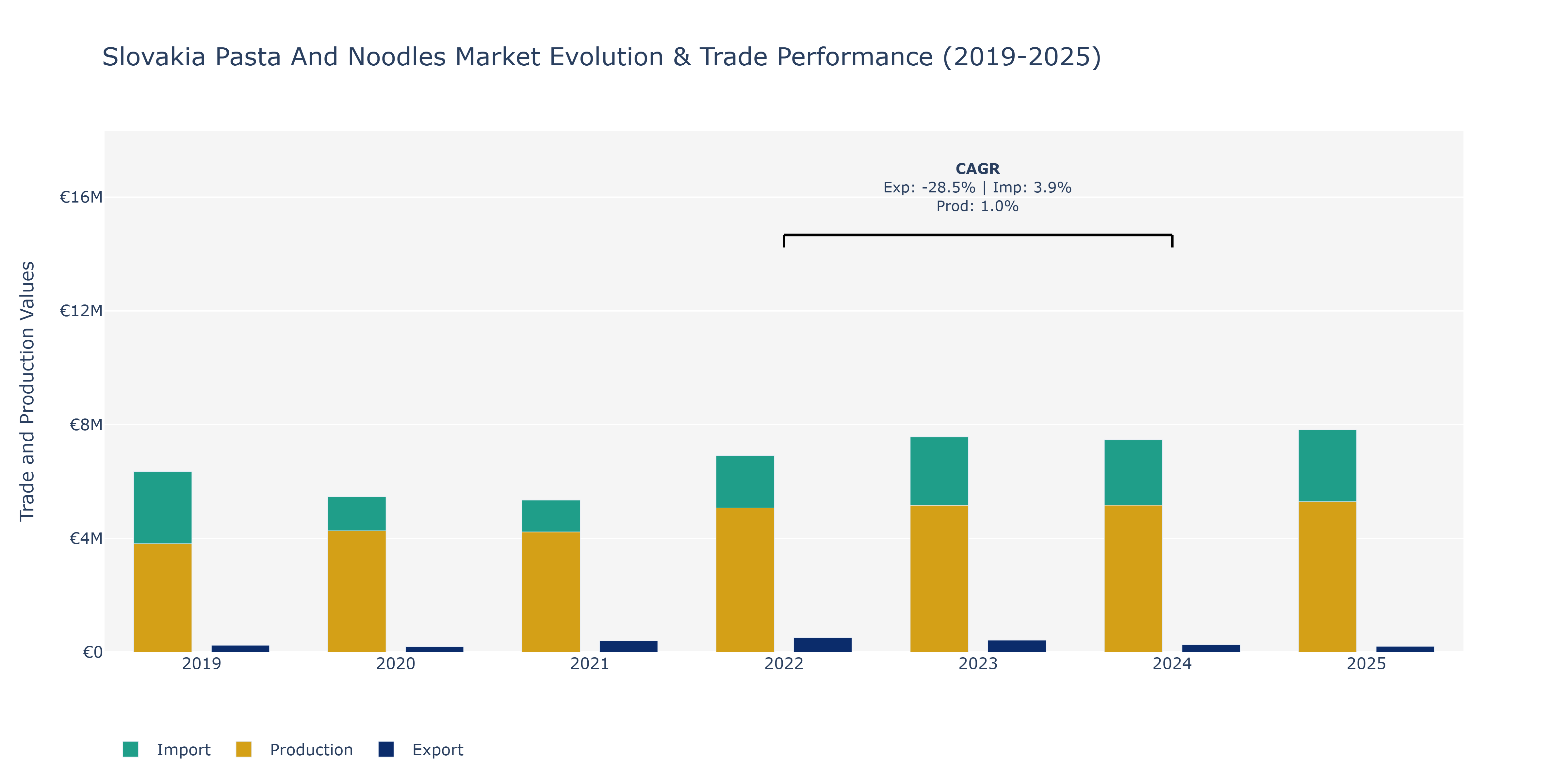
Between 2019 and 2025, Slovakia's Pasta And Noodles market witnessed fluctuations in Exports, Imports, and Production. Exports saw a peak in 2022 at €503.17 thousand before declining to €200.79 thousand in 2025, possibly due to changing consumer preferences or external economic factors. Imports remained relatively stable, with a peak in 2023 at €7.57 million and a slight decrease by 2025 to €7.81 million. This stability may be attributed to consistent demand for diverse pasta and noodle products in Slovakia. Production levels fluctuated but showed an overall increase from €3.81 million in 2019 to €5.29 million in 2025. This growth could be linked to technological advancements in manufacturing processes, enabling efficient production to meet the rising demand for pasta and noodles. Further market analysis may reveal the impact of evolving consumer tastes and competitive pricing strategies on these trends.
Slovakia Pasta and Noodles Market Overview
The Slovakia Pasta and Noodles Market is experiencing steady growth driven by factors such as changing consumer preferences towards convenient and ready-to-eat meals, the increasing popularity of pasta dishes in Slovakian cuisine, and the expanding presence of international pasta and noodle brands in the market. The market is characterized by a wide variety of pasta and noodle products available, including traditional Slovakian varieties such as halušky and spaetzle, as well as global favorites like spaghetti and ramen. Market players are focusing on product innovation, packaging sustainability, and expanding distribution channels to cater to the evolving demands of consumers. The market is also witnessing a rise in health-conscious consumers opting for whole grain and gluten-free pasta and noodles, driving manufacturers to introduce healthier product options to meet this demand.
Slovakia Pasta and Noodles Market Trends
The Slovakia Pasta and Noodles Market is witnessing several key trends. Firstly, there is a growing demand for healthier and more innovative pasta and noodle options, such as gluten-free, whole grain, and vegetable-based products, driven by increasing health consciousness among consumers. Secondly, convenience is a significant factor influencing purchasing decisions, leading to a rise in demand for ready-to-eat and easy-to-prepare pasta and noodle products. Additionally, there is a trend towards premiumization, with consumers showing a willingness to pay more for higher quality and gourmet pasta and noodle varieties. Lastly, sustainability and ethical sourcing practices are becoming more important to consumers, leading to a shift towards environmentally friendly packaging and ingredients in the Slovakia Pasta and Noodles Market.
Slovakia Pasta and Noodles Market Challenges
In the Slovakia Pasta and Noodles market, one of the main challenges faced is increasing competition from both domestic and international brands. This competition leads to price wars and pressure on profit margins for companies operating in the market. Additionally, changing consumer preferences and dietary trends towards healthier food options present a challenge for traditional pasta and noodle products that may be perceived as less healthy. Furthermore, fluctuations in raw material prices, such as wheat and durum wheat, can impact the cost of production for companies in the market. To stay competitive and address these challenges, companies in the Slovakia Pasta and Noodles market need to focus on product innovation, marketing strategies, and diversification of product offerings to cater to evolving consumer demands.
Slovakia Pasta and Noodles Market Investment Opportunities
The Slovakia Pasta and Noodles Market presents various investment opportunities for both domestic and international investors. With a growing trend towards convenience and ready-to-eat meals, there is a rising demand for pasta and noodles products in Slovakia. Investors can consider opportunities in product innovation to cater to changing consumer preferences, such as gluten-free or organic options. Additionally, investing in marketing strategies to promote healthier pasta alternatives or traditional Slovakian noodle varieties can help capture a wider market share. Collaborating with local suppliers for sourcing high-quality ingredients can also enhance the value proposition of the products. Overall, the Slovakia Pasta and Noodles Market offers promising investment prospects for those looking to capitalize on the evolving food preferences and consumption habits in the region.
Slovakia Pasta and Noodles Market Government Policy
Government policies related to the Slovakia Pasta and Noodles Market primarily focus on food safety regulations, import/export requirements, and labeling standards. The Slovak Republic follows the European Union regulations for food products, ensuring that all pasta and noodles meet stringent quality and safety standards. Importers and exporters are required to comply with customs procedures and tariffs, which may impact the pricing and availability of pasta and noodles in the market. Additionally, labeling requirements mandate accurate information on packaging, including ingredient lists, nutritional information, and allergen warnings. The government also supports domestic producers through agricultural subsidies and incentives to promote local production and consumption. Overall, these policies aim to ensure consumer protection, fair competition, and the sustainability of the Slovakia Pasta and Noodles Market.
Slovakia Pasta and Noodles Market Future Outlook
The Slovakia Pasta and Noodles Market is expected to exhibit steady growth in the coming years. Factors such as the increasing trend of convenience food consumption, busy lifestyles leading to higher demand for quick and easy meal options, and the growing popularity of pasta and noodles as versatile and affordable meal choices are driving the market growth. Additionally, the rising health consciousness among consumers is leading to a shift towards healthier and organic options in the pasta and noodles segment. With ongoing product innovations, introduction of new flavors and varieties, and expanding distribution channels, the market is poised for further expansion. However, challenges such as fluctuating raw material prices and increasing competition from alternative products may impact the market growth to some extent.
Key Highlights of the Report:
- Slovakia Pasta and Noodles Market Outlook
- Market Size of Slovakia Pasta and Noodles Market, 2021
- Forecast of Slovakia Pasta and Noodles Market, 2031
- Historical Data and Forecast of Slovakia Pasta and Noodles Revenues & Volume for the Period 2018 - 2031
- Slovakia Pasta and Noodles Market Trend Evolution
- Slovakia Pasta and Noodles Market Drivers and Challenges
- Slovakia Pasta and Noodles Price Trends
- Slovakia Pasta and Noodles Porter's Five Forces
- Slovakia Pasta and Noodles Industry Life Cycle
- Historical Data and Forecast of Slovakia Pasta and Noodles Market Revenues & Volume By Product for the Period 2018 - 2031
- Historical Data and Forecast of Slovakia Pasta and Noodles Market Revenues & Volume By Ambient for the Period 2018 - 2031
- Historical Data and Forecast of Slovakia Pasta and Noodles Market Revenues & Volume By Dried for the Period 2018 - 2031
- Historical Data and Forecast of Slovakia Pasta and Noodles Market Revenues & Volume By Chilled for the Period 2018 - 2031
- Slovakia Pasta and Noodles Import Export Trade Statistics
- Market Opportunity Assessment By Product
- Slovakia Pasta and Noodles Top Companies Market Share
- Slovakia Pasta and Noodles Competitive Benchmarking By Technical and Operational Parameters
- Slovakia Pasta and Noodles Company Profiles
- Slovakia Pasta and Noodles Key Strategic Recommendations






































