Slovakia Phenol Market - Import Trends (2019-2025)
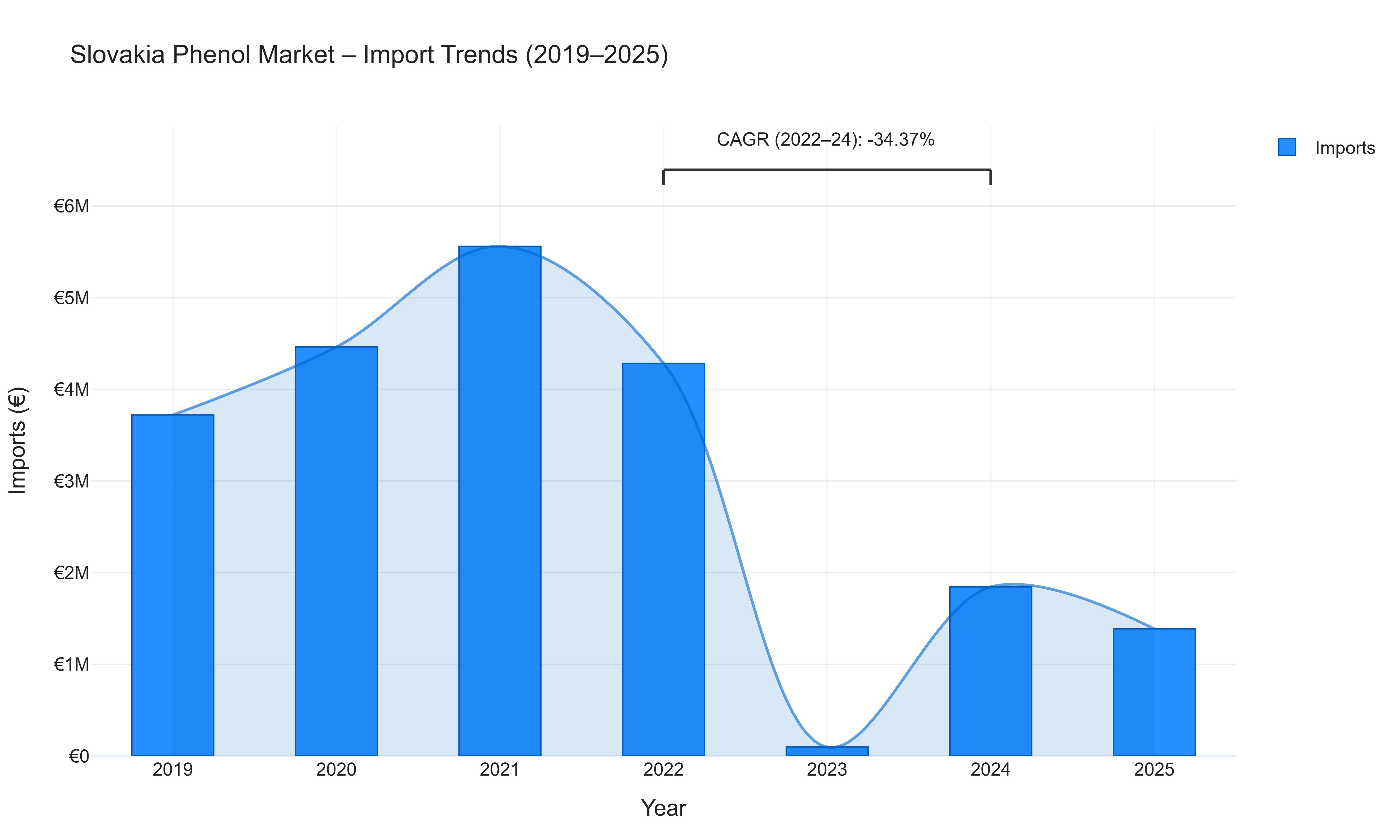
In the Slovakia Phenol Market, import values have exhibited significant volatility in recent years. Import values saw steady growth from 2019 to 2021, with notable increases of 19.97% and 24.58% in 2020 and 2021, respectively. However, a sharp decline of -22.96% in 2022 was followed by a staggering -97.70% drop in 2023. The market experienced a remarkable recovery in 2024, with import values soaring by 1776.24%, reaching €1.84 million. This sudden surge was likely influenced by supply chain disruptions or shifts in demand dynamics. The subsequent decrease by -24.82% in 2025 may indicate a stabilization of import activities. The CAGR of -34.37% from 2022 to 2024 reflects the market's overall erratic trend, showcasing the challenges and uncertainties faced by importers during this period.
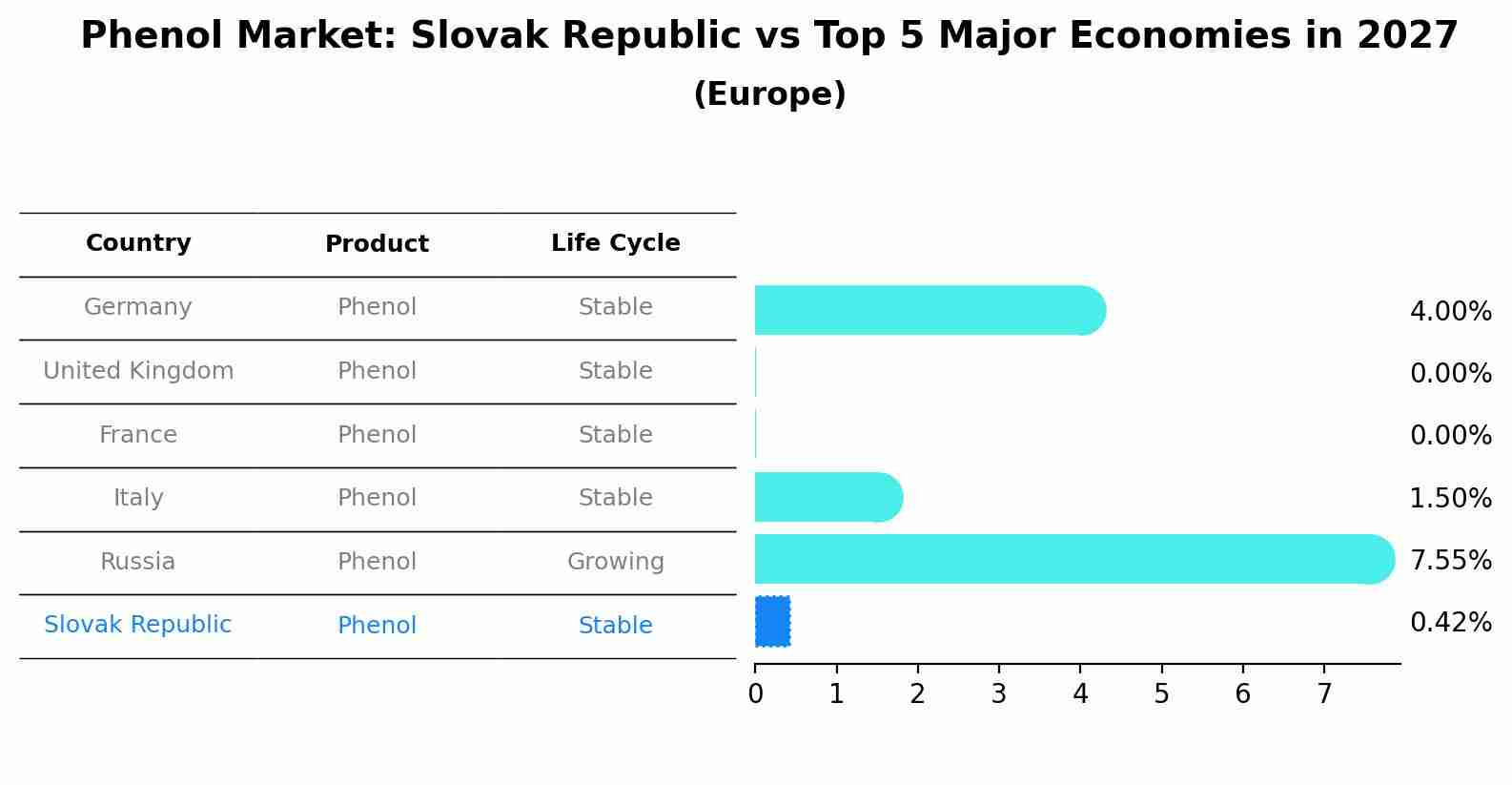
Phenol Market: Slovak Republic vs Top 5 Major Economies in 2027 (Europe)
The Phenol market in Slovak Republic is projected to grow at a stable growth rate of 0.42% by 2027, within the Europe region led by Germany, along with other countries like United Kingdom, France, Italy and Russia, collectively shaping a dynamic and evolving market environment driven by innovation and increasing adoption of emerging technologies.
Slovakia Phenol Market Overview
The Slovakia phenol market is experiencing steady growth driven by the increasing demand from various industries such as automotive, construction, and electronics. Phenol is a key chemical used in the production of resins, adhesives, and plastics, making it a critical component in these industries. The market is also benefiting from the rising awareness regarding sustainable practices, leading to an increased demand for bio-based phenol. Key players in the Slovakia phenol market include Versalis, INEOS, and Shell Chemicals. Regulatory initiatives promoting the use of eco-friendly materials are expected to further boost market growth. However, challenges such as volatility in raw material prices and environmental concerns regarding phenol production processes remain key factors influencing market dynamics.
Slovakia Phenol Market Trends
The Slovakia Phenol Market is experiencing steady growth due to increasing demand from various end-use industries such as automotive, electronics, and construction. The market is witnessing a shift towards eco-friendly and sustainable phenol production methods to meet the growing consumer preference for environmentally friendly products. Additionally, there is a rising focus on developing innovative applications of phenol in sectors such as healthcare and personal care products. The market is also influenced by factors such as fluctuating raw material prices and regulatory policies impacting production and distribution. Overall, the Slovakia Phenol Market is projected to continue its growth trajectory in the coming years, driven by evolving consumer preferences and technological advancements in phenol production processes.
Slovakia Phenol Market Challenges
In the Slovakia Phenol Market, some challenges include fluctuating raw material prices, increasing competition from other phenol producers in the region, and changing regulatory requirements impacting production processes and costs. Additionally, the market may face challenges related to environmental sustainability as there is a growing emphasis on adopting eco-friendly production practices and reducing carbon footprint. Adapting to these challenges will require companies in the Slovakia Phenol Market to invest in research and development for innovative production techniques, enhance operational efficiency, and strengthen relationships with key suppliers and customers to ensure a competitive edge in the market.
Slovakia Phenol Market Investment Opportunities
The Slovakia Phenol Market presents promising investment opportunities due to its growing demand in various industries such as automotive, construction, electronics, and pharmaceuticals. With the expanding manufacturing sector in Slovakia and the increasing focus on sustainable practices, the demand for phenol, a key chemical compound used in the production of resins, plastics, and pharmaceuticals, is expected to rise. Investors can consider opportunities in phenol production facilities, distribution networks, or strategic partnerships with local manufacturers to capitalize on this growing market. Additionally, advancements in technology and the shift towards eco-friendly alternatives present avenues for innovation and differentiation in the Slovakia Phenol Market, making it an attractive sector for investment.
Slovakia Phenol Market Government Policy
In Slovakia, government policies related to the Phenol market primarily focus on environmental regulations and safety standards to ensure the proper handling and disposal of phenol. The government has implemented laws and regulations to limit the emissions of phenol into the environment, as well as guidelines for safe production and storage practices. Additionally, there are regulations in place to monitor and control the import and export of phenol to maintain market stability and prevent any potential risks to public health and the environment. Overall, the government`s policies aim to strike a balance between promoting the growth of the phenol market in Slovakia while ensuring the protection of the environment and the well-being of its citizens.
Slovakia Phenol Market Future Outlook
The future outlook for the Slovakia Phenol Market appears positive, driven by increasing demand from various end-use industries such as automotive, construction, electronics, and healthcare. The market is expected to witness steady growth due to the rising application of phenol in the manufacturing of bisphenol-A, phenolic resins, and caprolactam, among others. Additionally, the growing focus on sustainability and environmental regulations is likely to drive the demand for eco-friendly phenol derivatives, thus presenting opportunities for market expansion. However, challenges such as fluctuating raw material prices and competition from substitutes may pose some constraints. Overall, the Slovakia Phenol Market is anticipated to grow in the coming years, supported by ongoing industrial developments and innovation in product offerings.
Key Highlights of the Report:
- Slovakia Phenol Market Outlook
- Market Size of Slovakia Phenol Market, 2021
- Forecast of Slovakia Phenol Market, 2031
- Historical Data and Forecast of Slovakia Phenol Revenues & Volume for the Period 2021 - 2031
- Slovakia Phenol Market Trend Evolution
- Slovakia Phenol Market Drivers and Challenges
- Slovakia Phenol Price Trends
- Slovakia Phenol Porter's Five Forces
- Slovakia Phenol Industry Life Cycle
- Historical Data and Forecast of Slovakia Phenol Market Revenues & Volume By End-users for the Period 2021 - 2031
- Historical Data and Forecast of Slovakia Phenol Market Revenues & Volume By Bisphenol A for the Period 2021 - 2031
- Historical Data and Forecast of Slovakia Phenol Market Revenues & Volume By Phenolic Resins for the Period 2021 - 2031
- Historical Data and Forecast of Slovakia Phenol Market Revenues & Volume By Caprolactam for the Period 2021 - 2031
- Historical Data and Forecast of Slovakia Phenol Market Revenues & Volume By Alkyl Phenyls for the Period 2021 - 2031
- Historical Data and Forecast of Slovakia Phenol Market Revenues & Volume By Others for the Period 2021 - 2031
- Slovakia Phenol Import Export Trade Statistics
- Market Opportunity Assessment By End-users
- Slovakia Phenol Top Companies Market Share
- Slovakia Phenol Competitive Benchmarking By Technical and Operational Parameters
- Slovakia Phenol Company Profiles
- Slovakia Phenol Key Strategic Recommendations






































