Slovakia Plastic Waste Management Market Size, Share & Growth Rate
The Slovakia Plastic Waste Management Market was estimated at USD 656 Million in 2025 and is projected to reach USD 931 Million by 2032, growing at a CAGR of 5.1% from 2026 to 2032. This growth trajectory is largely attributed to heightened public awareness of environmental sustainability and stringent government regulations aimed at reducing plastic waste. The ongoing development of advanced recycling technologies and collaborative initiatives among industry stakeholders further bolster the market's potential, creating a robust framework for sustainable waste management in Slovakia.
Slovakia Plastic Waste Management Market Year-wise Growth Rate and Key Drivers
This graph highlights how the Slovakia Plastic Waste Management Market has steadily grown over the years, supported by major growth factors.
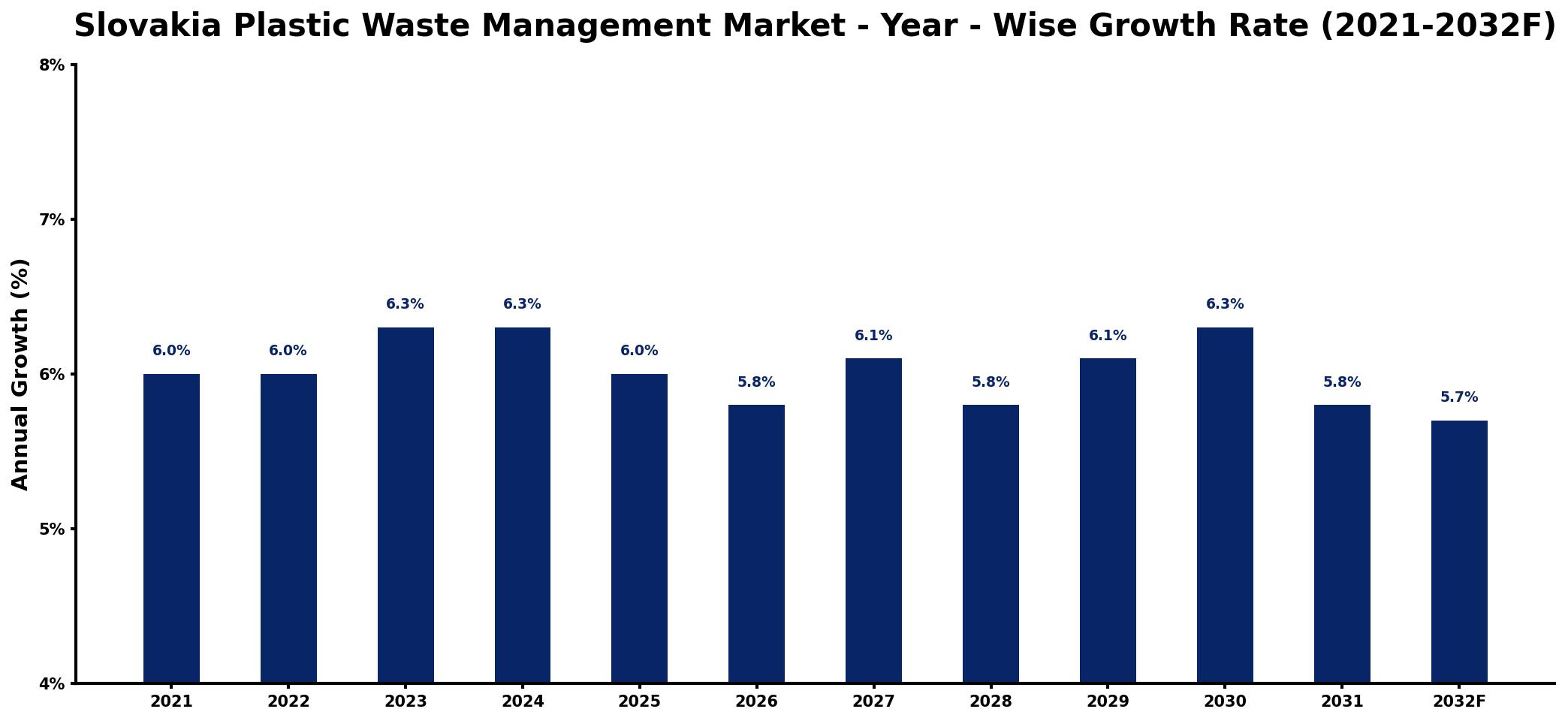
The table below presents the year‑wise growth rates along with the key drivers influencing the market
| Year | Growth Rate | Major Drivers |
| 2021 | 6.0% | Increased consumer recycling initiatives |
| 2022 | 6.0% | Growing environmental awareness campaigns |
| 2023 | 6.3% | Expansion of green technology investments |
| 2024 | 6.3% | Rising demand for sustainable packaging |
| 2025 | 6.0% | Enhanced corporate sustainability commitments |
| 2026 | 5.8% | Development of innovative recycling solutions |
| 2027 | 6.1% | Strengthened regulatory compliance requirements |
| 2028 | 5.8% | Surge in eco-friendly product offerings |
| 2029 | 6.1% | Increased public-private partnerships initiatives |
| 2030 | 6.3% | Growth in circular economy practices |
| 2031 | 5.8% | Emergence of biodegradable alternatives trends |
| 2032 | 5.7% | Advancements in resource recovery technologies |
Note: Market size estimations and growth projections presented in this report are based on 6Wresearch's proprietary forecasting methodology, utilizing the latest available industry data, government publications, and primary research inputs.
Slovakia Plastic Waste Management Market Synopsis
The Slovakia Plastic Waste Management Market is evolving rapidly as a response to increasing environmental concerns and legislative pressures. Recent trends reveal a concerted effort to enhance recycling processes and improve waste segregation mechanisms, driving both public and private sectors to embrace sustainable practices.
Moreover, the partnership between governmental agencies and non-profit organizations is instrumental in advancing initiatives aimed at promoting a circular economy for plastics. As Slovakia positions itself at the forefront of sustainable waste management, the synergy between innovative technologies and collaborative strategies stands to redefine the landscape of plastic waste handling.
Slovakia Plastic Waste Management Market Key Takeaways
- Strong market growth fueled by rising environmental awareness and regulatory pressures.
- Investment in advanced recycling technologies is essential for meeting EU targets.
- Collaboration among stakeholders is key to fostering sustainable practices.
- Consumer demand for eco-friendly products is driving innovation in manufacturing.
- Infrastructure investments are crucial for improving overall waste management efficiency.
Evaluation of Restraints in Slovakia Plastic Waste Management Market
Despite promising growth, the Slovakia Plastic Waste Management Market faces significant challenges that hinder its progress. One prominent restraint is the lack of sufficient infrastructure to support effective recycling and waste management practices, which limits the ability to handle increasing volumes of plastic waste. Additionally, there remains a gap in public awareness and engagement in recycling initiatives, further complicating efforts to minimize waste generation. Coupled with the high costs associated with implementing cutting-edge recycling technologies, these factors create hurdles that require strategic investments and a united commitment from all involved parties to overcome.
Slovakia Plastic Waste Management Market Trends
The market is currently trending towards increased implementation of circular economy principles, with an emphasis on recycling and reusing materials. Businesses are actively innovating to incorporate recycled plastics into their manufacturing processes, further promoting a closed-loop system. Additionally, consumer preferences are shifting towards eco-friendly products, compelling companies to adopt sustainable practices throughout their supply chains. These trends highlight a growing recognition of the critical role that sustainable practices play in addressing plastic waste challenges in Slovakia.
Slovakia Plastic Waste Management Market Opportunities
There are ample investment opportunities within the Slovakia Plastic Waste Management Market, particularly in technologies aimed at enhancing the efficiency of plastic waste collection, sorting, and recycling. As Slovakia seeks to align with EU recycling targets, companies providing innovative solutions for converting plastic waste into valuable products stand to benefit significantly. Moreover, investments in infrastructure development, such as modern recycling facilities and waste-to-energy plants, present substantial growth prospects. Collaborating with municipalities and industry players to spearhead sustainability initiatives will create further avenues for growth.
Government Initiatives in the Slovakia Plastic Waste Management Market
The Slovak government has enacted a variety of policies aimed at enhancing plastic waste management throughout the country. The Waste Act provides a regulatory framework for waste handling processes, including collection, sorting, and recycling of plastics. Extended Producer Responsibility (EPR) mandates that producers are accountable for the entire lifecycle of their products, incentivizing waste reduction and recycling. Additionally, Slovakia has embraced the EU Single-Use Plastics Directive, reinforcing its commitment to minimizing the environmental impact of certain plastic products. Financial incentives are also available for companies investing in innovative recycling technologies, highlighting governmental support for sustainability initiatives.
Future Insights of the Slovakia Plastic Waste Management Market
Looking ahead to 2026-2032, the Slovakia Plastic Waste Management Market is poised for significant advancements driven by ongoing environmental awareness and the implementation of stricter waste management regulations. The market is likely to see an uptick in innovative recycling technologies and enhanced collaboration among stakeholders focused on tackling plastic waste challenges. With increasing emphasis on sustainability and the circular economy, advancements in collection, sorting, recycling, and disposal methods are expected, presenting ample opportunities for investment in eco-friendly solutions and contributing to a greener future for Slovakia.
Slovakia Plastic Waste Management Market Latest Developments (2025 - 2026)
In recent months, the Slovakia Plastic Waste Management Market has witnessed a surge in initiatives aimed at improving recycling infrastructures and promoting public awareness about sustainability practices. Industry players are collaborating with government bodies to enhance the efficiency of waste collection systems, while community programs aimed at encouraging recycling participation are gaining traction. Additionally, advancements in technology are being explored to increase the feasibility and effectiveness of plastic waste recycling processes, highlighting a commitment to innovation within the sector.
Slovakia Plastic Waste Management Market - Key Attractiveness of the Report
- 10 Years of Market Numbers
- Historical Data Starting from 2022 to 2025
- Base Year: 2025
- Forecast Data until 2032
- Key Performance Indicators Impacting the Market
- Major Upcoming Developments and Projects
Key Highlights of the Report:
- Slovakia Plastic Waste Management Market Outlook
- Market Size of Slovakia Plastic Waste Management Market, 2025
- Forecast of Slovakia Plastic Waste Management Market, 2032
- Historical Data and Forecast of Slovakia Plastic Waste Management Revenues & Volume for the Period 2022-2032F
- Slovakia Plastic Waste Management Market Trend Evolution
- Slovakia Plastic Waste Management Market Drivers and Challenges
- Slovakia Plastic Waste Management Price Trends
- Slovakia Plastic Waste Management Porter's Five Forces
- Slovakia Plastic Waste Management Industry Life Cycle
- Historical Data and Forecast of Slovakia Plastic Waste Management Market Revenues & Volume By Source for the Period 2022-2032F
- Historical Data and Forecast of Slovakia Plastic Waste Management Market Revenues & Volume By Industrial Waste for the Period 2022-2032F
- Historical Data and Forecast of Slovakia Plastic Waste Management Market Revenues & Volume By Municipal Waste for the Period 2022-2032F
- Historical Data and Forecast of Slovakia Plastic Waste Management Market Revenues & Volume By Material for the Period 2022-2032F
- Historical Data and Forecast of Slovakia Plastic Waste Management Market Revenues & Volume By Polyethylene for the Period 2022-2032F
- Historical Data and Forecast of Slovakia Plastic Waste Management Market Revenues & Volume By Polypropylene for the Period 2022-2032F
- Historical Data and Forecast of Slovakia Plastic Waste Management Market Revenues & Volume By Polyethylene Terephthalate for the Period 2022-2032F
- Historical Data and Forecast of Slovakia Plastic Waste Management Market Revenues & Volume By Polystyrene for the Period 2022-2032F
- Historical Data and Forecast of Slovakia Plastic Waste Management Market Revenues & Volume By Others for the Period 2022-2032F
- Historical Data and Forecast of Slovakia Plastic Waste Management Market Revenues & Volume By Product Type for the Period 2022-2032F
- Historical Data and Forecast of Slovakia Plastic Waste Management Market Revenues & Volume By Packaging for the Period 2022-2032F
- Historical Data and Forecast of Slovakia Plastic Waste Management Market Revenues & Volume By Construction for the Period 2022-2032F
- Historical Data and Forecast of Slovakia Plastic Waste Management Market Revenues & Volume By Automotive for the Period 2022-2032F
- Historical Data and Forecast of Slovakia Plastic Waste Management Market Revenues & Volume By Electrical & Electronics for the Period 2022-2032F
- Historical Data and Forecast of Slovakia Plastic Waste Management Market Revenues & Volume By Others for the Period 2022-2032F
- Historical Data and Forecast of Slovakia Plastic Waste Management Market Revenues & Volume By Treatment Method for the Period 2022-2032F
- Historical Data and Forecast of Slovakia Plastic Waste Management Market Revenues & Volume By Collection for the Period 2022-2032F
- Historical Data and Forecast of Slovakia Plastic Waste Management Market Revenues & Volume By Recycling for the Period 2022-2032F
- Historical Data and Forecast of Slovakia Plastic Waste Management Market Revenues & Volume By Disposal for the Period 2022-2032F
- Slovakia Plastic Waste Management Import Export Trade Statistics
- Market Opportunity Assessment By Source
- Market Opportunity Assessment By Material
- Market Opportunity Assessment By Product Type
- Market Opportunity Assessment By Treatment Method
- Slovakia Plastic Waste Management Top Companies Market Share
- Slovakia Plastic Waste Management Competitive Benchmarking By Technical and Operational Parameters
- Slovakia Plastic Waste Management Company Profiles
- Slovakia Plastic Waste Management Key Strategic Recommendations






































