Slovakia Public Cloud Market Size & Growth Rate (2026-2032)
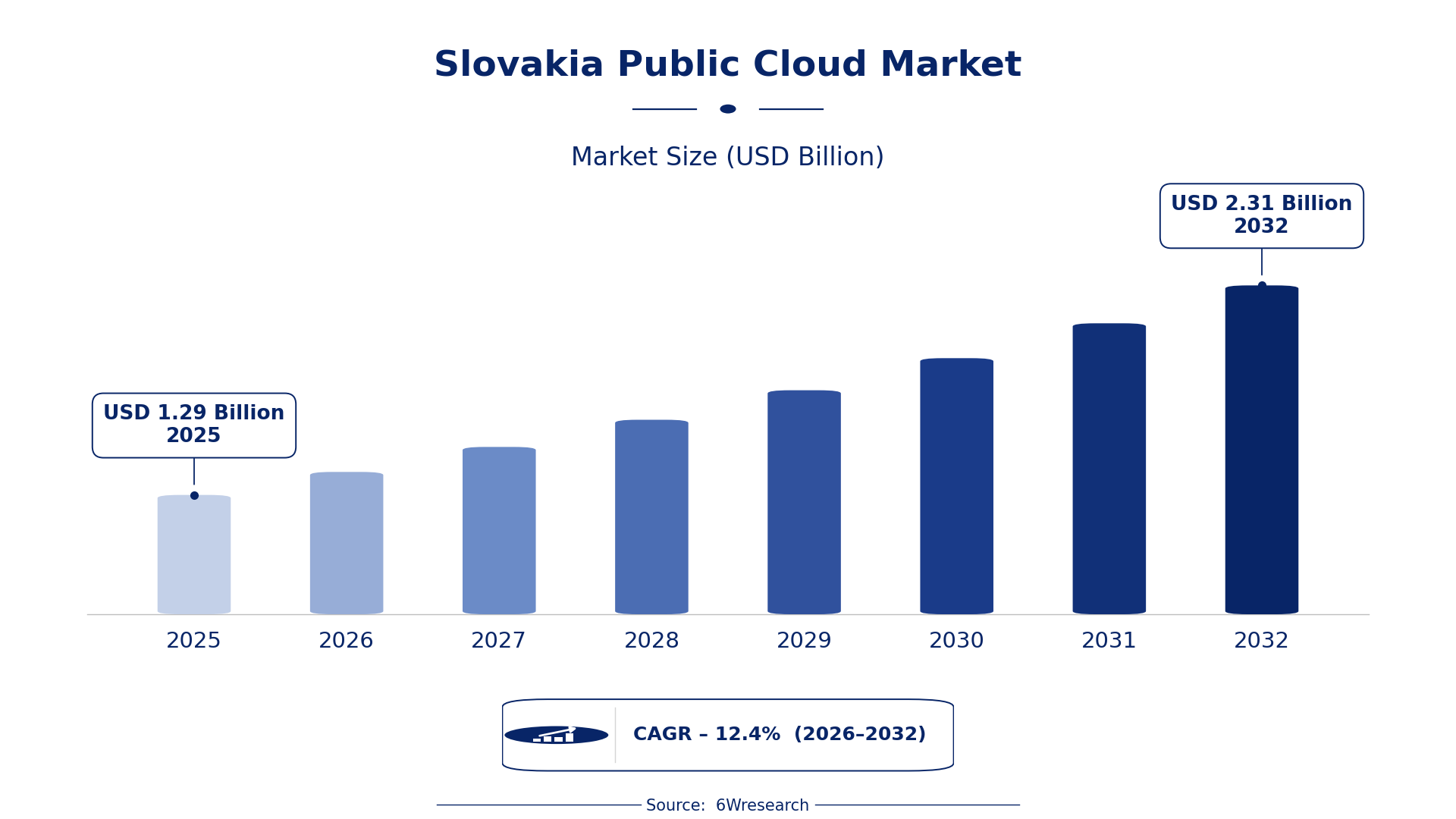
The Slovakia Public Cloud Market was estimated at USD 1292 Million in 2025 and is projected to reach USD 2313 Million by 2032, growing at a CAGR of 12.4% from 2026 to 2032.
Slovakia Public Cloud Market Synopsis
Slovakia's public cloud market is currently on a steady upward trajectory, fueled by heightened demand from various sectors. As businesses increasingly recognize the advantages of cloud solutions, the landscape is shifting towards greater adoption and innovation.
Looking ahead, the market is set to transform further, with hybrid cloud solutions gaining traction. The emphasis on security and compliance will shape provider offerings as organizations strive for efficient and secure cloud integration.
Slovakia Public Cloud Market Year-wise Growth Rate and Key Drivers
This graph illustrates the annual growth rates of the Slovakia Public Cloud Market from 2021 to 2032, highlighting a steady upward trajectory and projected expansion over the forecast period.
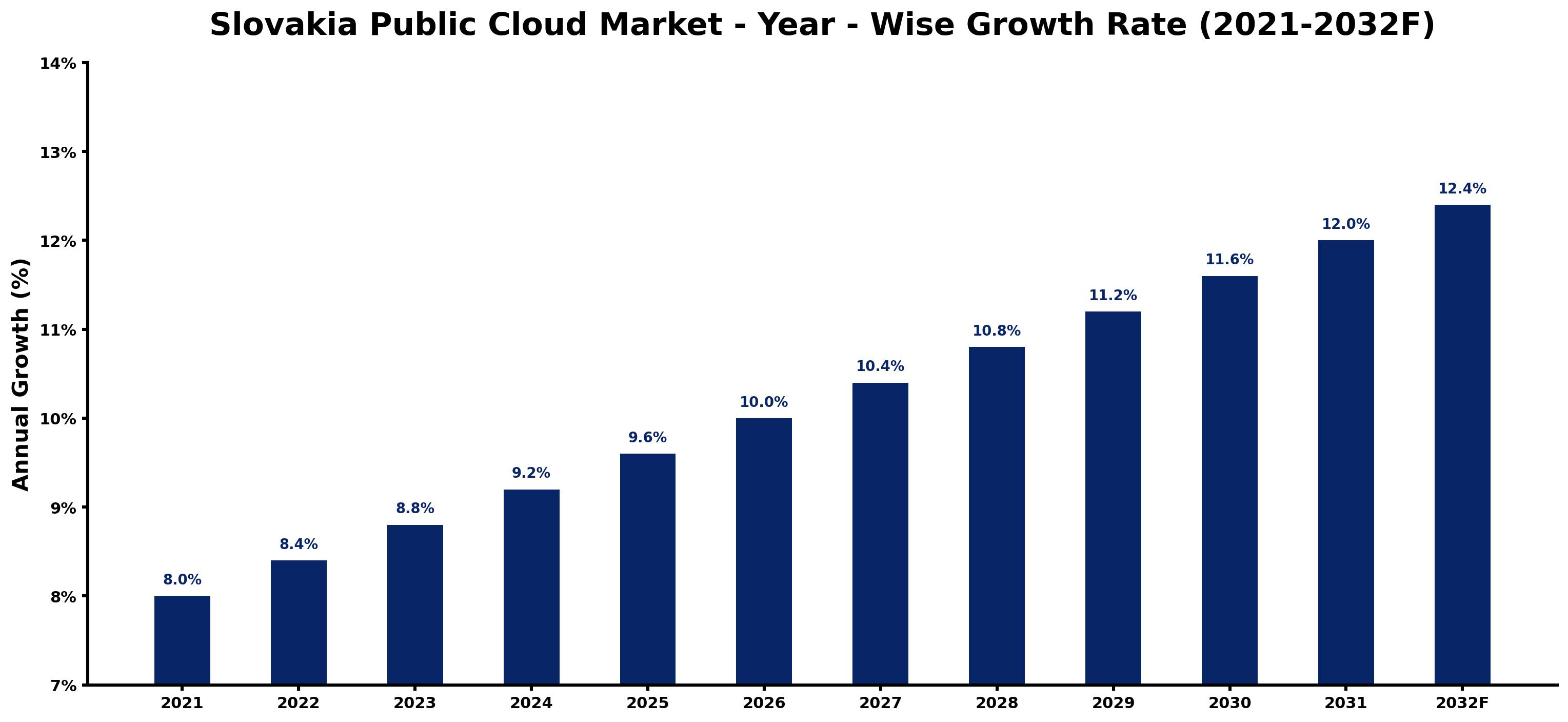
The table below presents the year‑wise growth rates along with the key drivers influencing the market
| Year | Growth Rate | Major Drivers |
| 2021 | 8.0% | Increased adoption of digital services by SMEs. |
| 2022 | 8.4% | National Cloud Strategy promoting scalable cloud solutions. |
| 2023 | 8.8% | Rising investment in IT infrastructure by government sector. |
| 2024 | 9.2% | Local tech startups driving innovation in cloud applications. |
| 2025 | 9.6% | Slovak health sector digitizing records and services. |
| 2026 | 10.0% | Incentives for businesses transitioning to cloud-based operations. |
| 2027 | 10.4% | Educational institutions adopting hybrid learning models. |
| 2028 | 10.8% | Growing importance of data sovereignty in local businesses. |
| 2029 | 11.2% | Strengthening cybersecurity regulations influencing cloud service adoption. |
| 2030 | 11.6% | Public sector increasingly utilizing cloud for e-governance. |
| 2031 | 12.0% | Retail sector leveraging cloud for enhanced customer engagement. |
| 2032 | 12.4% | Mature cloud ecosystem attracting foreign technology investments. |
Note: Market size estimations and growth projections presented in this report are based on 6Wresearch's proprietary forecasting methodology, utilizing the latest available industry data, government publications, and primary research inputs.
Slovakia Public Cloud Market Key Takeaways
Below are some of the specific key takeaways from the market, including:
- The shift towards hybrid cloud solutions is increasingly appealing to businesses seeking flexibility.
- Demand for SaaS solutions continues to grow as organizations look to enhance operational efficiency.
- Data security and compliance remain central to cloud adoption strategies in Slovakia.
- Investment opportunities are emerging in cloud security and data management sectors.
- Government initiatives are actively promoting cloud technology adoption in the public sector.
Evaluation of Restraints in Slovakia Public Cloud Market
Despite its growth, the Slovakia public cloud market faces notable restraints. Data security concerns, driven by stringent regulations, pose a significant barrier to widespread adoption. Many businesses still lack a comprehensive understanding of cloud benefits, which hinders their transition. The shortage of skilled professionals further complicates the situation, preventing organizations from fully leveraging cloud technologies. Additionally, local providers grapple with competition from larger global firms, making differentiation a challenge.
Slovakia Public Cloud Market Trends
Several trends are reshaping the Slovakia public cloud market. The increasing reliance on SaaS reflects a broader move towards operational efficiency and cost reduction. Businesses are also exploring AI and IoT capabilities to enhance their cloud infrastructure. Notably, the interest in hybrid models demonstrates a desire for flexibility in managing data. As security concerns mount, cloud service providers are innovating to offer enhanced compliance and protection features.
Slovakia Public Cloud Market Opportunities
The Slovakia public cloud market holds substantial investment opportunities, particularly in the IT services and software development sectors. The rising demand for IaaS and PaaS solutions presents a chance for companies to cater to local needs. Investing in cloud security services can capitalize on growing privacy concerns. As businesses seek tailored solutions, providers that innovate and adapt will likely thrive in this dynamic environment.
Government Initiatives in the Slovakia Public Cloud Market
Government policy plays a crucial role in shaping the Slovakia public cloud market. With a clear focus on digital transformation, the government is promoting cloud adoption through various initiatives. Regulatory frameworks ensure that public cloud services meet security and compliance standards, fostering a reliable environment for businesses to operate.
- A national digital infrastructure upgrade program launched in early 2023 aims to enhance cloud capabilities across government agencies.
- Ongoing initiatives led by the National Agency for Network and Electronic Services (NASES) are focused on developing security guidelines for cloud services.
- Planned public-private partnerships are expected to expand access to cloud services by 2026, further bolstering local infrastructure.
- In 2024, a regulatory framework was introduced to enhance billing transparency for cloud services, ensuring better compliance.
- Current programs are underway to incentivize domestic cloud service providers through grants and support programs.
Future Insights of the Slovakia Public Cloud Market
In the years leading to 2032, the Slovakia public cloud market is likely to witness robust growth as cloud adoption deepens across various sectors. As businesses prioritize agility and innovation, the demand for diverse cloud services will intensify. The entrance of new providers and the expansion of existing ones will enhance competition, driving down costs and improving service offerings. With government backing, the market is set to evolve rapidly, catering to the increasing needs of Slovak enterprises.
Slovakia Public Cloud Market Latest Developments
Recent developments in the Slovakia public cloud market highlight a vibrant industry responding to evolving needs. The last year has seen a flurry of activity, as companies strive to enhance their cloud offerings and address security concerns.
- A leading regional operator launched a new cloud-based AI service in early 2023, targeting businesses looking to integrate advanced analytics.
- In mid-2023, a major technology vendor completed a nationwide rollout of upgraded cloud infrastructure, improving service delivery.
- Currently, an initiative is underway to develop a comprehensive cloud training program aimed at upskilling local professionals in cloud technologies.
- By late 2024, a planned service upgrade is expected to introduce enhanced security features for existing cloud platforms.
- A collaborative project initiated in early 2023 aims to foster innovation in cloud computing among local startups.
Slovakia Public Cloud Market - Key Attractiveness of the Report
- 10 Years of Market Numbers
- Historical Data Starting from 2022 to 2025
- Base Year: 2025
- Forecast Data until 2032
- Key Performance Indicators Impacting the Market
- Major Upcoming Developments and Projects
Key Highlights of the Report:
- Slovakia Public Cloud Market Outlook
- Market Size of Slovakia Public Cloud Market, 2025
- Forecast of Slovakia Public Cloud Market, 2032
- Historical Data and Forecast of Slovakia Public Cloud Revenues & Volume for the Period 2022-2032F
- Slovakia Public Cloud Market Trend Evolution
- Slovakia Public Cloud Market Drivers and Challenges
- Slovakia Public Cloud Price Trends
- Slovakia Public Cloud Porter's Five Forces
- Slovakia Public Cloud Industry Life Cycle
- Historical Data and Forecast of Slovakia Public Cloud Market Revenues & Volume By Service Model for the Period 2022-2032F
- Historical Data and Forecast of Slovakia Public Cloud Market Revenues & Volume By Infrastructure as a Service for the Period 2022-2032F
- Historical Data and Forecast of Slovakia Public Cloud Market Revenues & Volume By Platform as a Service for the Period 2022-2032F
- Historical Data and Forecast of Slovakia Public Cloud Market Revenues & Volume By Software as a Service for the Period 2022-2032F
- Historical Data and Forecast of Slovakia Public Cloud Market Revenues & Volume By Organization Size Large enterprises for the Period 2022-2032F
- Historical Data and Forecast of Slovakia Public Cloud Market Revenues & Volume By Small for the Period 2022-2032F
- Historical Data and Forecast of Slovakia Public Cloud Market Revenues & Volume By Medium Enterprises SMEs for the Period 2022-2032F
- Historical Data and Forecast of Slovakia Public Cloud Market Revenues & Volume By Verticals for the Period 2022-2032F
- Historical Data and Forecast of Slovakia Public Cloud Market Revenues & Volume By BFSI for the Period 2022-2032F
- Historical Data and Forecast of Slovakia Public Cloud Market Revenues & Volume By Telecommunication for the Period 2022-2032F
- Historical Data and Forecast of Slovakia Public Cloud Market Revenues & Volume By IT & ITeS for the Period 2022-2032F
- Historical Data and Forecast of Slovakia Public Cloud Market Revenues & Volume By Government & Public Sector for the Period 2022-2032F
- Historical Data and Forecast of Slovakia Public Cloud Market Revenues & Volume By Retail & Consumer Goods for the Period 2022-2032F
- Historical Data and Forecast of Slovakia Public Cloud Market Revenues & Volume By Manufacturing for the Period 2022-2032F
- Historical Data and Forecast of Slovakia Public Cloud Market Revenues & Volume By Energy & Utility for the Period 2022-2032F
- Historical Data and Forecast of Slovakia Public Cloud Market Revenues & Volume By Media & Entertainment for the Period 2022-2032F
- Slovakia Public Cloud Import Export Trade Statistics
- Market Opportunity Assessment By Service Model
- Market Opportunity Assessment By Organization Size Large enterprises
- Market Opportunity Assessment By Verticals
- Slovakia Public Cloud Top Companies Market Share
- Slovakia Public Cloud Competitive Benchmarking By Technical and Operational Parameters
- Slovakia Public Cloud Company Profiles
- Slovakia Public Cloud Key Strategic Recommendations






































