Slovakia Renewable Chemicals Market Size, Share & Growth Rate
The Slovakia Renewable Chemicals Market was estimated at USD 310 Million in 2025 and is projected to reach USD 428 Million by 2032, growing at a CAGR of 4.7% from 2026 to 2032. This growth trajectory is significantly influenced by heightened environmental awareness and increasing governmental initiatives aimed at reducing reliance on conventional petrochemicals. As industries pivot towards sustainable alternatives, the demand for bio-based chemicals and bioplastics continues to surge, creating new market opportunities.
Slovakia Renewable Chemicals Market Year-wise Growth Rate and Key Drivers
This graph highlights how the Slovakia Renewable Chemicals Market has steadily grown over the years, supported by major growth factors.
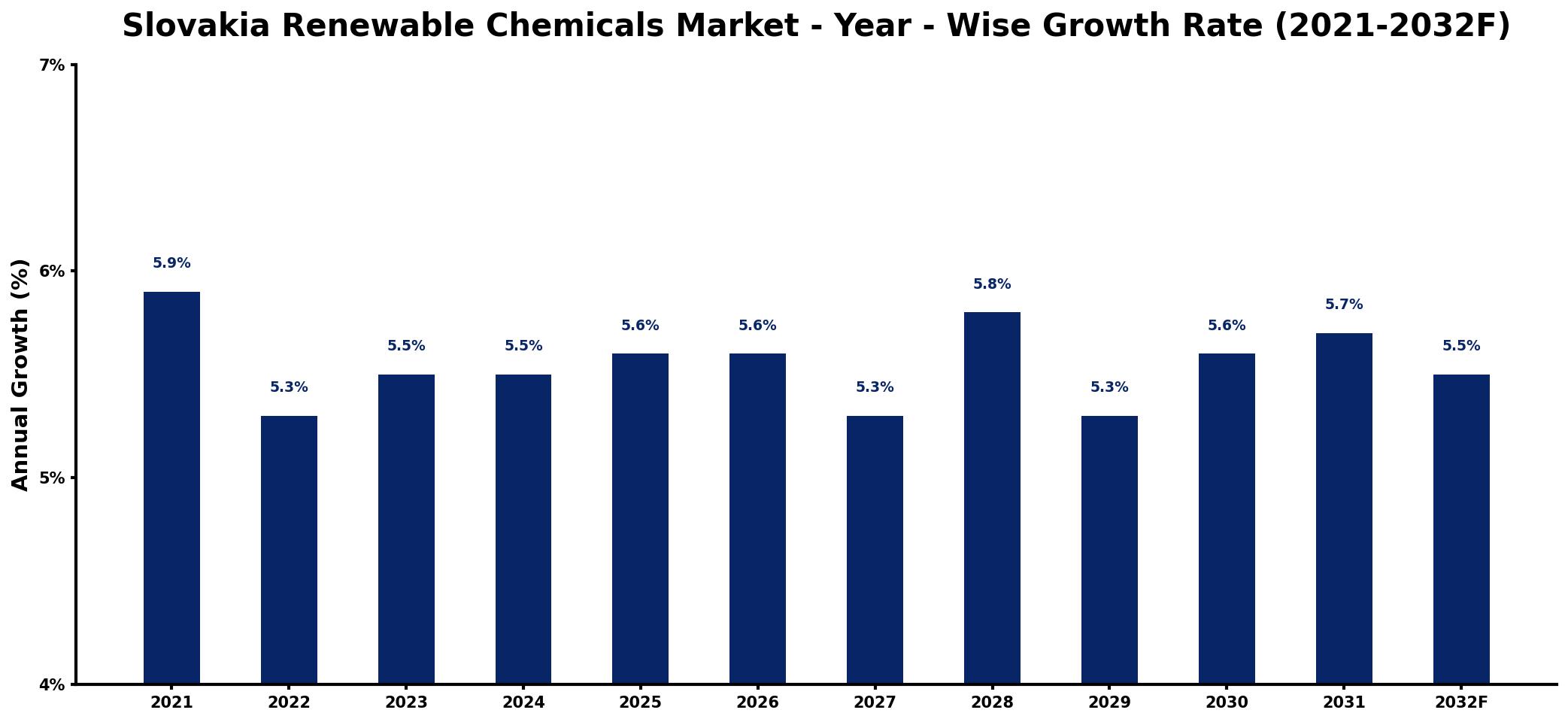
The table below presents the year‑wise growth rates along with the key drivers influencing the market
| Year | Growth Rate | Major Drivers |
| 2021 | 5.9% | Rising investment in sustainable practices |
| 2022 | 5.3% | Increased consumer demand for eco-friendly |
| 2023 | 5.5% | Government incentives for green technologies |
| 2024 | 5.5% | Growth in bioplastics market applications |
| 2025 | 5.6% | Expansion of bio-based product offerings |
| 2026 | 5.6% | Partnerships in clean technology sectors |
| 2027 | 5.3% | Emergence of innovative production methods |
| 2028 | 5.8% | Surge in environmental regulations compliance |
| 2029 | 5.3% | Development of alternative feedstock sources |
| 2030 | 5.6% | Strengthened supply chain sustainability efforts |
| 2031 | 5.7% | stronger distribution network expansion |
| 2032 | 5.5% | Increased collaboration among industry stakeholders |
Note: Market size estimations and growth projections presented in this report are based on 6Wresearch's proprietary forecasting methodology, utilizing the latest available industry data, government publications, and primary research inputs.
Slovakia Renewable Chemicals Market Synopsis
The primary force shaping the Slovakia Renewable Chemicals Market is the growing commitment to environmental sustainability. With consumers and businesses actively seeking eco-friendly alternatives, there is a notable shift towards renewable chemicals derived from bio-based sources, such as agricultural waste and biomass. This is not only driven by consumer demand but also by regulatory frameworks encouraging the adoption of green technologies.
The market's expansion is supported by strategic investments in research and development aimed at enhancing production processes and product offerings. Governmental policies and support initiatives play a crucial role, fostering collaboration among stakeholders to promote innovation and accelerate the transition to renewable chemical solutions in various sectors, including packaging and automotive.
Slovakia Renewable Chemicals Market Key Takeaways
- The market is driven by a strong emphasis on sustainable practices and environmental responsibility.
- Government initiatives are encouraging investment and innovation in bio-based chemicals.
- The rise in demand for bioplastics and biofuels is particularly notable across key industries.
- Investment in R&D is crucial for improving production efficiencies and developing new products.
- Strategic partnerships between industry and research entities are shaping the market landscape.
Evaluation of Restraints in Slovakia Renewable Chemicals Market
Despite the growth potential, the Slovakia Renewable Chemicals Market faces notable restraints. A significant challenge is the limited consumer awareness regarding the benefits and applications of renewable chemicals, which can slow adoption rates. Additionally, the infrastructure necessary for renewable chemical production is still in development stages, affecting scalability. Regulatory uncertainties and inconsistent government incentives could also pose risks for industry players looking to invest in this sector. Addressing these barriers will require a concerted effort in education, advocacy, and policy engagement to foster a more conducive environment for growth.
Slovakia Renewable Chemicals Market Trends
A prominent trend in the Slovakia Renewable Chemicals Market is the increasing incorporation of innovative solutions aimed at sustainability. Companies are increasingly utilizing bio-based feedstocks to manufacture chemicals and materials, reflecting a commitment to reducing carbon footprints. Furthermore, the emphasis on circular economy principles is gaining traction, as businesses seek to minimize waste and enhance resource efficiency. Collaborative efforts among industry players, government bodies, and research institutions are also on the rise, driving technology advancements and commercialization of renewable chemicals.
Slovakia Renewable Chemicals Market Opportunities
The market landscape reveals substantial investment opportunities in the development and production of biofuels, bioplastics, and other bio-based chemicals. With the growing emphasis on sustainability, businesses that invest in innovative production technologies and expand their product lines are likely to benefit. Collaborations with academia and industry partners can enhance market presence, while Slovakia's strategic location within Central Europe offers a competitive advantage for accessing broader markets. These factors create fertile ground for innovative initiatives and sustainable practices to flourish.
Government Initiatives in the Slovakia Renewable Chemicals Market
The Slovak government has been proactive in promoting the renewable chemicals sector through various supportive policies and financial incentives. This includes grants for research and development projects that aim to enhance sustainability in the chemical industry. Additionally, tax breaks and regulatory frameworks are being implemented to encourage the adoption of bio-based feedstocks in chemical production. The government is also fostering collaboration among stakeholders to stimulate innovation and growth in the renewable chemicals space, ensuring a conducive environment for investment.
Future Insights of the Slovakia Renewable Chemicals Market
Looking ahead to the 2026-2032 period, the Slovakia Renewable Chemicals Market is set for robust growth. The increasing regulatory push for reduced carbon emissions and the shift towards a more sustainable economy are expected to drive significant investments in renewable chemicals production. As technological advancements continue to evolve, they will not only enhance production efficiencies but also expand the range of sustainable products available. With a favorable regulatory landscape and a collective industry shift towards green solutions, the market is poised to experience steady expansion.
Slovakia Renewable Chemicals Market Latest Developments (2025 - 2026)
In recent months, there has been a noticeable uptick in industry activity as companies are unveiling innovative products aimed at meeting the growing demand for sustainable alternatives. Research collaborations have been strengthened, particularly in areas focused on bio-based materials. Additionally, several conferences and forums have been held to discuss advancements in renewable chemical technologies, fostering knowledge exchange among industry experts and stakeholders. These developments signal a vibrant momentum in the market as the focus on sustainable practices intensifies.
Slovakia Renewable Chemicals Market - Key Attractiveness of the Report
- 10 Years of Market Numbers
- Historical Data Starting from 2022 to 2025
- Base Year: 2025
- Forecast Data until 2032
- Key Performance Indicators Impacting the Market
- Major Upcoming Developments and Projects
Key Highlights of the Report:
- Slovakia Renewable Chemicals Market Outlook
- Market Size of Slovakia Renewable Chemicals Market, 2025
- Forecast of Slovakia Renewable Chemicals Market, 2032
- Historical Data and Forecast of Slovakia Renewable Chemicals Revenues & Volume for the Period 2022-2032F
- Slovakia Renewable Chemicals Market Trend Evolution
- Slovakia Renewable Chemicals Market Drivers and Challenges
- Slovakia Renewable Chemicals Price Trends
- Slovakia Renewable Chemicals Porter's Five Forces
- Slovakia Renewable Chemicals Industry Life Cycle
- Historical Data and Forecast of Slovakia Renewable Chemicals Market Revenues & Volume By Product Type for the Period 2022-2032F
- Historical Data and Forecast of Slovakia Renewable Chemicals Market Revenues & Volume By Alcohols for the Period 2022-2032F
- Historical Data and Forecast of Slovakia Renewable Chemicals Market Revenues & Volume By Organic Acids for the Period 2022-2032F
- Historical Data and Forecast of Slovakia Renewable Chemicals Market Revenues & Volume By Ketones for the Period 2022-2032F
- Historical Data and Forecast of Slovakia Renewable Chemicals Market Revenues & Volume By Platform Chemicals for the Period 2022-2032F
- Historical Data and Forecast of Slovakia Renewable Chemicals Market Revenues & Volume By Biopolymers for the Period 2022-2032F
- Historical Data and Forecast of Slovakia Renewable Chemicals Market Revenues & Volume By Others for the Period 2022-2032F
- Historical Data and Forecast of Slovakia Renewable Chemicals Market Revenues & Volume By Applications for the Period 2022-2032F
- Historical Data and Forecast of Slovakia Renewable Chemicals Market Revenues & Volume By Transportation for the Period 2022-2032F
- Historical Data and Forecast of Slovakia Renewable Chemicals Market Revenues & Volume By Textiles for the Period 2022-2032F
- Historical Data and Forecast of Slovakia Renewable Chemicals Market Revenues & Volume By Food safety for the Period 2022-2032F
- Historical Data and Forecast of Slovakia Renewable Chemicals Market Revenues & Volume By Environment for the Period 2022-2032F
- Historical Data and Forecast of Slovakia Renewable Chemicals Market Revenues & Volume By Communication for the Period 2022-2032F
- Historical Data and Forecast of Slovakia Renewable Chemicals Market Revenues & Volume By Housing for the Period 2022-2032F
- Historical Data and Forecast of Slovakia Renewable Chemicals Market Revenues & Volume By Recreation for the Period 2022-2032F
- Historical Data and Forecast of Slovakia Renewable Chemicals Market Revenues & Volume By Other Applications for the Period 2022-2032F
- Slovakia Renewable Chemicals Import Export Trade Statistics
- Market Opportunity Assessment By Product Type
- Market Opportunity Assessment By Applications
- Slovakia Renewable Chemicals Top Companies Market Share
- Slovakia Renewable Chemicals Competitive Benchmarking By Technical and Operational Parameters
- Slovakia Renewable Chemicals Company Profiles
- Slovakia Renewable Chemicals Key Strategic Recommendations






































