Slovakia Smart Airport Market Size, Share & Growth Rate
The Slovakia Smart Airport Market was estimated at USD 600 Million in 2025 and is projected to reach USD 1074 Million by 2032, growing at a CAGR of 8.7% from 2026 to 2032. This growth is primarily fueled by the increasing integration of advanced technologies aimed at enhancing operational efficiency and passenger experiences. As key airports in Slovakia, such as Bratislava Airport, adopt smart solutions, the demand for innovative systems that streamline processes and ensure safety will continue to surge.
Slovakia Smart Airport Market Year-wise Growth Rate and Key Drivers
This graph highlights how the Slovakia Smart Airport Market has steadily grown over the years, supported by major growth factors.
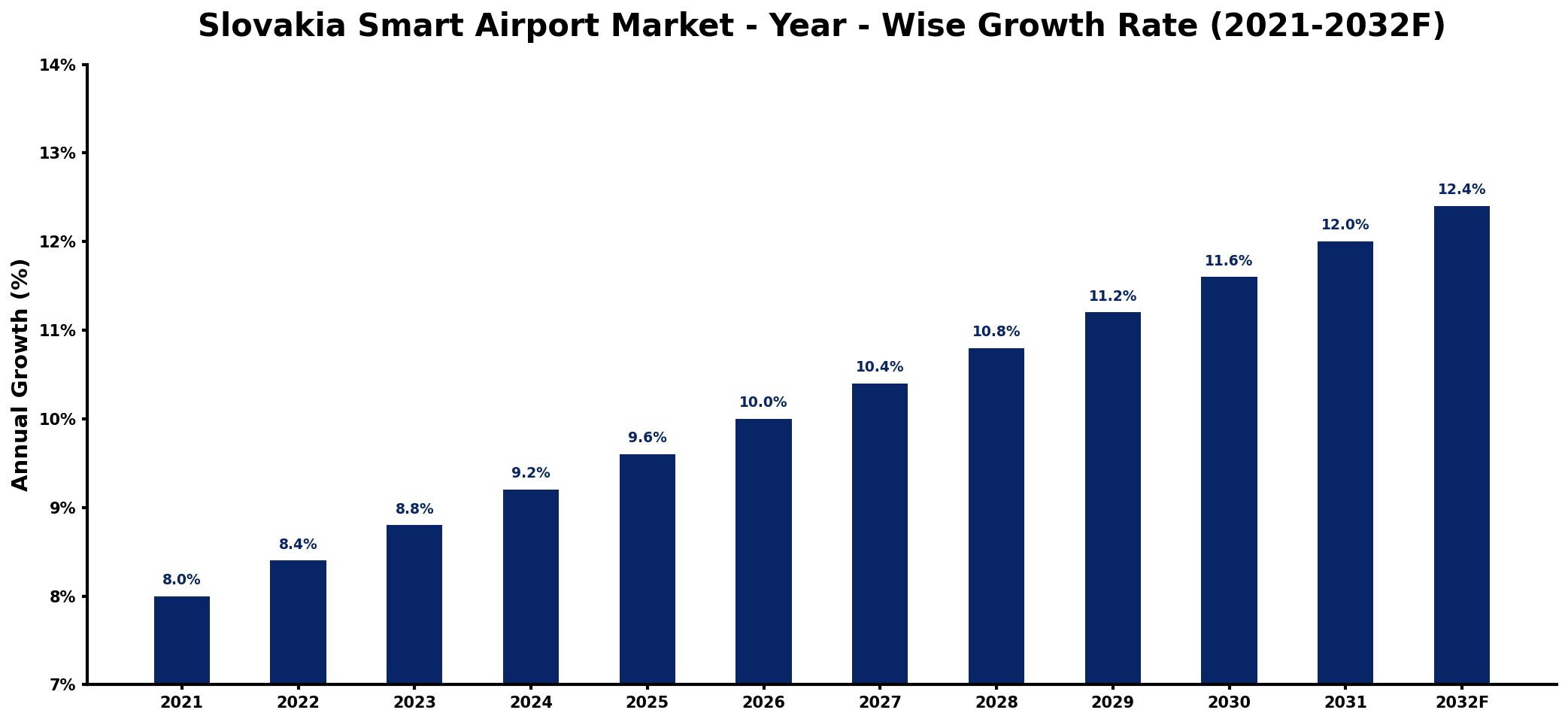
The table below presents the year‑wise growth rates along with the key drivers influencing the market
| Year | Growth Rate | Major Drivers |
| 2021 | 8.0% | increased travel demand recovery |
| 2022 | 8.4% | growing investment in technology |
| 2023 | 8.8% | rise in passenger traffic volumes |
| 2024 | 9.2% | enhanced operational efficiency measures |
| 2025 | 9.6% | expansion of digital services offerings |
| 2026 | 10.0% | improved infrastructure development projects |
| 2027 | 10.4% | increased focus on sustainability initiatives |
| 2028 | 10.8% | growth in tourism sector activities |
| 2029 | 11.2% | advancements in automation technologies |
| 2030 | 11.6% | rising demand for connectivity solutions |
| 2031 | 12.0% | growing downstream application demand |
| 2032 | 12.4% | increased regulatory support frameworks |
Note: Market size estimations and growth projections presented in this report are based on 6Wresearch's proprietary forecasting methodology, utilizing the latest available industry data, government publications, and primary research inputs.
Slovakia Smart Airport Market Synopsis
The Slovakia Smart Airport Market is on an upward trajectory, characterized by rapid technological advancements and rising passenger traffic. Airports are increasingly incorporating smart solutions like biometrics and IoT to enhance their operational capabilities, thereby improving overall passenger satisfaction.
Recent developments highlight the focus on automation and real-time data utilization, resulting in seamless passenger experiences. Key initiatives include self-service check-ins and smart baggage handling systems that not only improve efficiency but also cater to the evolving demands of modern travelers.
Slovakia Smart Airport Market Key Takeaways
- The integration of IoT, AI, and biometrics is redefining airport operations in Slovakia.
- There is a strong emphasis on sustainability, with investments in energy-efficient and green technologies.
- Major Slovak airports are leading the way in implementing smart technologies for enhanced safety and efficiency.
- Real-time passenger information systems are becoming crucial for optimizing resource allocation and improving the travel experience.
- Government policies are supportive of smart airport initiatives, emphasizing modernization and innovation.
Evaluation of Restraints in Slovakia Smart Airport Market
Despite the promising growth trajectory, the Slovakia Smart Airport Market faces notable restraints. One significant challenge is the necessity for substantial investments in upgrading existing airport infrastructure to support advanced technologies. This upgrade process demands careful planning to ensure that IoT, AI, and biometric systems are seamlessly integrated. Furthermore, concerns around data privacy and security persist, necessitating robust measures to protect passenger information. Regulatory complexities also pose hurdles that may slow the adoption of smart solutions, requiring concerted efforts from all stakeholders to navigate.
Slovakia Smart Airport Market Trends
Key trends shaping the Slovakia Smart Airport Market include the widespread implementation of advanced security technologies, such as biometric identification systems, which are improving safety measures. Additionally, the integration of IoT devices and sensors is facilitating real-time monitoring of airport facilities, enhancing operational efficiency. The utilization of data analytics is gaining traction, allowing airports to predict passenger flows and optimize resource allocation effectively. Sustainability is also a growing focus, as airports are increasingly adopting eco-friendly practices to minimize their environmental impact.
Slovakia Smart Airport Market Opportunities
Investment opportunities abound in the Slovakia Smart Airport Market, particularly in areas such as smart technology integration and automated baggage handling solutions. With an emphasis on enhancing operational efficiency and passenger experiences, demand for innovative systems continues to rise. Collaborations with airport authorities and technology providers can yield fruitful ventures in implementing smart airport initiatives. Investors can capitalize on the ongoing digital transformation, thereby positioning themselves advantageously in this rapidly evolving market.
Government Initiatives in the Slovakia Smart Airport Market
The Slovak government is actively promoting modernization within the airport sector, guided by the National Smart City Strategy and National Aviation Strategy. These frameworks emphasize the importance of technological innovation and sustainability in airport operations. By encouraging partnerships between the public and private sectors, the government aims to drive investments in smart airport infrastructure and services. This collaboration is essential for optimizing resource utilization and enhancing the overall travel experience while ensuring adherence to data privacy and cybersecurity regulations.
Future Insights of the Slovakia Smart Airport Market
Looking ahead to 2026-2032, the Slovakia Smart Airport Market is poised for remarkable growth. The continuous advancements in smart technologies will not only streamline airport operations but also significantly improve passenger experiences. As air traffic increases, there will be an urgent need for more efficient, safe, and user-friendly airport environments. Government support for infrastructure development and a collective push towards embracing innovative technologies will drive this market forward, positioning Slovak airports as pivotal players in the global aviation sector.
Slovakia Smart Airport Market Latest Developments (2025 - 2026)
Recent developments in the Slovakia Smart Airport Market indicate a marked shift towards the adoption of cutting-edge technologies. Airports are increasingly focusing on automating operations and implementing smart solutions that leverage data analytics for enhanced decision-making. Additionally, there are ongoing discussions among stakeholders regarding potential collaborations aimed at accelerating the transition to smarter infrastructures, reflecting a collective commitment to innovation and modernization in the aviation sector.
Slovakia Smart Airport Market - Key Attractiveness of the Report
- 10 Years of Market Numbers
- Historical Data Starting from 2022 to 2025
- Base Year: 2025
- Forecast Data until 2032
- Key Performance Indicators Impacting the Market
- Major Upcoming Developments and Projects
Key Highlights of the Report:
- Slovakia Smart Airport Market Outlook
- Market Size of Slovakia Smart Airport Market, 2025
- Forecast of Slovakia Smart Airport Market, 2032
- Historical Data and Forecast of Slovakia Smart Airport Revenues & Volume for the Period 2022-2032F
- Slovakia Smart Airport Market Trend Evolution
- Slovakia Smart Airport Market Drivers and Challenges
- Slovakia Smart Airport Price Trends
- Slovakia Smart Airport Porter's Five Forces
- Slovakia Smart Airport Industry Life Cycle
- Historical Data and Forecast of Slovakia Smart Airport Market Revenues & Volume By System for the Period 2022-2032F
- Historical Data and Forecast of Slovakia Smart Airport Market Revenues & Volume By Communication and Network Systems for the Period 2022-2032F
- Historical Data and Forecast of Slovakia Smart Airport Market Revenues & Volume By Endpoint Devices for the Period 2022-2032F
- Historical Data and Forecast of Slovakia Smart Airport Market Revenues & Volume By Data Storage for the Period 2022-2032F
- Historical Data and Forecast of Slovakia Smart Airport Market Revenues & Volume By Software and Solutions for the Period 2022-2032F
- Historical Data and Forecast of Slovakia Smart Airport Market Revenues & Volume By End User for the Period 2022-2032F
- Historical Data and Forecast of Slovakia Smart Airport Market Revenues & Volume By Implementation for the Period 2022-2032F
- Historical Data and Forecast of Slovakia Smart Airport Market Revenues & Volume By Upgrades and Services for the Period 2022-2032F
- Historical Data and Forecast of Slovakia Smart Airport Market Revenues & Volume By Location for the Period 2022-2032F
- Historical Data and Forecast of Slovakia Smart Airport Market Revenues & Volume By Landside for the Period 2022-2032F
- Historical Data and Forecast of Slovakia Smart Airport Market Revenues & Volume By Airside for the Period 2022-2032F
- Historical Data and Forecast of Slovakia Smart Airport Market Revenues & Volume By Terminal Side for the Period 2022-2032F
- Slovakia Smart Airport Import Export Trade Statistics
- Market Opportunity Assessment By System
- Market Opportunity Assessment By End User
- Market Opportunity Assessment By Location
- Slovakia Smart Airport Top Companies Market Share
- Slovakia Smart Airport Competitive Benchmarking By Technical and Operational Parameters
- Slovakia Smart Airport Company Profiles
- Slovakia Smart Airport Key Strategic Recommendations






































