South Africa Print Label Market: Import Trend Analysis
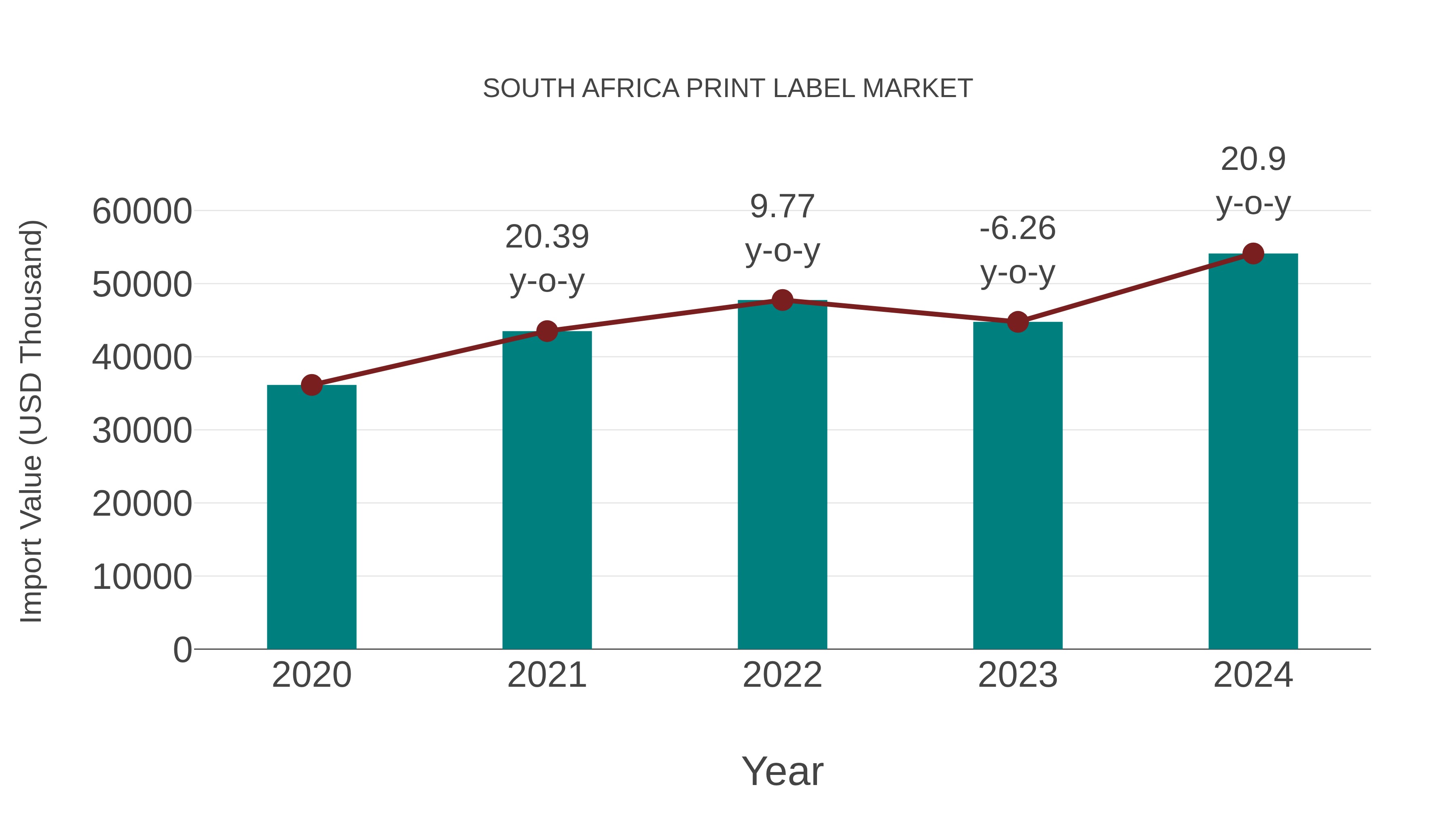
In the South African print label market, the import trend experienced significant growth from 2023 to 2024, with a notable increase of 20.9%. The compound annual growth rate (CAGR) for the period of 2020 to 2024 stood at 10.63%. This surge in imports could be attributed to a shift in demand dynamics or favorable trade policies during this period.
South Africa Print Label Market Overview
The South Africa print label market is experiencing steady growth driven by increasing demand from various industries such as food and beverage, pharmaceuticals, retail, and logistics. The market is characterized by a shift towards digital printing technologies, leading to higher quality, customization, and shorter turnaround times. The adoption of advanced labeling solutions, including RFID and smart labels, is also on the rise to enhance supply chain visibility and product authentication. Key players in the market are focusing on sustainable practices and innovative labeling solutions to meet the evolving consumer preferences and regulatory requirements. Overall, the South Africa print label market is poised for further expansion with a growing emphasis on product differentiation, brand promotion, and compliance with labeling standards.
South Africa Print Label Market Trends
The South Africa Print Label Market is experiencing a shift towards digital printing technologies, driven by the demand for customization and shorter print runs. This trend is particularly prominent in the food and beverage industry, where brands are seeking innovative and eye-catching label designs to stand out on the shelves. Sustainability is also a key trend, with a growing focus on eco-friendly labeling materials and printing processes to reduce environmental impact. Additionally, advancements in QR codes and RFID technology are being increasingly integrated into labels for improved traceability and consumer engagement. Overall, the market is evolving towards more flexible and sustainable printing solutions to meet the changing needs of both businesses and consumers in South Africa.
South Africa Print Label Market Challenges
In the South Africa Print Label Market, some key challenges include intense competition among label manufacturers, fluctuating raw material costs, and the need for continuous technological advancements to meet evolving customer demands. The market is also impacted by economic uncertainties, regulatory changes, and the pressure to adopt sustainable practices. Additionally, the presence of counterfeit products and the growing trend of e-commerce pose challenges in terms of brand protection and supply chain management. To succeed in this competitive landscape, companies in the South Africa Print Label Market must focus on innovation, efficiency, and sustainability while also ensuring compliance with industry regulations and maintaining strong customer relationships.
South Africa Print Label Market Investment Opportunities
The South Africa print label market presents promising investment opportunities due to the growing demand for packaging solutions across various industries such as food and beverage, pharmaceuticals, and retail. The market is driven by increasing consumer awareness regarding product information, safety, and branding. Opportunities exist for investments in advanced printing technologies, innovative labeling materials, and sustainable packaging solutions to cater to the evolving needs of businesses and consumers. Additionally, the rise of e-commerce and online retail platforms in South Africa further enhances the demand for printed labels for shipping and product identification. Investors can consider partnerships with local printing companies, technological advancements, and market expansion strategies to capitalize on the growth potential of the South Africa print label market.
South Africa Print Label Market Government Policy
In South Africa, the Print Label Market is governed by various policies and regulations to ensure compliance and fair competition. The Department of Trade, Industry, and Competition oversees regulations related to labeling and packaging standards, including the Labelling and Advertising of Foods (R146) and the Consumer Protection Act (CPA). Additionally, the South African Revenue Service (SARS) imposes import duties and tariffs on printed labels to protect local manufacturers. The Competition Commission enforces competition laws to prevent anti-competitive behavior in the market. Overall, these government policies aim to promote consumer protection, fair trade practices, and support local industry growth within the South Africa Print Label Market.
South Africa Print Label Market Future Outlook
The South Africa Print Label Market is poised for steady growth in the coming years, driven by increasing demand for packaged goods across various industries such as food and beverage, pharmaceuticals, and cosmetics. With a growing population and rising disposable incomes, there is a greater emphasis on product branding and labeling, leading to a greater need for high-quality and innovative labeling solutions. Additionally, the adoption of advanced printing technologies, such as digital printing and RFID labeling, is also expected to fuel market growth. However, the market may face challenges such as fluctuating raw material prices and increasing competition. Overall, the South Africa Print Label Market is likely to experience moderate growth with a focus on customization, sustainability, and technological advancements.
Key Highlights of the Report:
- South Africa Print Label Market Outlook
- Market Size of South Africa Print Label Market, 2021
- Forecast of South Africa Print Label Market, 2031
- Historical Data and Forecast of South Africa Print Label Revenues & Volume for the Period 2018 - 2031
- South Africa Print Label Market Trend Evolution
- South Africa Print Label Market Drivers and Challenges
- South Africa Print Label Price Trends
- South Africa Print Label Porter's Five Forces
- South Africa Print Label Industry Life Cycle
- Historical Data and Forecast of South Africa Print Label Market Revenues & Volume By Print Process for the Period 2018 - 2031
- Historical Data and Forecast of South Africa Print Label Market Revenues & Volume By Offset lithography for the Period 2018 - 2031
- Historical Data and Forecast of South Africa Print Label Market Revenues & Volume By Gravure for the Period 2018 - 2031
- Historical Data and Forecast of South Africa Print Label Market Revenues & Volume By Flexography for the Period 2018 - 2031
- Historical Data and Forecast of South Africa Print Label Market Revenues & Volume By Screen for the Period 2018 - 2031
- Historical Data and Forecast of South Africa Print Label Market Revenues & Volume By Letterpress for the Period 2018 - 2031
- Historical Data and Forecast of South Africa Print Label Market Revenues & Volume By Electrophotography for the Period 2018 - 2031
- Historical Data and Forecast of South Africa Print Label Market Revenues & Volume By Inkjet for the Period 2018 - 2031
- Historical Data and Forecast of South Africa Print Label Market Revenues & Volume By Label Format for the Period 2018 - 2031
- Historical Data and Forecast of South Africa Print Label Market Revenues & Volume By Wet-glue labels for the Period 2018 - 2031
- Historical Data and Forecast of South Africa Print Label Market Revenues & Volume By Pressure-sensitive labels for the Period 2018 - 2031
- Historical Data and Forecast of South Africa Print Label Market Revenues & Volume By Linerless labels for the Period 2018 - 2031
- Historical Data and Forecast of South Africa Print Label Market Revenues & Volume By Multi-part tracking labels for the Period 2018 - 2031
- Historical Data and Forecast of South Africa Print Label Market Revenues & Volume By In-mold labels for the Period 2018 - 2031
- Historical Data and Forecast of South Africa Print Label Market Revenues & Volume By Sleeves for the Period 2018 - 2031
- Historical Data and Forecast of South Africa Print Label Market Revenues & Volume By End-User for the Period 2018 - 2031
- Historical Data and Forecast of South Africa Print Label Market Revenues & Volume By Food for the Period 2018 - 2031
- Historical Data and Forecast of South Africa Print Label Market Revenues & Volume By Beverage for the Period 2018 - 2031
- Historical Data and Forecast of South Africa Print Label Market Revenues & Volume By Healthcare for the Period 2018 - 2031
- Historical Data and Forecast of South Africa Print Label Market Revenues & Volume By Cosmetics for the Period 2018 - 2031
- Historical Data and Forecast of South Africa Print Label Market Revenues & Volume By Household for the Period 2018 - 2031
- Historical Data and Forecast of South Africa Print Label Market Revenues & Volume By Industrial for the Period 2018 - 2031
- Historical Data and Forecast of South Africa Print Label Market Revenues & Volume By Logistics for the Period 2018 - 2031
- Historical Data and Forecast of South Africa Print Label Market Revenues & Volume By Other for the Period 2018 - 2031
- South Africa Print Label Import Export Trade Statistics
- Market Opportunity Assessment By Print Process
- Market Opportunity Assessment By Label Format
- Market Opportunity Assessment By End-User
- South Africa Print Label Top Companies Market Share
- South Africa Print Label Competitive Benchmarking By Technical and Operational Parameters
- South Africa Print Label Company Profiles
- South Africa Print Label Key Strategic Recommendations






































