South Africa Warehousing and Storage Market Growth Rate
According to 6Wresearch internal database and industry insights, the South Africa Warehousing and Storage Market is expected to grow at a compound annual growth rate (CAGR) of 8.1% during the forecast period (2026-2032).
South Africa Warehousing and Storage Market Year-wise Growth Rate and Key Drivers
This graph highlights how the South Africa Warehousing and Storage Market has steadily grown over the past five years, supported by major growth factors.
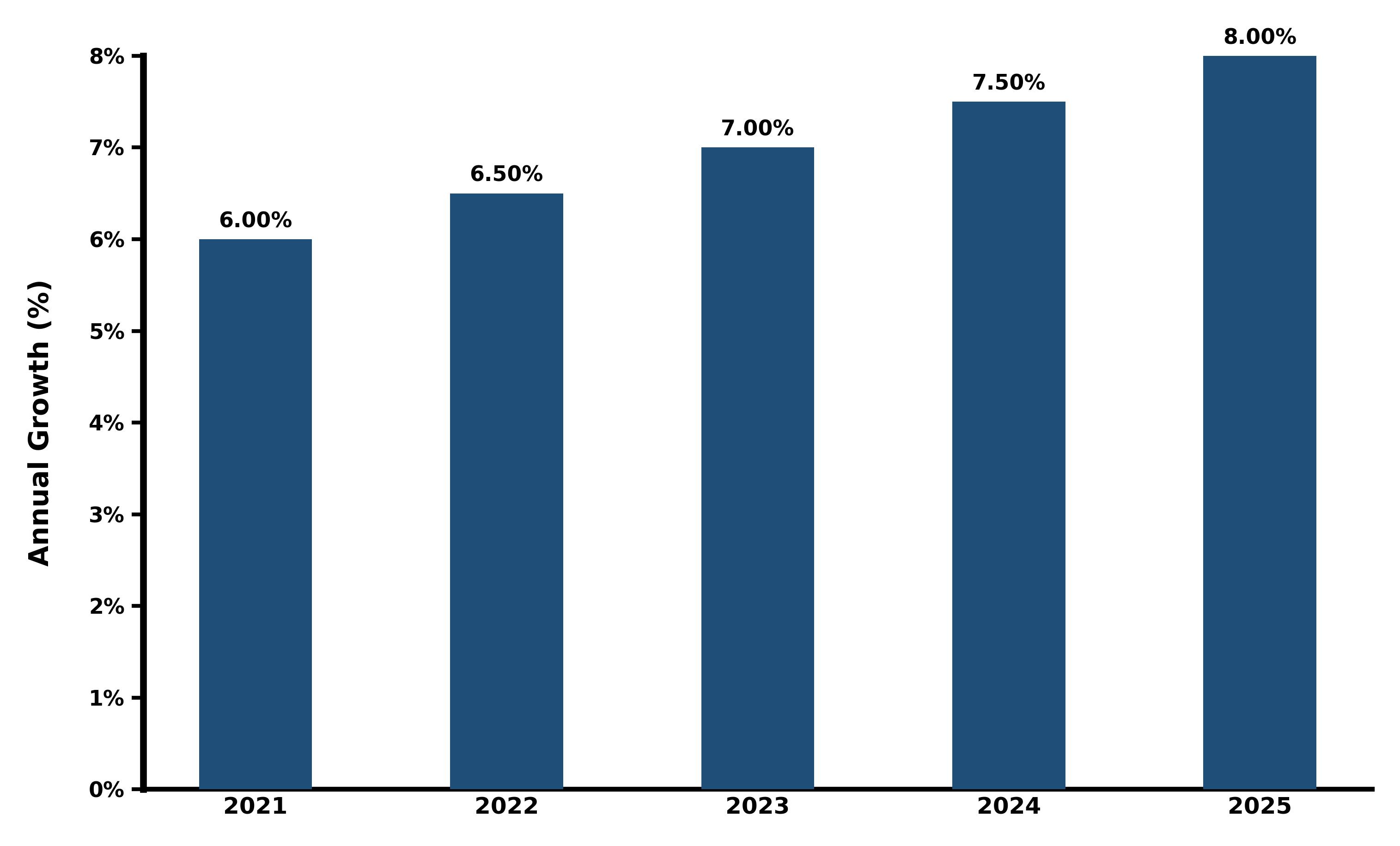
The table below presents the year‑wise growth rates along with the key drivers influencing the market
| Years | Est. Annual Growth in % | Growth Drivers |
| 2021 | 6% | Increase in e-commerce driving demand for warehousing space. |
| 2022 | 6.5% | Expansion of manufacturing sectors and retail demand. |
| 2023 | 7% | Government support for infrastructure and logistics. |
| 2024 | 7.5% | Rise in consumer goods and food and beverage storage needs. |
| 2025 | 8% | Technological advancements in warehouse management systems (WMS) and automation. |
Topics Covered in the South Africa Warehousing and Storage Market Report
The South Africa Warehousing and Storage Market report provides a thorough analysis of the market by type, ownership, and end-use. It covers key industry trends, growth opportunities, challenges, and provides insights into the factors driving the market forward. It includes information on leading players, investment opportunities, and the impact of government initiatives on market growth.
South Africa Warehousing and Storage Market Highlights
| Report Name | South Africa Warehousing and Storage Market |
| Forecast period | 2026-2032 |
| CAGR | 8.1% |
| Growing Sector |
Retail |
South Africa Warehousing and Storage Market Synopsis
The South Africa warehousing and storage sector is expanding due to rapid industrialization, increased e-commerce activity, and changing consumer preferences. Businesses implement automated storage solutions through their adoption of technology-based warehouse management systems (WMS) which create more efficient storage operations. The logistics and warehousing industry experiences expansion as of government support which includes infrastructure development and policies that benefit the sector. The development of food and beverage industries drives higher demand for specialized warehousing which includes refrigerated storage facilities.
Evaluation of Growth Drivers in the South Africa Warehousing and Storage Market
Below mentioned are some growth drivers and their impact on market dynamics:
| Drivers | Primary Segments Affected | Why It Matters |
| Government Support | All Segments | Infrastructure and logistics development enhance warehousing capabilities and market growth. |
| Rise of E-commerce | E-commerce, Retail, Consumer Goods | E-commerce growth fuels demand for efficient and scalable warehousing solutions. |
| Technological Advancements | All Segments | The automation and WMS increases efficiency and storage space utilization. |
| Expansion of Manufacturing | Manufacturing, Consumer Goods | Increased production and demand for storage space in manufacturing sectors drive warehousing growth. |
| Urbanization and Infrastructure Development | All Segments | Growing urbanization and the demand for warehousing, especially in major cities and logistics hubs. |
The South Africa Warehousing and Storage Market is expected to grow robustly, at a CAGR of 8.1% during the forecast period of 2026-2032. The South Africa Warehousing and Storage Market development gets driven by three main factors which include the increasing e-commerce market, the rising need for storage solutions in retail and food and beverage industries and the government support for infrastructure projects. The operational efficiency of businesses gets improved through technological advancements which include automation and warehouse management systems (WMS) technology. The growth of manufacturing and consumer goods industries creates a greater demand for storage space which drives market expansion.
Evaluation of Restraints in the South Africa Warehousing and Storage Market
Below mentioned are some major restraints and their influence on market dynamics:
| Restraints | Primary Segments Affected | What This Means |
| High Infrastructure Costs | All Segments | The high cost of setting up warehouses, especially with specialized storage facilities, deters small businesses from entering the market. |
| Skilled Labor Shortages | All Segments | A shortage of trained personnel to manage and operate modern warehouse systems slows growth and adoption. |
| Regulatory Compliance | All Segments | Stringent government regulations increase operational costs and may limit warehouse expansions. |
| Security Concerns | All Segments | Increasing concerns about theft and data security in warehouses are growing the need for investment in security systems. |
| Logistical Challenges | All Segments | Inadequate transport infrastructure in certain regions affects the efficiency and cost-effectiveness of warehousing operations. |
South Africa Warehousing and Storage Market Challenges
The South Africa Warehousing and Storage Market encounters obstacles as its high infrastructure expenses prevent small enterprises from building new storage facilities. The market expansion process becomes more difficult as there is a lack of skilled workers who can operate contemporary warehouse systems and regulatory compliance expenses continue to rise. Security concerns about theft and damage at storage facilities create additional security risks. The transportation infrastructure problems that exist in specific regions of the country create difficulties for warehousing and logistics functions which ultimately restricts market development.
South Africa Warehousing and Storage Market Trends
Some major trends contributing to the South Africa Warehousing and Storage Market Growth are:
- Data-Driven Warehousing Solutions: Growing tech advancements such as IoT devices, and cloud-based solutions is increasing the market expansion by improving warehouse management and enhancing inventory accuracy.
- Rise of E-commerce and Last-Mile Delivery: There is a growing need of warehouses close to urban centers due to the expansion of e-commerce industry.
- Increase in Cold Chain Logistics: There is growing demand among consumers for refrigerated storage solutions due to growing food and pharmaceutical sectors.
Investment Opportunities in the South Africa Warehousing and Storage Market
Here are some investment opportunities in the South Africa Warehousing and Storage Industry:
- Cold Storage Infrastructure: More investments in the cold chain logistics and refrigerated warehouses can cater to increasing demand for perishable goods, such as food and pharmaceuticals.
- Sustainable Warehousing Solutions: Developing eco-friendly, energy-efficient warehouses using renewable energy sources and green technologies will attract environmentally conscious consumers and businesses.
- Warehouse Automation: Investment in automated systems and robotics will improve efficiency and reduce operational costs in warehouses, making it an attractive area for growth.
Top 5 Leading Players in the South Africa Warehousing and Storage Market
Here are the key player contributing to the South Africa Warehousing and Storage Market share:
1. Imperial Logistics (A DP World Company)
| Company Name | Imperial Logistics (A DP World Company) |
|---|---|
| Established Year | 1948 |
| Headquarters | Germiston, Gauteng |
| Official Website | - |
Imperial is the undisputed giant of the South African market. Following its acquisition by DP World, it has leveraged global capital to expand its "Market Access" strategy. As of 2026, Imperial operates over 900,000 m² of high-spec warehousing space in South Africa alone.
2. Bidvest Freight (Bidvest Group)
| Company Name | Bidvest Freight (Bidvest Group) |
|---|---|
| Established Year | 1988 |
| Headquarters | Johannesburg, South Africa |
| Official Website | Click Here |
Bidvest Freight is a powerhouse in specialized industrial and port-side storage. As of 2026, they manage over 850,000 m² of storage capacity, with a dominant presence in Durban, Richards Bay, and Isando. They are the market leader for bulk liquid storage (through Bidvest Tank Terminals) and agricultural bulk handling.
3. Super Group
| Company Name | Super Group |
|---|---|
| Established Year | 1986 |
| Headquarters | Sandton, Johannesburg |
| Official Website | Click Here |
Super Group has seen exceptional growth in 2025 and 2026, particularly in its supply chain and commodity-focused divisions. They manage over 375,000 m² of warehousing space across Southern Africa. In 2026, Super Group is notable for its aggressive tech adoption, utilizing AI-powered forecasting and automated picking assistance to handle the high-volume demands of its consumer-facing clients.
4. DSV South Africa
| Company Name | DSV South Africa |
|---|---|
| Established Year | 1976 |
| Headquarters | Kempton Park, Gauteng |
| Official Website | Click Here |
DSV operates one of the most technologically advanced facilities in Africa: DSV Park Gauteng. This massive consolidated hub features a 79,000 m² logistics warehouse and a 39,000 m² cross-dock facility near OR Tambo International Airport. In 2026, DSV is the leader in "Green Warehousing," with their flagship park powered largely by solar energy.
5. Barloworld Logistics
| Company Name | Barloworld Logistics |
|---|---|
| Established Year | 1902 |
| Headquarters | Sandton, Johannesburg |
| Official Website | Click Here |
Barloworld Logistics continues to be a top-tier player, deeply integrated into the automotive and industrial supply chains. While the group has undergone restructuring in recent years, its warehousing division remains a critical provider for the "just-in-time" requirements of South Africa's heavy equipment and manufacturing sectors.
Government Regulations Introduced in the South Africa Warehousing and Storage Market
According to the South African government data, the South African National Logistics Master Plan (NLMP) serves as one of the multiple initiatives which support warehousing and logistics development. The policy establishes three objectives which include developing better logistics infrastructure and creating more efficient operations and improving supply chain performance. The National Ports Act and Infrastructure Development Act regulations create a framework that enables public and private entities to make investments in warehousing and storage facilities. The sector benefits from these regulations because they create opportunities for both public and private investments.
Future Insights of the South Africa Warehousing and Storage Market
The South Africa Warehousing and Storage Market will experience positive development as e-commerce activities continue to expand and urban areas grow. The demand for automated warehouses which use advanced technology will create operational cost savings while improving operational efficiency. The market growth will be further supported by increased cold storage capacity for food and pharmaceutical products and government infrastructure development projects. The growing complexity of supply chains will create a greater need for specialized storage solutions which will lead to major market growth opportunities.
Market Segmentation Analysis
The report offers a comprehensive study of the subsequent market segments and their leading categories:
General Warehousing and Storage to Dominate the Market – By Type
According to Guneet Kaur, Senior Research Analyst at 6Wresearch, the General warehousing dominates the market. Mainly due to its versatility and broad applicability across multiple industries. Also, it offers efficient businesses storage solutions for various products, consisting of consumer goods, and IT hardware, and is cost-effective compared to specialized storage options.
Private Warehouses to Dominate the Market – By Ownership
Private warehouses is leading the market by ownership segment. As businesses are preferring owning warehousing facilities to manage their inventory, lower operational costs, and ensure better control over storage conditions, mainly in manufacturing and food sectors.
Retail to Dominate the Market – By End-Use
The retail sector is leading the market by end-use category. Mainly due to the significant rise in e-commerce and consumer demand for fast, reliable deliveries. Also, retailers are increasingly investing more in the warehouses to store goods closer to end customers, making sure timely fulfillment and lowering shipping costs.
Key attractiveness of the report
- 10 Years Market Numbers.
- Historical Data Starting from 2022 to 2025.
- Base Year: 2025
- Forecast Data until 2032.
- Key Performance Indicators Impacting the Market.
- Major Upcoming Developments and Projects.
Key Highlights of the Report:
- South Africa Warehousing and Storage Market Outlook
- Market Size of South Africa Warehousing and Storage Market, 2025
- Forecast of South Africa Warehousing and Storage Market, 2032
- Historical Data and Forecast of South Africa Warehousing and Storage Revenues & Volume for the Period 2022-2032
- South Africa Warehousing and Storage Market Trend Evolution
- South Africa Warehousing and Storage Market Drivers and Challenges
- South Africa Warehousing and Storage Price Trends
- South Africa Warehousing and Storage Porter's Five Forces
- South Africa Warehousing and Storage Industry Life Cycle
- Historical Data and Forecast of South Africa Warehousing and Storage Market Revenues & Volume By Type for the Period 2022-2032
- Historical Data and Forecast of South Africa Warehousing and Storage Market Revenues & Volume By General Warehousing and Storage for the Period 2022-2032
- Historical Data and Forecast of South Africa Warehousing and Storage Market Revenues & Volume By Refrigerated Warehousing and Storage for the Period 2022-2032
- Historical Data and Forecast of South Africa Warehousing and Storage Market Revenues & Volume By Farm Product Warehousing and Storage for the Period 2022-2032
- Historical Data and Forecast of South Africa Warehousing and Storage Market Revenues & Volume By Ownership for the Period 2022-2032
- Historical Data and Forecast of South Africa Warehousing and Storage Market Revenues & Volume By Private Warehouses for the Period 2022-2032
- Historical Data and Forecast of South Africa Warehousing and Storage Market Revenues & Volume By Public Warehouses for the Period 2022-2032
- Historical Data and Forecast of South Africa Warehousing and Storage Market Revenues & Volume By Bonded Warehouses for the Period 2022-2032
- Historical Data and Forecast of South Africa Warehousing and Storage Market Revenues & Volume By End-Use for the Period 2022-2032
- Historical Data and Forecast of South Africa Warehousing and Storage Market Revenues & Volume By Manufacturing for the Period 2022-2032
- Historical Data and Forecast of South Africa Warehousing and Storage Market Revenues & Volume By Consumer Goods for the Period 2022-2032
- Historical Data and Forecast of South Africa Warehousing and Storage Market Revenues & Volume By Retail for the Period 2022-2032
- Historical Data and Forecast of South Africa Warehousing and Storage Market Revenues & Volume By Food and Beverage for the Period 2022-2032
- Historical Data and Forecast of South Africa Warehousing and Storage Market Revenues & Volume By IT Hardware for the Period 2022-2032
- Historical Data and Forecast of South Africa Warehousing and Storage Market Revenues & Volume By Healthcare for the Period 2022-2032
- Historical Data and Forecast of South Africa Warehousing and Storage Market Revenues & Volume By Chemicals for the Period 2022-2032
- Historical Data and Forecast of South Africa Warehousing and Storage Market Revenues & Volume By Others for the Period 2022-2032
- South Africa Warehousing and Storage Import Export Trade Statistics
- Market Opportunity Assessment By Type
- Market Opportunity Assessment By Ownership
- Market Opportunity Assessment By End-Use
- South Africa Warehousing and Storage Top Companies Market Share
- South Africa Warehousing and Storage Competitive Benchmarking By Technical and Operational Parameters
- South Africa Warehousing and Storage Company Profiles
- South Africa Warehousing and Storage Key Strategic Recommendations
Market Covered
The report subsequently covers the market by following segments and subsegments:
By Type
- General Warehousing and Storage
- Refrigerated Warehousing and Storage
- Farm Product Warehousing and Storage
By Ownership
- Private Warehouses
- Public Warehouses
- Bonded Warehouses
By End-Use
- Manufacturing
- Consumer Goods
- Retail
- Food and Beverage
- IT Hardware
- Healthcare
- Chemicals
- Others






































