South Korea 3D Printing Plastic Market Growth Rate
According to 6Wresearch internal database and industry insights, the South Korea 3D Printing Plastic Market is projected to grow at a compound annual growth rate (CAGR) of 4.28% during the forecast period (2026-2032).
South Korea 3D Eye Tracking Software Market Year-wise Growth Rate and Key Drivers
This graph illustrates the annual growth rates of the South Korea 3D Printing Plastic Market from 2021 to 2032, highlighting a steady upward trajectory and projected market expansion over the forecast period.
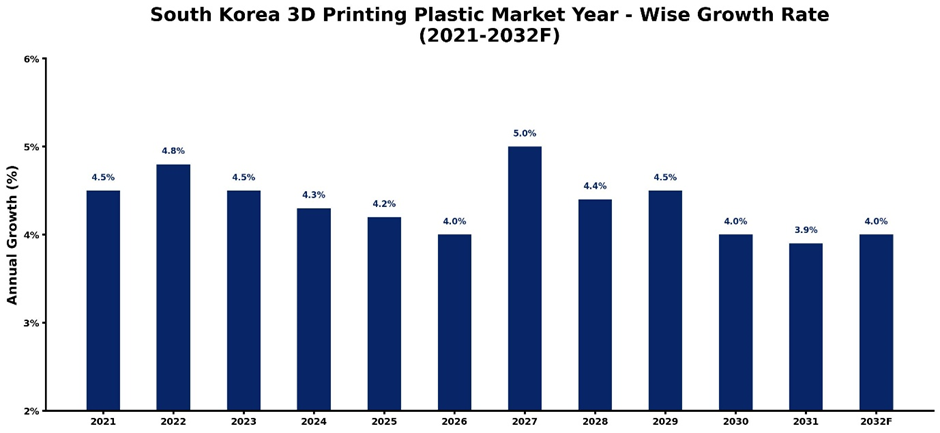
The following table summarizes the historical and forecasted growth rates of the South Korea 3D Printing Plastic Market, along with the rationale behind each year’s performance.
| Year | Estimated Growth (%) | Market Rationale |
| 2021 | 4.5% | Recovery from COVID-19 disruptions; growth in automotive prototyping and consumer electronics. |
| 2022 | 4.8% | Rising adoption of 3D printing in healthcare and industrial applications; government incentives. |
| 2023 | 4.5% | Expansion of polymer materials; increased industrial 3D printing applications. |
| 2024 | 4.3% | Continuous demand in aerospace and automotive sectors; more domestic 3D printing startups. |
| 2025 | 4.2% | Growth in eco-friendly and recyclable plastics; increasing R&D investments. |
| 2026 | 4% | Adoption in mass customization and consumer electronics; stable industrial demand. |
| 2027 | 5% | Accelerated adoption in medical devices and dental applications; government support. |
| 2028 | 4.4% | Integration of AI and 3D printing for process optimization; wider use of engineering plastics. |
| 2029 | 4.5% | Expansion of 3D printing services; increasing exports of 3D printed components. |
| 2030 | 4% | Steady industrial adoption; new material innovations driving demand. |
| 2031 | 3.9% | Slight moderation due to market saturation in consumer electronics; continued industrial growth. |
| 2032 | 4% | Growth driven by dental, healthcare, aerospace sectors; adoption of high-performance polymers. |
Topics Covered in the South Korea 3D Printing Plastic Market Report
The South Korea 3D Printing Plastic Market report thoroughly covers the market by Plastic Type, Technology, Form and End User. The market report provides an unbiased and detailed analysis of ongoing market trends, opportunities/high growth areas, and market drivers, which help stakeholders devise and align their market strategies according to the current and future market dynamics.
South Korea 3D Printing Plastic Market Highlights
| Report Name | South Korea 3D Printing Plastic Market |
| Forecast period | 2026-2032 |
| CAGR | 4.28% |
| Growing Sector | Automotive & Consumer Goods |
South Korea 3D Printing Plastic Market Synopsis
South Korea 3D Printing Plastic Market is expected to register substantial growth driven by increasing adoption of additive manufacturing in automotive, healthcare, and electronics sectors. The major components of the market are PLA, ABS, PETG, and Polyamide, which are employed in prototyping and small-scale productions. The growth of the market is further being boosted by increasing incentives offered by the government to create smart manufacturing plants and development in the field of 3D printing polymers, coupled with innovations made by domestic startups.
Evaluation of Growth Drivers in the South Korea 3D Printing Plastic Market (2026-2032)
Below mentioned are some prominent drivers and their influence on the market dynamics:
| Drivers | Primary Segments Affected | Why it Matters (Evidence) |
| Increased Industrial Automation | FDM, SLA, SLS | Smart factory adoption drives demand for rapid prototyping and precision components. |
| Growth in Automotive 3D Printing | ABS, PETG, Polyamide | Rising use of lightweight polymer components improves fuel efficiency and reduces manufacturing lead time. |
| Availability of Advanced Material | PLA, PETG, Polyamide | The use of strong polymers enables wider application in manufacturing industries and consumers goods. |
| Customization of Consumer Products | Filament, Powder | The growth in e-commerce leads to an increased need for customized figurines, household items, and footwear models. |
| Government Support for Smart Factories | All Types | Incentives and subsidies for additive manufacturing enhance industry adoption across SMEs and large enterprises. |
South Korea 3D Printing Plastic Market is expected to grow at the CAGR of 4.28% during the forecast period of 2026-2032. Growth is primarily driven by expansion of additive manufacturing applications in automotive, healthcare, and electronics, while strong government initiatives, advanced polymer availability, and startup innovation further accelerate the South Korea 3D Printing Plastic Market Growth.
Evaluation of Restraints in the South Korea 3D Printing Plastic Market
Below mentioned are some major restraints and their influence on the market dynamics:
| Restraints | Primary Segments Affected | What This Means (Evidence) |
| High Material Costs | ABS, Polyamide | Advanced polymers remain expensive, limiting widespread adoption among SMEs. |
| Limited Industrial Awareness | SLA, DLP | Many manufacturers are unfamiliar with design optimization for 3D printing, slowing uptake. |
| Bottlenecks in the Supply Chain | Filament, Powder | The importation of raw materials and the shortage of resins affect reliable manufacturing in the industry. |
| Complexity in Post-Processing | SLA, SLS | The extra post-processing needs decrease the effectiveness of operations. |
| Standardization Issues | All | Standardization of 3D printed components in the automotive and aerospace industries is lacking. |
South Korea 3D Printing Plastic Market Challenges
Despite the rapid adoption and technological advancements, the adoption of the technology has been swift, and innovations continue to be made at a fast pace. There are still several challenges faced by the Market that might hamper its growth. The prohibitive prices of advanced plastic materials, along with poor supply chains, restrict their industrial applications on a wide scale. Moreover, the absence of standards for 3D printed parts, problems during processing, and the shortage of skilled labor hamper operational efficiency.
South Korea 3D Printing Plastic Market Trends
Primary technological and operational trends driving the South Korea 3D Printing Plastic Market are:
- Multi-Material Printing Integration: Use of hybrid polymers and composites is increasing for advanced prototypes and functional parts.
- Move toward High-Performance Polymers: Usage of PLA, PETG, and polyamide polymers is increasing in the automotive and aerospace industry.
- On-Demand Printing Services Expansion: Various start-ups are offering on-demand printing services for business-to-business and business-to-consumer uses.
- Use of Sustainable Filaments: Biodegradable and recycled filaments are gaining popularity to minimize environmental harm.
Investment Opportunities in the South Korea 3D Printing Plastic Market
Some of the major segments where considerable returns can be made in the South Korea 3D Printing Plastic Market include:
- Smart Manufacturing Plants: Creation of advanced automated systems for industrial manufacturing.
- Development of High-Performance Polymers: Creating unique polymers for aerospace, automotive, and medical printing.
- B2B & Consumer-Based On: Demand Printing Services: Setting up B2B and consumer-based printing services in urban areas.
- Circular Economy Solutions: Development of sustainable filaments through recycling and production of biodegradable filaments.
Top 5 Leading Players in the South Korea 3D Printing Plastic Market
Top organizations influencing market growth in South Korea 3D Printing Plastic include:
1. Stratasys Ltd.
| Company Name | Stratasys Ltd. |
|---|---|
| Established Year | 1989 |
| Headquarters | Eden Prairie, USA |
| Official Website | Click Here |
Stratasys specializes in polymer-based 3D printing solutions, offering FDM and PolyJet technologies for industrial prototyping, automotive, and healthcare applications worldwide.
2. 3D Systems Corporation
| Company Name | 3D Systems Corporation |
|---|---|
| Established Year | 1986 |
| Headquarters | Rock Hill, USA |
| Official Website | Click Here |
3D Systems provides SLA, SLS, and DLP printing systems with a broad range of plastic materials, supporting rapid prototyping and production in electronics and medical industries.
3. EOS GmbH
| Company Name | EOS GmbH |
|---|---|
| Established Year | 1989 |
| Headquarters | Krailling, Germany |
| Official Website | Click Here |
EOS offers SLS 3D printing systems and high-performance polymer solutions widely used in aerospace, automotive, and industrial applications in South Korea.
4. Materialise NV
| Company Name | Materialise NV |
|---|---|
| Established Year | 1990 |
| Headquarters | Leuven, Belgium |
| Official Website | Click Here |
Materialise provides software and additive manufacturing services for customized polymer parts, medical devices, and consumer products, enabling on-demand manufacturing solutions.
5. Arkema Group
| Company Name | Arkema Group |
|---|---|
| Established Year | 2004 |
| Headquarters | Colombes, France |
| Official Website | Click Here |
Arkema manufactures high-performance polymers and specialty filaments for FDM, SLA, and SLS applications, supporting automotive, electronics, and healthcare industries globally.
Government Initiatives Being Implemented in the South Korea 3D Printing Plastic Market
According to South Korea Government Data, major initiatives that are being implemented are mentioned below:
- Smart Factory 2.0 Initiative: Offers funding in the form of grants, tax breaks, and research & development credits to incorporate additive manufacturing into SMEs.
- High-Tech Materials Innovation Fund: Helps develop advanced polymers for use in industry-specific 3D printing.
- Industry 4.0 Additive Manufacturing Center: Creates collaboration hubs that provide 3D printing infrastructure and training programs.
Future Insights of the South Korea 3D Printing Plastic Market
The outlook for the South Korea 3D Printing Plastic Industry is highly promising, as ongoing technological advancements in polymer development, growing adoption of multi-material 3D printing systems, and rising government-backed smart factory initiatives are expected to drive market expansion. Increasing collaboration between domestic manufacturers and international technology providers, along with investments in additive manufacturing training programs, will strengthen industrial adoption, enhance product customisation capabilities, and ultimately support sustained growth over the forecast period.
Market Segmentation Analysis
The report offers a comprehensive study of the subsequent market segments and their leading categories:
By Plastic Type
According to Ritika, Senior Research Analyst, 6Wresearch, PLA led with 46.8% of the South Korea 3D Printing Plastic Market share in 2025 due to its affordability, biodegradability, and suitability for consumer product prototyping. ABS is projected to grow at 17.5% CAGR during 2026–2032, driven by demand for automotive components and electronic housings requiring higher durability.
By Technology
FDM dominated with 51.2% share in 2025, due to cost-effectiveness and ease of use for prototyping and small-scale production. SLA and SLS are projected to grow at a 19.1% CAGR during 2026–2032, driven by increasing adoption in medical devices and industrial-grade parts manufacturing requiring high precision.
Note: Market size estimations and growth projections presented in this report are based on 6Wresearch’s advanced forecasting approach, validated with industry datasets as of June 2026.
Key Attractiveness of the Report
- 10 Years of Market Numbers.
- Historical Data Starting from 2022 to 2025.
- Base Year: 2025.
- Forecast Data until 2032.
- Key Performance Indicators Impacting the Market.
- Major Upcoming Developments and Projects.
Key Highlights of the Report:
- South Korea 3D Printing Plastic Market Outlook
- Market Size of South Korea 3D Printing Plastic Market, 2025
- Forecast of South Korea 3D Printing Plastic Market, 2032
- Historical Data and Forecast of South Korea 3D Printing Plastic Revenues & Volume for the Period 2022-2032
- South Korea 3D Printing Plastic Market Trend Evolution
- South Korea 3D Printing Plastic Market Drivers and Challenges
- South Korea 3D Printing Plastic Price Trends
- South Korea 3D Printing Plastic Porter's Five Forces
- South Korea 3D Printing Plastic Industry Life Cycle
- Historical Data and Forecast of South Korea 3D Printing Plastic Market Revenues & Volume By Plastic Type for the Period 2022-2032
- Historical Data and Forecast of South Korea 3D Printing Plastic Market Revenues & Volume By ABS for the Period 2022-2032
- Historical Data and Forecast of South Korea 3D Printing Plastic Market Revenues & Volume By PLA for the Period 2022-2032
- Historical Data and Forecast of South Korea 3D Printing Plastic Market Revenues & Volume By PETG for the Period 2022-2032
- Historical Data and Forecast of South Korea 3D Printing Plastic Market Revenues & Volume By Polyamide for the Period 2022-2032
- Historical Data and Forecast of South Korea 3D Printing Plastic Market Revenues & Volume By Others for the Period 2022 - 2032
- Historical Data and Forecast of South Korea 3D Printing Plastic Market Revenues & Volume By Technology for the Period 2022-2032
- Historical Data and Forecast of South Korea 3D Printing Plastic Market Revenues & Volume By FDM for the Period 2022-2032
- Historical Data and Forecast of South Korea 3D Printing Plastic Market Revenues & Volume By SLS for the Period 2022-2032
- Historical Data and Forecast of South Korea 3D Printing Plastic Market Revenues & Volume By SLA for the Period 2022-2032
- Historical Data and Forecast of South Korea 3D Printing Plastic Market Revenues & Volume By DLP for the Period 2022-2032
- Historical Data and Forecast of South Korea 3D Printing Plastic Market Revenues & Volume By Form for the Period 2022-2032
- Historical Data and Forecast of South Korea 3D Printing Plastic Market Revenues & Volume By Filament for the Period 2022-2032
- Historical Data and Forecast of South Korea 3D Printing Plastic Market Revenues & Volume By Powder for the Period 2022-2032
- Historical Data and Forecast of South Korea 3D Printing Plastic Market Revenues & Volume By Others for the Period 2022-2032
- Historical Data and Forecast of South Korea 3D Printing Plastic Market Revenues & Volume By End User for the Period 2022-2032
- Historical Data and Forecast of South Korea 3D Printing Plastic Market Revenues & Volume By Consumer Goods for the Period 2022-2032
- Historical Data and Forecast of South Korea 3D Printing Plastic Market Revenues & Volume By Automotive for the Period 2022-2032
- Historical Data and Forecast of South Korea 3D Printing Plastic Market Revenues & Volume By Aerospace for the Period 2022-2032
- Historical Data and Forecast of South Korea 3D Printing Plastic Market Revenues & Volume By Healthcare for the Period 2022-2032
- South Korea 3D Printing Plastic Import Export Trade Statistics
- Market Opportunity Assessment By Plastic Type
- Market Opportunity Assessment By Technology
- Market Opportunity Assessment By Form
- Market Opportunity Assessment By End User
- South Korea 3D Printing Plastic Top Companies Market Share
- South Korea 3D Printing Plastic Competitive Benchmarking By Technical and Operational Parameters
- South Korea 3D Printing Plastic Company Profiles
- South Korea 3D Printing Plastic Key Strategic Recommendations
Market Covered
The report offers a comprehensive study of the subsequent market segments:
By Plastic Type
- ABS
- PLA
- PETG
- Polyamide
- Others
By Technology
- FDM
- SLS
- SLA
- DLP
By Form
- Filament
- Powder
- Others
By End User
- Consumer Goods
- Automotive
- Aerospace
- Healthcare






































