South Korea 3D Ultrasound Market Growth Rate
According to 6Wresearch internal database and industry insights, the South Korea 3D Ultrasound Market is projected to grow at a compound annual growth rate (CAGR) of 7.6% during the forecast period (2026-2032).
South Korea 3D Ultrasound Market Year-wise Growth Rate and Key Drivers
This graph illustrates the annual growth rates of the South Korea 3D Ultrasound Market from 2021 to 2032, highlighting a steady upward trajectory and projected market expansion over the forecast period.
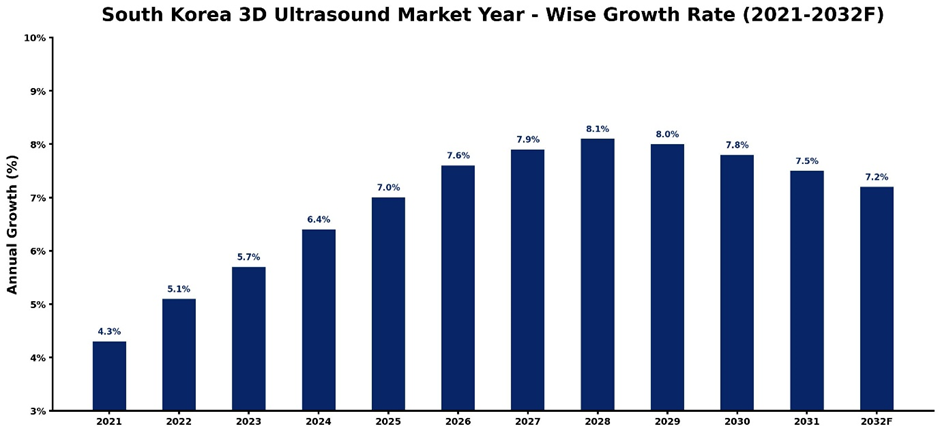
The following table summarizes the historical and forecasted growth rates of the South Korea 3D Ultrasound Market, along with the rationale behind each year’s performance.
| Year | Estimated Growth (%) | Market Rationale |
| 2021 | 4.3% | Post-pandemic recovery in diagnostic procedures |
| 2022 | 5.1% | Rising maternal healthcare awareness |
| 2023 | 5.7% | Increased adoption of advanced imaging systems |
| 2024 | 6.4% | Growing demand for prenatal diagnostics |
| 2025 | 7% | Expansion of private diagnostic centers |
| 2026 | 7.6% | Higher investment in AI-enabled ultrasound |
| 2027 | 7.9% | Growing use in cardiology diagnostics |
| 2028 | 8.1% | Technological advancements in 3D imaging |
| 2029 | 8% | Increased healthcare infrastructure spending |
| 2030 | 7.8% | Wider adoption across specialty clinics |
| 2031 | 7.5% | Rising elderly population driving diagnostics |
| 2032 | 7.2% | Market maturity with sustained replacement demand |
Topics Covered in the South Korea 3D Ultrasound Market Report
The South Korea 3D Ultrasound Market report thoroughly covers the market by type and application. The market report provides an unbiased and detailed analysis of ongoing market trends, opportunities/high growth areas, and market drivers, which help stakeholders devise and align their market strategies according to the current and future market dynamics.
South Korea 3D Ultrasound Market Highlights
| Report Name | South Korea 3D Ultrasound Market |
| Forecast period | 2026-2032 |
| CAGR | 7.6% |
| Growing Sector | Obstetrics & Gynecology |
South Korea 3D Ultrasound Market Synopsis
The South Korea 3D Ultrasound Market is expected to exhibit strong growth owing to increasing awareness regarding advanced diagnostics for fetus, availability of premium cancer treatments, and increased government interest in building state-of-the-art healthcare infrastructure. In general, 3D ultrasound technology, which offers three-dimensional images of body organs and tissues, is being increasingly used as a result of increased diagnostic procedures and AI-based clinical screening programs.
Furthermore, the growing role of international medical collaborations is further supporting early diagnosis, affordability of high-end imaging hardware, and specialized technician training across the country.
Evaluation of Growth Drivers in the South Korea 3D Ultrasound Market (2026-2032)
Below mentioned are some prominent drivers and their influence on the market dynamics:
| Drivers | Primary Segments Affected | Why it Matters (Evidence) |
| Integration of AI in Imaging | Software, Hardware | AI-driven auto-measurement reduces scan time and operator subjectivity. |
| Aging Population | Cardiology, Radiology | Increased demand for regular vascular and heart monitoring diagnostics. |
| Government R&D Funding | Hospitals, Research | Subsidies for "world-first" diagnostic tools boost local manufacturing. |
| Shift to 3D/4D Volumetric | OB/GYN, Musculoskeletal | High resolution leads to superior patient outcomes and clinical confidence. |
| Portable/Point-of-Care Systems | Clinics, Emergency | Decentralizes imaging, allowing diagnostics at the patient's bedside. |
South Korea 3D Ultrasound Market is expected to grow at the CAGR of 7.6% during the forecast period of 2026-2032. Growth is driven by improving diagnostic imaging accuracy, increasing adoption of AI-enhanced software, and expanding clinical application areas. Additional contributions come from national healthcare modernization programs and strategic investments by top-tier domestic manufacturers aimed at strengthening technological leadership in the global medical device landscape across the country.
Evaluation of Restraints in the South Korea 3D Ultrasound Market
Below mentioned are some major restraints and their influence on the market dynamics:
| Restraints | Primary Segments Affected | What This Means (Evidence) |
| High Upfront Capital | Hospitals, Imaging Centers | Expensive high-end units limit adoption in smaller, resource-constrained facilities. |
| Technical Talent Shortage | All Types | Lack of specialized sonographers slows the transition to volumetric imaging. |
| Regulatory Hurdles | Hardware, Software | Strict compliance for AI-integrated software delays new product time-to-market. |
| Maintenance Costs | Hospitals, Clinics | Recurring expenses for probe replacements and software updates strain budgets. |
| Data Privacy Concerns | Digital Platforms, Cloud | Fears regarding patient data security hinder full-scale remote imaging adoption. |
South Korea 3D Ultrasound Market Challenges
Irrespective of massive growth and development, the Market faces several challenges, such as high initial procurement costs, stringent regulatory pathways for software-as-a-medical-device (SaMD), and limited availability of specialised diagnostic staff. In addition to this, the complexity of integrating advanced imaging data into existing hospital information systems, high maintenance overheads, and concerns regarding data security for AI-enabled diagnostics reduce the broader South Korea 3D Ultrasound Market Growth and treatment accessibility.
South Korea 3D Ultrasound Market Trends
Major trends influencing the competitive dynamics of the South Korea 3D Ultrasound Market are:
- AI-Driven Automated Workflow: Increased use of deep-learning algorithms to automate fetal measurements and organ contouring, reducing scan time and improving reproducibility.
- Expanding Use of Handheld 3D Ultrasound Scanners: Increasing popularity of small, fast-scanning 3D ultrasound probes capable of generating quality diagnostic imaging for bedside emergency evaluations.
- Combining 3D Ultrasound with Telemedicine: Increasing need for cloud-based ultrasounds, enabling doctors to perform a real-time evaluation of three-dimensional images from distant locations.
- Application of 3D Ultrasound for Less Invasive Procedures: Increased use of 3D ultrasounds to assist with less invasive biopsy and needle placement procedures.
Investment Opportunities in the South Korea 3D Ultrasound Market
Opportunities fueling investments in the South Korea 3D Ultrasound market are:
- AI Software Development for Special Purposes: Designing customized software that is capable of identifying early-stage pathologies in 3D ultrasound images.
- Mobile Diagnostics Centers: Developing mobile diagnostic centers utilizing 3D ultrasound technology for diagnosing people in the rural areas.
- Facility Upgrades: Developing specialist clinics concentrating on upgrading existing facilities using 3D imaging and artificial intelligence.
- Sonographer Schools: Establishing partnerships with various universities to provide training to sonographers to interpret 3D images.
Top 5 Leading Players in the South Korea 3D Ultrasound Market
Leading companies strengthening their presence in the South Korea 3D Ultrasound Market include:
1. Samsung Medison
| Company Name | Samsung Medison |
|---|---|
| Established Year | 1985 |
| Headquarters | Seoul, South Korea |
| Official Website | Click Here |
Samsung Medison offers advanced 3D ultrasound systems with AI-enabled diagnostic capabilities for obstetrics and radiology applications.
2. Alpinion Medical Systems
| Company Name | Alpinion Medical Systems |
|---|---|
| Established Year | 2007 |
| Headquarters | Seoul, South Korea |
| Official Website | Click Here |
Alpinion develops innovative 3D ultrasound devices delivering high-resolution imaging for hospitals and specialized clinics.
3. GE Healthcare
| Company Name | GE Healthcare |
|---|---|
| Established Year | 1994 (Global entity established earlier) |
| Headquarters | Chicago, USA |
| Official Website | Click Here |
GE Healthcare provides 3D ultrasound technologies focused on advanced visualization and efficient clinical workflows.
4. Siemens Healthineers
| Company Name | Siemens Healthineers |
|---|---|
| Established Year | 1847 (Global entity established earlier) |
| Headquarters | Erlangen, Germany |
| Official Website | Click Here |
Siemens Healthineers offers high-performance 3D ultrasound solutions with strong data processing and system integration capabilities.
5. Canon Medical Systems
| Company Name | Canon Medical Systems |
|---|---|
| Established Year | 1915 (Global entity established earlier) |
| Headquarters | Otawara, Japan |
| Official Website | Click Here |
Canon Medical Systems manufactures advanced 3D ultrasound systems designed for detailed diagnostic imaging applications.
Government Initiatives Being Implemented in the South Korea 3D Ultrasound Market
According to South Korean Government Data, "The Advanced Medical Device Development Project (Phase II)," which runs from 2026 through 2032, represents a critical component of the project cycle. The project is backed by the Ministries of Health and Welfare and Science and ICT, which provide considerable funding to local manufacturers for developing innovative diagnostics such as AI-enabled ultrasonic technology and unique probe types. Through tax incentives and research grants to promote local business development, the project seeks to minimize the reliance of the healthcare system on foreign imaging technology.
Future Insights of the South Korea 3D Ultrasound Market
South Korea 3D Ultrasound Industry outlook is promising due to the profound impact of upgraded healthcare infrastructure, increasing international support for the diagnostic imaging sector through strategic investments in high-tech volumetric technologies, the expansion of on-line telemedicine services, and a focused shift toward AI-assisted detection. These factors, alongside systemic investments in specialized training programs for radiology and oncology professionals, will ultimately boost long-term opportunities for sustainable expansion and advanced patient care within the market.
Market Segmentation Analysis
The report offers a comprehensive study of the subsequent market segments and their leading categories:
By Type- Market Dominated by 3D Ultrasound, 2D Systems Set for Steady Maintenance
According to Bhawna Singh, Assistant Manager, 6Wresearch, 3D ultrasound solutions accounted for a dominant 62.50% of the South Korea 3D Ultrasound Market Share in 2025, driven by the critical need for volumetric visualization in high-risk pregnancies and complex cardiac assessments. Conversely, 2D ultrasound systems are projected to maintain a steady footprint with a CAGR of 3.4% during 2026–2032, fuelled by their cost-effectiveness for routine, high-volume baseline screenings.
By Application - Obstetrics and Gynaecology Leads Market, Cardiology Solutions Show Rapid Growth
By application, obstetrics and Gynaecology contributed 48.20% share to the total revenues of South Korea's 3D ultrasound imaging market in 2025, driven by extensive use of 3D ultrasound imaging technology for prenatal monitoring. On the other hand, cardiology is expected to experience tremendous growth with a CAGR of 7.2% from 2023 to 2032, due to the growing incidence of cardiac diseases.
Note: Market size estimations and growth projections presented in this report are based on 6Wresearch’s advanced forecasting approach, validated with industry datasets as of June 2026.
Key Attractiveness of the Report
- 10 Years of Market Numbers.
- Historical Data Starting from 2022 to 2025.
- Base Year: 2025.
- Forecast Data until 2032.
- Key Performance Indicators Impacting the Market.
- Major Upcoming Developments and Projects.
Key Highlights of the Report:
- South Korea 3D Ultrasound Market Outlook
- Market Size of South Korea 3D Ultrasound Market, 2025
- Forecast of South Korea 3D Ultrasound Market, 2032
- Historical Data and Forecast of South Korea 3D Ultrasound Revenues & Volume for the Period 2022-2032
- South Korea 3D Ultrasound Market Trend Evolution
- South Korea 3D Ultrasound Market Drivers and Challenges
- South Korea 3D Ultrasound Price Trends
- South Korea 3D Ultrasound Porter's Five Forces
- South Korea 3D Ultrasound Industry Life Cycle
- Historical Data and Forecast of South Korea 3D Ultrasound Market Revenues & Volume By Type for the Period 2022-2032
- Historical Data and Forecast of South Korea 3D Ultrasound Market Revenues & Volume By 2D Ultrasound for the Period 2022-2032
- Historical Data and Forecast of South Korea 3D Ultrasound Market Revenues & Volume By 3D Ultrasound for the Period 2022-2032
- Historical Data and Forecast of South Korea 3D Ultrasound Market Revenues & Volume By Application for the Period 2022-2032
- Historical Data and Forecast of South Korea 3D Ultrasound Market Revenues & Volume By Obstetrics & Gynecology for the Period 2022-2032
- Historical Data and Forecast of South Korea 3D Ultrasound Market Revenues & Volume By Cardiology for the Period 2022-2032
- Historical Data and Forecast of South Korea 3D Ultrasound Market Revenues & Volume By Musculoskeletal for the Period 2022-2032
- Historical Data and Forecast of South Korea 3D Ultrasound Market Revenues & Volume By Others for the Period 2022-2032
- South Korea 3D Ultrasound Import Export Trade Statistics
- Market Opportunity Assessment By Type
- Market Opportunity Assessment By Application
- South Korea 3D Ultrasound Top Companies Market Share
- South Korea 3D Ultrasound Competitive Benchmarking By Technical and Operational Parameters
- South Korea 3D Ultrasound Company Profiles
- South Korea 3D Ultrasound Key Strategic Recommendations
Market Covered
The report offers a comprehensive study of the subsequent market segments:
By Type
- 2D Ultrasound
- 3D Ultrasound
By Application
- Obstetrics & Gynecology
- Cardiology
- Musculoskeletal
- Others






































